When it comes to writing or speaking about events that repeat, many people struggle with whether to use yearly, every year, or annual. While these terms might seem interchangeable, subtle differences in tone, formality, and usage can affect clarity.
This guide will break down the distinctions, provide examples, and give practical tips for proper usage in both casual and formal contexts.
Breaking Down the Core Question
English has many words that appear similar but carry different nuances. Yearly and every year are two such examples. Writers often use them interchangeably, but doing so without understanding the context can make text sound awkward, overly formal, or even unclear. This article will clarify when to use each term effectively, comparing them with annual, their formal cousin.
What “Annual” Really Means
Annual comes from the Latin word annus, meaning “year.” It is typically used in formal or professional contexts, like business, academic, or financial writing. It emphasizes the scheduled occurrence of an event once every year.
Examples of Annual in Context:
- The annual shareholders’ meeting will be held on June 10th.
- Our company publishes an annual report summarizing financial performance.
- The school hosts an annual science fair to showcase students’ projects.
Key Takeaways:
- Formal tone
- Common in reports, events, and subscriptions
- Can be used as an adjective to describe something recurring every year
What “Yearly” Really Means
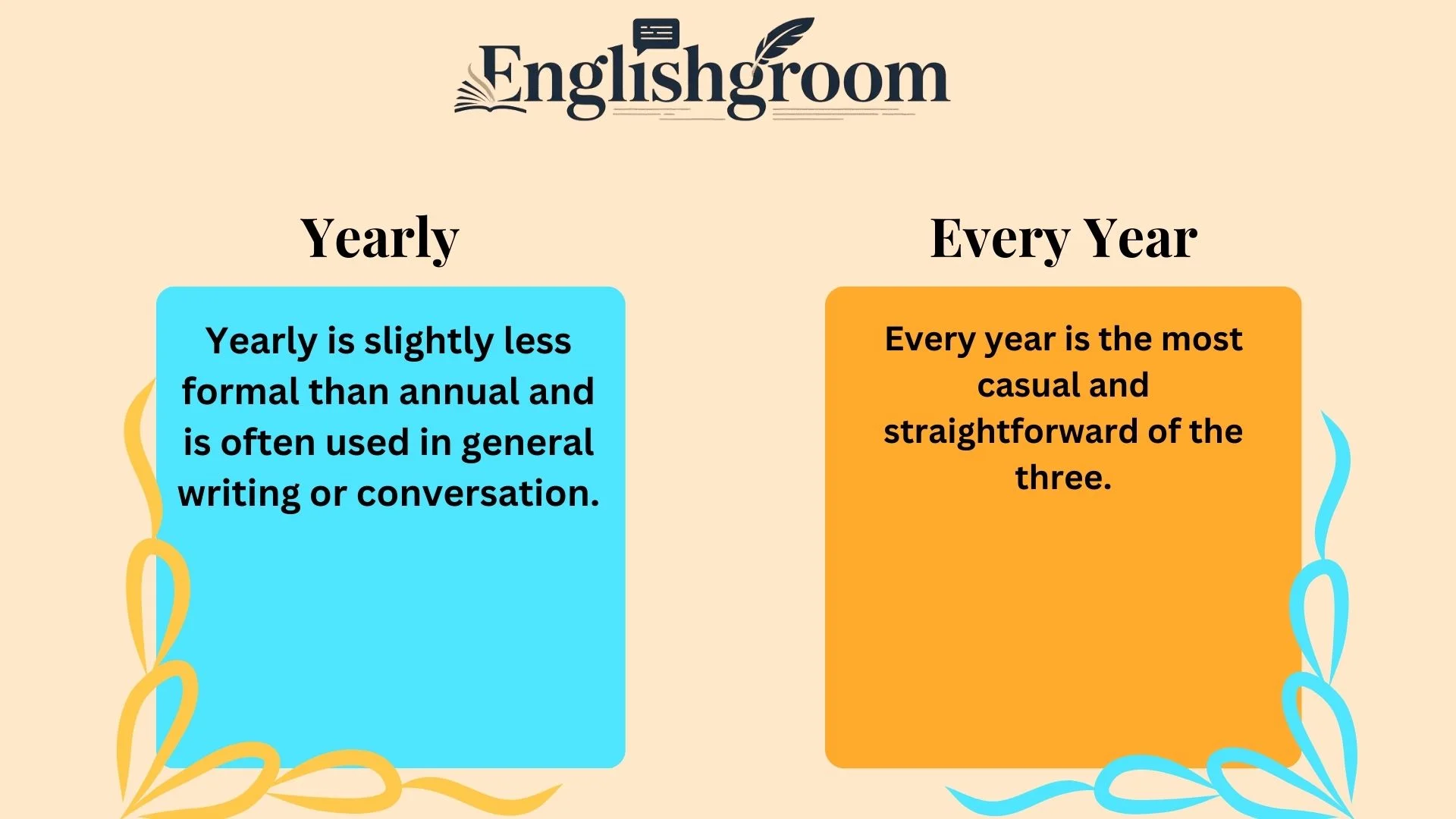
Yearly is slightly less formal than annual and is often used in general writing or conversation. It describes something that happens once every year but does not carry the same professional weight as annual.
Examples of Yearly in Context:
- I pay a yearly subscription to my favorite magazine.
- We go on a yearly family vacation to the mountains.
- The garden requires yearly maintenance to stay healthy.
Key Takeaways:
- Neutral tone
- Works for both formal and casual contexts
- Flexible and widely used in everyday writing
What “Every Year” Really Means
Every year is the most casual and straightforward of the three. It emphasizes repetition rather than formality or schedule. Writers use it often in storytelling, casual writing, or spoken English.
Examples of Every Year in Context:
- Every year, we decorate the house for Christmas.
- She donates to the charity every year without fail.
- Every year, the festival attracts thousands of visitors.
Key Takeaways:
- Informal tone
- Highlights repetition and continuity
- Works best in everyday communication or narrative writing
Comparing Annual, Yearly, and Every Year
To make the differences clearer, here’s a comparison table:
| Term | Tone | Formality | Typical Use Case | Notes |
|---|---|---|---|---|
| Annual | Formal | High | Reports, meetings, subscriptions | Often preferred in professional contexts |
| Yearly | Neutral | Medium | Everyday writing, calendars | Can replace annual in many contexts |
| Every Year | Informal | Low | Casual speech, storytelling | Emphasizes repetition over style |
Insight: Use annual for business, finance, or academic contexts, yearly for general writing, and every year for casual or narrative situations.
Practical Examples in Sentences
Using Annual
- The annual financial review is scheduled for next Monday.
- Our team attends the annual marketing conference each September.
- Participation in the annual art competition is open to all local students.
Mistakes to Avoid:
- Saying “I go to an annual vacation” sounds stiff. Use yearly or every year instead.
Using Yearly
- She completes a yearly health checkup in January.
- I subscribe to a yearly membership at the local library.
- We host a yearly barbecue for friends and neighbors.
Tip: Yearly is versatile. It can be swapped for “annual” in many professional settings without sounding odd.
Using Every Year
- Every year, my grandparents visit us during summer.
- The town holds a festival every year, attracting visitors from around the country.
- I make it a goal to read at least five books every year.
Tip: Every year emphasizes the regular occurrence rather than formality.
Common Confusions and Misuses
Annual vs Annually
- Annual is an adjective: “The annual meeting.”
- Annually is an adverb: “The meeting occurs annually.”
- Mistake: “The meeting is annual” is correct, but “The meeting is annually” is incorrect.
Yearly vs “Yearlies”
- Yearly is standard; yearlies is rarely used and mostly appears in niche contexts like magazine editions.
- Stick to yearly to avoid confusion.
Every Year vs Each Year
- Every year: general repetition without specifying individuality.
- Each year: emphasizes individuality or uniqueness of events.
- Example: “Each year, a new theme is chosen for the festival.”
Usage Tips for Writers and Speakers
- Use annual when writing formal documents, financial reports, or professional announcements.
- Use yearly for flexible, everyday usage that is neither too stiff nor too casual.
- Use every year when writing stories, blogs, or emails where conversational tone matters.
- Avoid mixing the terms in a single paragraph unless emphasizing style shifts intentionally.
- Think about your audience: business readers expect formal phrasing, casual readers prefer plain language.

Case Study: Business vs Casual Writing
Business Example (Formal):
The annual report for 2025 will be released next month. Shareholders are required to attend the annual meeting, where quarterly performance is discussed.
Casual Example (Everyday):
Every year, I visit my hometown for the festival. The streets are decorated, and there’s music everywhere. It’s a tradition my family and I cherish.
Key Takeaways:
- Formal business writing leans toward annual.
- Casual, narrative writing prefers yearly or every year.
FAQs
What is the difference between annual and yearly?
Answer: Annual is formal; yearly is neutral. Both mean something happens once per year, but annual suits professional contexts better.
Can I use every year instead of yearly?
Answer: Yes, in casual writing or speech. Every year emphasizes repetition, while yearly can sound more polished.
Is annual the same as annually?
Answer: No. Annual is an adjective; annually is an adverb describing how often something occurs.
Which is more formal: yearly or every year?
Answer: Yearly is more formal than every year. Every year is casual and conversational.
When should I use annual instead of yearly?
Answer: Use annual in professional, academic, or business writing where formal tone is required.
Conclusion
Understanding the difference between yearly, every year, and annual helps writers and speakers communicate clearly.
Use annual for formal contexts, yearly for flexible everyday use, and every year for casual or narrative writing.
By choosing the right term, you can make your writing precise, professional, and natural, whether in business reports, personal blogs, or storytelling.

Hi! I’m Sami, a 28-year-old content writer with a love for words and storytelling. Writing has always been my way of expressing ideas, sharing knowledge, and connecting with people. I enjoy creating engaging and well-researched content—whether it’s blogs, articles, or social media posts—that not only informs but also inspires readers. My goal is to turn complex ideas into clear, creative, and meaningful pieces of writing that leave a lasting impact.