Last updated on February 17th, 2026 at 07:48 am
Ever stopped mid-sentence wondering whether to say who else or whom else? You’re not alone. Even confident writers sometimes second-guess themselves when these two tiny words appear together.
English grammar has a knack for tripping people up, especially when who and whom come into play.
In this guide, you’ll learn exactly when to use who else and whom else, how to tell them apart instantly, and how to sound natural in every situation—from essays to emails. Let’s dive in.
Quick Answer: Is It “Who Else” or “Whom Else”?
The quick answer:
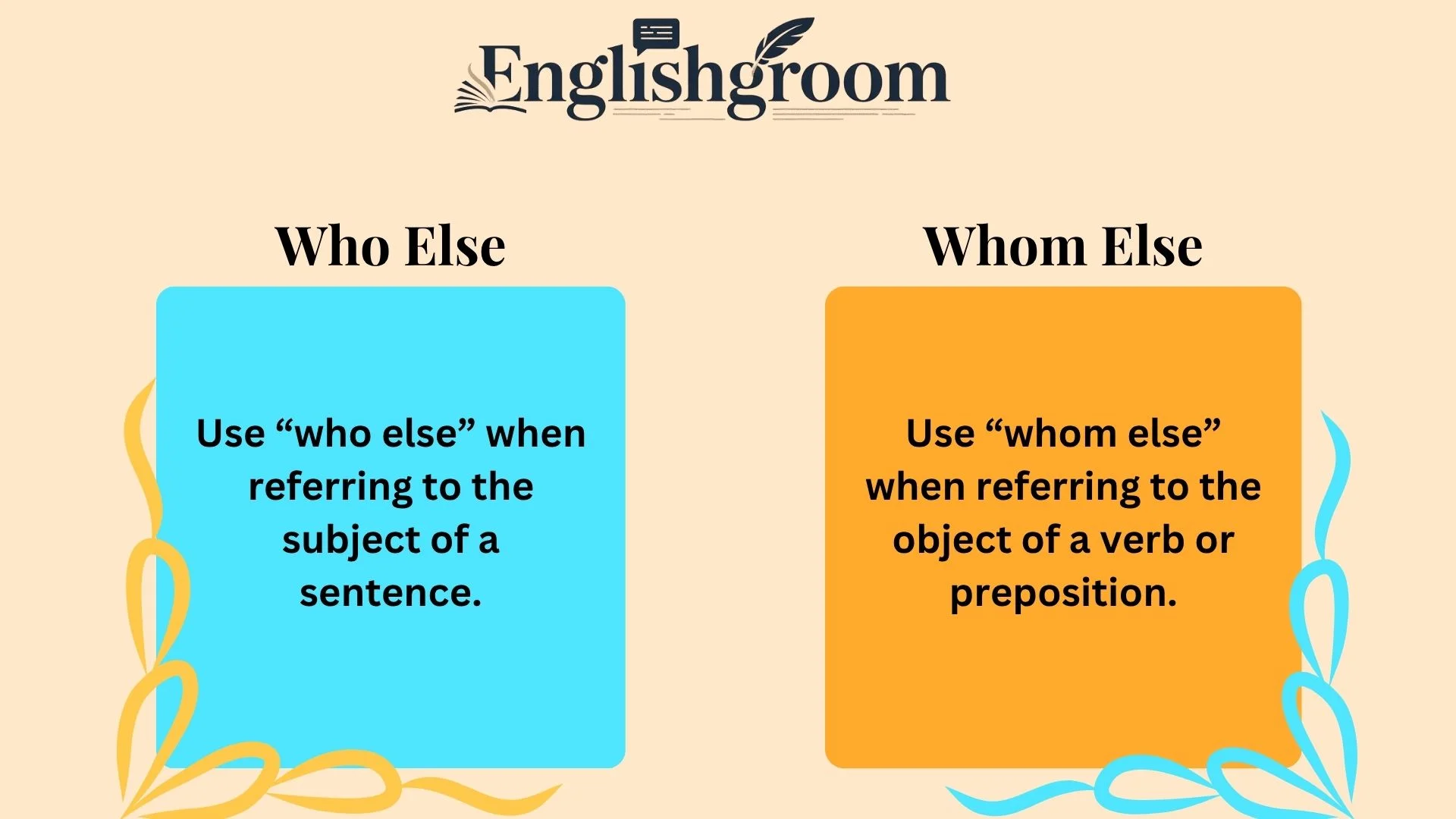
✅ Use “who else” when referring to the subject of a sentence.
✅ Use “whom else” when referring to the object of a verb or preposition.
Examples:
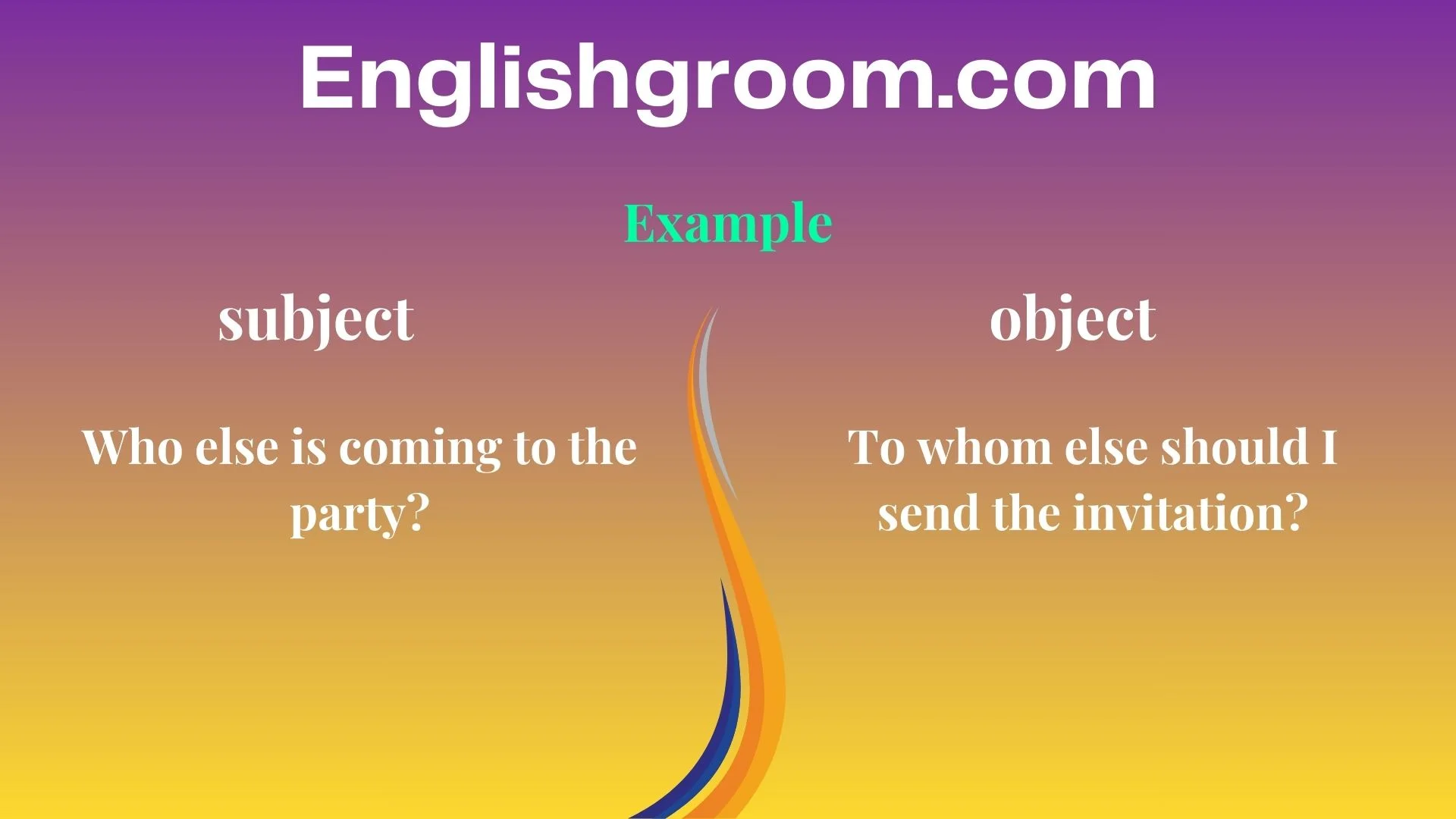
- Who else is coming to the party? (subject)
- To whom else should I send the invitation? (object)
If you’re unsure, you can usually get by with “who else” in everyday conversation. Modern English leans that way—grammar rules aside.
Understanding the Grammar: Subject vs. Object Pronouns
Let’s rewind for a moment. The difference between who and whom is the same as between he and him or they and them.
Subject Pronouns
A subject pronoun performs the action in a sentence.
Examples include:
| Pronoun | Example Sentence |
|---|---|
| He | He called me yesterday. |
| She | She loves chocolate. |
| They | They are leaving soon. |
| Who | Who called you? |
Object Pronouns
An object pronoun receives the action of the verb or follows a preposition.
| Pronoun | Example Sentence |
|---|---|
| Him | I called him yesterday. |
| Her | She hugged her friend. |
| Them | I saw them at the park. |
| Whom | To whom did you speak? |
So when you’re choosing between who and whom, think about whether that word is doing the action or receiving it.
Breaking Down “Who” vs. “Whom”
Let’s visualize it:
Sentence Diagram Example:
I know who called you.
→ “Who” is the one doing the calling → subject → who
I know whom you called.
→ “Whom” is the one being called → object → whom
Shortcut:
If you can replace it with he/she/they, use who.
If you can replace it with him/her/them, use whom.
Examples:
- “Who/whom do you trust?” → You trust him → ✅ Whom
- “Who/whom called you?” → He called → ✅ Who
Does “Else” Change the Rule?
Nope. The word “else” doesn’t change a thing about the rule.
It’s just an adverb meaning other or in addition.
Think of it like this:
- “Who else” = “Which other person.”
- “Whom else” = “To which other person.”
Examples:
- Who else wants coffee? → “Who” = subject.
- You gave it to whom else? → “Whom” = object.
| Phrase | Function | Example |
|---|---|---|
| Who else | Subject | Who else needs help with this project? |
| Whom else | Object | To whom else should I forward the report? |
So, “else” simply modifies the pronoun; it doesn’t affect the case.
Trick to Know Which to Use
Here’s an old-school trick English teachers love:
If you can replace it with he, it’s who.
If you can replace it with him, it’s whom.
Let’s test it:
Example 1:
“____ else is coming to dinner?”
→ He is coming → ✅ Who else
Example 2:
“To ____ else should I address the letter?”
→ I should address it to him → ✅ Whom else
Keep this trick handy—it works 99% of the time.
How to Identify the Role in a Sentence
Sometimes the sentence isn’t that simple. Try this step-by-step test:
- Find the clause that includes “who” or “whom.”
- See if the pronoun performs or receives the action.
- Apply substitution test (he/him).
- Decide: subject → who | object → whom.
Example:
“I wonder who/whom she invited.”
→ She invited him → ✅ Whom
Example:
“I know who/whom baked this cake.”
→ He baked → ✅ Who
Real-Life Usage: What Do People Actually Say?
Now here’s where grammar meets reality. Most people rarely say “whom else” in conversation. It sounds overly formal or even stiff.
According to modern usage trends and corpus studies, “who else” dominates both spoken and written English. You’ll find “whom else” mainly in formal contexts—academic papers, legal writing, or professional emails.
Common examples you’ll hear:
- “Who else is going?”
- “Who else wants one?”
- “Who else did you tell?”
Even though “whom else” can be correct, saying it aloud often sounds unnatural in casual settings.
Common Mistakes and Why They Happen
Common Errors
- ❌ “Whom is coming to the meeting?” → Should be Who
- ❌ “Who did you give it to?” (technically should be Whom, but accepted in speech)
- ❌ “Whom else do you think is joining?” → Should be Who else
Why These Mistakes Happen
- English speakers have simplified pronoun cases over time.
- The distinction between who and whom is fading in everyday speech.
- People prioritize natural rhythm and clarity over strict grammar.
As linguist Steven Pinker notes:
“Language evolves toward efficiency, not purity.”
So yes—sometimes grammar rules bend to how people actually speak.
How Language Is Evolving: Grammar vs. Usage
There’s an ongoing tug-of-war between prescriptive grammar (the rules) and descriptive grammar (how people really talk).
Key Observations:
- In formal English, whom is correct when functioning as an object.
- In informal English, who often replaces whom without confusion.
- Modern writers and journalists rarely use whom unless preceded by a preposition (“to whom,” “for whom,” etc.).
Case Study: Corpus Data Snapshot
A quick review of linguistic databases (like the COCA corpus) reveals:
| Phrase | Frequency | Context |
|---|---|---|
| “Who else” | Extremely common | Everyday speech, articles, blogs |
| “Whom else” | Rare | Legal writing, academic contexts |
The takeaway: grammar evolves with usage—and who else has become the natural choice.
Formal vs. Informal Usage: Which Should You Use?
Here’s how to decide based on context:
| Context | Preferred Form | Example |
|---|---|---|
| Formal writing (essays, business, academic) | Whom else | “To whom else should we extend our thanks?” |
| Informal speech or writing | Who else | “Who else wants a slice of pizza?” |
Tip:
When in doubt, pick who else—you’ll sound natural, not careless.
How to Avoid Sounding Stiff or Wrong
To balance correctness with clarity:
- Use “who else” unless your sentence includes a preposition directly before it.
- Don’t overthink it in conversation—clarity beats perfection.
- In formal writing, check your clause structure to confirm pronoun case.
Examples of natural-sounding grammar:
- ✅ “Who else are you inviting?”
- ✅ “To whom else should we deliver this?”
- ✅ “Who else knows the answer?”
Dos and Don’ts:
| Do | Don’t |
|---|---|
| Use “whom” only when it clearly fits an object role. | Force “whom” where it sounds unnatural. |
| Keep speech natural and simple. | Overcorrect every sentence. |
| Read sentences aloud to test flow. | Assume “whom” makes you sound smarter—it usually doesn’t. |
Quick Reference Table: “Who Else” vs. “Whom Else”
| Situation | Correct Form | Example |
|---|---|---|
| Subject of clause | Who else | “Who else is on the list?” |
| Object of verb | Whom else | “Whom else did you call?” |
| After preposition | Whom else | “For whom else should we plan?” |
| Informal tone | Who else | “Who else wants in?” |
| Formal tone | Whom else | “To whom else may we direct inquiries?” |
Decision Tree: Should You Use “Who Else” or “Whom Else”?
→ Is it the subject of the verb?
    ↓ Yes → Use WHO ELSE
    ↓ No
→ Is there a preposition before it (to, for, with)?
    ↓ Yes → Use WHOM ELSE
    ↓ No → Use WHO ELSE
This quick logic path works every time.
Case Studies: Grammar in the Wild
Case Study 1: Business Email
“Please confirm who else will attend the meeting.”
✅ Correct. “Who” is the subject (will attend).
“Please let me know to whom else we should send the files.”
✅ Correct. “Whom” is the object of “to.”
Case Study 2: College Essay
“The committee must decide to whom else the award should go.”
→ Perfectly formal and grammatically correct.
“Who else deserves this recognition?” → Natural and clear in any context.
Case Study 3: Social Media
“Who else can relate? 🙋♀️”
→ Informal, engaging, natural.
“Whom else can relate?” → Feels robotic.
Observation:
Real people overwhelmingly use “who else” online because it fits conversational tone.
Key Takeaways
- Who = subject; whom = object.
- Else doesn’t change the grammar—it just adds emphasis.
- Who else is dominant in modern speech and writing.
- Whom else fits formal writing, especially after a preposition.
- Prioritize clarity and flow over rigid rule-following.
FAQs About “Who Else” vs. “Whom Else”
Is “Whom Else” ever wrong?
Not grammatically. It’s just formal and rarely used in speech. You’ll sound precise but slightly stiff if overused.
Can I always use “Who Else”?
Almost always. Modern English favors simplicity. Unless you’re writing academic papers or official correspondence, “who else” works fine.
Why does “whom” sound unnatural?
Because English speakers have mostly stopped distinguishing subject/object cases in conversation. “Whom” survives mainly in formal or traditional writing.
Is it wrong to say “Who else did you invite?”
No. While “Whom else did you invite?” is technically correct, “Who else did you invite?” is completely acceptable today.
Should I use “whom” in emails or resumes?
Use it only if you’re addressing formal or academic audiences. Otherwise, stick with “who” for natural tone.
Learn More English With These Best Articles:
Same Difference Meaning Origin and Real-Life Examples Explained
As Evidenced By or As Evident By? The Ultimate Grammar Guide to Getting It Right
Heard vs Herd vs Hurd The Simple Guide to Sound-Alike Confusion
Passersby or Passerbyers? The Right Way to Say It
What Does “Deem Fit” Mean? The Complete Guide to This Formal Phrase
Conclusion
At the end of the day, the choice between “who else” and “whom else” boils down to context.
Use “who else” when speaking or writing casually—it’s what most people say. Use “whom else” when writing formally or after a preposition.
The beauty of language lies in its flexibility. Rules guide us, but usage shapes what feels right. So the next time you pause mid-sentence, trust your ear—and if it sounds natural, it probably is.

Hi! I’m Sami, a 28-year-old content writer with a love for words and storytelling. Writing has always been my way of expressing ideas, sharing knowledge, and connecting with people. I enjoy creating engaging and well-researched content—whether it’s blogs, articles, or social media posts—that not only informs but also inspires readers. My goal is to turn complex ideas into clear, creative, and meaningful pieces of writing that leave a lasting impact.