Ever stumbled upon “PSA” in a text or social media post and wondered what it means? You’re not alone.
This abbreviation has become a common part of online conversations, yet its meaning can shift depending on the context.
Most people search for “PSA meaning in text” to decode how it’s used in chats, memes, or even professional posts.
In simple terms, PSA stands for Public Service Announcement—a message meant to inform, warn, or remind people about something important. But that’s not the whole story.
From funny memes to serious public messages, the phrase “PSA” carries various tones and purposes. This article breaks down every aspect of “PSA,” helping you understand how to use it naturally and correctly in both casual and formal communication.
1. Meaning & Definition of PSA
The acronym PSA stands for Public Service Announcement. In text messages and online chats, it’s typically used to share a helpful tip, warning, or reminder for others.
- Primary meaning (in texting/social media): A quick note to inform others of something useful, funny, or important.
- Example: “PSA: Don’t microwave metal. Trust me.”
- Secondary meaning (in media and official use): A government or organization’s broadcast to raise awareness about issues like health, safety, or the environment.
In texting culture, however, it has evolved beyond serious topics. People now use “PSA” to share humorous advice or relatable life lessons:
- “PSA: Don’t shop online when you’re sleepy. You’ll regret it.”
- “PSA: Stay hydrated before your coffee!”
So, while its roots are formal, its modern use blends humor, empathy, and everyday wisdom.
2. Background & Origin
The phrase Public Service Announcement first appeared in the United States during World War II. Governments used PSAs to spread awareness and motivate citizens—for example, encouraging people to conserve food or buy war bonds.
The concept gained traction in the 1940s when the Ad Council began producing nationwide PSAs to promote health and safety. Classic campaigns like “Only You Can Prevent Forest Fires” by Smokey Bear are early examples.
With the rise of the internet and mobile communication, PSA took on a more casual meaning. Social media users adopted it to share “mini-announcements” that aren’t necessarily official but still aim to help or alert others.
Modern evolution:
| Era | Use | Example |
|---|---|---|
| 1940s–1960s | Government/Media Awareness | “Buckle Up for Safety” campaigns |
| 2000s | Public Awareness on TV/Radio | Health or safety PSAs |
| 2010s–Today | Social Media Humor/Advice | “PSA: Don’t skip breakfast before meetings!” |
3. Usage in Different Contexts
“PSA” changes tone depending on where and how it’s used:
1. Casual Chats
Used to share friendly reminders or funny truths.
- “PSA: Don’t text your ex after 2 AM.”
- “PSA: Fridays are for pizza.”
2. Social Media Posts
Often paired with sarcasm or humor to attract attention.
- “PSA: Your pet doesn’t want another Halloween costume.”
3. Professional Settings
Used to make official internal or public notices concise and eye-catching.
- “PSA: The team meeting is postponed to Monday.”
4. Educational or Nonprofit Contexts
Used seriously to inform or warn the public.
- “PSA: Always check your sources before sharing news online.”
4. Meanings Across Platforms
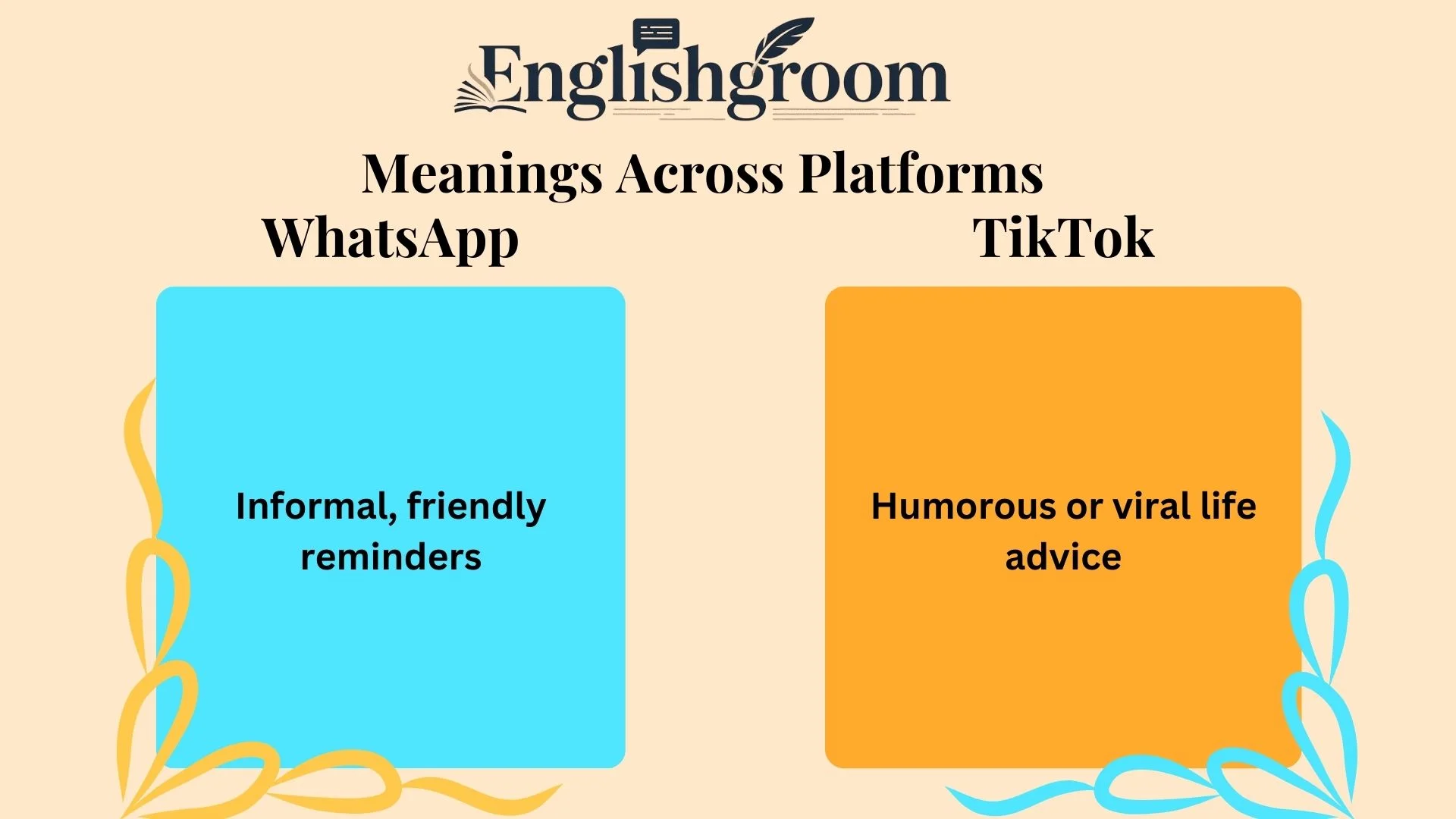
| Platform | Common Tone | Example |
|---|---|---|
| Informal, friendly reminders | “PSA: Bring your chargers for the trip!” | |
| Witty captions or lifestyle tips | “PSA: Your mirror selfies are perfect as they are 😎” | |
| TikTok | Humorous or viral life advice | “PSA: Don’t try every food trend you see.” |
| Snapchat | Quick updates or private warnings | “PSA: Don’t open snaps from unknown users.” |
| Twitter/X | Sarcastic or awareness-style posts | “PSA: Muting negativity is good for mental health.” |
Each platform adds its own flavor—TikTok makes it funny, Instagram turns it aesthetic, and WhatsApp keeps it casual.
5. Examples in Real Conversations or Memes
- Friend 1: “I’m running late again.”
Friend 2: “PSA: Set two alarms next time 😅.” - Group Chat: “PSA: Don’t park near the cafeteria; there’s construction.”
- Meme Example: A cat sitting on a laptop with the caption — “PSA: Don’t leave your laptop unattended if you own a cat.”
6. Cultural or Regional Interpretations
Different cultures interpret PSA differently:
- US/UK: Used humorously in casual speech and memes.
- Asia (especially Japan, South Korea): More associated with official government notices.
- Europe: Commonly seen in marketing or awareness campaigns, not everyday texting.
In multicultural groups, context matters. A casual “PSA” could sound too formal to non-native English speakers unfamiliar with internet slang.
7. Other Fields Using PSA
While texting slang dominates pop culture, “PSA” holds technical meanings too:
| Field | Meaning | Description |
|---|---|---|
| Medical | Prostate-Specific Antigen | A blood test used for prostate health screening. |
| Aviation | Pacific Southwest Airlines | A historic US airline. |
| Science | Pressure-Swing Adsorption | A process for gas separation in chemical industries. |
| Finance | Professional Services Agreement | A business contract type. |
This shows that “PSA” isn’t just slang—it has deep roots in various professional domains.
8. Common Misconceptions & Mistakes
- ❌ Thinking “PSA” means “Please See Announcement.”
- ❌ Using it for personal rants instead of public advice.
- ❌ Confusing it with “FYI” (For Your Information).
- ✅ Correct use: When your message benefits or warns others.
Example:
- Wrong: “PSA: I’m tired of Mondays.”
- Right: “PSA: Don’t forget your ID; the new policy starts today.”
9. Psychological or Emotional Meaning Behind It
“PSA” often reflects care, awareness, and social connection. When someone uses it, they’re subtly saying, “I want to help you avoid mistakes.” It triggers a friendly and informative tone, even when the subject is lighthearted.
On social media, people use it to gain trust and attention—it signals value, like you’re sharing something worth reading. In a sense, it’s a small act of empathy in the digital world.
10. Similar Terms & Alternatives
| Term | Meaning | Use Case |
|---|---|---|
| FYI | For Your Information | When sharing neutral info. |
| TIL | Today I Learned | When discovering something new. |
| Heads up | Warning/Alert | Used before giving a tip. |
| Note to self | Personal reminder | Reflective posts or messages. |
| Reminder | Gentle alert | Everyday warnings or tips. |
11. Is It Offensive or Friendly?
“PSA” is not offensive—it’s typically polite or playful. However, tone matters. If used sarcastically, it might sound passive-aggressive.
Compare:
- Friendly: “PSA: Drink water before your morning coffee 💧”
- Sarcastic: “PSA: Some people really need a manners class.”
Always gauge your tone to keep it respectful, especially in professional or group settings.
12. Famous Quotes or Lines Using “PSA”
While direct quotes are rare, you’ll often see influencers or brands using PSA-style statements:
- “PSA: Mental health matters as much as physical health.”
- “PSA: Kindness is free—spread it everywhere.”
These posts attract engagement because they sound both caring and authoritative.
13. Grammar or Linguistic Insights
“PSA” functions as a noun or introductory phrase. It doesn’t require “a” or “the.”
Correct: “PSA: Don’t forget sunscreen.”
Incorrect: “A PSA: Don’t forget sunscreen.” (unless referring to an actual broadcast).
It’s often written in all caps since it’s an acronym, but lowercase “psa” is acceptable in casual texting.
14. How to Respond to It
Chat-Style Examples:
- A: “PSA: The party’s been moved to Saturday.”
B: “Got it, thanks for the heads up!” - A: “PSA: Bring your own snacks 🍿.”
B: “Noted! I’m bringing chips.” - A: “PSA: The server’s down.”
B: “Good catch. I’ll wait before logging in.”
15. Differences From Similar Words
| Phrase | Tone | Usage Difference |
|---|---|---|
| PSA | Informative | For tips or advice to others. |
| FYI | Neutral | For factual sharing. |
| Reminder | Gentle | For pre-scheduled alerts. |
| Heads up | Casual warning | To alert someone before something happens. |
16. Relevance in Online Conversations & Dating Apps
“PSA” adds a mix of wit and awareness in online dating and social chats. For example:
- “PSA: I’m only here for dog lovers 🐶.”
- “PSA: Ghosting isn’t cute.”
It helps people express boundaries or humor while sounding confident and self-aware.
17. Popularity & Trends Over Time
According to Google Trends, searches for “PSA meaning in text” have spiked in the past five years. The term’s rise correlates with social media culture, where creators use PSA-style posts for short, attention-grabbing advice.
TikTok and Twitter/X have popularized the format—short, snappy, and easy to share. It’s now as common as “FYI” or “BTW,” especially among Gen Z and millennials.
18. FAQs (What People Also Ask)
1. What does PSA mean in slang?
It means “Public Service Announcement,” usually shared to inform or advise people about something.
2. Is PSA the same as FYI?
Not exactly. PSA shares a general alert, while FYI provides information without urgency.
3. How do you use PSA in a sentence?
“PSA: Always back up your files.”
4. Is PSA professional to use in emails?
Yes, in informal or internal emails. Avoid it in formal external communication.
5. What’s the difference between PSA and TMI?
PSA informs others; TMI (Too Much Information) shares personal or excessive details.
Learn More English With These Best Meanings:
TM Meaning in Text What It Really Means and How to Use It
UT Meaning in Text What Does “UT” Really Stand For?
TGIF Meaning in Text What It Really Stands For
White Heart Emoji Meaning Symbolism, Usage & Secrets Explained
What Does “DTF” Mean in Text? A Clear Guide to the Slang and Beyond
Conclusion
“PSA” began as a formal phrase for serious announcements but has evolved into a friendly, modern expression used in daily digital life.
Whether you’re sharing a warning, giving advice, or cracking a joke, “PSA” adds clarity and a helpful tone to your message.
Next time you see someone say “PSA: Don’t skip breakfast”—you’ll know they’re not preaching, just sharing a friendly reminder.
In today’s fast-moving online world, these small alerts make communication smoother and a little more human.

Hi! I’m Sami, a 28-year-old content writer with a love for words and storytelling. Writing has always been my way of expressing ideas, sharing knowledge, and connecting with people. I enjoy creating engaging and well-researched content—whether it’s blogs, articles, or social media posts—that not only informs but also inspires readers. My goal is to turn complex ideas into clear, creative, and meaningful pieces of writing that leave a lasting impact.