Last updated on February 21st, 2026 at 04:25 pm
If you’ve ever come across “HU” in a text message or social media chat and scratched your head, you’re not alone. The term “HU” is short, simple, and slightly mysterious—and that’s why people search for it.
Whether you found it in a group chat, a dating app, or a meme, you likely wondered: what does it mean, exactly?
In this friendly, clear guide I’ll walk you through the ins and outs of “HU meaning in text” — what it stands for, how it’s used, and when you should or shouldn’t use it yourself.
Meaning & Definition

When you see “HU” in a conversation, the meaning depends a lot on context. The two most common interpretations are:
- “Hook up” — In informal slang, “HU” often stands for “hook up.” That can mean two people hooking up in a casual dating sense or just meeting up to hang out. 7ESL+2Texting.io+2
- “Hit up” — Another usage treats “HU” as a shorthand for “hit up,” meaning “contact me,” “get in touch,” or “ask me (for something).” Pikupsline+1
Beyond those, less common definitions include:
- “Hey you” — As a greeting or attention-grabber in casual texts. NoSlang+1
- Other technical/abbreviated uses — For example, in science or in country codes (“HU” for Hungary) though these aren’t about texting slang. 7ESL+1
So in short: If someone writes “HU?” they might be asking “Hook up?” or “Hit up?” depending on tone. It’s generally casual and informal.
Background & Origin

Where did “HU” come from? Its evolution is a little fuzzy, but here’s what we know:
The slang “hook up” has been used for decades to mean meeting up, often with romantic or sexual connotations. Over time, digital chatter and shortening for speed turned “hook up” into “HU” in some circles. 7ESL+1
Meanwhile “hit up” (to call or message someone) also got shortened in online talk to “HU,” particularly among younger texters looking to convey “contact me” quickly. Pikupsline+1
In texting and chat apps, acronyms multiply because typing fewer letters is faster, so “HU” fits the pattern of casual shorthand emerging from online culture.
Usage in Different Contexts
Let’s explore how “HU” works in various settings:
Chat / Social Messaging
- In a friends’ chat: “Anyone free this weekend for a HU?” — likely meaning “hook up/hang out.”
- In DMs or dating apps: “HU if you’re around 😏” — might mean “hit me up/contact me,” or even suggest interest in hooking up.
Social Media Posts
- Instagram story: “Bored … HU” — implies “Hit me up” (get in touch) or “HU?” as a prompt for meeting.
- Snapchat: “Last night we HU’d” — more likely “hooked up.”
Professional or Formal Fields
In a business or formal setting “HU” is rarely appropriate because it’s too casual and ambiguous. For example, a coworker texting “HU this afternoon?” might confuse the recipient, making it unclear whether they mean “hit up,” “hook up,” or simply “hang up.”
Meanings Across Platforms
Here’s a breakdown of how “HU” appears on different platforms:
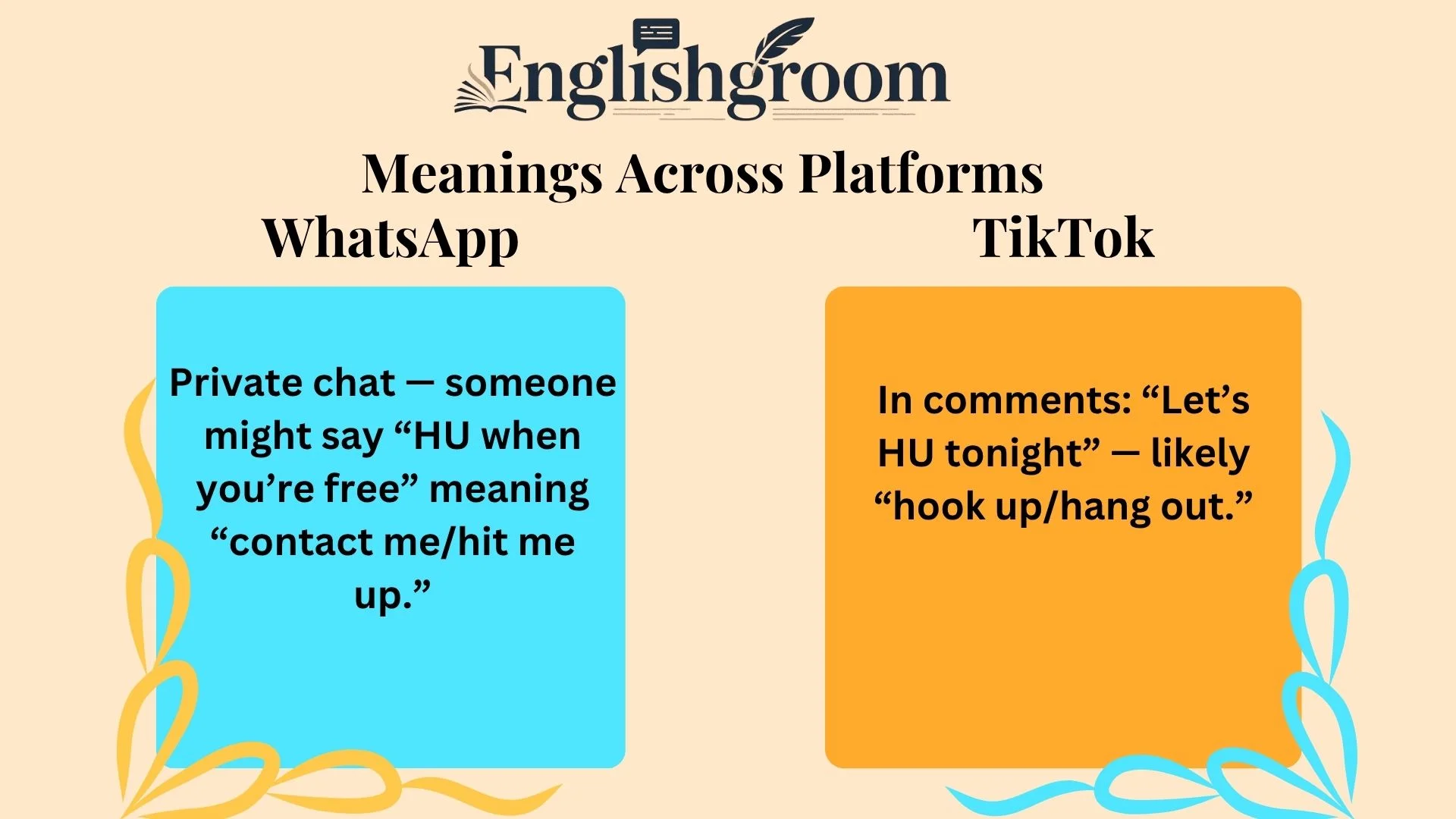
- WhatsApp / Text Message: Private chat — someone might say “HU when you’re free” meaning “contact me/hit me up.”
- Instagram: Story caption: “HU if you want” — inviting direct message or meet-up.
- TikTok: In comments: “Let’s HU tonight” — likely “hook up/hang out.”
- Snapchat: Quick chat: “HU?” — short for “hook up?” or “hit up?” depending on tone and relationship.
Because each platform has its own tone (Snapchat and TikTok skew more casual), the meaning can shift subtly based on audience and context.
Examples in Real Conversations or Memes
Here are some quick real-life style examples:
- Friend A: “Weekend plans?”
Friend B: “HU at my place 8pm.” (Meaning: “Hit up/hang out at my place.”) - On Tinder chat: “You free tonight? HU?” 😏 (Meaning: “Hook up?”)
- Meme text: “When bae says ‘HU tonight?’ and you pretend you’re busy 😂”
- Group chat: “Who’s down to HU after class?” (Meaning: “Hang out/hook up.”)
- Instagram story caption: “Bored… HU!” (Meaning: “Hit me up.”)
Cultural or Regional Interpretations
Slang evolves differently depending on region and culture. For example:
- In North America, “HU” used among younger adults might lean toward “hook up.”
- In other English-speaking regions or among mixed age groups, “HU” might simply mean “hit up” or “hang up” rather than anything sexual.
- Among teens, parents or outsiders may interpret “HU” differently (or wrongly), thinking it means something more serious than intended. DC Urban Moms and Dads
Because of these regional nuances, clarity really depends on who’s texting and what their usual style is.
Other Fields — Technical, Medical, Aircraft, etc.
“HU” also appears in various technical or professional domains — though these aren’t about texting:
- In medical imaging, HU stands for Hounsfield Unit, a measurement in CT scans.
- In postal/country codes, “HU” may refer to Hungary (ISO 3166 code).
- In electronics/engineering, “HU” could be shorthand in internal documentation (though less common).
- In everyday texting, these technical meanings are rarely relevant — so if you see “HU” in a chat with friends, it’s almost certainly slang, not “Hounsfield Unit.”
Common Misconceptions & Mistakes
Here are some frequent misunderstandings around “HU”:
- Mistaking “HU” for “who?” — Because it’s short, some people see “HU?” and assume “Who?” rather than “Hook up?”
- Using “HU” in a professional email — This is risky because the recipient may not know the slang or might interpret it unprofessionally.
- Assuming “HU” always means “hook up” — Sometimes it just means “hit up” or “hang out,” which is much more innocent.
- Ignoring context — Without tone or relationship knowledge, “HU” is ambiguous and may cause confusion.
Psychological or Emotional Meaning Behind It
When someone uses “HU” in a chat, it can carry emotional or relational undertones:
- Invitation or interest: “HU?” may indicate the sender wants to spend time, meet up, or pursue something more.
- Casual openness: Using shorthand like “HU” shows a relaxed vibe, less formal, more peer-to-peer.
- Ambiguity or non-commitment: Because “HU” is vague, it can reflect a casual, flexible agenda (“Let’s hang out if we feel like it”) rather than a solid plan.
- Peer bonding: Among friends, “HU” often signals “let’s chill,” which strengthens social connection.
Understanding the emotion behind it helps you gauge what the sender really means — are they asking to hang out, flirting, or simply checking in?
Similar Terms & Alternatives
Here’s a table comparing “HU” with similar shorthand and full phrases:
| Term | Meaning | Tone |
|---|---|---|
| HU | “Hook up” / “Hit up” | Very casual |
| HMU (“hit me up”) | “Contact me” / “get in touch” | Casual |
| HBU (“how about you?”) | Asking a question about preference | Casual |
| HUH / HUH? | “What?” / confusion | Casual |
| Hang out | Meet socially | Neutral-Casual |
| Hook up | Casual dating or encounter | Casual-Flirt |
(Internal linking suggestion: You might link to related abbreviation pages like “HMU meaning in text,” “HBU meaning in text” for further reading.)
Is It Offensive or Friendly?
In most cases, “HU” is friendly and informal. It’s a casual invitation or shorthand among peers. However:
- If used in a context where “hook up” implies sexual intention and the recipient isn’t comfortable, it could feel awkward or off-putting.
- In professional or formal conversations, “HU” might appear lazy or sloppy and could damage tone or credibility.
- With unfamiliar people, “HU” without clarification may lead to misinterpretation (e.g., “Are they asking to meet up or something else?”)
So, the tone matters. Among friends it’s fine; in formal settings steer clear.
Famous Quotes or Lines Using the Term
Since “HU” is very slang-based and informal, it doesn’t appear frequently in famous literature or formal quotes. However, in online culture and memes you might see lines like:
- “When they slide into your DMs with ‘HU?’ and you’re like ‘Chill, I’m busy’ 😉”
- “HU tonight? More like Netflix and actual chill.”
- “Best friends say ‘HU’ when they mean ‘Help U’ or ‘Hang Up’ on the drama.”
While not “famous quotes” in the traditional sense, these examples illustrate how “HU” has found its place in digital vernacular.
Grammar or Linguistic Insights
From a linguistic standpoint:
- “HU” functions as a verb or noun depending on use: “Wanna HU?” (verb) vs “Let’s have a HU.” (noun)
- It’s an initialism: each letter stands for a word (“hook up” or “hit up”), but because it’s slang the letters aren’t always explicitly tied to words.
- It’s context-sensitive: Without context, “HU” is ambiguous. The surrounding words or relationship tell you whether it means “hook up,” “hit up,” or something else.
- Informality prevails: “HU” is rarely capitalized in casual text (you might see “hu” or “HU”) and is not suited for formal writing or conversation.
How to Respond to It — Practical Replies
Here are some chat-style responses you can use when someone says “HU” to you:
Example 1
Friend: “HU tonight?”
You: “Sure — what time and where?” 🙂
Example 2
Match on dating app: “HU?”
You: “Hey! What did you have in mind?”
Example 3
Group message: “Anyone up to HU this weekend?”
You: “I might be free Sunday afternoon — you guys okay then?”
Example 4
Acquaintance: “HU if you need anything.”
You: “Thanks! I’ll ping you if I do.”
These approaches keep things polite, clear and friendly.
Differences From Similar Words
It’s helpful to contrast “HU” with similar short phrases:
- HU vs HMU: “HMU” means “hit me up” (get in touch). “HU” might mean “hit up” or “hook up.” So “HMU” is more clearly “contact me,” while “HU” is more ambiguous.
- HU vs HBU: “HBU” means “how about you?” — a question to ask someone back. “HU” is an action/invitation rather than a question about preference.
- HU vs Hook up (full phrase): “Hook up” is the full phrase; “HU” is the shorthand. Using the full phrase adds clarity but loses the casual brevity.
- HU vs Hang out: “Hang out” means spending time casually; “HU” might mean “hang out” but sometimes implies more. So “hang out” is more neutral.
Relevance in Online Conversations & Dating Apps
“HU” plays a significant role in online messaging culture:
- On dating apps, a quick “HU?” can be a low-commitment way to ask “Want to meet up?”
- In group chats, it signals spontaneity and casual connection (“Anyone down to HU after class?”)
- In social media captions, “HU” is shorthand that shows familiarity and peer-to-peer tone (“Bored. HU”).
- Its brevity fits mobile texting habits: fewer keystrokes, faster interaction.
- Because online communication often lacks tone and face-to-face cues, using “HU” requires clarity; ambiguity can lead to misunderstandings or crossed signals.
Popularity & Trends Over Time
Although detailed long-term statistics for “HU” are hard to come by, observations indicate:
- The use of “HU” rose with the prevalence of texting and messaging apps (mid-2010s onward) as users adopted more shorthand.
- On Google and social-media slang dictionaries, “HU meaning in text” is a trending search term as younger users ask “what does HU mean?” Texting.io+1
- Its frequency varies by platform: more common in casual environments (Snapchat, Instagram) than professional ones.
- As with many acronyms, usage may fade or evolve as new terms appear — but as of now it remains recognizable among younger demographics.
FAQs & Related Search Queries
Q1. What does HU mean in texting?
A: Typically “hook up” or “hit up,” depending on context.
Q2. Is HU always sexual?
A: No. It might mean “hang out” or “contact me.” Only context tells if it’s sexual.
Q3. Can I use HU in a professional email?
A: It’s best to avoid it — it’s too informal and may confuse the recipient.
Q4. How do I respond if someone sends “HU?”
A: Ask for clarification if needed. Or respond with your availability: “Yes, what did you have in mind?”
Q5. Is HU the same as HMU?
A: Not exactly. “HMU” means “hit me up.” “HU” is shorter and more ambiguous — could mean “hook up” or “hit up.”
Q6. Could HU mean something else entirely?
A: Yes — in technical or niche contexts, “HU” may mean something unrelated to texting (like country code for Hungary). Always check context.
Conclusion
So there you have it: the full scoop on “HU meaning in text.” In casual chat, “HU” most often means either “hook up” or “hit up,” depending on tone and relationship.
It thrives in informal, digital settings but may confuse people outside that bubble.
The key takeaway: gauge the context, know your audience, and if in doubt, ask for clarification. Use it among friends or in relaxed chats, but drop it in more formal settings. Happy texting!

Hi! I’m Sami, a 28-year-old content writer with a love for words and storytelling. Writing has always been my way of expressing ideas, sharing knowledge, and connecting with people. I enjoy creating engaging and well-researched content—whether it’s blogs, articles, or social media posts—that not only informs but also inspires readers. My goal is to turn complex ideas into clear, creative, and meaningful pieces of writing that leave a lasting impact.