Language and technology constantly shape each other. In the world of software, user interfaces, and writing, even a small word choice—like whether to say “unselect” or “deselect”—can make a big difference.
This guide dives deep into the debate between the two terms. You’ll learn what each word means, which one’s officially correct, how tech culture shaped their usage, and which you should use in your writing or design system.
Quick Answer: “Deselect” Is the Correct Term, “Unselect” Is Colloquial
Let’s start with the short version.
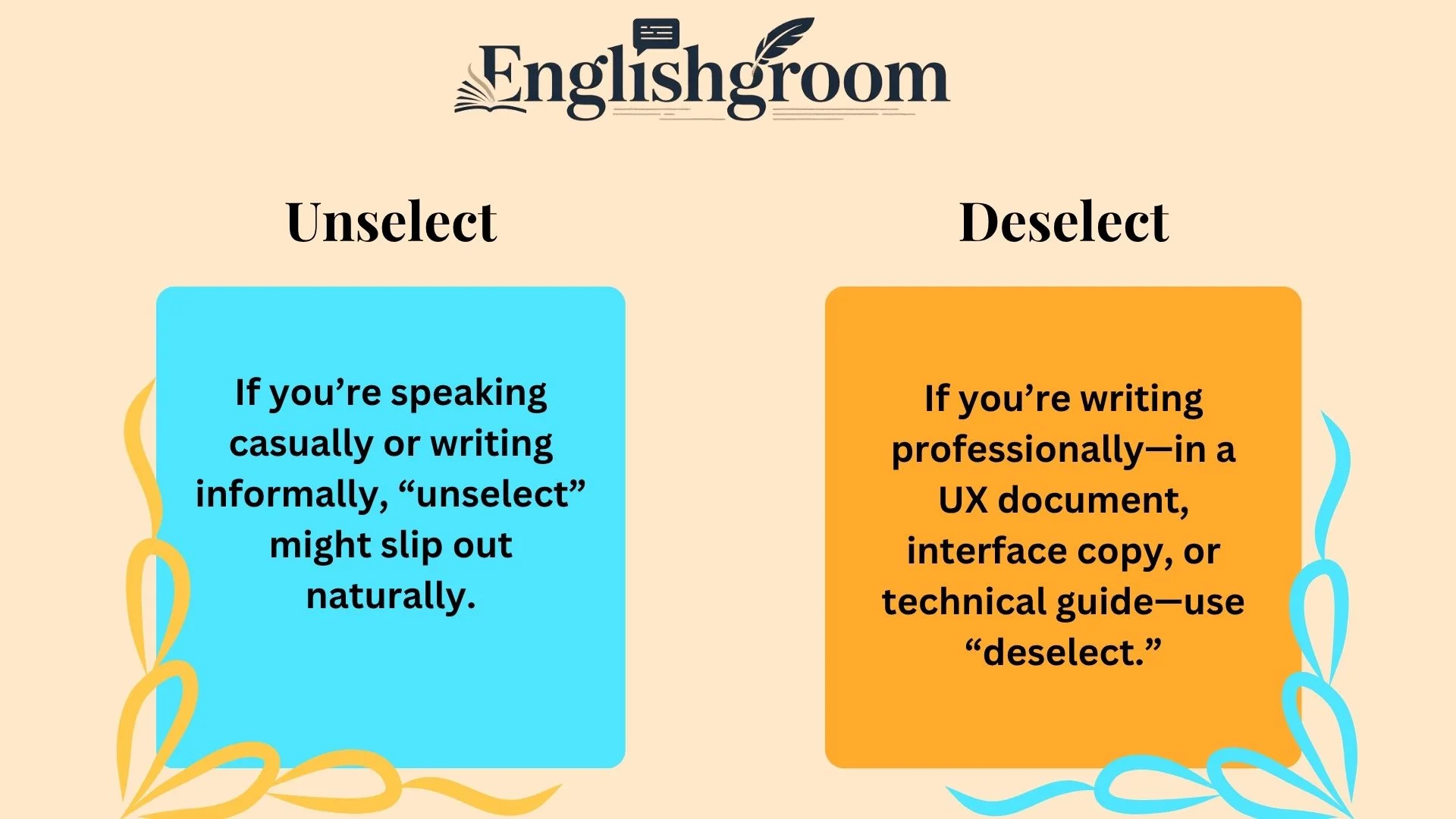
If you’re writing professionally—in a UX document, interface copy, or technical guide—use “deselect.”
If you’re speaking casually or writing informally, “unselect” might slip out naturally.
Think of it this way:
| Style | Preferred Word | Example |
|---|---|---|
| Professional/Technical | Deselect | “Click again to deselect the item.” |
| Casual/Conversational | Unselect | “You can unselect the pictures you don’t need.” |
👉 Bottom line: “Deselect” is the standard. “Unselect” is the colloquial cousin that’s slowly creeping into casual speech but not yet into dictionaries.
What Each Word Means
Before we decide which is better, let’s unpack what these words actually mean.
Definition of “Deselect”
According to major dictionaries like Oxford and Merriam-Webster, deselect means:
“To remove a choice or selection previously made.”
It comes from the Latin prefix de-, meaning to reverse or undo.
You select an item when you choose it; you deselect it when you remove that choice.
Examples:
- “To deselect all files, press Ctrl + D.”
- “Click the checkbox again to deselect it.”
This word follows standard English formation patterns. Similar verbs include deactivate, defrost, and decompress—all reversing a previous action.
Definition of “Unselect”
The word unselect appears in informal contexts, especially in software discussions or forums, but it’s not recognized by most major dictionaries.
It uses the prefix un-, which typically means not or opposite of. For instance:
- Unplug = remove from a socket
- Unfollow = stop following
That’s why unselect feels natural to many people. It mimics that same pattern.
Examples from informal usage:
- “You can unselect photos you don’t want to upload.”
- “If you unselect a row, it won’t be exported.”
However, because it’s not widely accepted in formal English, unselect can look unpolished or inconsistent in professional writing.
Linguistic Background: Why Both Words Exist
Why do both deselect and unselect exist in the first place? The answer lies in the way prefixes work in English—and how technology blurs linguistic lines.
The Prefix Puzzle
English uses both de- and un- to indicate reversal.
But their usage depends on tradition, not strict logic.
| Prefix | Meaning | Example | Common Context |
|---|---|---|---|
| de- | reverse, remove | deactivate, debug, deconstruct | formal, technical |
| un- | not, opposite | unbutton, untie, uninstall | informal, everyday speech |
In traditional grammar, “de-” fits technical verbs, while “un-” suits everyday ones.
That’s why you “deactivate” a machine but “untie” your shoes.
How Tech Changed the Game
Digital products introduced verbs like unfollow, unblock, and unfriend.
These terms made “un-” the go-to prefix in online culture.
Over time, people started applying it to new verbs—even ones that already had formal versions like deselect.
That’s why unselect feels intuitive, even if it’s technically nonstandard.
It’s an example of language evolution driven by user experience.
Tech Influence: How UI Language Shapes Vocabulary
User interface (UI) design has reshaped English more than people realize. The way we label buttons, menus, and commands influences everyday speech.
Case Study 1: The Rise of “Undo”
Before computers, “undo” was rarely used as a command.
Now, it’s universal—every app, from Photoshop to Google Docs, has an Undo button.
Case Study 2: “Unfollow” and “Unfriend”
When social media exploded, words like “unfriend” (popularized by Facebook) became mainstream.
They normalized the “un-” prefix in tech terminology, reinforcing unselect as a natural extension.
Case Study 3: Design System Terminology
Big tech companies stick to deselect for precision:
| Company | Preferred Term | Example Usage |
|---|---|---|
| Google Material Design | Deselect | “To deselect an item, tap again.” |
| Apple Human Interface Guidelines | Deselect | “Command-click to deselect items.” |
| Microsoft Style Guide | Deselect | “Use ‘Deselect’ rather than ‘Unselect.’” |
These examples show that major style authorities consistently use deselect—not unselect.
Usage and Recognition in Dictionaries
When in doubt, dictionaries settle the argument.
| Dictionary | Lists “Deselect”? | Lists “Unselect”? |
|---|---|---|
| Oxford English Dictionary | ✅ Yes | ❌ No |
| Merriam-Webster | ✅ Yes | ❌ No |
| Cambridge Dictionary | ✅ Yes | ❌ No |
| Collins Dictionary | ✅ Yes | ❌ No |
| Macmillan | ✅ Yes | ❌ No |
Corpus Data Insight
Using tools like Google Ngram Viewer and the Corpus of Contemporary American English (COCA):
- Deselect shows a clear rise since the 1980s (when GUIs became mainstream).
- Unselect barely registers, appearing mostly in forum discussions and software documentation.
That’s compelling evidence that deselect is the established and widely recognized term.
Professional Writing & UX Guidelines
In user experience (UX) writing, clarity and consistency matter more than personal preference.
Your goal is to make users understand immediately what action to take.
Best Practices for Choosing Between “Deselect” and “Unselect”
- Follow Style Guides:
Use the terminology recommended by your company’s design system.
(e.g., Google Material → Deselect) - Be Consistent:
Pick one term and stick with it across all interfaces and documents. - Prioritize Clarity:
Avoid mixing technical and colloquial words in the same UI. - Write for Global Audiences:
Non-native English users rely on standardized terms found in dictionaries.
Deselect is clearer and more universally understood.
Example UX Microcopy
✅ “To deselect items, press Esc.”
❌ “To unselect items, press Esc.”
That single word difference can subtly affect your brand’s perceived quality and professionalism.
Quick Reference: UX Writer’s Cheat Sheet
| Context | Preferred Term | Example | Notes |
|---|---|---|---|
| Button Labels | Deselect | “Deselect All” | Always use for clarity |
| Instructions | Deselect | “Tap again to deselect the item.” | Industry standard |
| Informal Text | Unselect (rare) | “You can unselect photos.” | Acceptable in casual tone |
| Code Comments | Either | // deselect all rows | Developers may use either |
| Documentation | Deselect | “Use this option to deselect a field.” | Follow dictionary usage |
Summary
Here’s the big picture.
- “Deselect” is the standard English term found in dictionaries, style guides, and professional writing.
- “Unselect” is colloquial—common in informal speech or user forums but rarely accepted in formal contexts.
- Tech culture popularized unselect by analogy with undo and unfollow, but it hasn’t replaced deselect in official writing.
- When in doubt, choose clarity over novelty. Your readers (and users) will thank you.
FAQs
What does “deselect” mean?
It means to remove a previous selection. For example, clicking a checked box again to unmark it.
Is “unselect” grammatically correct?
It’s not formally recognized in dictionaries, but it’s understandable in casual speech. For professional contexts, use deselect.
Why do people say “unselect”?
Because other common tech verbs use un- prefixes like unfollow or unmute. It feels natural, even though it’s not standard English.
Which word should I use in UX writing?
Always use deselect in UX, documentation, and product interfaces. It’s clearer, consistent, and industry-approved.
Will “unselect” ever become accepted?
Possibly. Language evolves, and as tech jargon spreads, unselect could gain dictionary status in the future—but it’s not there yet.
Conclusion
In the end, this debate isn’t just about two words—it’s about how language evolves alongside technology.
“Deselect” remains the preferred and professional choice, supported by dictionaries and major tech style guides.
Still, “unselect” reflects how people naturally speak and how digital culture reshapes English over time.
If you’re writing for clarity, consistency, and global comprehension, stick with “deselect.”
It’s clean, recognized, and universally understood—exactly what good UX writing should be.

Hi! I’m Sami, a 28-year-old content writer with a love for words and storytelling. Writing has always been my way of expressing ideas, sharing knowledge, and connecting with people. I enjoy creating engaging and well-researched content—whether it’s blogs, articles, or social media posts—that not only informs but also inspires readers. My goal is to turn complex ideas into clear, creative, and meaningful pieces of writing that leave a lasting impact.