Last updated on December 16th, 2025 at 05:45 pm
You’ve probably scrolled through a chat or social-media comment and seen the shorthand “DPWM” pop up. But what does it mean, and why are so many people using it?
In a world where texting and social media rules the day, acronyms like this help folks communicate quickly, punchily, and often with emotion.
This article walks you through the meaning of “DPWM meaning in text”, why you might search for it, and how to use or respond to it with confidence. We’ll take you from the slang definition all the way to technical uses and common mistakes—so you’re fully equipped no matter where you see it.
Meaning & Definition
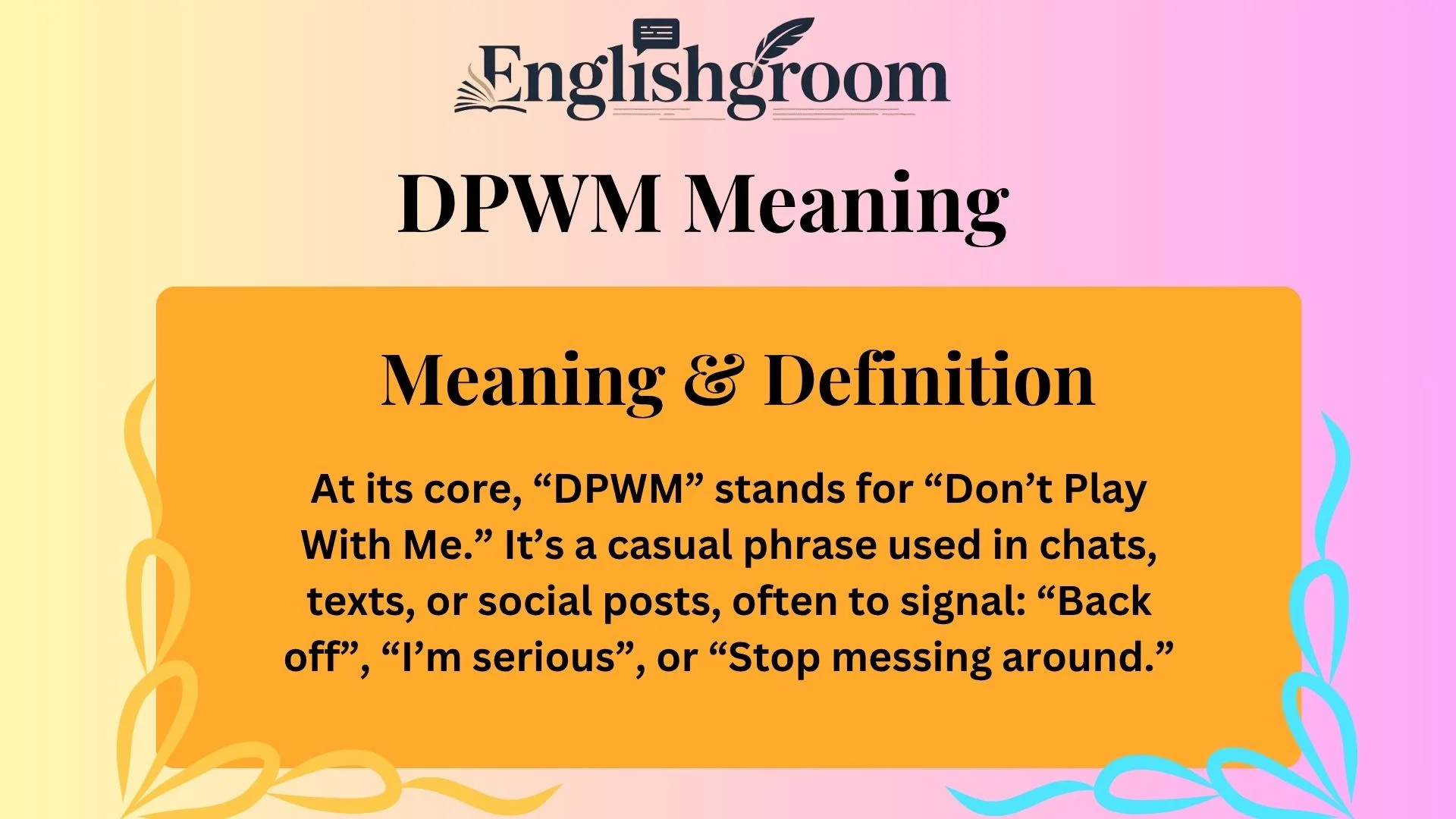
At its core, “DPWM” stands for “Don’t Play With Me.” It’s a casual phrase used in chats, texts, or social posts, often to signal: “Back off”, “I’m serious”, or “Stop messing around.” Texting.io+2talksknow.com+2
Primary meaning
- Don’t Play With Me – used when someone is irritated, wants to set a boundary, or assert themselves.
- Example: “You’re going to be late again? DPWM. 😤”
Secondary meanings
Beyond texting, “DPWM” may also appear in technical or professional fields with different expansions:
- Digital Pulse Width Modulation – a technique in electronics and signal processing. Abbreviations+1
- Digital Power Management or other acronyms in computing/IT. Abbreviations+1
Thus, when you see “DPWM” you need to look at context to know whether it’s slang or technical.
Background & Origin
Acronyms in texting and social media exploded because people wanted speed and brevity. “DPWM” emerged as part of that trend. Here’s how:
- With SMS and early chat platforms, character limits and fast responses encouraged shortening phrases like “Don’t play with me.”
- Slang communities—especially among younger users—often adopt phrases that sound strong, playful or boundary-setting. “DPWM” fits that pattern.
- As platforms like TikTok, Instagram and instant messaging grew, so did shorthand acronyms used in captions, comments, DMs. Sources suggest “DPWM” gained traction in the early to mid-2020s. talksknow.com+1
- The technical meaning (e.g., “Digital Pulse Width Modulation”) has a much older history in engineering and electronics—so when you see “DPWM” in that context it’s unrelated to slang. Analog Devices+1
In short: one origin lies in rapid-fire texting culture; another lies in engineering/technical abbreviations. Context is your “decoder ring”.
Usage in Different Contexts
“DPWM” can appear in very different situations. Let’s break several down:
Casual chat with friends
- A friend teases you: “You forgot again? DPWM 😅.”
- You’re annoyed: “DPWM — I already told you I’m done with this joke.”
Social media posts or comments
- On Instagram, someone might post a selfie with caption: “Mood today: DPWM 😎”.
- In a TikTok comment: “When someone says you can’t dance… DPWM!”
Gaming or group chat
- In a gaming lobby: “DPWM if you steal my loot again.”
- Among teammates: “DPWM — we’re serious about these rankings.”
Professional/technical fields
- In an engineering forum: “The controller uses DPWM to reduce switching losses.” (Here it means Digital Pulse Width Modulation)
- In IT/management: “We need the DPWM process defined before we proceed.” (Here it might mean Data Processing Workflow Management)
The tone and audience matter: in casual settings it can be playful or assertive; in professional settings it might be purely technical and neutral.
Meanings Across Platforms
Here’s how “DPWM” shows up on various platforms:
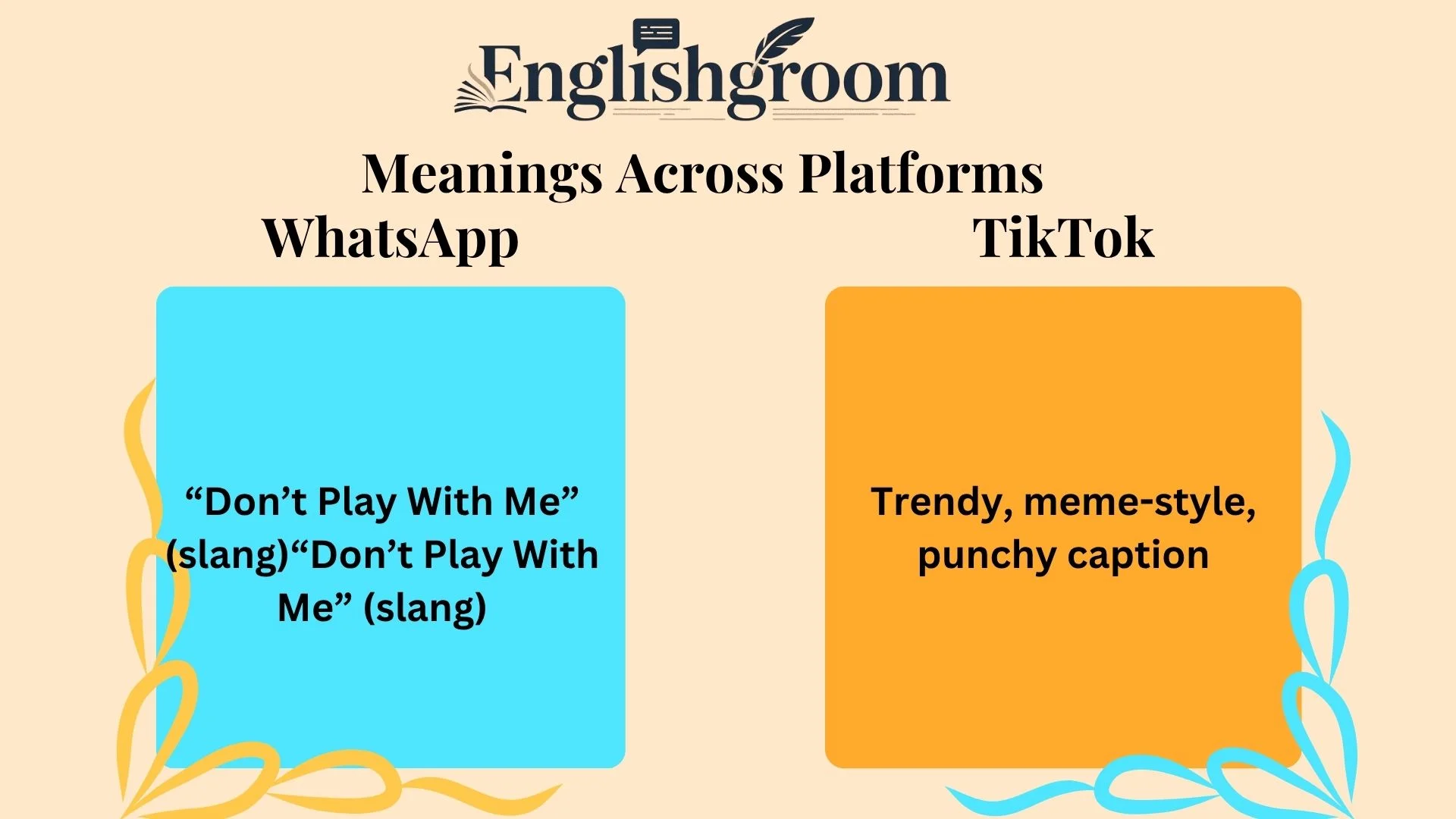
| Platform | Typical Meaning | Example Use |
|---|---|---|
| “Don’t Play With Me” (slang) | “DPWM, I told you already I’m busy today.” | |
| Slang, attitude, caption vibe | “Me after the meeting… DPWM 😏” | |
| TikTok | Trendy, meme-style, punchy caption | “When you show up late… DPWM 😂 #oops” |
| Snapchat | Quick chat slang between friends | “DPWM or I’m not coming tomorrow 😜” |
| Technical forums | “Digital Pulse Width Modulation” etc. | “DPWM becomes critical at high switching frequencies.” |
As you can see, the meaning shifts by platform — always check tone, emojis, and surrounding text.
Examples in Real Conversations or Memes
Here are some short examples to give you a feel (with emoji cues):
- Friend: “You forgot to pick me up again?”
You: “DPWM 😤 I’ll come now.” - Crush: “You ghosted me last night?”
You: “Haha, DPWM 😉 wasn’t ignoring you.” - Gamer: “You think you’re better than me?”
Response: “DPWM, watch the scoreboard.” - Meme caption: Picture of tired person at desk – “When someone asks why you’re working on Friday… DPWM 😩”
These examples show how tone can slide from serious to playful depending on how it’s used.
Cultural or Regional Interpretations
Slang is rarely universal; “DPWM” is no exception. Here are some cultural/regional notes:
- In the US and Canada, younger users (Gen Z, millennials) are most likely to use or understand “DPWM”.
- In the UK, while it may be recognized, there are alternative phrases like “don’t mug me off” (UK slang) that carry similar meaning.
- In non-English speaking regions where English slang is borrowed, “DPWM” may be less common or replaced by local equivalents.
- In engineering or professional circles globally, “DPWM” likely refers to the technical term and not slang.
Therefore, if you’re texting someone from a different region, you might choose to clarify rather than assume they know “DPWM”.
Other Fields — Physics, Medical, Aircraft, Technical Meanings
Yes—“DPWM” isn’t just slang. Here are some alternate meanings:
- Digital Pulse Width Modulation: A method of modulating a digital signal’s duty cycle to control power or signal characteristics. Analog Devices+1
- Digital Power Management: In computing or electronics, managing and controlling power digitally. Abbreviations
- Data Processing Workflow Management: In IT/software contexts, might use “DPWM” as shorthand for workflows. talksknow.com
- Very rarely, you might see “DPWM” in a medical/academic abbreviation list, but this is niche and not widespread.
When reading a document or forum that’s technical, always check if “DPWM” is being used in this engineering/IT sense—not as slang.
Common Misconceptions & Mistakes
Here are some pitfalls to watch out for when you encounter “DPWM”:
- Mistaking it for always meaning “Don’t Play With Me” — in technical texts it may be entirely different.
- Thinking “DPWM” is universally understood — younger users are more likely to know it than older generations.
- Using it in professional or formal communications without considering tone — it might seem unprofessional or aggressive.
- Responding incorrectly because you mis-read the tone — e.g., someone uses “DPWM 😉” in a playful way, but you respond seriously and it kills the vibe.
- Overusing it — if you say “DPWM” all the time, it loses impact and can become a joke rather than a boundary.
In short: context and tone are everything.
Psychological or Emotional Meaning Behind It
From a psychological perspective, “DPWM” carries more than just words—it signals emotion and boundaries.
- On one level, it asserts boundary-setting: the speaker is saying “I will not tolerate messing around.”
- On another level, it can carry playfulness: the tone might be mock-serious or teasing rather than genuinely angry.
- Emotionally, using “DPWM” can serve as a defense mechanism: if someone feels teased or threatened, they send “DPWM” to protect themselves or test whether the other person is serious.
- In a social media context, “DPWM” also functions as identity work: showing someone is confident, aware, not to be messed with—or simply “in the know” about current slang.
Thus, when you reply to “DPWM”, you’re not just decoding words—you’re interpreting emotion, attitude and relationship.
Similar Terms & Alternatives
Here’s a table showing “DPWM” alongside similar slang or alternatives:
| Term | Full Form | Usage Tone |
|---|---|---|
| DPM | Don’t Play Me | More direct, potentially sharper |
| DPWM | Don’t Play With Me | Slightly more playful/teasing |
| Stop Messing Around | — | More spelled-out, less slang |
| Don’t Test Me | — | Stronger, more confrontational |
| Back Off | — | Clear boundary, less slang |
You can see where “DPWM” fits: it’s shorter than a phrase, but less harsh than some alternatives.
Is It Offensive or Friendly?
Short answer: it depends.
- In a friendly context (with an emoji, with friends who understand you) “DPWM 😉” is playful teasing.
- In a more serious chat, “DPWM.” (with no smiley) could be interpreted as a warning or mild threat.
- In a professional environment it can come off as unprofessional or abrasive.
- If sent to someone who doesn’t know the slang, it might confuse or offend them.
So check your audience. Use “DPWM” when you know the vibe; skip it when you’re not sure.
Famous Quotes or Lines Using the Term
Because “DPWM” is fairly new in slang terms, there aren’t classic “famous quotes” in literature or film. But you may spot it in memes or social-media captions like:
“DPWM if you call me at 2 am again. 😴”
“When she says she’s not hungry… DPWM 😂”
These reflect the casual, punchy tone of current digital communication.
Grammar or Linguistic Insights
Here are a few linguistic notes on “DPWM”:
- It’s an initialism/acronym: each letter stands for a word (Don’t Play With Me).
- Pronunciation: often spelled out: “D-P-W-M.” Some may try to pronounce it as a word (“dep-wim”) but that’s rare.
- It functions as a stand-alone sentence in chats. Example: “DPWM.” meaning “Don’t play with me.”
- Its tone is contextual: punctuation (like period, exclamation, question), emoji use and capitalization all affect meaning.
- It’s part of the digital register—i.e., slang used in informal online communication, not formal writing.
- Note: Because texting lacks vocal tone and facial cues, the surrounding cues (emoji, context) help clarify whether the term is serious or playful.
How to Respond to It — Practical Replies
Here are some sample chat-style responses depending on the tone you detect:
Playful response
Friend: “You didn’t bring chips? DPWM 😜”
You: “Haha sorry, I’ll bring a mega bag next time! 😄”
Flirty response
Crush: “DPWM if you leave early again 😏”
You: “Guess I’ll stick around then 😉”
Serious response
Friend: “DPWM — I’m not kidding this time.”
You: “Understood. I’ll be there early and we’ll get things done.”
Clarification response
Partner: “Why DPWM?”
You: “Just making sure we’re on the same page—don’t want this to become a thing. All-good?”
These replies vary depending on how the message hits you—teasing, serious, uncertain.
Differences From Similar Words
Compare “DPWM” with some related expressions:
- “Don’t Play Me” vs “Don’t Play With Me”: the former is more direct and may sound harsher; the latter (DPWM) has a slightly lighter or more playful tone.
- “Stop playing” is spelled out and less slang-y; “DPWM” is truncated and digital-native.
- “Back off” or “Leave me alone” are more formal or blunt; DPWM carries a bit of attitude and can be both playful and firm.
- “SMH” (Shaking My Head) expresses disappointment but doesn’t directly address someone like DPWM does.
In essence, DPWM bridges the gap between “I’m joking” and “I’m serious: don’t mess with me.”
Relevance in Online Conversations & Dating Apps
On dating apps and social media, brevity and attitude go a long way. “DPWM” fits nicely in that ecosystem:
- In a DM on Tinder / Bumble: someone might use “DPWM 😉” to flirt and assert a boundary at the same time.
- In comment sections or replies: “DPWM” can serve as a shortcut to “I’m not joking around.”
- Because millennials/Gen Z often prefer snappy, punchy language, acronyms like DPWM gain traction quickly.
- In group chats, using “DPWM” signals you’re up-to-speed with current slang and helps you stay in sync with chat culture.
That said—use caution. On dating apps, tone can be misinterpreted. If you use “DPWM” without prior rapport you risk sounding too serious or abrasive.
Popularity & Trends Over Time
According to trending-term trackers, searches for “DPWM meaning” and similar phrases have increased steadily from around 2021, peaking in 2023–2025. meanzspot.com+1
On platforms like TikTok and Instagram, hashtags like #DPWM have surfaced, often in meme or caption form.
What that tells us:
- The term is fairly new and rising, not yet as ubiquitous as “LOL” or “BRB”.
- Its presence in multiple platforms suggests it’s more than a passing fad—it’s part of the current chat-lingo wave.
- Because slang evolves, “DPWM” may either solidify in everyday use or be replaced by the next four-letter acronym.
If you want we can pull actual Google Trends graphs showing “DPWM meaning” over the past few years.
FAQs & Related Search Queries
What people also ask:
Q1: What does DPWM mean in text?
A1: It typically means “Don’t Play With Me” in casual chats—used to express a playful warning or boundary.
Q2: Is DPWM rude or friendly?
A2: It depends on context. With friends and emojis, it can be friendly/teasing. Without cues, it may seem stern or rude.
Q3: Can DPWM have other meanings?
A3: Yes—especially in technical fields. For example, “Digital Pulse Width Modulation” in electronics.
Q4: How should I respond when someone says DPWM?
A4: Match tone. If playful, respond with humor or acknowledgment. If serious, respond sincerely or clarify.
Q5: Is it appropriate for professional or formal communication?
A5: Usually not. Because it’s informal slang with attitude, using it in formal messages may not be appropriate.
Q6: How common is DPWM among older users?
A6: Less common. It’s mostly used by younger users familiar with texting slang.
Q7: Where should I avoid using DPWM?
A7: In formal emails, professional settings, or with people who may not understand it—it can be misread as aggressive or confusing.
Conclusion
So there you have it: the full scoop on the “DPWM meaning in text.” It’s a four-letter acronym that packs a punch—primarily meaning “Don’t Play With Me” in casual chat, while also showing up in technical fields with entirely different meanings.
The key to using or interpreting it well lies in context: look at the tone, the platform, and your relationship with the person. Use it playfully when appropriate, and skip it when you’re unsure. With this knowledge, you’ll be ready to spot “DPWM” in your messages—and respond in style.

Hi! I’m Sami, a 28-year-old content writer with a love for words and storytelling. Writing has always been my way of expressing ideas, sharing knowledge, and connecting with people. I enjoy creating engaging and well-researched content—whether it’s blogs, articles, or social media posts—that not only informs but also inspires readers. My goal is to turn complex ideas into clear, creative, and meaningful pieces of writing that leave a lasting impact.