English loves to play tricks. Some words sound almost identical yet carry completely different meanings. Few pairs cause as much confusion as “tortuous” and “torturous.”
They share a root, look nearly the same, and often appear in similar contexts. But mix them up, and your sentence can twist in the wrong direction — quite literally.
By the end of this guide, you’ll know exactly when to use tortuous, when to choose torturous, and why a third cousin, tortious, occasionally enters the scene. Let’s straighten out this linguistic maze.
Understanding “Tortuous” 🌀
What “Tortuous” Really Means
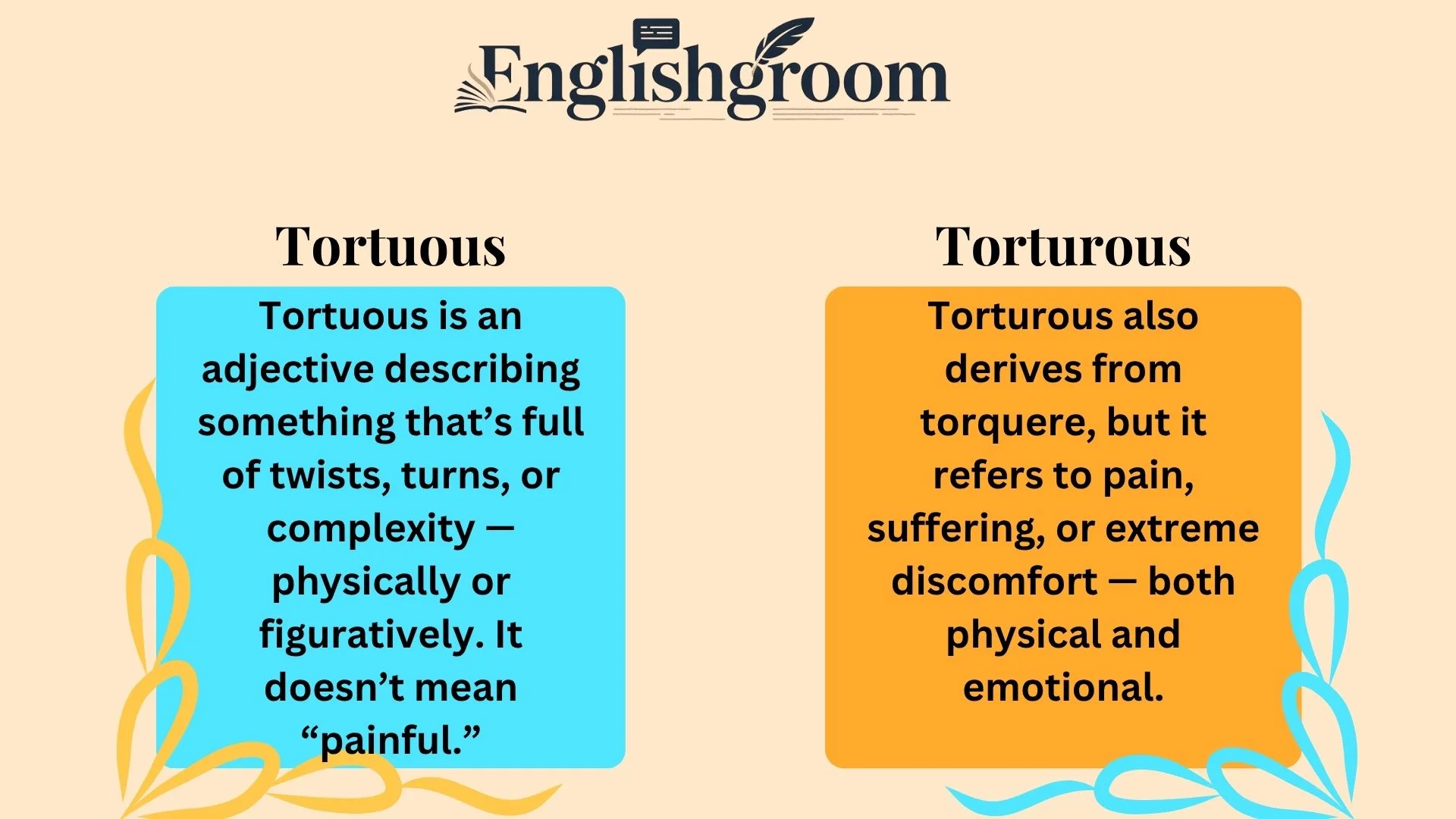
Tortuous is an adjective describing something that’s full of twists, turns, or complexity — physically or figuratively. It doesn’t mean “painful.” Instead, it means winding or intricate, like a curvy road, a complicated process, or a tricky argument.
Definition: “Tortuous” means full of twists and turns or marked by complexity.
Etymology: Where It Comes From
“Tortuous” stems from the Latin word torquere, meaning “to twist.”
Over centuries, it evolved through Old French into English, keeping its sense of “twisting” rather than “torturing.”
So, when you say something is tortuous, you’re talking about a path, process, or story that bends and winds — not something that causes pain.
Common Examples of “Tortuous” in Sentences
- The hikers followed a tortuous trail through the mountains.
- The negotiations took a tortuous route before reaching agreement.
- Her reasoning was so tortuous that only a lawyer could follow it.
When to Use “Tortuous”
Use tortuous when referring to:
- Physical paths that twist or bend
- Processes that are complicated or indirect
- Thoughts or logic that are convoluted
Synonyms for “Tortuous”
| Synonym | Meaning |
|---|---|
| Winding | Physically twisting or bending |
| Circuitous | Taking an indirect route |
| Convoluted | Complex and difficult to follow |
| Meandering | Wandering without a clear path |
| Sinuous | Having many curves or turns |
Quick Tip: If you could describe something as “curvy,” “twisting,” or “complicated,” tortuous fits perfectly.
Exploring “Torturous” 🔥
What “Torturous” Really Means
Torturous also derives from torquere, but it refers to pain, suffering, or extreme discomfort — both physical and emotional.
Definition: “Torturous” means causing or characterized by extreme pain or anguish.
Where tortuous describes twists, torturous describes torment.
Examples of “Torturous” in Sentences
- The prisoner endured torturous questioning for hours.
- Waiting for the test results was a torturous experience.
- That final climb up the steep hill felt torturous in the heat.
When to Use “Torturous”
Choose torturous when describing:
- Painful experiences — physical or emotional
- Excruciating processes — something that causes suffering
- Distress or agony — situations that make you cringe or dread
Synonyms for “Torturous”
| Synonym | Meaning |
|---|---|
| Excruciating | Intensely painful |
| Agonizing | Causing great mental or physical pain |
| Grueling | Extremely tiring and demanding |
| Harrowing | Disturbing or distressing |
| Painful | Causing physical or emotional pain |
Mnemonic: Think torturous → torture → pain.
If pain’s involved, torturous is your word.
Tortuous vs. Torturous: The Key Difference 🧩
They share a Latin ancestor but walk separate paths in meaning. Here’s the side-by-side comparison you need:
| Aspect | Tortuous | Torturous |
|---|---|---|
| Root Meaning | Twisting, winding | Causing pain or torment |
| Part of Speech | Adjective | Adjective |
| Emotion Involved | None | Yes — negative |
| Common Context | Roads, logic, plans, arguments | Pain, suffering, hardship |
| Example | A tortuous mountain trail | A torturous medical procedure |
| Synonyms | Winding, circuitous | Painful, excruciating |
How to Tell Them Apart
Ask yourself one simple question:
👉 Is it twisted or painful?
If twisted → tortuous
If painful → torturous
Example:
The road was tortuous, but the wait for rescue was torturous.
When Both Words Might Apply ⚖️
Sometimes, a situation can be both winding and painful.
For example:
- The tortuous and torturous path up the mountain left them exhausted but victorious.
In this case:
- The trail was tortuous (winding).
- The experience was torturous (painful).
Quick Decision Framework
- Twisting or complex path? → Tortuous
- Emotionally or physically painful? → Torturous
- Both? → Use both intentionally
Bonus: “Tortious” — The Legal Cousin ⚖️
You’ve seen tortuous and torturous, but tortious also joins the family.
It’s a legal adjective referring to a tort, which means a civil wrong (not criminal).
Definition: “Tortious” means relating to or involving a tort — a wrongful act that leads to legal liability.
Examples of “Tortious” in Legal Context
- The company was sued for tortious interference with a contract.
- Negligence is one of the most common tortious acts.
Distinguishing the Trio
| Word | Field | Meaning | Example |
|---|---|---|---|
| Tortuous | General English | Twisting, complex | A tortuous road through the hills |
| Torturous | General English | Painful, agonizing | A torturous night of waiting |
| Tortious | Legal English | Involving civil wrongdoing | A tortious breach of duty |
Cultural and Media Misuse 🎬
Pop culture often mixes these words up.
You’ll hear journalists or writers describe a “tortuous” process as “torturous,” assuming they’re the same. They’re not.
Common Misuses in Media
- ❌ The torturous road led to the castle. → Incorrect (should be tortuous).
- ❌ The tortuous punishment left him in agony. → Incorrect (should be torturous).
Why Misuse Happens
- Sound similarity: They’re pronounced almost the same.
- Shared root: Both come from torquere (to twist).
- Overlapping imagery: A “twisting road” can also feel “painful.”
But accuracy matters — especially in professional writing, journalism, and academia. Getting it right improves clarity and credibility.
Memory Tricks & Mnemonics 🧩
Here are quick ways to remember which is which:
- Tortuous = Twisting (both have U for turns).
- Torturous = Torture (think pain).
Visual Mnemonic (ASCII Diagram)
TORTUOUS → twists → winding → road 🛣️
TORTUROUS → torture → pain → suffering 😣
Quick Example Table
| Word | Clue | Example |
|---|---|---|
| Tortuous | Twisting, complex | The river followed a tortuous course. |
| Torturous | Painful, agonizing | The wait felt torturous. |
Real-World Case Study: Miscommunication Gone Wrong 📚
Imagine a travel blogger describing a difficult mountain hike:
“The torturous path up the Andes took us eight hours.”
At first glance, readers might think hikers were tortured.
What the writer meant was tortuous — winding and challenging, not painful in a literal sense.
This small mistake shifts tone from adventure to suffering, showing how one wrong letter can twist meaning dramatically.
Writer’s Tip 💡
When proofreading:
- Read the sentence aloud.
- If it sounds like “pain”, choose torturous.
- If it sounds like “twisting or complex”, choose tortuous.
Quote to Remember:
“Language is precise. One wrong word, and the meaning takes a tortuous — or torturous — turn.”
Summary: Key Takeaways 🏁
| Word | Meaning | Context | Mnemonic |
|---|---|---|---|
| Tortuous | Full of twists, complex | Roads, reasoning, journeys | “U” = “turns” |
| Torturous | Painful, agonizing | Experiences, suffering | Think “torture” |
| Tortious | Legal wrongdoing | Civil law | “Tort” = wrong act |
Quick Checklist Before You Write
✅ Talking about pain → torturous
✅ Talking about twists or complexity → tortuous
✅ Talking about law → tortious
Master these, and you’ll never trip over these tricky twins again.
FAQs About Tortuous vs. Torturous ❓
What does “tortuous” mean in simple terms?
It means full of twists or complicated — like a winding road or complex argument.
What’s the difference between “tortuous” and “torturous”?
Tortuous = twisted or complex.
Torturous = painful or agonizing.
Can I use “tortuous” to describe a painful experience?
Not usually. Use torturous for pain, tortuous for complexity.
Example: A tortuous path vs. a torturous day.
What does “tortious” mean in law?
It means relating to a tort, a civil wrong like negligence or defamation.
Why do people confuse these words so often?
They look and sound almost identical, share Latin roots, and sometimes overlap in emotional tone.
Learn More English With These Best Articles:
Soo vs. So — The Real Difference Explained (With Examples & Fun Insights)
Unregister vs Deregister: The Real Difference You Need to Know
Invision vs Envision: Why People Confuse Them and What You Should Really Use
Its Self or Itself? The Definitive Grammar Guide You’ll Never Forget
Embed vs. Imbed What’s the Real Difference and Which Should You Use?
Final Thoughts 🌟
Both tortuous and torturous spring from the same linguistic root but twist in different directions.
One winds and curves; the other hurts and burns.
Use tortuous for paths and processes that twist.
Use torturous for experiences that torment.
And remember tortious belongs in the courtroom, not your travel blog.
Precision in language doesn’t just show skill — it builds trust.
Get this pair right, and your writing will stand out for the right reasons.

Hi! I’m Sami, a 28-year-old content writer with a love for words and storytelling. Writing has always been my way of expressing ideas, sharing knowledge, and connecting with people. I enjoy creating engaging and well-researched content—whether it’s blogs, articles, or social media posts—that not only informs but also inspires readers. My goal is to turn complex ideas into clear, creative, and meaningful pieces of writing that leave a lasting impact.