Last updated on February 11th, 2026 at 07:25 am
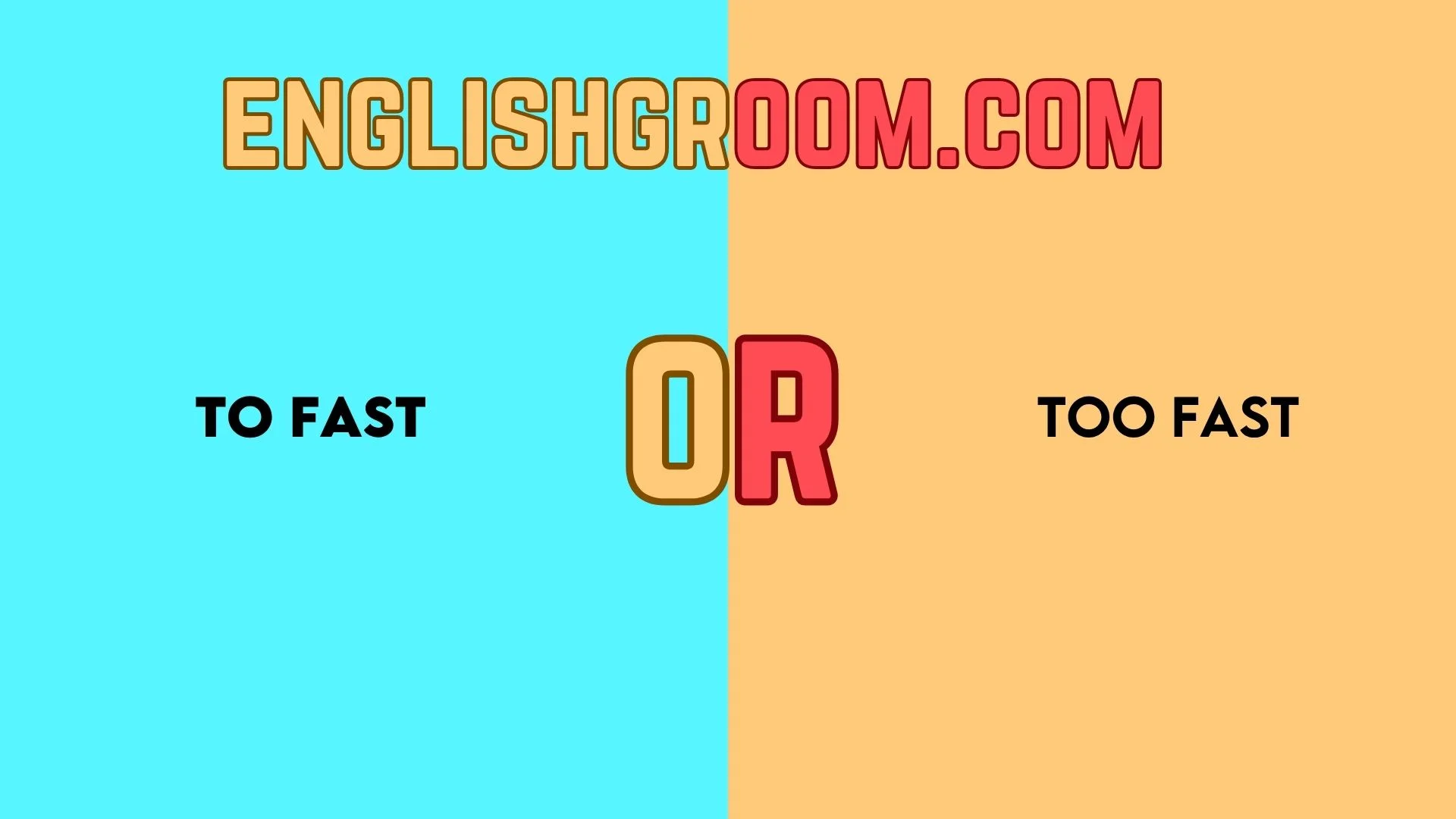
Ever found yourself typing to fast and second-guessing it? You’re not alone. This tiny difference between “to” and “too” trips up native speakers and language learners alike.
Though they sound identical, their meanings couldn’t be more different — and using the wrong one can twist your sentence’s meaning completely.
Let’s break it all down in plain English so you’ll never confuse “to fast” and “too fast” again.
Why “To Fast” and “Too Fast” Confuse So Many People
English is full of homophones — words that sound alike but have different meanings or spellings. Think of their, there, and they’re — same sound, different sense. The same goes for to, too, and two.
This confusion matters because grammar changes meaning. A single misplaced “o” can turn a sentence from logical to nonsensical.
Example:
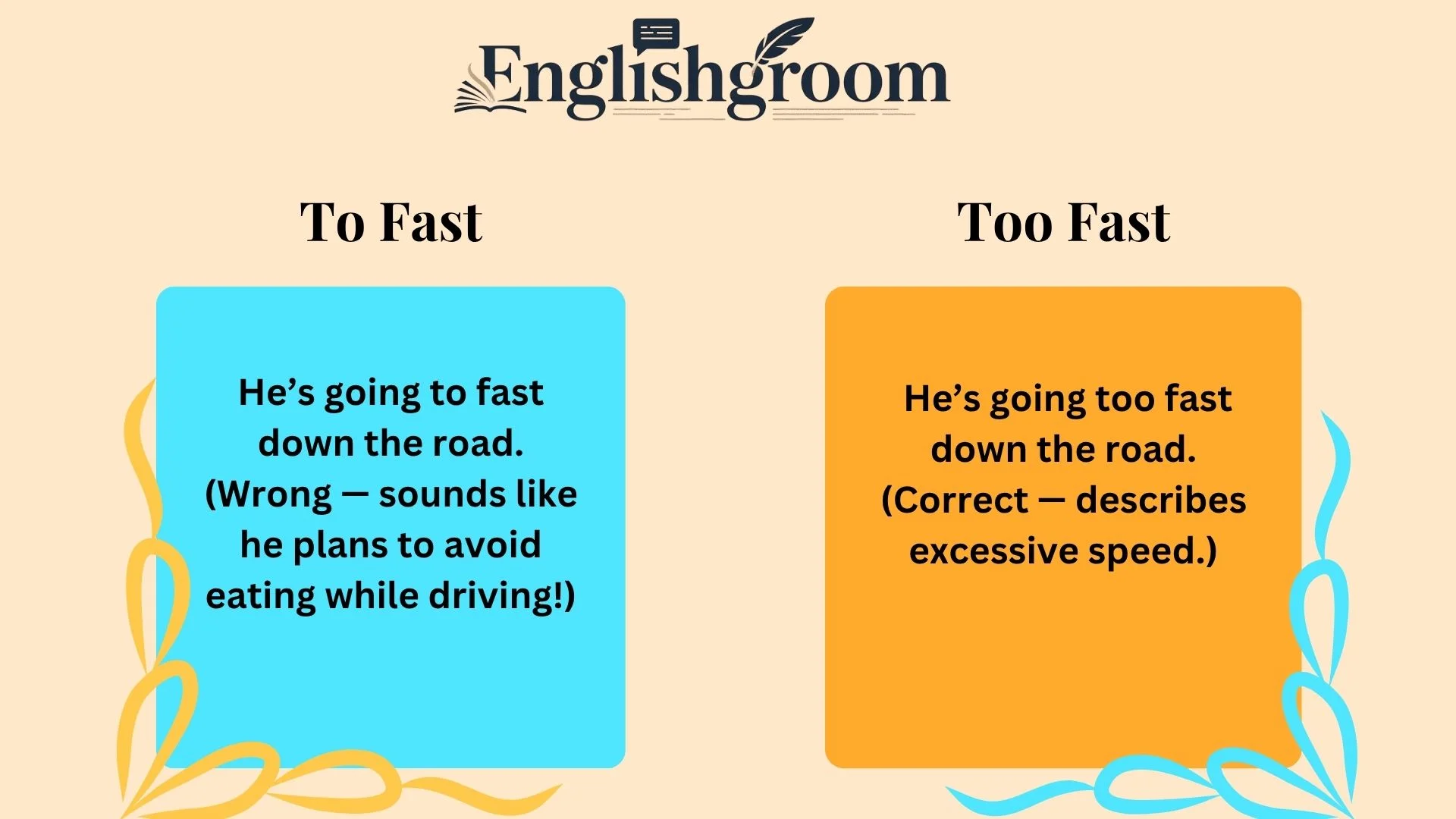
- ❌ He’s going to fast down the road. (Wrong — sounds like he plans to avoid eating while driving!)
- ✅ He’s going too fast down the road. (Correct — describes excessive speed.)
In spoken English, you might not notice the mistake. But in writing, it jumps off the page and can hurt clarity — especially in professional communication.
Breaking Down the Basics: ‘To’ vs. ‘Too’
Even though they sound the same, ‘to’ and ‘too’ perform completely different jobs in a sentence.

| Word | Part of Speech | Meaning | Example |
|---|---|---|---|
| To | Preposition / Infinitive Marker | Direction, relation, or purpose | I’m going to the store. |
| Too | Adverb | Means “excessively” or “also” | It’s too late now. / I want to go too. |
Think of “to” as a connector — it links actions or directions. “Too”, on the other hand, is an intensifier or a tag-along word that adds emotion or inclusion.
What Does ‘To’ Actually Do in a Sentence?
As a Preposition
‘To’ often shows direction, destination, or relationship.
- She’s heading to work.
- Give this to John.
- Listen to your teacher.
It connects one part of a sentence to another, usually linking an action to its target.
As an Infinitive Marker
‘To’ also appears before a verb to show intention or purpose — called an infinitive.
- I want to learn Spanish.
- They decided to stay home.
- We need to act now.
A simple trick: if you can add “in order” before “to” and it still makes sense, you’re using an infinitive.
I need (in order) to eat. ✅
In Prepositional Phrases
‘To’ often starts a prepositional phrase that adds meaning:
- According to the rules
- Next to the window
- Close to home
In each case, ‘to’ shows connection or proximity.
How ‘Too’ Changes Meaning Entirely
‘Too’ plays a different game — it adds or amplifies.
‘Too’ = Excessively
When you say something is “too” something, you’re talking about degree or excess.
- It’s too cold to swim.
- He’s driving too fast.
- You’re talking too loudly.
The key is: too + adjective/adverb = “more than desirable.”
‘Too’ = Also / As Well
It can also mean “also” or “as well.”
- I want to come too!
- You like pizza? Me too.
- She was tired too.
‘Too’ = Emphasis
Sometimes ‘too’ adds emotion or emphasis.
- That’s too good to be true!
- She’s too kind!
It’s like turning up the emotional volume.
‘To Fast’ or ‘Too Fast’? The Real Grammar Rule
This is where most people get tripped up — and where meaning shifts completely depending on context.
| Phrase | Meaning | Example |
|---|---|---|
| To fast | To abstain from food or drink, usually for religious or health reasons | Many people choose to fast during Ramadan. |
| Too fast | Describes excessive speed or intensity | The car is moving too fast. |
So, “to fast” is only correct when “fast” is a verb. In all other cases — like describing speed or performance — you need “too fast.”
Examples:
- ✅ I plan to fast tomorrow. (verb form)
- ✅ He’s driving too fast again. (adverb form)
- ❌ He’s going to fast again. (wrong — unless he’s literally skipping meals!)
Common Grammar Mistakes and How to Fix Them
Even fluent speakers mix up to and too, especially when typing fast or texting.
Common errors:
- I want to go too the store. ❌
- You’re to kind! ❌
- She’s too go to the party. ❌
Correct forms:
- I want to go to the store. ✅
- You’re too kind! ✅
- She’s to go to the party. (only correct if “to” links with “go”)
Quick Fix Tip:
If you can replace the word with “also” or “very,” use too.
If it shows direction or purpose, use to.
Using ‘Too’ with Adjectives and Adverbs the Right Way
‘Too’ modifies adjectives or adverbs to show excess.
Formula:
Too + adjective/adverb + (to + verb)
Examples:
- Too hot to handle 🔥
- Too early to tell
- Too fast to stop
Common pattern in writing:
| Example | Meaning |
|---|---|
| She’s too tired to work. | She’s so tired that working isn’t possible. |
| It’s too expensive to buy. | The cost prevents buying. |
Avoid overusing “too.” It can sound dramatic if repeated excessively in one paragraph.
Quick Visual Cues and Memory Tricks
Visual learners remember better with imagery and mnemonics. Try these:
The “Double O” Rule
“Too” has extra O’s, so think extra or more — because “too” means excess or also.
“Too many O’s = too much.”
Color-Coded Tip
- 🟢 To = direction or purpose
- 🔴 Too = excess or inclusion
Mnemonic:
“You need too many O’s when there’s too much of something.”
These tiny memory tricks will make the difference automatic over time.
‘To,’ ‘Too,’ and ‘Two’: The Homophone Trio Explained
English loves to keep you on your toes with sound-alike words. Here’s a quick refresher:
| Word | Part of Speech | Meaning | Example |
|---|---|---|---|
| To | Preposition/Infinitive marker | Direction or purpose | Go to the store. |
| Too | Adverb | Also or excessively | It’s too hot today. |
| Two | Noun/Number | The number 2 | I have two dogs. |
💡 Pro Tip: If you’re writing about numbers, it’s always two — never “to” or “too.”
Real-Life Usage Scenarios and Media Examples
Let’s explore how these words show up in the real world — and how even brands and celebrities slip up.
Case Study 1: Social Media Slip-Ups
In 2022, a viral tweet read:
“I’m going to fast to see the results!”
What the user meant: “I’m going too fast.” But that one missing “o” sparked hundreds of playful replies about dieting instead of driving!
Case Study 2: Marketing Mix-Up
A fitness brand once posted:
“It’s never to late to start.”
That one typo cost credibility. Grammar mistakes like this subtly erode trust — even in casual social media posts.
Case Study 3: Everyday Speech vs. Writing
People often say “I wanna go too!” quickly — which sounds like “I wanna go to.” In spoken English, tone and rhythm fill in the blanks, but in writing, precision matters.
Mini Grammar Challenge: Can You Spot the Error?
Try these five — answers below each!
- He’s driving to fast again. ❌ Wrong — should be too fast (excessive speed).
- I plan too fast every weekend. ❌ Wrong — should be to fast (verb form).
- It’s never to late to learn. ❌ Wrong — too late is correct (excessive lateness).
- You’re to kind to me. ❌ Wrong — too kind is correct (degree of kindness).
- Can I come too? ✅ Correct — means “as well.”
Quick Grammar Recap: Key Takeaways
- ‘To’ = direction, purpose, or infinitive marker.
- ‘Too’ = excessively, also, or emphasis.
- ‘To fast’ only makes sense if “fast” is a verb.
- ‘Too fast’ means “at excessive speed.”
- The Double O Rule will always steer you right.
“If it’s about going somewhere, use to.
If it’s about too much, use too.”
Bonus Tools and Resources
Here are some trusted tools to help you catch “to” and “too” mix-ups automatically:
- Grammarly – Highlights misused homophones instantly.
- Merriam-Webster Dictionary – Great for quick grammar lookups.
- Hemingway App – Checks sentence flow and readability.
- LanguageTool – Multilingual grammar checker for advanced writers.
- Purdue OWL – Trusted resource for all grammar questions.
FAQs
What’s the difference between “to fast” and “too fast”?
“To fast” means to abstain from food, while “too fast” means moving or acting at excessive speed.
Is “to fast” ever correct?
Yes — only when “fast” is a verb, such as in “I plan to fast for 12 hours.”
Can I use “too” before verbs?
No. “Too” modifies adjectives and adverbs, not verbs directly. You’d say “too quickly,” not “too run.”
What’s an easy way to remember the difference?
Remember the Double O Rule — more O’s means “more” or “extra.” So “too” means “too much” or “also.”
Are “to,” “too,” and “two” pronounced the same?
Yes, they’re homophones, but they differ completely in meaning and usage. Context tells you which one fits.
🏁 Final Thoughts: Write Clearly, Not Too Quickly
In English, tiny words carry big weight. Mixing up “to” and “too” can make your message sound careless — even if you know the rule deep down. With practice, you’ll start catching these errors naturally.
When you write, pause before “to” or “too” and ask yourself,
“Is this showing direction or excess?”
That single second of thought will save you endless corrections later.
So next time you’re about to type to fast, stop for a heartbeat — and make sure you’re not going too fast with your grammar!

Hi! I’m Sami, a 28-year-old content writer with a love for words and storytelling. Writing has always been my way of expressing ideas, sharing knowledge, and connecting with people. I enjoy creating engaging and well-researched content—whether it’s blogs, articles, or social media posts—that not only informs but also inspires readers. My goal is to turn complex ideas into clear, creative, and meaningful pieces of writing that leave a lasting impact.