Ever catch yourself saying, “Time has flew by!” and wonder if it’s actually correct? You’re not alone.
Many English speakers make this mistake without realizing it.
Understanding the difference between “time has flew by” and “time has flown by” isn’t just grammar pedantry—it helps you speak confidently and write clearly.
In this post, we’ll break down the grammar, explore examples, examine common mistakes, and give you real-life alternatives so you never trip over this phrase again.
Understanding the Verb “Fly”
The confusion around “time has flew by” comes from the verb fly, which is irregular. Let’s break it down.
The Three Main Forms of “Fly”
| Tense | Form | Example Sentence |
|---|---|---|
| Present | fly | I fly to New York every summer. |
| Past | flew | Yesterday, time flew by while I was working. |
| Past Participle | flown | Time has flown by faster than I imagined. |
The key point: when you use has, have, or had, it must be followed by the past participle—in this case, flown, not flew.
How English Uses “Has” + Past Participle
The present perfect tense connects past events to the present. For example:

- ✅ “I have flown to Paris three times.”
- ❌ “I have flew to Paris three times.”
See the difference? Using flew after has is grammatically incorrect.
Literal vs Figurative Meaning
The phrase “time has flown by” is mostly figurative, but understanding both senses helps.
Literal Meaning
- Birds and airplanes literally fly through the sky.
- Example: “The bird flew over the river yesterday.”
Figurative Meaning
When we say time has flown by, we’re not talking about birds or planes. It’s a metaphor: time passes quickly, often unnoticed.
- Example: “It feels like yesterday we started high school—now graduation is here. Time has flown by!”
- Emotional tone: reflective, nostalgic, or amazed at how fast life moves.
Correct vs. Incorrect Usage
Now that we understand the verb, let’s see what’s correct and what trips people up.
Why “Time Has Flown By” is Correct
- Uses has + past participle (flown)
- Fits the present perfect tense
- Works for both spoken and written English
Examples:
- “Summer has flown by, and I can’t believe school is starting.”
- “This year has flown by faster than any other in my life.”
Why “Time Has Flew By” is Incorrect
- Flew is simple past, not past participle
- Doesn’t pair with has in proper grammar
- Sounds wrong to native speakers
Common mistake explanation:
People often hear the phrase in conversation and mimic it without thinking about the tense.
Common Confusions
- Flown by vs. Flown bye: “bye” is a misspelling, not related to time. Always use by.
- Other irregular verbs with similar mistakes:
| Verb | Past | Past Participle |
|---|---|---|
| Go | went | gone |
| Take | took | taken |
| See | saw | seen |
| Do | did | done |
Alternatives and Synonyms
If you want variety in your writing or speech, there are plenty of ways to express “time has flown by.”
Casual Alternatives
- “Time went by so fast.”
- “Where did the time go?”
- “I can’t believe how quickly the day passed.”
Formal Alternatives
- “The passage of time was swift.”
- “The year has elapsed rapidly.”
- “Time has progressed at an astonishing pace.”
Poetic or Figurative Alternatives
- “Time slips through our fingers.”
- “The hours melted away like snow in the sun.”
- “Moments vanish before you realize they’re gone.”
Examples in Context
- Everyday Conversation:
- Friend: “How’s your vacation?”
- You: “Amazing! Time has flown by. I can’t believe it’s already Friday.”
- Emails or Letters:
- “I hope this message finds you well. Time has flown by, and I look forward to catching up soon.”
- Social Media Captions:
- “Can’t believe my little one is 5 today! Time has flown by! 😢❤️”
Real-Life Examples
Seeing this phrase in action helps reinforce correct usage.
In Literature
- “Time has flown by since we last met,” said the character in classic fiction.
- Poets often use it to convey nostalgia.
In Speeches
- Motivational speaker: “Friends, time has flown by, but every moment counts. Let’s make the most of today.”
Everyday Conversations
- Parents, students, and professionals frequently use it to express surprise at how fast events pass.
Quick Recap
- ✅ Correct: Time has flown by
- ❌ Incorrect: Time has flew by
- ✅ Acceptable alternative (simple past): “Time flew by yesterday.”
- Avoid confusion with spelling (by vs bye)
- Remember: has/have + past participle
FAQs
What is correct: Time has flew by or Time has flown by?
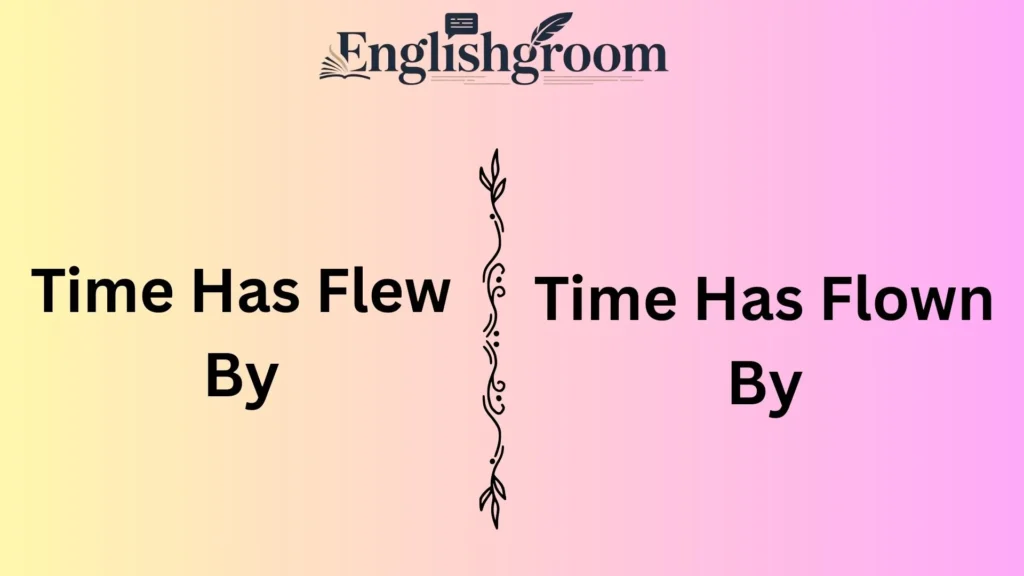
Answer: “Time has flown by” is correct.
Why do people say Time has flew by?
Answer: It’s a common mistake due to irregular verb confusion and mimicking spoken language.
What does Time has flown by mean?
Answer: It means time has passed quickly, often unexpectedly.
Is Time has flew by ever acceptable?
Answer: Only in casual speech, but it is grammatically incorrect in writing.
What is the difference between flew and flown?
Answer: Flew = simple past; flown = past participle used with has/have/had.
Conclusion
The difference between “Time has flew by” and “Time has flown by” might seem small, but it affects your credibility in both writing and speech. Remember:
- Use flown with has/have/had
- Keep an eye on irregular verbs
- Explore alternatives to keep your language fresh
- Notice how writers, speakers, and everyday people use it in context
Mastering this phrase adds clarity, sophistication, and confidence to your English.
Next time you blink and realize a year has passed, you’ll say it correctly: “Time has flown by!”

Hi! I’m Sami, a 28-year-old content writer with a love for words and storytelling. Writing has always been my way of expressing ideas, sharing knowledge, and connecting with people. I enjoy creating engaging and well-researched content—whether it’s blogs, articles, or social media posts—that not only informs but also inspires readers. My goal is to turn complex ideas into clear, creative, and meaningful pieces of writing that leave a lasting impact.