Last updated on February 16th, 2026 at 07:16 am
Language is full of subtle differences that shape tone and meaning. One such pair that often puzzles even fluent English speakers is “thus far” and “so far.” Both sound similar, yet they carry distinct levels of formality and tone.
Understanding when to use each can make your writing sound more natural, precise, and contextually appropriate.
Let’s explore the real difference — backed by history, grammar, and everyday examples.
Why This Confuses Even Fluent Speakers
You’ve probably said or written both at some point:
- “So far, everything looks good.”
- “Thus far, our efforts have succeeded.”
They seem interchangeable, right? Yet the first sounds like something you’d say to a friend, while the second fits better in a report or academic paper.
This distinction isn’t just stylistic — it’s rooted in history, grammar, and tone. Once you understand that foundation, you’ll never second-guess your choice again.
The Core Difference Between “Thus Far” and “So Far”
At their core, both phrases mean “up to this point in time.”
However, the key difference lies in tone and formality:

| Phrase | Meaning | Tone | Common Use |
|---|---|---|---|
| Thus Far | Up to this point, until now | Formal, deliberate | Academic writing, speeches, reports |
| So Far | Up to this point, until now | Informal, conversational | Everyday speech, casual writing, dialogue |
In short:
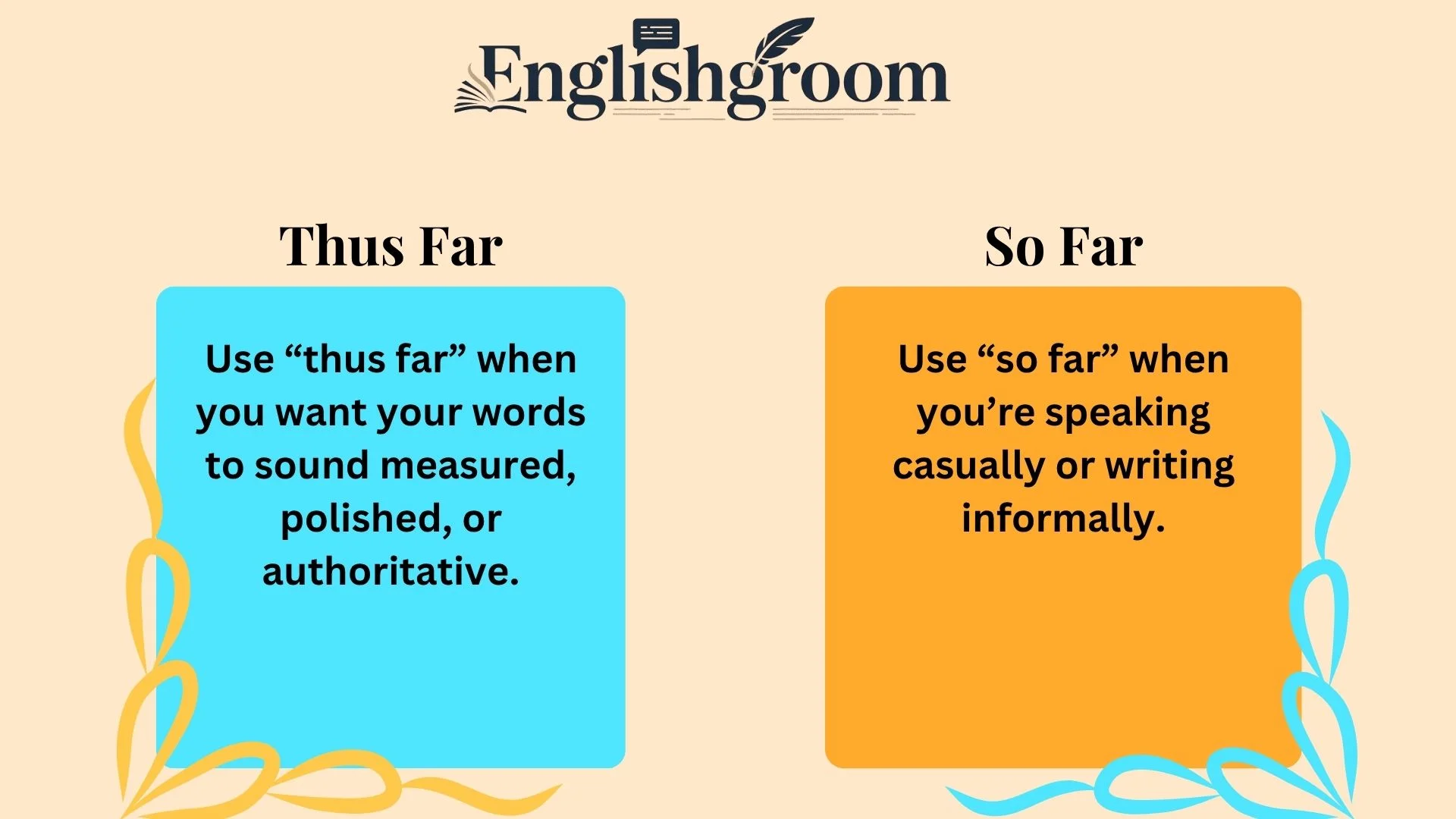
- Use “thus far” when you want your words to sound measured, polished, or authoritative.
- Use “so far” when you’re speaking casually or writing informally.
Example comparison:
“Thus far, the experiment has yielded positive results.”
“So far, the experiment’s going pretty well.”
Same meaning — different vibe.
Historical Origins: How “Thus” and “So” Shaped Their Meanings
Both phrases trace back to Old English, but their roots reveal why they feel so different today.
| Word | Origin | Original Meaning | Modern Evolution |
|---|---|---|---|
| Thus | Old English þus | “In this way,” “accordingly” | Used in formal or logical statements |
| So | Old English swa | “In like manner,” “as such” | Evolved into casual, flexible connector |
Fun fact:
The word thus was once used frequently in Biblical and philosophical writing — think “Thus saith the Lord.” Over time, it became associated with serious or formal contexts.
Meanwhile, so became the everyman’s connector — short, smooth, and natural. By the 19th century, so far had almost completely replaced thus far in everyday English.
Tone and Formality: When “Thus Far” Fits Better
“Thus far” belongs to the more refined side of English. It’s what you’d expect to see in reports, historical accounts, or speeches.
Typical Contexts
- Academic research papers
- Legal or business reports
- Historical analyses
- Speeches or political addresses
- Religious or philosophical discussions
Examples
- “Thus far, our research confirms the proposed hypothesis.”
- “The negotiations have, thus far, remained cordial.”
- “Thus far, the kingdom has prospered under his reign.”
Pro Tip
Use “thus far” when you want your words to sound intentional, balanced, or measured.
It’s not old-fashioned; it’s simply formal and precise.
Everyday Versatility: Why “So Far” Dominates Modern English
“So far” has taken over modern usage because it’s shorter, lighter, and more flexible. You can use it in almost any situation without sounding stiff.
Common in
- Daily conversation
- Social media posts
- Emails and texts
- News and blogs
- Informal essays
Examples
- “So far, so good!”
- “We’ve raised $10,000 so far.”
- “So far, the trip’s been amazing.”
So far fits easily into spoken language because it mimics how people naturally talk. It feels friendly, open, and current.
Comparative Nuances: Meaning, Connotation, and Register
Let’s see how they compare side by side.
| Aspect | Thus Far | So Far |
|---|---|---|
| Formality Level | High | Medium to low |
| Tone | Serious, deliberate | Conversational, light |
| Frequency in Modern English | Less common | Highly common |
| Use in Speech | Rare | Frequent |
| Impression on Reader | Educated, polished | Friendly, relatable |
In essence:
“Thus far” impresses.
“So far” connects.
Both are correct — the difference lies in how you want to sound.
Grammar and Mechanics
Both “thus far” and “so far” function as adverbial phrases modifying verbs.
They usually answer the question: “To what extent?” or “Up to when?”
Sentence Placement
You can place them at the:
- Beginning: “So far, we’ve had no issues.”
- Middle: “We have, thus far, achieved our goals.”
- End: “We haven’t found any errors thus far.”
Punctuation Tips
- When at the start, use a comma after the phrase.
- When mid-sentence, set off with commas if it interrupts the flow.
- No comma needed when it comes at the end.
Common Mistakes
| Mistake | Why It’s Wrong | Correct Form |
|---|---|---|
| “Thus far yet” | Redundant — both mean continuation | “Thus far” or “So far” |
| “So far ago” | Contradictory — so far refers to the present | “A long time ago” |
| “Thus far I did” | Incorrect tense | “Thus far, I’ve done” |
“Thus Far and No Further”: A Fixed Expression Worth Knowing
This phrase, “Thus far and no further,” is a set idiom meaning “up to this point and not beyond.”
It often implies a limit, boundary, or final decision.
Origin and Usage
The phrase appears in the Book of Job (38:11):
“Hitherto shalt thou come, but no further.”
It’s since become a powerful rhetorical line used in politics, literature, and speeches.
Modern Examples
- “Thus far and no further — our patience has run out.”
- “The team’s budget cuts will go thus far and no further.”
It carries a tone of finality and authority, emphasizing boundaries or resolve.
Real-World Usage Comparison
Here’s how tone shifts depending on the setting.
| Context | Example with Thus Far | Example with So Far |
|---|---|---|
| Academic Writing | “Thus far, results suggest a positive correlation between variables.” | “So far, results look positive.” |
| Business Report | “The merger has, thus far, delivered measurable returns.” | “So far, the merger seems to be working.” |
| Fiction/Dialogue | “Thus far, you’ve proven loyal, soldier.” | “So far, you’ve been a good friend.” |
| News Reporting | “Negotiations have thus far failed to produce agreement.” | “So far, talks haven’t led to a deal.” |
Notice how thus far elevates tone, while so far feels approachable.
Alternatives and Synonyms by Context
If you want to vary your writing, here are other phrases that mean “up to this point.”
| Tone | Alternatives | Example |
|---|---|---|
| Formal | to date, up to this point, as yet, until now | “To date, no evidence has surfaced.” |
| Neutral | so far, up till now | “Up till now, progress has been steady.” |
| Informal | so far, so good, until now, by now | “By now, you should have received the email.” |
Pro Tip:
Use to date or as yet in reports. Use until now or so far in everyday writing.
Common Mistakes and Misunderstandings
Even advanced speakers make small slips with these expressions. Let’s clear them up.
1. Using “Thus Far” in Casual Speech
- ❌ “Thus far, I’ve been chillin’ at home.”
- ✅ “So far, I’ve been chilling at home.”
“Thus far” sounds too stiff for informal conversation.
2. Mixing Past and Present Tenses
“So far” and “thus far” refer to the present continuing period.
So, use present perfect tense (has/have + past participle).
- ❌ “So far I did all the tasks.”
- ✅ “So far, I’ve done all the tasks.”
3. Regional Differences
In British English, “thus far” is still heard in formal circles, while Americans lean heavily toward “so far.”
In global communication, “so far” is the safer, universally understood choice.
Best Practices for Writers and Speakers
Here’s how to decide which phrase fits your message.
✅ Use “Thus Far” When:
- Writing reports, research papers, or essays
- Delivering speeches or formal presentations
- You want to sound authoritative or reflective
✅ Use “So Far” When:
- Writing emails, social posts, or personal blogs
- Having a conversation or giving casual updates
- You want to sound approachable and natural
Quick Checklist
| Question | If YES → Use “Thus Far” | If NO → Use “So Far” |
|---|---|---|
| Is the setting formal or academic? | ✅ | |
| Is this everyday conversation? | ✅ | |
| Do you want to sound polished? | ✅ | |
| Do you want to sound relaxed? | ✅ |
Bonus Tip
Read your sentence aloud. If it sounds like something you’d say, use so far.
If it sounds like something you’d write in a paper, use thus far.
Summary: Key Takeaways
- Meaning: Both mean “up to this point.”
- Formality: Thus far = formal, so far = casual.
- Grammar: Both are adverbs modifying verbs.
- Usage: Choose based on tone and context.
- Avoid mixing tenses or redundant phrasing.
In short:
Use “thus far” when precision matters.
Use “so far” when connection matters.
FAQs About “Thus Far vs So Far”
What does “thus far” mean exactly?
It means “up to this point” or “until now” but carries a formal tone. It’s often used in academic or official writing.
Is “so far” less correct than “thus far”?
No. Both are grammatically correct. The only difference is formality and tone, not correctness.
Can I use “thus far” in spoken English?
You can, but it may sound overly formal in casual talk. Stick with so far in conversations.
Is “thus far” outdated?
Not outdated — just formal. It still appears in legal, academic, and literary contexts.
What’s the best alternative to “so far”?
You can use up to now, to date, or until now, depending on tone and context.
Learn More English With These Best Articles:
Tortuous vs Torturous The Confusing Pair Explained Simply
Same Difference Meaning Origin and Real-Life Examples Explained
In the Street vs. On the Street: What Native Speakers Really Mean
When to Use “Eaten” or “Ate”: The Ultimate Grammar Guide for Perfect Usage
Unregister vs Deregister The Real Difference You Need to Know
Conclusion
Understanding “thus far vs so far” isn’t about memorizing definitions — it’s about mastering tone.
When you write, ask yourself who you’re addressing and what impression you want to leave. If you’re drafting a scholarly article, “thus far” elevates your writing.
If you’re chatting with a friend or writing a blog post, “so far” keeps things warm and natural.
Language isn’t just rules — it’s rhythm. Knowing which phrase to use helps your words strike the right chord, every time.

Hi! I’m Sami, a 28-year-old content writer with a love for words and storytelling. Writing has always been my way of expressing ideas, sharing knowledge, and connecting with people. I enjoy creating engaging and well-researched content—whether it’s blogs, articles, or social media posts—that not only informs but also inspires readers. My goal is to turn complex ideas into clear, creative, and meaningful pieces of writing that leave a lasting impact.