
English learners often stumble over two nearly identical phrases: “there has been” and “there have been.”
At first glance, they seem interchangeable, but using the wrong one can make your sentence sound odd—or just plain wrong.
This comprehensive guide breaks it all down in plain English. You’ll learn when and how to use each form, see real-world examples, and walk away knowing exactly why one word—has or have—changes everything.
Why This Distinction Matters
Even native speakers sometimes pause before writing has or have in sentences that start with there. The difference isn’t about formality or style—it’s about subject-verb agreement.
You use “there has been” for singular or uncountable nouns.
You use “there have been” for plural nouns.
That’s it. But understanding why it works this way helps you use both forms confidently, even in complex sentences.
Core Concept: Singular vs. Plural Agreement
Before diving into examples, let’s get the grammar right.
In English, verbs change depending on whether the subject is singular or plural.
- Has is singular.
- Have is plural.
The tricky part is that there isn’t the true subject—it’s a dummy subject, used to start the sentence for smoothness.
The real subject comes after been.
Example:
- ✅ There has been a delay. (delay = singular noun)
- ✅ There have been delays. (delays = plural noun)
If you remember nothing else, remember this:
The verb “has” or “have” agrees with the real subject, not with “there.”
When to Use “There Has Been”
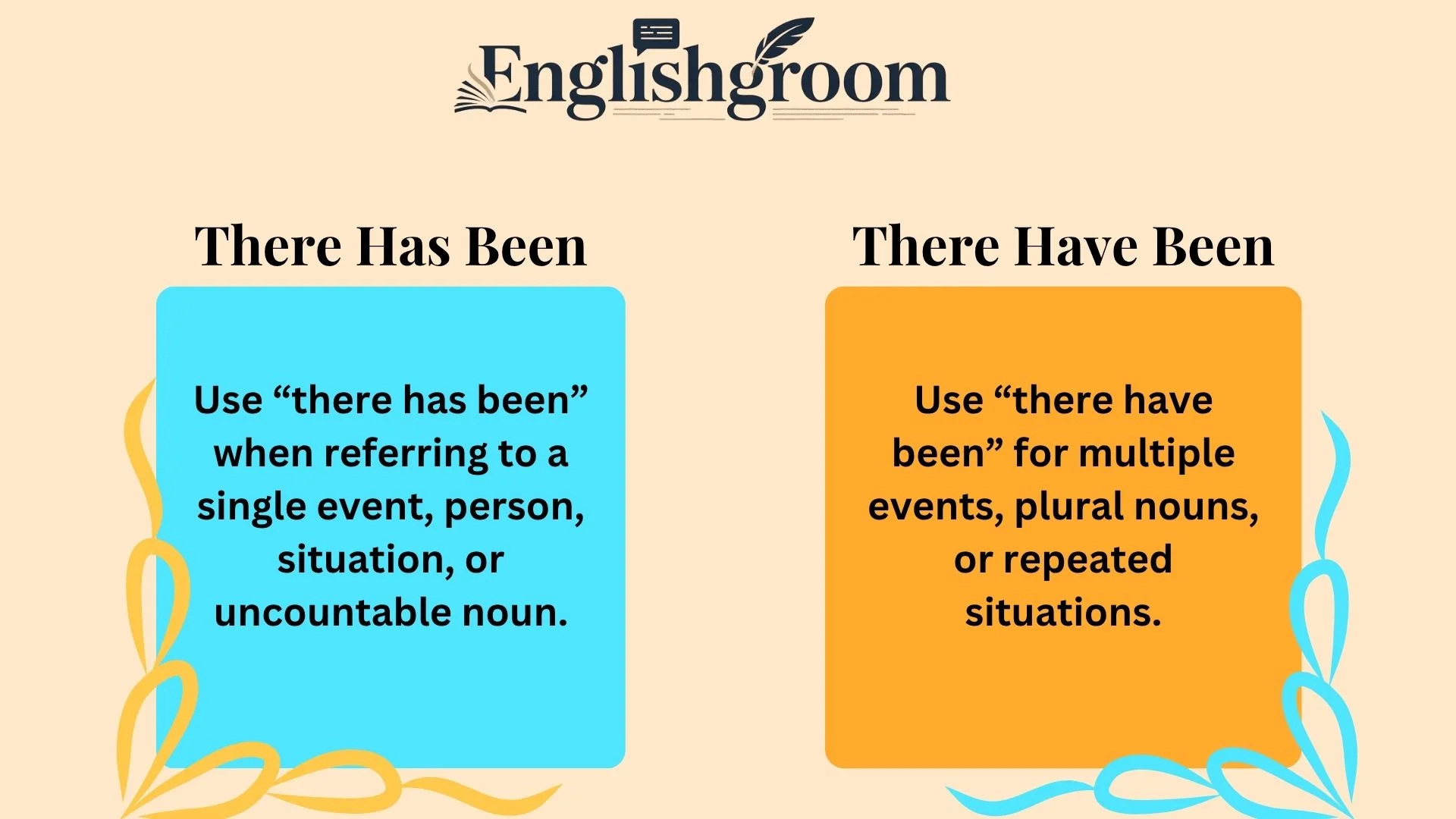
Use “there has been” when referring to a single event, person, situation, or uncountable noun.
Grammar Pattern
There has been + singular noun / uncountable noun
Examples
- There has been an accident on the highway.
- There has been progress on the new bridge project.
- There has been heavy rainfall this week.
- There has been a misunderstanding between departments.
Each sentence refers to one event or one ongoing situation.
Mini Case Study: News Report Example
Imagine a news anchor saying:
“There has been a fire in the downtown area this morning.”
The phrase immediately tells you that one incident occurred, not multiple. If the reporter said “There have been fires,” you’d expect more than one.
This distinction matters in journalism, formal writing, and even daily speech when precision counts.
When to Use “There Have Been”
Use “there have been” for multiple events, plural nouns, or repeated situations.
Grammar Pattern
There have been + plural noun
Examples
- There have been several delays in production.
- There have been many reports of phishing scams recently.
- There have been problems with the software update.
- There have been improvements across all departments.
Quick Comparison Table
| Usage Type | Correct Form | Example | Explanation |
|---|---|---|---|
| Singular event | There has been | There has been an error. | Refers to one occurrence |
| Plural events | There have been | There have been errors. | Refers to multiple occurrences |
| Uncountable noun | There has been | There has been water leakage. | Uncountable = singular form |
This table shows that “has” pairs with singular or uncountable nouns, while “have” pairs with plural nouns.
Grammar Mechanics Behind “Been”
Let’s dig deeper.
“Been” is the past participle of the verb be. It’s used with has, have, or had to form perfect tenses.
- There has been → Present perfect, singular
- There have been → Present perfect, plural
Tense Nuance
Both phrases show that something started in the past and continues or has relevance now.
Example Comparison:
- There was a mistake. → A past event (no link to now).
- There has been a mistake. → A past event with current relevance (still matters).
Avoiding Common Mistakes
Even experienced writers make these blunders. Let’s fix them.
Mistake 1: Misidentifying the Subject
❌ There has been many problems.
✅ There have been many problems.
(Problems = plural, so use have.)
Mistake 2: Switching Tenses Mid-Sentence
❌ There have been issues yesterday.
✅ There were issues yesterday.
(Yesterday demands past tense, not present perfect.)
Mistake 3: Overusing Contractions
It’s fine to write There’s been trouble in conversation,
but avoid it in formal writing unless it fits the tone.
Context Matters: Making the Right Choice
Sometimes the line between singular and plural can blur. Let’s look at a few context clues.
Ask Yourself
- What’s the real subject after been?
- Is that subject countable or uncountable?
- Am I referring to one or many?
Examples
- There has been confusion → one overall situation.
- There have been confusions → several instances or misunderstandings.
Tip: Even if confusion feels plural, it’s actually uncountable. Stick with has been.
Questions and Interrogative Forms
You’ll often hear both forms in questions. The structure simply flips the subject and auxiliary verb.
Structure
Has there been…? / Have there been…?
Examples
- Has there been any progress on your project?
- Have there been any complaints so far?
- Has there been a change in schedule?
- Have there been updates from the team?
Usage Note
Use has when the expected answer refers to one event.
Use have when multiple instances are likely.
Affirmative and Negative Statements
Affirmative Use
- There has been progress this month.
- There have been improvements in the system.
- There has been an update to our policies.
- There have been reports of high traffic.
Negative Use
- There hasn’t been enough rain this year.
- There haven’t been any complaints yet.
- There hasn’t been a single mistake.
- There haven’t been many opportunities lately.
Pro Tip:
Use contractions like hasn’t and haven’t for a natural, conversational tone.
Historical & Linguistic Trends
Over the last century, written English has shifted toward “there have been” in everyday use, reflecting the plural-heavy nature of modern communication.
In older literature, “there has been” appeared more often, possibly because formal styles preferred singular phrasing.
Examples from News & Literature
- “There has been no evidence to support the claim.” — The Guardian
- “There have been several reports of sightings.” — BBC News
- “There has been a quiet revolution in public opinion.” — The Economist
Such examples show how the two forms balance between precision and plurality depending on context.
Special Cases and Edge Scenarios
English wouldn’t be English without exceptions. Let’s look at a few.
Delayed Subject
Sometimes, the real subject comes later in the sentence.
- There has been, in recent years, a rise in online learning.
Here, the subject a rise appears after an inserted phrase.
Collective Nouns
- There has been a team decision.
(Team acts as a singular unit.)
But if emphasizing individuals:
- There have been disagreements within the team.
Indefinite Quantifiers
- There have been some people asking questions.
- There has been some confusion about the results.
Quantifiers like some, many, few, or much help determine whether the noun is plural or uncountable.
Quick Reference Summary Table
| Situation | Correct Form | Example |
|---|---|---|
| One event happened | There has been | There has been an accident. |
| Several events happened | There have been | There have been delays. |
| Question (singular) | Has there been | Has there been an error? |
| Question (plural) | Have there been | Have there been any issues? |
| Negative (singular) | There hasn’t been | There hasn’t been enough time. |
| Negative (plural) | There haven’t been | There haven’t been mistakes lately. |
Keep this table handy—it’s your cheat sheet for quick grammar clarity.
Case Study: Business Communication Example
A company sends a quarterly update to clients:
“There have been improvements in our customer service system, but there has been a delay in the new product launch.”
Analysis:
- There have been improvements → plural (multiple updates).
- There has been a delay → singular (one setback).
This precise wording builds professionalism and clarity in written communication.
FAQs About “There Has Been” vs. “There Have Been”
What’s the main difference between “There has been” and “There have been”?
The difference is number agreement. Use has for singular or uncountable nouns, and have for plural nouns.
Can I say “There’s been” instead of “There has been”?
Yes, in informal speech or writing. It’s a contraction of there has been. Avoid it in academic or formal writing.
Is “There was” the same as “There has been”?
Not exactly. There was refers to a past event with no current relevance. There has been connects the past to the present.
Can I use “There have been” with time expressions?
Yes, but only when the time period connects to the present.
Example: “There have been several updates this week.” (still ongoing)
Which is more common in everyday English?
“There have been” tends to appear more often in spoken and written English today because we often talk about multiple situations or experiences.
Learn More English With These Best Articles:
Let Your Hair Down Meaning Origins and Real-Life Usage
Inquiring Minds Want to Know Meaning Usage & Real-Life Examples
Who Else or Whom Else? The Complete Grammar Guide You’ll Actually Remember
A Chip off the Old Block Meaning Origin & Modern Significance
Finger in the Dike Meaning Origins & Real-Life Lessons
Conclusion
When you’re unsure whether to use “there has been” or “there have been,” look at the real subject.
- If it’s singular or uncountable, use has.
- If it’s plural, use have.
Both phrases live in the present perfect tense, linking past and present in a single idea.
The difference may seem small, but mastering it makes your English sound clear, accurate, and natural—just like a native speaker’s.
Practice by observing real examples in news articles, reports, or conversations, and soon the right form will roll off your tongue automatically.

Hi! I’m Sami, a 28-year-old content writer with a love for words and storytelling. Writing has always been my way of expressing ideas, sharing knowledge, and connecting with people. I enjoy creating engaging and well-researched content—whether it’s blogs, articles, or social media posts—that not only informs but also inspires readers. My goal is to turn complex ideas into clear, creative, and meaningful pieces of writing that leave a lasting impact.