Last updated on February 17th, 2026 at 08:02 am
Have you ever typed tear when you actually meant tare—or vice versa? Don’t worry, you’re not alone.
These two little words sound almost identical, yet they carry entirely different meanings depending on context. One deals with emotion or destruction, while the other concerns measurement and trade.
In this detailed guide, you’ll learn the key differences between tear and tare, how to use each correctly, and easy tricks to remember them forever.
Let’s tear (not tare 😉) into it.
Understanding “Tear” — Meaning, Usage, and Nuances
The word tear wears many hats in the English language. It can mean to rip something apart, to move swiftly, or even refer to the drops that fall from your eyes when you’re emotional. Context determines everything here.
Tear as a Verb
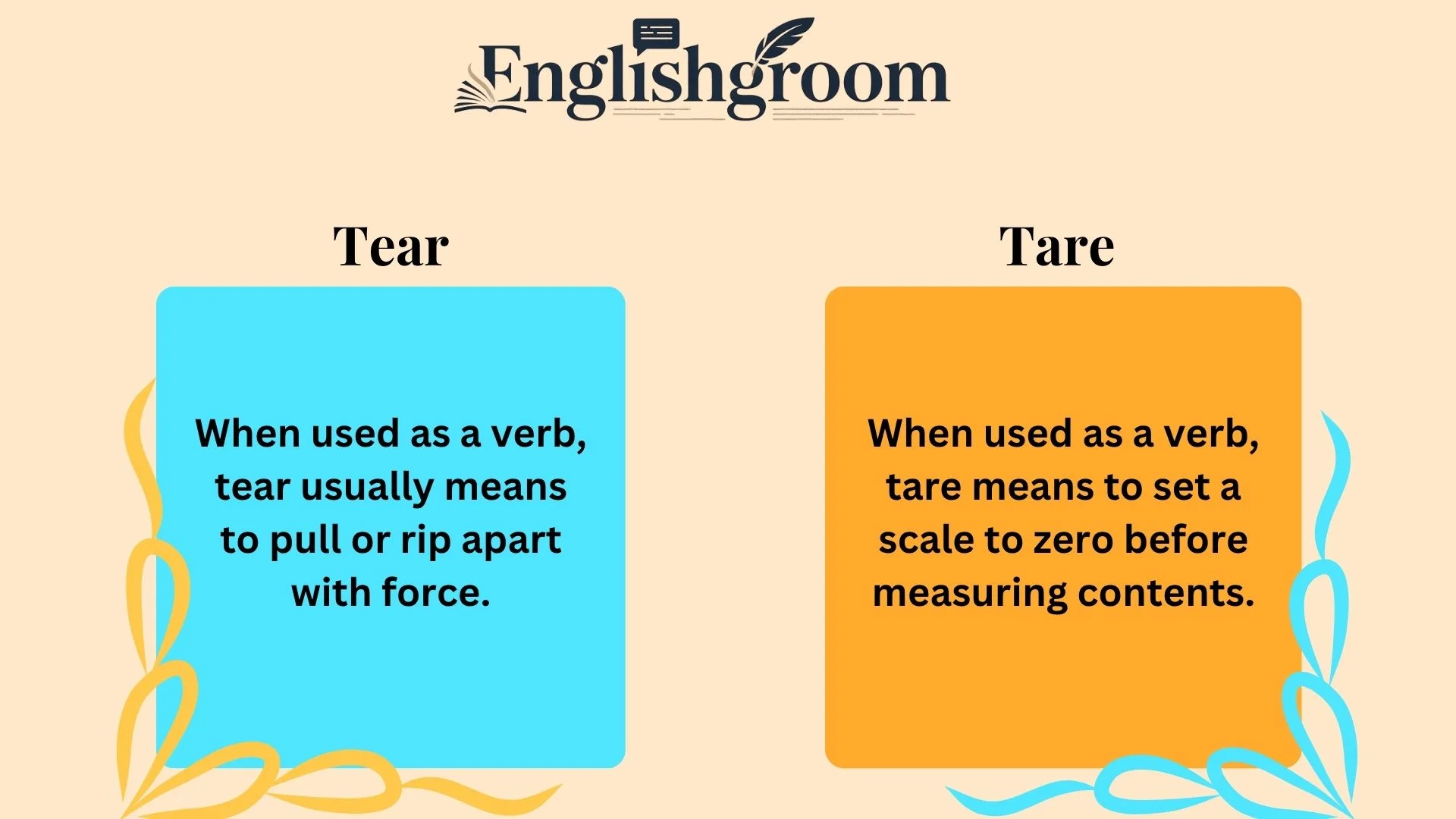
When used as a verb, tear usually means to pull or rip apart with force.
Examples:
- She accidentally tore her dress on a nail.
- The dog tore the newspaper into shreds.
- Don’t tear the wrapping paper — I want to reuse it!
But tear can also express swift movement:
- The car tore down the highway at full speed.
- He tore out of the room in anger.
And in a different pronunciation, tear (/tɪər/) means to cry.
- She teared up during the movie.
- He couldn’t stop tearing when he heard the sad news.
So yes, same spelling — totally different meanings and pronunciations.

Tear as a Noun
As a noun, tear can refer to either a drop of liquid from the eye or a rip or hole in something.
Examples:
- A single tear rolled down her cheek.
- There’s a tear in your jeans.
- He repaired the tear with a patch.
You’ll often find tear in common expressions such as:
- Burst into tears
- Crocodile tears
- Tear gas
- Tearjerker (a movie or story that makes people cry)
Pronunciation and Context
Here’s where English likes to play tricks. The word tear has two pronunciations depending on meaning:
| Pronunciation | IPA | Meaning | Example |
|---|---|---|---|
| teer | /tɪər/ | A drop from the eye | She shed a tear. |
| tair | /tɛər/ | To rip or damage | Don’t tear the paper. |
Tip: If emotion’s involved, it’s “teer.” If something’s breaking, it’s “tair.”
Fun Fact 💡
The word tear comes from the Old English teran, meaning to rend, lacerate, or pull apart. Over centuries, it evolved to represent both physical ripping and emotional release — two very human experiences.
Understanding “Tare” — The Trade and Science Term
While tear lives in everyday language, tare belongs to the world of commerce, logistics, and science. It might not show up in your emotional journal, but it’s crucial when measuring accurate weight.
Tare as a Noun
The noun “tare” has two distinct meanings:
- Weight of a container or packaging deducted from total (gross) weight.
- Used in shipping, laboratories, and food industries.
- For instance, if a jar weighs 100g empty and 350g with contents, the tare weight is 100g.
- You subtract tare to find net weight.
- A type of plant, specifically vetch, often considered a weed in cereal crops.
- This usage is rare and mostly appears in agricultural or biblical contexts.
Examples:
- The tare weight is printed on most packaged goods.
- “Separate the wheat from the tares” comes from a biblical parable (Matthew 13:24–30).
Tare as a Verb
When used as a verb, tare means to set a scale to zero before measuring contents.
Examples:
- Please tare the scale before adding ingredients.
- The lab assistant tared each container before recording weights.
- Modern digital scales automatically tare after pressing a single button.
This ensures only the actual substance or product weight is measured, excluding the container.
Origin and Historical Context
Tare originated from the Old French “tare”, meaning deficiency or deduction, and was adopted into Middle English trade terminology.
Merchants used it to calculate net weight accurately and prevent overcharging customers.
Even today, it’s a cornerstone term in shipping, packaging, and food processing industries.
Tear vs. Tare — The Key Differences
Though these two words sound the same, their meanings couldn’t be further apart. Here’s a clear comparison:
| Feature | Tear | Tare |
|---|---|---|
| Part of Speech | Noun, Verb | Noun, Verb |
| Primary Meaning | Rip, damage, or cry | Weight of container or deduction |
| Context | Emotional, physical, or figurative | Industrial, scientific, trade |
| Pronunciation | /tɪər/ (teer), /tɛər/ (tair) | /tɛər/ (tair) |
| Example | She shed a tear of joy. | Subtract the tare before weighing. |
| Origin | Old English teran (to tear) | Old French tare (deficiency) |
In short:
- Tear involves emotion or destruction.
- Tare involves measurement and precision.
Tear in Context — Real Sentence Examples
Let’s explore how tear behaves in real-world sentences. Notice how context clues help identify its meaning.
As a Verb (to rip):
- Be careful not to tear the fragile wrapping paper.
- She tore the letter into pieces after reading it.
As a Verb (to move quickly):
- The child tore across the playground, laughing.
- A sports car tore past us on the highway.
As a Verb (to cry):
- He teared up during the graduation speech.
- She tears easily when she’s nostalgic.
As a Noun (a drop or rip):
- A tear rolled down his cheek.
- There’s a small tear on your sleeve.
Tare in Context — Real Sentence Examples
Now, let’s look at tare in action — often in technical or business settings.
As a Noun:
- The tare weight of this bottle is 150 grams.
- Always record the tare before starting the experiment.
- The shipment invoice includes the tare, net, and gross weights.
As a Verb:
- Tare the digital scale before placing the cup.
- The technician tared the container to ensure accurate measurement.
How to Remember Tear vs. Tare
Confusing these homophones can lead to errors — especially in professional documents. Here’s how to remember the difference easily.
Visual and Phonetic Memory Tricks
Mnemonic Devices:
- 🧵 Tear → Think of ripping fabric → both start with “tear.”
- ⚖️ Tare → Think of a weighing scale → “tare” rhymes with “weigh.”
Phonetic Cue:
- “Tear your paper.” (rip)
- “Tare your scale.” (weigh)
Visualization Idea:
- Picture a crying emoji 😢 when you think of tear.
- Picture a digital scale ⚖️ when you think of tare.
Everyday Scenarios to Reinforce Learning
- If it involves emotions or damage → It’s tear.
- If it involves weighing or measuring → It’s tare.
- If you can cry it or rip it → It’s tear.
- If you can subtract it → It’s tare.
Common Mistakes and How to Avoid Them
Even native speakers stumble over these tricky twins. Here are common mix-ups and how to steer clear of them.
1. Typing “Tare” Instead of “Tear”
- ❌ Incorrect: Please tare the paper gently.
- ✅ Correct: Please tear the paper gently.
2. Using “Tear” for Weight Calculations
- ❌ Incorrect: The tear weight is 50g.
- ✅ Correct: The tare weight is 50g.
3. Ignoring Context Clues
Always look for hints:
- Is emotion, damage, or speed involved? → Tear.
- Is it about measurement or packaging? → Tare.
4. Overlooking Pronunciation
If the word sounds like “teer,” it’s about crying.
If it sounds like “tair,” check context — could be either.
Summary Table — Tear vs. Tare
| Feature | Tear | Tare |
|---|---|---|
| Meaning | Rip, move quickly, or cry | Container’s weight deduction |
| Common Usage | Emotional or physical | Scientific or commercial |
| Verb Form | Tear (tearing, tore, torn) | Tare (taring, tared) |
| Noun Form | Tear (drop, rip) | Tare (weight deduction) |
| Pronunciation | /tɪər/, /tɛər/ | /tɛər/ |
| Example Sentence | Don’t tear your jeans. | Tare the scale before use. |
Real-World Case Study: When Mixing Them Up Matters
Case Study: The Logistics Error That Cost Thousands
In 2018, a food distribution company made a costly documentation mistake. An employee mistakenly entered tear instead of tare in the shipment records.
Because the tare weights weren’t properly deducted, invoices showed inflated product weights — resulting in overbilling customers by nearly $12,000 across multiple shipments.
When auditors reviewed the records, they flagged the term misuse as the root cause. A single homophone caused weeks of confusion, customer complaints, and financial loss.
Lesson learned: One misplaced vowel can cost more than embarrassment — it can cost money.
Frequently Asked Questions (FAQs)
What is the main difference between tear and tare?
Tear means to rip or cry, while tare means the weight of a container deducted from the total weight.
Are tear and tare pronounced the same?
Yes, they can sound the same (/tɛər/), but tear can also be pronounced /tɪər/ when referring to crying.
Can tare be used as a verb?
Absolutely. To tare means to set a weighing scale to zero before measurement.
Is tare used outside trade or science?
Rarely. It appears mainly in weighing, logistics, and laboratory contexts.
How do I remember the difference quickly?
Think: “If it’s about crying or ripping, it’s tear.” If it’s about weighing, it’s tare.”
Learn More English With These Best Articles:
Die vs Dice The Definitive Guide to Correct Usage
Tortuous vs Torturous The Confusing Pair Explained Simply
Mastering Having vs Having Had in English Grammar
Same Difference Meaning Origin and Real-Life Examples Explained
Gooned Meaning, Origins & Uses Explained
Conclusion
English can be a minefield of similar-sounding words, and tear vs. tare is one of the sneakiest pairs. But once you understand their origins, meanings, and usage, the confusion vanishes.
Remember:
- Tear expresses emotion, destruction, or speed.
- Tare expresses precision, measurement, and deduction.
When in doubt, picture the scene — if someone’s crying or ripping, it’s tear. If someone’s weighing or calculating, it’s tare.
Mastering these subtle distinctions doesn’t just polish your writing — it sharpens your thinking.

Hi! I’m Sami, a 28-year-old content writer with a love for words and storytelling. Writing has always been my way of expressing ideas, sharing knowledge, and connecting with people. I enjoy creating engaging and well-researched content—whether it’s blogs, articles, or social media posts—that not only informs but also inspires readers. My goal is to turn complex ideas into clear, creative, and meaningful pieces of writing that leave a lasting impact.