Last updated on February 21st, 2026 at 07:05 am
Have you ever paused mid-sentence, wondering whether to write “the team that won” or “the team who won”? You’re not alone. Even seasoned writers get tangled in this grammar puzzle.
Choosing between that, who, and which when referring to a team depends on grammar rules, tone, and even geography. This guide dives deep into the logic, usage, and style of these pronouns, so you can write with precision and confidence.
Why This Question Matters
Language shapes perception. The way you refer to a team can subtly shift how readers view it—either as a unified entity or a group of individuals.
Think about the difference between:
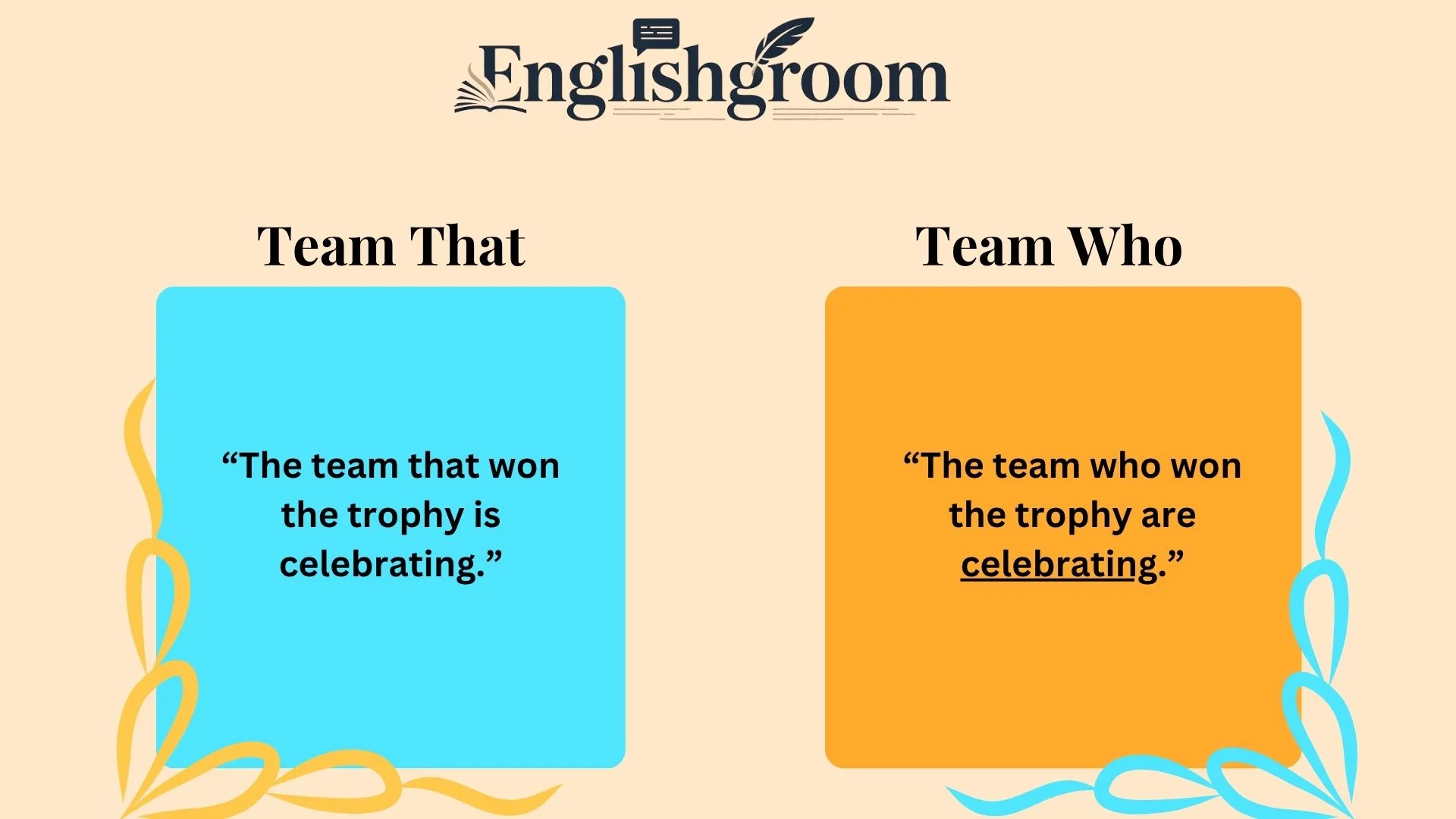
- “The team that won the trophy is celebrating.”
- “The team who won the trophy are celebrating.”
Both are correct in different contexts, but they feel different. The first sounds formal and American, while the second sounds warm and British. Let’s uncover why.
Understanding Collective Nouns
What’s a Collective Noun?
A collective noun names a group considered as one unit. Words like team, family, committee, staff, and audience fall into this category.
But here’s where it gets tricky: sometimes a collective noun acts singular, other times plural.
American vs. British Usage

| Example | American English | British English |
|---|---|---|
| The team is winning. | ✅ Correct | ❌ Unnatural |
| The team are winning. | ❌ Incorrect | ✅ Correct |
In American English, a collective noun is singular because it represents a single unit.
In British English, the same noun is often plural, emphasizing the people within the group.
Example:
- US: “The company is hiring.”
- UK: “The company are hiring.”
Why It Causes Confusion
“Team” sits on the fence—it’s one thing made up of many people. Writers often struggle to decide whether to treat it as a single body or a group of humans. That’s where pronouns like that, who, and which come into play.
Relative Pronouns: That, Who, and Which
Quick Refresher
Relative pronouns connect clauses and add information about a noun.
Each serves a different purpose:
| Pronoun | Used For | Example |
|---|---|---|
| That | Things, groups, or essential information | “The team that won the match…” |
| Who | People or personified groups | “The players who trained hardest…” |
| Which | Nonhuman entities or extra info | “The team, which was founded in 1998…” |
Why It Matters
Using the wrong pronoun can make your sentence sound off or overly formal. It’s not just grammar—it’s about tone and readability.
“Grammar is not just about correctness—it’s about clarity and connection.”
— Stylewise Writing Institute
Applying Pronouns to “Team”
“Team” is a collective noun, so the choice of pronoun depends on how you view the team in your sentence.
If You See the Team as One Entity
Use that.
Example: “The team that won the game is celebrating tonight.”
This fits American English and sounds professional and concise.
If You See the Team as People
Use who.
Example: “The team who trained every morning finally succeeded.”
This feels human and relatable—common in British or informal contexts.
If You’re Adding Nonessential Info
Use which.
Example: “The team, which has a new coach, won easily.”
The clause “which has a new coach” adds extra detail, not crucial to the main idea.
Team That
When to Use “Team That”
In American English, “team that” is standard. It’s grammatically correct because a team is treated as a singular thing.
Example Sentences:
- “The team that won the trophy deserves recognition.”
- “The company that sponsors the team plans a parade.”
Why It Works:
- Treats “team” as one unit.
- Matches major style guides like AP, Chicago Manual of Style, and Merriam-Webster.
- Sounds objective and professional.
Style Tip
If you’re writing for business, journalism, or academic purposes, stick with “team that.”
Team Who
When to Use “Team Who”
Writers use “team who” when they personify the team—as a group of people, not a faceless entity.
Examples:
- “The team who fought hardest won the championship.”
- “The team who volunteered for charity made us proud.”
This phrasing is common in British English, sports commentary, and casual speech.
Why It Feels Different
“Who” gives the team personality. It emphasizes the human side of the group.
Example in context:
“The team who trained together every morning showed remarkable chemistry.”
— BBC Sports Report
Use “team who” if you want warmth, personality, or conversational tone.
Team Which
Why “Team Which” Is Rare
“Team which” sounds stiff because “which” usually refers to things, not people or personified groups.
Example:
- “The team, which practices daily, won the tournament.” ✅ (Correct, but formal)
- “The team which won the tournament…” ❌ (Awkward in modern usage)
Use “which” only when:
- The clause is nonessential.
- The sentence sounds smoother with commas.
Key Takeaway
Use “which” for extra information, not for identifying clauses. It’s grammatically fine but stylistically heavy.
Regional and Stylistic Differences
American English
- Treats “team” as singular.
- Prefers that.
- Example: “The team that won is celebrating.”
British English
- Treats “team” as plural.
- Prefers who.
- Example: “The team who won are celebrating.”
Style Guide Snapshot
| Guide | Recommendation | Notes |
|---|---|---|
| AP Stylebook | Use “that” | Treat collective nouns as singular |
| Chicago Manual of Style | “That” preferred | “Who” acceptable if personified |
| The Guardian Style Guide | “Who” for human collectives | Reflects British idiom |
Case Study: Media Usage
- ESPN (US): “The team that claimed victory…”
- BBC (UK): “The team who fought to the end…”
Same story, different grammar lens.
Contextual Considerations
Audience and Tone
Ask yourself:
- Am I writing formally or conversationally?
- Who’s my audience—Americans, Brits, or an international mix?
For formal/business writing: “team that”
For friendly or narrative writing: “team who”
Brand Voice Consistency
If your brand or publication follows a specific style (like AP or Guardian), stick with it. Consistency builds credibility.
Emotional Tone
- “That” = detached, factual, neutral.
- “Who” = human, emotional, personal.
Quick Decision Checklist
| Context | Pronoun | Reason |
|---|---|---|
| Academic or corporate writing | That | Objective tone |
| Conversational or narrative | Who | Human tone |
| Adding extra info | Which | Nonessential clause |
Best Practices
- ✅ Be consistent throughout your article or brand material.
- ✅ Follow a style guide if your organization uses one.
- ✅ Read aloud to hear what sounds natural.
- ❌ Avoid mixing forms like “the team that… they are…”
- ❌ Don’t overthink minor variations—clarity beats rigidity.
“Good grammar doesn’t call attention to itself—it simply guides understanding.”
— The Elements of Style
Quick Reference Table
| Situation | Recommended Pronoun | Example |
|---|---|---|
| Formal / US English | That | “The team that won…” |
| British / Conversational | Who | “The team who won…” |
| Adding Nonessential Info | Which | “The team, which trains daily…” |

FAQs
Can I use “team who” in American English?
Yes, but sparingly. It’s not technically wrong, just informal. Most American editors prefer “team that.”
Why does British English allow “team who”?
Because British grammar often treats collective nouns as plural, recognizing the people within the group.
Is “team which” ever completely wrong?
No—but it’s uncommon. Use it for nonessential clauses only, not for identifying which team you mean.
What about other collective nouns like “family” or “committee”?
The same logic applies.
- US: “The committee that decided…”
- UK: “The committee who decided…”
How do I decide quickly which one to use?
Ask yourself:
“Am I describing people or a thing?”
If people → use “who.”
If a single unit → use “that.”
Conclusion
Language evolves, but clarity never goes out of style.
Use “team that” for formal or American writing, “team who” for British or conversational tone, and “team which” only for descriptive add-ons.
Your goal isn’t to impress grammar purists—it’s to communicate clearly and consistently. Choose the form that fits your audience, stick with it, and your writing will always sound polished and natural.
“Write for clarity, not for correctness alone. When it’s clear, it’s right.”
— Grammar Mastery Journal

Hi! I’m Sami, a 28-year-old content writer with a love for words and storytelling. Writing has always been my way of expressing ideas, sharing knowledge, and connecting with people. I enjoy creating engaging and well-researched content—whether it’s blogs, articles, or social media posts—that not only informs but also inspires readers. My goal is to turn complex ideas into clear, creative, and meaningful pieces of writing that leave a lasting impact.