Ever paused before sending an email and wondered if you should write “Sorry to bother you” or “Sorry for bothering you”?
You’re not alone. These two short phrases sound almost identical but carry slightly different tones, levels of formality, and timing of apology.
Language is a living thing. The way you phrase your apology can change how polite, confident, or even professional you sound. In this guide, you’ll learn when and how to use each expression naturally, how culture affects apology etiquette, and how to sound sincere without overdoing it.
Why These Phrases Matter
Communication today happens fast — messages, emails, DMs. A single word can shift how your tone is perceived.
“Sorry to bother you” often sounds polite and proactive.
“Sorry for bothering you” feels reflective and remorseful.
Both express respect for another person’s time, but one looks forward and the other looks back. Understanding that nuance makes your language sharper and your communication more effective — whether you’re writing a professional email or texting a friend.
The Core Difference Explained
Let’s break down what’s really happening in these phrases grammatically and emotionally.
| Phrase | Structure | Meaning | Tone |
|---|---|---|---|
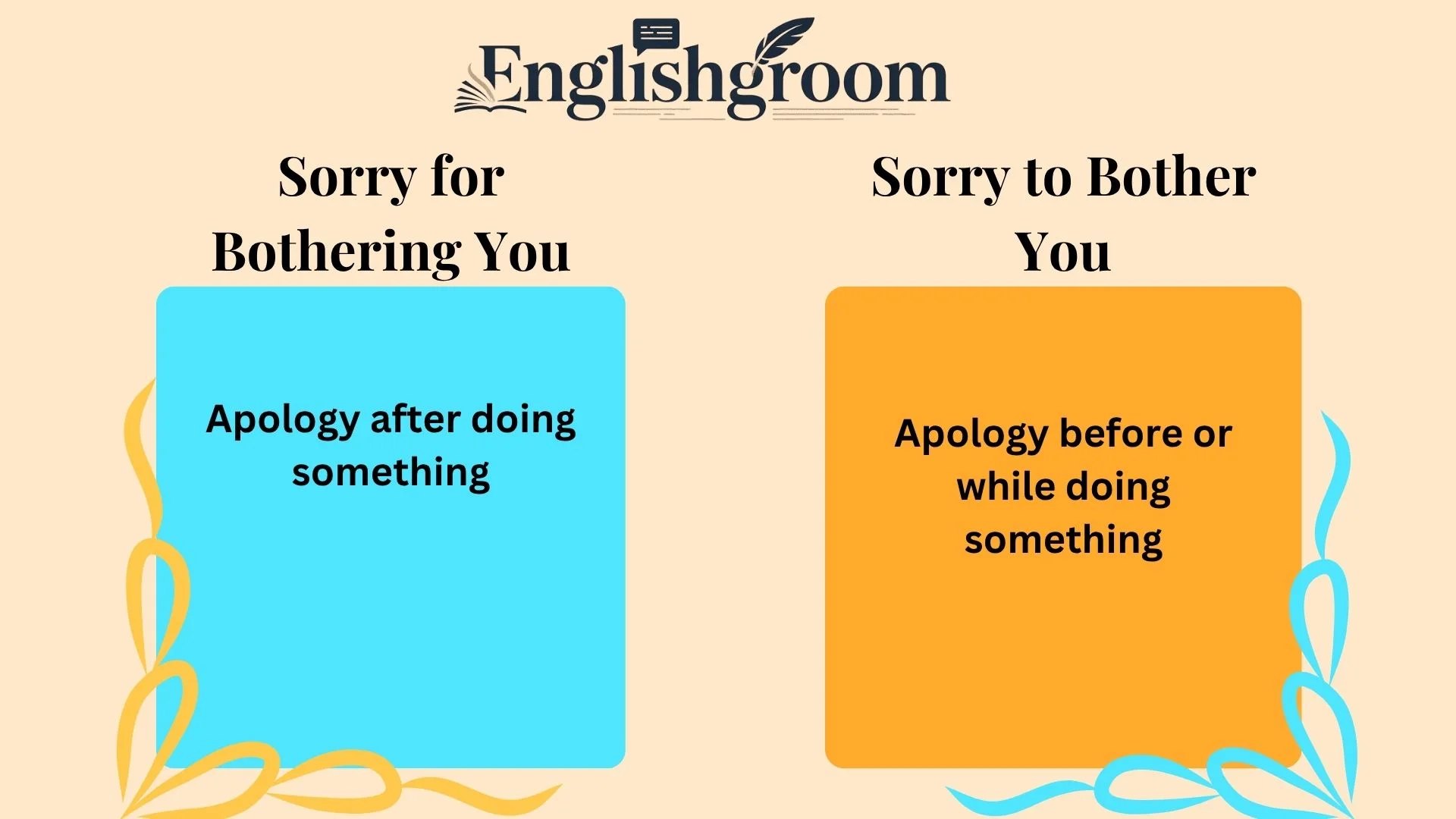
| Sorry to bother you | “to bother” = infinitive (future or immediate action) | Apology before or while doing something | Polite, anticipatory |
| Sorry for bothering you | “for bothering” = gerund (past or ongoing action) | Apology after doing something | Reflective, remorseful |
Think of it this way:
“Sorry to bother you” = I’m about to interrupt you.
“Sorry for bothering you” = I already interrupted you.
It’s all about timing.
Example:
- Before action: “Sorry to bother you, but could I ask a quick question?”
- After action: “Sorry for bothering you again about this report.”
The difference may be small, but in English, those small differences create big changes in how others perceive your tone.
Context Determines the Right Choice
Context gives words their color. You might choose one phrase over the other depending on whether you’re:
- Starting a conversation or following up
- Speaking formally or casually
- Talking face-to-face or over email
When Each Feels More Natural
| Context | Use “Sorry to Bother You” | Use “Sorry for Bothering You” |
|---|---|---|
| Asking for help or permission | ✅ Yes | ❌ No |
| Following up on an unanswered message | ❌ No | ✅ Yes |
| Interrupting a coworker in person | ✅ Yes | ❌ No |
| After multiple reminders | ❌ No | ✅ Yes |
Spoken vs. Written English
- In spoken English, “Sorry to bother you” sounds more spontaneous and natural.
- In emails, “Sorry for bothering you” softens tone and feels more thoughtful.
In short, one phrase politely opens a conversation, the other gracefully closes it.
Comparison Table: When to Use Each Phrase
| Situation | Recommended Phrase | Example | Tone |
|---|---|---|---|
| Before asking a favor | Sorry to bother you | “Sorry to bother you, but could I get your opinion?” | Polite / anticipatory |
| After repeated contact | Sorry for bothering you | “Sorry for bothering you again about the meeting.” | Apologetic / respectful |
| Quick question at work | Sorry to bother you | “Sorry to bother you for a sec — do you know where the file is?” | Light / courteous |
| Post-interruption | Sorry for bothering you | “Thanks for your time earlier, and sorry for bothering you.” | Appreciative / reflective |
Politeness in Professional Communication
Emails are where tone can make or break impressions. Too direct, and you sound cold. Too apologetic, and you sound unsure.
Here’s how these phrases behave in professional writing.
Example: Proper Email Openings
✅ Correct:
“Sorry to bother you, but could you please confirm if the report was received?”
✅ Polite Follow-up:
“Sorry for bothering you again, but I wanted to check if you had a chance to review my proposal.”
Avoid Over-Apologizing
Saying “sorry” too often can make you sound insecure. Instead, use phrases that balance politeness and confidence.
| Overused | Better Alternative |
|---|---|
| “Sorry to bother you again” | “Thanks for your patience” |
| “Sorry for disturbing you” | “Appreciate your time” |
| “Apologies for the trouble” | “Thank you for understanding” |
Pro tip: Use “thank you” more often than “sorry.” Gratitude always feels warmer and more positive.
The Formality Spectrum: Choosing the Right Tone
Every audience requires a different tone. What works with your manager might sound stiff with a friend.
Formal Settings
- “Apologies for the interruption.”
- “I hope I’m not disturbing you.”
Semi-Formal
- “Sorry to bother you, but could I ask something quickly?”
- “Sorry for bothering you again, I just need clarification.”
Casual or Friendly
- “Hey, sorry if I’m bugging you.”
- “Sorry for bothering you so late.”
| Tone Level | Suitable Phrase | Example |
|---|---|---|
| Formal | “Apologies for the interruption.” | “Apologies for the interruption during your meeting.” |
| Neutral / Professional | “Sorry to bother you.” | “Sorry to bother you, but could I get an update?” |
| Casual | “Sorry if I’m bugging you.” | “Sorry if I’m bugging you, just wanted to check in.” |
Adjusting tone isn’t about changing meaning—it’s about respecting context.
When and How to Use “Sorry for Bothering You”
This phrase fits best after the event. It’s reflective and shows awareness.
Common Scenarios
- Following up on a previous email
- Sending a second reminder
- Interrupting twice in a short time
- Apologizing after realizing someone was busy
Example
“Sorry for bothering you earlier, I didn’t realize you were in a meeting.”
It’s especially effective when you acknowledge timing, repetition, or inconvenience.
Mistakes to Avoid:
- Don’t open every email with “Sorry.”
- Don’t say “Sorry for bothering you” before actually doing so — it sounds misplaced.
- Don’t use it to fill space when you’re unsure what to say.
Use it after something occurs, not before.
Alternatives to “Sorry to Bother You”
Sometimes you want to be polite without apologizing. Try these instead:
| Alternative Phrase | Best Used When | Example |
|---|---|---|
| “Hope this isn’t a bad time.” | Before requesting | “Hope this isn’t a bad time, could we discuss next steps?” |
| “I know you’re busy, but…” | Acknowledging workload | “I know you’re busy, but I’d appreciate your feedback.” |
| “I appreciate your time.” | Wrapping up politely | “I appreciate your time on this.” |
| “Thanks for taking a moment.” | In meetings or chats | “Thanks for taking a moment to clarify that.” |
These alternatives respect time without signaling insecurity. They maintain warmth while projecting confidence.
Striking the Balance: Sincere, Not Submissive
Apologies are polite, but overdoing them can weaken your message.
According to workplace communication studies, employees who over-apologize are often perceived as less decisive.
How to Sound Polite Yet Assertive
- Replace “Sorry” with “Thanks” where appropriate.
- Instead of “Sorry for the delay,” say “Thanks for waiting.”
- Keep your request clear and specific.
- Show appreciation after asking, not just before.
Real Example
❌ “Sorry to bother you again, but I need your input on this.”
✅ “Thanks for taking another look — I’d love your input on this.”
Respect + confidence = professionalism.
Cultural and Regional Nuances
Apologies vary across cultures. The English language adapts based on regional politeness norms.
| Region | Typical Style | Example |
|---|---|---|
| United States | Friendly, brief, casual | “Sorry to bother you, could you help me out?” |
| United Kingdom | Politeness is often layered | “Terribly sorry to bother you, would you mind if I asked?” |
| Japan | Deep formality and humility | “Sumimasen” often covers both “excuse me” and “sorry.” |
| Germany | Direct communication, minimal apologies | “Entschuldigung” used only when truly necessary. |
In multicultural environments, tailor your tone. Americans may find excessive apologies unnecessary, while Japanese colleagues may see them as respectful.
Tip for Global Professionals
When unsure, err on the side of politeness. It’s easier to tone down formality later than to repair a perceived rudeness.
Quick Reference Table: Do’s and Don’ts
| Situation | Do | Don’t |
|---|---|---|
| Asking for help | Use “Sorry to bother you” once | Start every sentence with “Sorry” |
| Following up | Use “Sorry for bothering you” once | Repeat it multiple times |
| Emails to superiors | Keep tone formal but not apologetic | Sound hesitant |
| Cross-cultural communication | Adapt tone | Assume all cultures value same level of apology |
| Friendly chat | Use casual phrases | Overthink tone |
Case Study: The Power of Subtle Wording in Professional Emails
Case:
A marketing associate named Emma emailed her supervisor three times about a campaign review. Her first two emails began with:
“Sorry to bother you again, just checking in.”
By the third, the supervisor stopped responding. Her tone sounded overly deferential.
After coaching, Emma changed her message to:
“Thanks for your time last week! Just wanted to follow up on the campaign draft when you have a moment.”
The result?
The supervisor replied within the hour.
Lesson:
Replacing “sorry” with “thanks” reframed her tone from apology to appreciation. It showed initiative rather than hesitation.
Key Takeaways
- “Sorry to bother you” = before or during a request.
- “Sorry for bothering you” = after you’ve already caused inconvenience.
- Use “thank you” more often than “sorry.”
- Adjust tone for formality, context, and culture.
- Over-apologizing weakens confidence; balance sincerity with assertiveness.
FAQs
What’s the main difference between “Sorry to bother you” and “Sorry for bothering you”?
“Sorry to bother you” is used before or while doing something; “Sorry for bothering you” is used after the action. The former is anticipatory, the latter is reflective.
Is “Sorry to bother you” polite?
Yes. It’s a polite and professional way to begin a conversation or request, especially in emails or messages to superiors.
Can I use “Sorry for bothering you” in professional emails?
Absolutely — when following up or acknowledging repeated contact. Just avoid overusing it.
What can I say instead of “Sorry to bother you”?
Use phrases like “Hope this isn’t a bad time,” “I appreciate your time,” or “Thanks for your patience.” These sound confident yet courteous.
Which phrase is more formal?
“Sorry for bothering you” is slightly more formal and reflective, while “Sorry to bother you” works in most professional and everyday settings.
Learn More English With These Best Articles:
Same Difference Meaning Origin and Real-Life Examples Explained
Do I Need Quotation Marks When I Quote Myself?
Mastering Having vs Having Had in English Grammar
Unlocking the Power of Verb Roots
What Is Full Proof? Meaning & Difference from “Foolproof”
Final Thoughts
Language is power. The phrases “Sorry to bother you” and “Sorry for bothering you” may look nearly identical, but their subtle differences can shift your tone from polite to overly apologetic—or from courteous to confident.
Use each phrase intentionally:
- Before a request → “Sorry to bother you.”
- After a request → “Sorry for bothering you.”
In today’s fast-paced, cross-cultural communication landscape, tone is everything. Mastering these nuances helps you sound respectful, natural, and self-assured—no matter who’s on the other side of the message.

Hi! I’m Sami, a 28-year-old content writer with a love for words and storytelling. Writing has always been my way of expressing ideas, sharing knowledge, and connecting with people. I enjoy creating engaging and well-researched content—whether it’s blogs, articles, or social media posts—that not only informs but also inspires readers. My goal is to turn complex ideas into clear, creative, and meaningful pieces of writing that leave a lasting impact.