The Tiny Word That Creates Big Confusion
Ever seen someone write “I’m sooo happy!” and wondered why they added extra O’s? You’re not alone. The words “so” and “soo” might look similar, but they play very different roles in English communication.
In this article, we’ll dig deep into what each means, why “soo” exists, how it took over digital communication, and when to use them correctly. You’ll walk away knowing the true difference between “so” and “soo”, and how context shapes which one fits best.
What Is “So” – and How It Functions in English
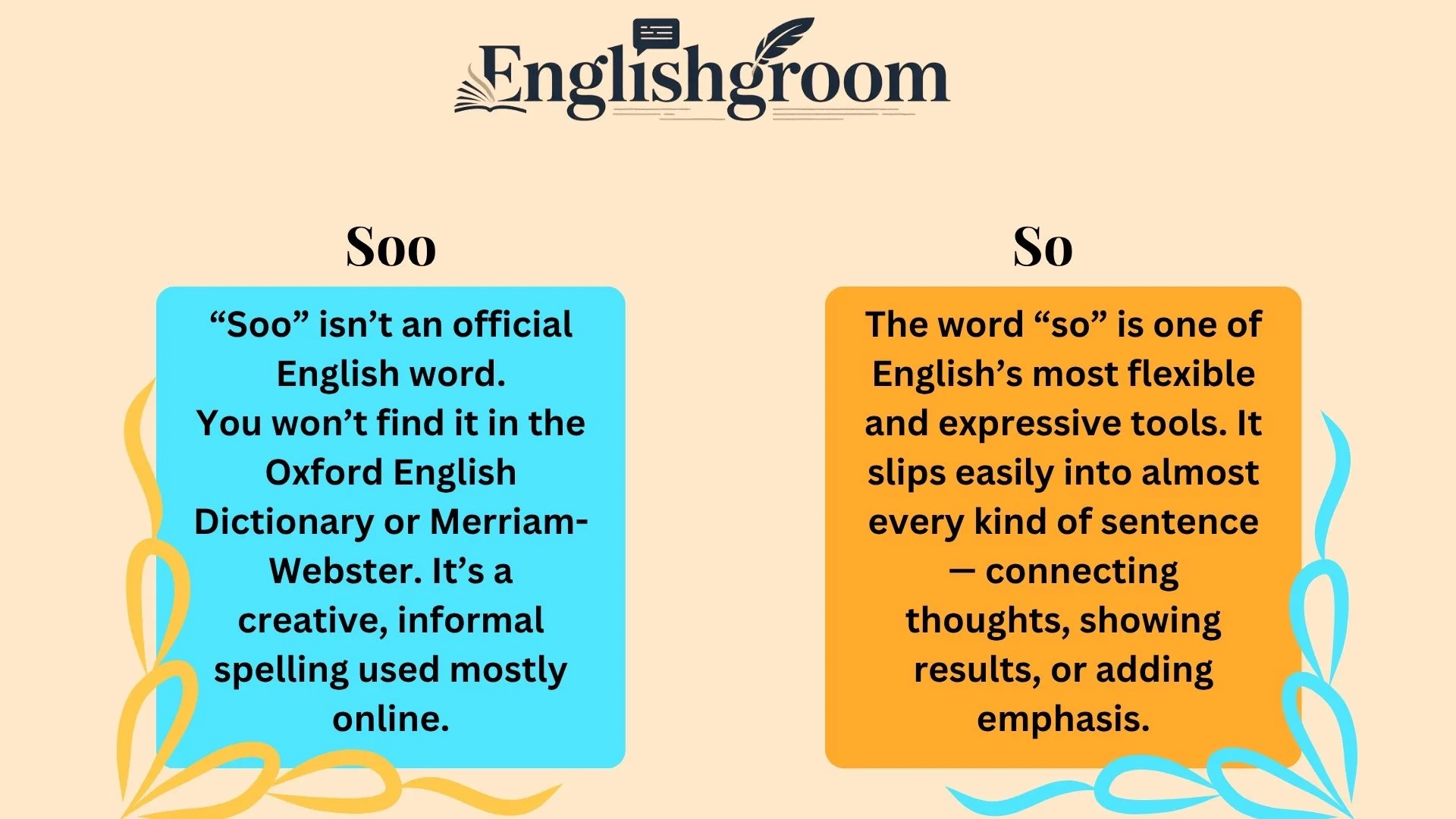
The word “so” is one of English’s most flexible and expressive tools. It slips easily into almost every kind of sentence — connecting thoughts, showing results, or adding emphasis.
Let’s break it down.
Grammatical Roles of “So”
| Function | Example | Meaning |
|---|---|---|
| Conjunction (Result) | “It was raining, so we stayed inside.” | Connects cause and effect. |
| Adverb (Degree) | “She’s so talented.” | Intensifies the adjective. |
| Adverb (Manner) | “Don’t act so surprised.” | Describes how something is done. |
| Emphasis (Emotion) | “That movie was so good!” | Adds emotion or excitement. |
Fact:
“So” comes from Old English swā, meaning in this way or to such a degree. Over time, it evolved into one of the most commonly used words in everyday speech.
Common Uses of “So”
- To show cause and effect: “He forgot his umbrella, so he got wet.”
- To emphasize degree or emotion: “I’m so excited for the weekend!”
- To link ideas smoothly: “So, what do you think about the plan?”
- To create a bridge in conversations: “So… where were we?”
“So” is everywhere because it feels natural and human. It softens sentences, keeps conversations flowing, and helps express subtle emotions without exaggeration.
Breaking Down “Soo”: Is It Even a Word?
Here’s the honest truth: “Soo” isn’t an official English word.
You won’t find it in the Oxford English Dictionary or Merriam-Webster. It’s a creative, informal spelling used mostly online.
So why does it exist at all?
Because humans love bending language to express emotion — especially online.
When we speak, tone and pitch show excitement or exaggeration.
When we type, we don’t have those tools. So, we stretch words instead: sooo, nooo, pleeease, yaaas, and so on.
In short, “soo” is a written reflection of spoken emphasis.
“Soo” is what happens when emotion meets keyboard.
Why “Soo” Exists in Digital Communication
1. To Express Emotion
Typing “sooo” feels like shouting “sooooo!” out loud. It helps convey excitement, frustration, sarcasm, or exaggeration.
- “That’s sooo funny!” → high excitement.
- “I’m sooo done.” → frustration or sarcasm.
- “You’re sooo sweet!” → genuine affection.
2. To Mimic Speech Rhythm
In texting, adding O’s lets you slow the rhythm of reading. It mimics how we’d actually speak.
“Sooo… what happened next?”
This adds a pause, curiosity, or a teasing tone.
3. To Match Internet Culture
From memes to tweets, “soo” has become part of digital personality. It softens tone and adds casual friendliness.
It’s common in:
- Text messages
- Social media posts
- Chat apps
- Informal blogs and captions
4. To Show Personality
Writers use “soo” to sound playful or relatable. It’s more expressive than “so,” especially in emotional contexts.
Compare:
- “I’m so tired.” → statement.
- “I’m sooo tired.” → dramatic sigh.
Contextual Comparison: “So” vs. “Soo” Side by Side
Let’s put them head-to-head for clarity.
| Aspect | “So” | “Soo” |
|---|---|---|
| Grammar Status | Standard English word | Informal / not in dictionaries |
| Use Case | Formal & informal contexts | Casual, playful, emotional tone |
| Tone | Neutral, natural | Dramatic, expressive |
| Acceptability | Professional & academic writing | Texts, social media, memes |
| Example | “I’m so tired.” | “I’m sooo tired.” |
| Perception | Correct and polished | Fun, informal, attention-grabbing |
Bottom line:
- Use “so” when you want to sound clear, professional, or grammatically correct.
- Use “soo” when tone or personality matters more than formality.
When “Soo” Crosses the Line
Everything’s fine in moderation — even extra O’s. But “soo” can go too far.
When It Works
- To show emotion in casual settings. “That’s sooo cute!”
- To add humor or emphasis in friendly chats. “I’m sooo over this week.”
When It Doesn’t
- Formal writing: Emails, resumes, essays, reports.
- Professional communication: Workplace chats, business posts, client messages.
- Academic papers: It weakens credibility.
Using “soo” in serious contexts feels unprofessional. Readers may assume you’re careless or trying too hard to sound funny.
Example of Tone Clash:
❌ “I’m sooo excited to discuss our Q3 financials!”
✅ “I’m so excited to discuss our Q3 financials.”
A single letter can change how seriously your message is taken.
“So” in Real-World English: Practical Examples
Let’s see how “so” functions in real-world contexts.
Everyday Conversations
“I was so happy to see you!”
“That food was so good.”
Used naturally to show feeling — without stretching the word.
Formal Writing
“The results were so significant that further research was required.”
Still works perfectly, even in academic or professional settings.
Speech & Media
Listen closely to interviews, movies, or podcasts. You’ll hear “so” constantly:
“So, the thing is…”
“So I was like…”
It helps transition smoothly and keeps speech engaging.
Language Evolution: Should “Soo” Be Considered Acceptable?
English is alive. It grows, bends, and evolves with culture.
Words that once felt informal can eventually earn a place in mainstream dictionaries. Think of how “selfie,” “LOL,” and “emoji” became legitimate entries.
So, could “soo” be next? Possibly — but not yet.
The Case For “Soo”
- Reflects natural digital speech patterns.
- Helps express emotion and tone missing from text.
- Popular across social media and pop culture.
The Case Against “Soo”
- Lacks official recognition in English grammar.
- Not used in formal or academic contexts.
- Can appear immature or unprofessional when overused.
“Language change is driven by people, not grammar books.”
— Dr. David Crystal, Linguist and Author
In short, “soo” isn’t “wrong.” It’s just context-dependent — like slang, emoji, or internet abbreviations.
The Final Verdict: How to Choose Between “Soo” and “So”
Here’s the quick, practical guide:
Use “So” When:
- You’re writing or speaking formally.
- You need grammatical precision.
- You want your tone to sound neutral or professional.
Use “Soo” When:
- You’re texting friends or posting casually.
- You want to exaggerate emotion or humor.
- You’re adding personality or dramatic tone.
Quick Checklist: Choosing the Right Form
| Situation | Correct Form | Example |
|---|---|---|
| Academic essay | So | “The study was so effective…” |
| Work email | So | “I’m so grateful for your feedback.” |
| Text to friend | Soo | “That’s sooo funny 😂” |
| Social media caption | Soo (optional) | “This outfit is sooo me!” |
| Marketing copy | So (for clarity) | “We’re so excited to launch this product!” |
Remember: good writers balance emotion with clarity.
Case Study: How “Soo” Impacts Tone in Writing
Let’s test it in action.
Scenario: You’re writing a review for your favorite café.
Version 1 — Using “So”
“The coffee is so smooth, and the atmosphere is relaxing. I’ll definitely come back.”
→ Polished, natural, fits blogs or formal reviews.
Version 2 — Using “Soo”
“The coffee is sooo smooth and the vibe is sooo chill!”
→ Friendly, casual, feels like a text or Instagram caption.
Both convey the same meaning, but the tone shifts. The first feels professional; the second feels personal.
That’s the subtle but powerful difference between “so” and “soo.”
5 Common Mistakes with “Soo” and “So”
- Using “soo” in essays or business emails
→ It looks unprofessional and distracts readers. - Overusing “so” in sentences
→ “So” fatigue happens when every sentence starts with it. Vary your structure. - Writing “soo” without purpose
→ Only use it when you intend to express emotion. - Confusing spelling for slang
→ “Soo” isn’t “sew” — it’s purely a creative form of “so.” - Thinking “soo” is wrong in all contexts
→ It’s fine informally. Just know your audience.

FAQs: Soo vs. So
1. Is “Soo” a real word?
No. “Soo” isn’t recognized in formal English dictionaries. It’s an informal variant of “so” used mainly in digital communication to show emotion or tone.
2. Can I use “Soo” in school or work writing?
Not recommended. Use “so” in essays, reports, and professional emails. “Soo” is for casual or playful contexts only.
3. Why do people write “Soo” online?
It’s a way to mimic speech tone and emotion in text. Adding extra O’s exaggerates feelings like excitement, sarcasm, or frustration.
4. Is “Soo” ever grammatically correct?
Grammatically speaking, no. It’s considered nonstandard. But socially, it’s acceptable in informal writing among peers.
5. Will “Soo” ever become an official English word?
Possibly in the future. Language evolves based on usage trends. If “soo” becomes widespread enough, it could eventually gain dictionary recognition — just like “LOL” or “selfie.”
Conclusion
“So” is a linguistic powerhouse — versatile, natural, and grammatically correct. “Soo,” on the other hand, lives in the colorful world of internet slang, where tone and emotion reign supreme.
Both have their place. You just need to know when to sound expressive and when to sound polished.
So the next time you type “sooo tired” or “so excited,” you’ll know exactly what you’re doing — and why it matters.
Tip: Use “so” to connect ideas. Use “soo” to connect emotions.

Hi! I’m Sami, a 28-year-old content writer with a love for words and storytelling. Writing has always been my way of expressing ideas, sharing knowledge, and connecting with people. I enjoy creating engaging and well-researched content—whether it’s blogs, articles, or social media posts—that not only informs but also inspires readers. My goal is to turn complex ideas into clear, creative, and meaningful pieces of writing that leave a lasting impact.