English can be tricky. Even native speakers often stumble over “shown” vs “showed.”
Are you using them correctly in your writing and speech? This guide will walk you through the rules, examples, and tips to use them confidently.
By the end, you’ll never second-guess yourself again.
Understanding the Verb “Show”
The verb “show” means to reveal, present, or display something. It’s one of those verbs that changes depending on tense and structure, which is where confusion often begins.
Here’s the simple breakdown:
- Base form: show
- Simple past: showed
- Past participle: shown
Many learners mix showed and shown, especially in perfect tenses. The key is knowing when a helping verb is needed.
Think of it like this: “showed” is for direct past actions, and “shown” is for perfect tenses where a helping verb joins the verb.
When to Use “Showed”
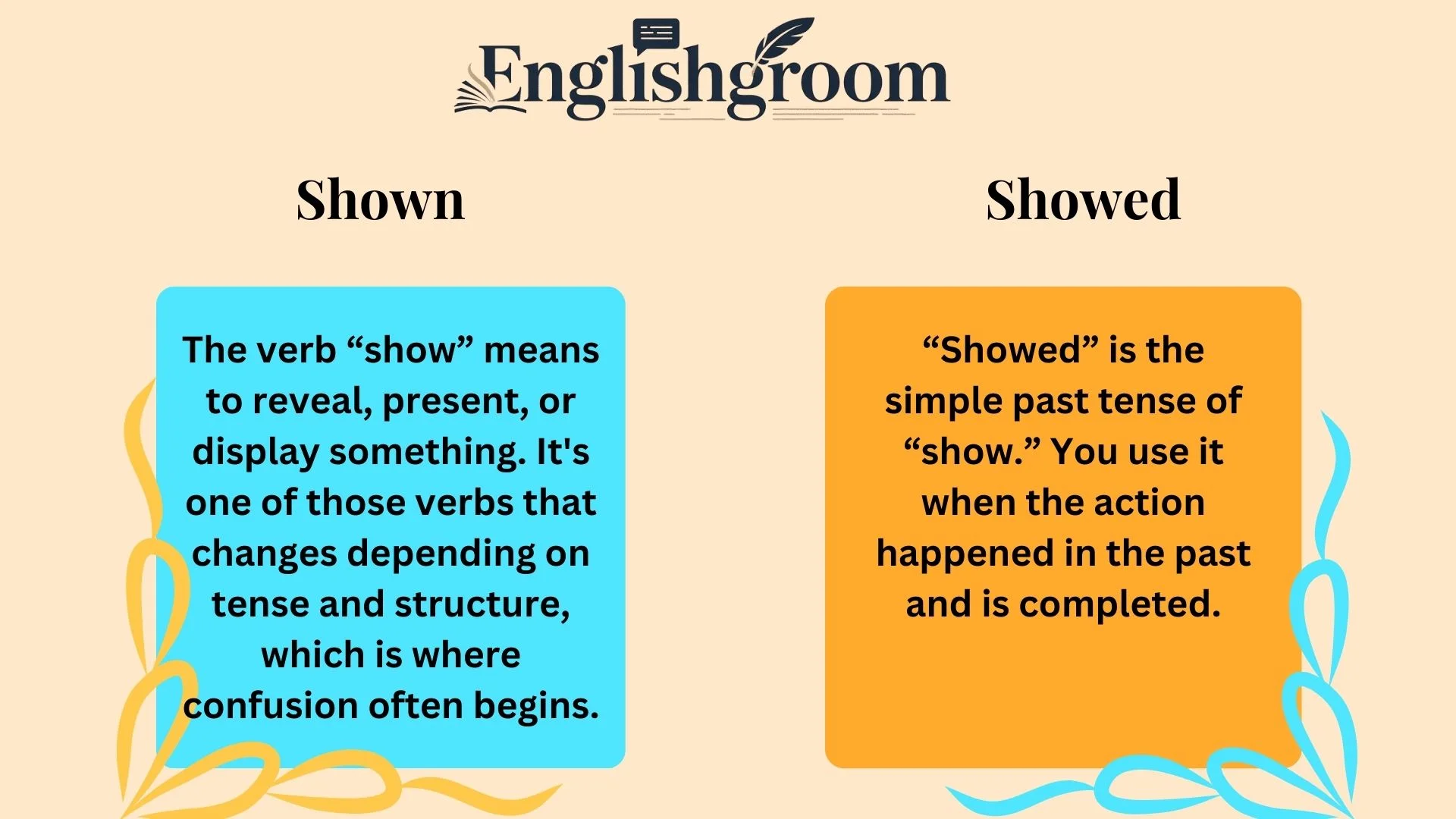
“Showed” is the simple past tense of “show.” You use it when the action happened in the past and is completed.
Examples:
- “Yesterday, I showed my sister the new painting.”
- “He showed courage during the competition.”
- “We showed our tickets before entering the theater.”
Quick Tips:
- No helping verb is needed.
- Use it for actions finished in the past.
- Works well in storytelling: “Last week, I showed my friends the secret hiking trail. They loved it!”
When to Use “Shown”
“Shown” is the past participle, used with helping verbs like have, has, or had. You cannot use “shown” alone as the main verb in the past.
Examples:
- “I have shown you the way before.”
- “The results have been shown to the committee.”
- “She had shown remarkable improvement over the past month.”
Why it matters:
- Perfect tenses show completed actions with relevance to the present or another past moment.
- Using shown correctly makes your writing sound polished and professional.
Side-by-Side Comparison: Shown vs Showed
Here’s a table to make things crystal clear:
| Form | Tense | Example | Key Notes |
|---|---|---|---|
| Showed | Simple Past | “I showed my ticket.” | Completed past action, no helping verb |
| Shown | Past Participle | “I have shown my ticket.” | Requires have/has/had, used in perfect tenses |
Memory Tip:
- Showed = Yesterday (finished past action)
- Shown = Has/Have/Had (needs a helping verb)
Perfect Tenses Made Simple
Perfect tenses often confuse learners because they combine “have” with the past participle. Let’s break them down:
Past Perfect
- Structure: had + shown
- Example: “By the time she arrived, I had shown my artwork to everyone.”
Present Perfect
- Structure: have/has + shown
- Example: “I have shown the report to the manager already.”
Future Perfect
- Structure: will have + shown
- Example: “By next week, we will have shown the new design to the clients.”
Quick Fact:
Using showed in perfect tenses (“I have showed”) sounds awkward and is rarely used in standard English.
“Have Showed” vs “Have Shown”
Many learners ask: “Can I say ‘have showed’ instead of ‘have shown’?”
- ✅ Grammatically, “have showed” exists, but it sounds informal or outdated.
- ✅ “Have shown” is preferred in modern English, especially in professional or academic writing.
Examples:
- Correct: “I have shown my work to the team.”
- Less common: “I have showed my work to the team.”
Tip: Stick with shown when using a helping verb—it will make your English sound natural.
Real-World Usage & Nuances
Spoken vs Written English
- In spoken English, some people use “have showed” casually, but writers prefer “shown.”
- Example: “I’ve shown you the best way.” ✅
“I’ve showed you the best way.” ❌ (sounds less formal)
Formal vs Informal Situations
- Use shown in business emails, academic papers, and presentations.
- Showed is perfect for storytelling, texts, and casual conversations.
Idioms & Phrases
- “As has been shown” – formal, often in research.
- “Showed up” – casual, used in spoken English: “He showed up late again.”
Quick Reference Guide
Here’s a handy cheat sheet:
- Showed: Simple past, finished action, no helping verb.
- Shown: Past participle, requires have/has/had, used in perfect tenses.
- Perfect Tense Rule: Always pair shown with a helping verb.
- Memory Trick: “Showed = Past action,” “Shown = With have/has/had.”
FAQs About Shown vs Showed
Is “showed” ever wrong?
No, it’s correct for simple past actions. Use “showed” when the action is completed in the past.
Can you use “shown” without a helping verb?
No, “shown” always needs have, has, or had to be grammatically correct.
Why does “have showed” sound odd?
Because standard English prefers the past participle “shown” in perfect tenses, making “have shown” the proper form.
Which is more common: “shown” or “showed”?
In perfect tenses and formal writing, “shown” is more common. “Showed” is more common in spoken English for past events.
How can I remember the difference?
Think “Showed = Past,” “Shown = Perfect.” Use the table above as a quick visual cue.
Case Study: Shown vs Showed in Real Sentences
| Sentence | Correct Form | Explanation |
|---|---|---|
| Yesterday, I ___ my new painting. | showed | Simple past, completed action |
| I ___ the report to my manager this morning. | have shown | Present perfect, helping verb needed |
| By the time she arrived, I ___ the documents. | had shown | Past perfect, sequence of events |
| Next week, we ___ the final design to the client. | will have shown | Future perfect, completed action by a future point |
Conclusion
Mastering shown vs showed is easier than it seems. Remember:
- Showed = simple past, no helping verb, finished action.
- Shown = past participle, always with a helping verb, used in perfect tenses.
- Use the cheat sheet, tables, and examples in your writing and speech.
With practice, you’ll never hesitate between these two forms again. Your English will sound natural, fluent, and professional.

Hi! I’m Sami, a 28-year-old content writer with a love for words and storytelling. Writing has always been my way of expressing ideas, sharing knowledge, and connecting with people. I enjoy creating engaging and well-researched content—whether it’s blogs, articles, or social media posts—that not only informs but also inspires readers. My goal is to turn complex ideas into clear, creative, and meaningful pieces of writing that leave a lasting impact.