Last updated on February 19th, 2026 at 09:19 am
English grammar can feel like a puzzle sometimes. Words we hear every day—like has and have—can still trip us up. If you’ve ever paused mid-sentence wondering, “Is it she has or she have?”, you’re not alone.
Let’s clear this up once and for all. By the end of this guide, you’ll not only know the correct answer (spoiler: it’s she has) but also why it’s correct, when “have” can still follow “she,” and how to confidently use both in any context.
Why “She Has or She Have” Confuses So Many People
The confusion stems from subject–verb agreement, one of the most important principles in English grammar. The problem is that both has and have are forms of the same verb — to have. They just appear differently depending on the subject of the sentence.
English learners, especially those from regions where auxiliary verbs are used differently, often mix them up. Plus, informal speech sometimes bends the rules, which makes it harder to know what’s truly correct in formal writing.
Here’s the golden rule:
In standard English, “She has” is always correct. “She have” is never used unless a modal verb comes before it.
Let’s break that down step by step.
The Core Grammar Rule: Subject–Verb Agreement Simplified
Subject–verb agreement means that the verb must match the subject in number and person. In simpler terms:
- Singular subjects use singular verbs.
- Plural subjects use plural verbs.
The verb to have changes depending on whether the subject is singular or plural:
| Subject | Verb Form | Example Sentence |
|---|---|---|
| I | have | I have a new laptop. |
| You | have | You have great taste. |
| He / She / It | has | She has a wonderful smile. |
| We | have | We have plans tonight. |
| They | have | They have arrived. |
Notice the pattern? Only he, she, and it take has in the present tense. Everyone else takes have.
💡 Memory Trick:
“If it’s he, she, or it — use has for it.”
That’s the entire logic behind why she has is correct and she have isn’t.
Breaking Down “Has” and “Have”
Both has and have come from the same root verb — to have. They mean to own, to possess, or to experience something.
The difference lies purely in who or what the sentence talks about.
- Has → Used with he, she, it, and singular nouns.
- Have → Used with I, you, we, they, and plural nouns.
Here’s how that looks:
| Word | Used With | Example |
|---|---|---|
| Has | He, she, it, a name, one item | She has an idea. / The dog has energy. |
| Have | I, you, we, they, plural items | They have ideas. / I have energy. |

So whenever the subject is she, there’s no debate — you use has.
“She Has” — The Correct Form Explained
Now that we’ve established the rule, let’s see it in action.
✅ Correct Forms
- She has a car.
- She has finished her homework.
- She has two sisters.
❌ Incorrect Forms
- She have a car.
- She have finished her homework.
The difference might seem small, but to a native speaker, the wrong form stands out immediately—just like hearing “He go to school every day.” It feels off because it breaks the agreement rule.
Key Point:
In standard English grammar, she have is incorrect unless there’s a modal verb (like should, could, might, etc.) before it.
When “Have” Can Appear After “She” (and Still Be Right)
Here’s where things get interesting.
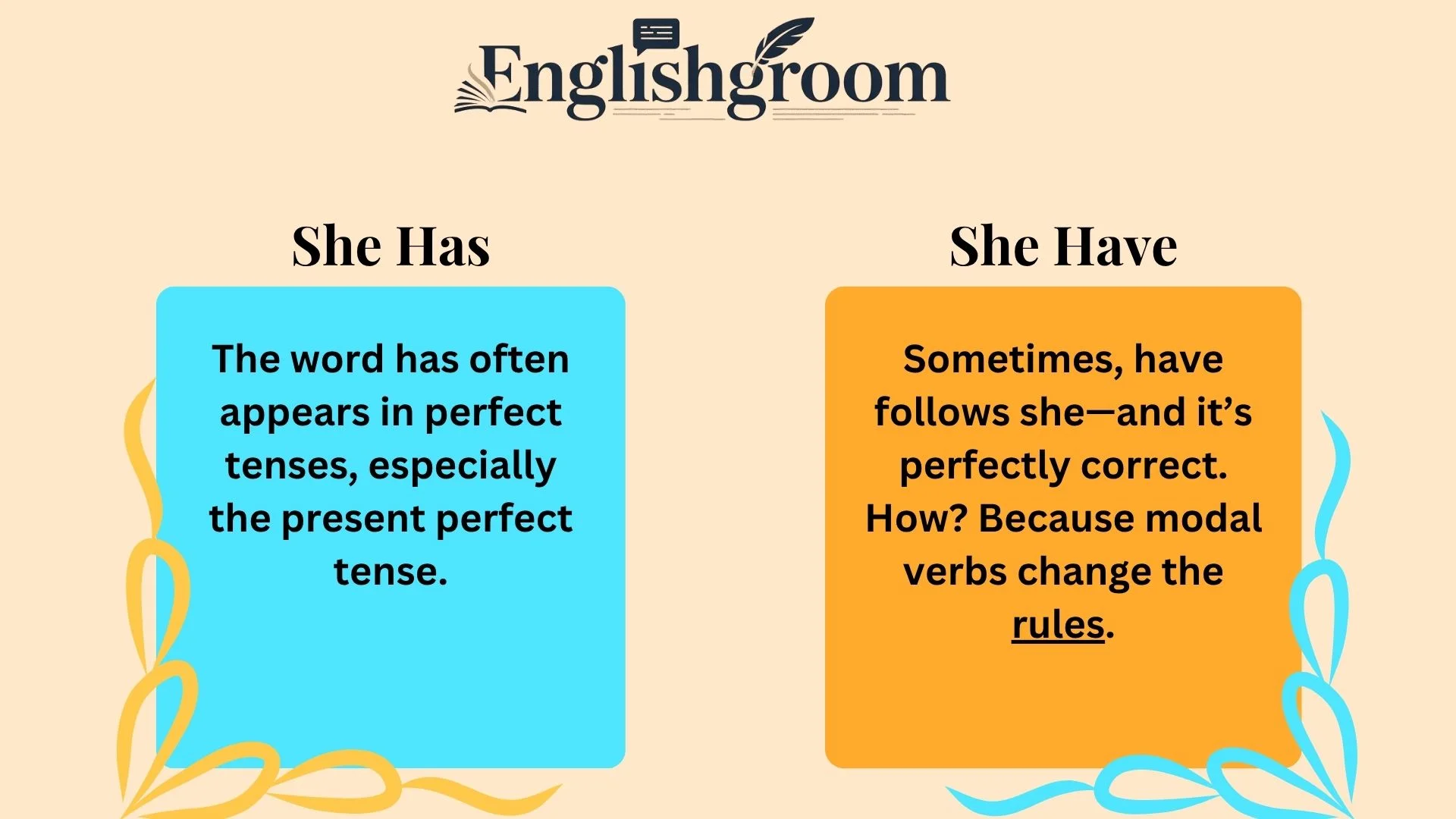
Sometimes, have follows she—and it’s perfectly correct. How? Because modal verbs change the rules.
🔹 What Are Modal Verbs?
Modal verbs are helping verbs that show ability, possibility, necessity, or permission. Common examples: can, could, may, might, must, shall, should, will, would.
When a modal verb comes before have, the verb stays in its base form—no matter what the subject is.
✅ Examples of Correct Usage
- She should have called earlier.
- She might have forgotten her keys.
- She could have been there by now.
- She must have known the truth.
In these sentences, have doesn’t change to has because it’s following a modal verb. That’s a fixed grammar rule.
💬 Quick Tip:
After a modal verb, always use the base form of the verb (have, not has).
Perfect Tenses with “She Has”
The word has often appears in perfect tenses, especially the present perfect tense.
🧩 Present Perfect Formula
has/have + past participle
This tense connects the past to the present — it describes something that began in the past but has relevance now.
| Tense | Formula | Example |
|---|---|---|
| Present Perfect | has/have + past participle | She has finished dinner. |
| Past Perfect | had + past participle | She had finished before they arrived. |
| Future Perfect | will have + past participle | She will have finished by 8 p.m. |
✅ Examples of “She Has” in Perfect Tenses
- She has eaten already.
- She has written a beautiful poem.
- She has traveled to Spain twice.
- She has been here before.
Compare that to plural subjects:
- They have eaten already.
- They have traveled to Spain twice.
Rule Recap:
Use has for singular subjects like she in perfect tenses. Use have for plural subjects.
Common Mistakes and Misunderstandings
Even advanced learners make errors with has and have. Let’s identify and fix the most common ones.
❌ Mistake 1: Using “She have” in simple present tense
- Incorrect: She have many friends.
- Correct: She has many friends.
❌ Mistake 2: Forgetting auxiliary verbs in questions
- Incorrect: Has she work here?
- Correct: Does she work here? / Has she worked here before?
❌ Mistake 3: Mixing tenses
- Incorrect: She has went home.
- Correct: She has gone home.
💡 Pro Tip: Always use the past participle form (not simple past) after has/have in perfect tenses.
Special Cases: Collective Nouns, Names, and Proper Nouns
English has some tricky cases where subject–verb agreement depends on meaning rather than strict number.
🏫 Collective Nouns
Collective nouns (like team, group, family, committee) can be singular or plural, depending on whether you treat the group as one unit or as individuals.
| Sentence | Meaning |
|---|---|
| The team has won the match. | Team as one unit. |
| The team have returned to their homes. | Individual members (British English). |
In American English, we usually treat collective nouns as singular: The team has won.
👩🏫 Names and Proper Nouns
Names follow the same rule as he, she, it if they’re singular.
- Maria has a lovely garden.
- The company has expanded internationally.
- John and Mary have finished their meal.
Idiomatic Expressions and Common Phrases with “Has”
English is full of idioms that use has. Understanding these helps your speech sound natural and fluent.
🌼 Common Expressions
- She has it all together.
- She has no idea.
- She has to go.
- She has her heart set on it.
- She has what it takes.
💬 Quick Note
Even in idioms, the grammar rule doesn’t change—she has remains correct.
Idioms might sound informal, but grammar consistency stays intact.
Quick Tips and Memory Tricks
Keeping track of has vs have doesn’t have to be hard. These quick reminders will make it automatic.
💡 Tips
- If your subject is he, she, it, use has.
- If your subject is I, you, we, they, use have.
- After modal verbs, always use have (not has).
- In perfect tenses, pair has/have with the past participle.
🧠 Mnemonics
- “He, she, it — one person, has fits.”
- “Modals rule — have stays cool.”
Practice Section: Test Your Knowledge
Try these short exercises to check your understanding. Fill in each blank with has or have.
- She ___ a beautiful voice.
- They ___ finished their homework.
- She ___ been studying hard lately.
- She ___ to go now.
- She ___ never seen the ocean before.
- We ___ a big project coming up.
- She ___ what it takes to win.
- They ___ been waiting for hours.
- She ___ left already.
- She ___ to call her mother tonight.
Answers:
- has
- have
- has
- has
- has
- have
- has
- have
- has
- has
Quick Check: If you wrote has for every “she,” you nailed
it!
FAQs
1. Is it correct to say “She have”?
No, it isn’t correct in standard English. You only use she have when a modal verb comes before it (e.g., She should have gone).
2. Why do people say “She have” in some regions?
In some dialects or informal speech (like Caribbean or African English varieties), she have may appear. However, it’s considered nonstandard in formal English writing.
3. What’s the difference between “She has” and “She’s”?
“She’s” can mean “She is” or “She has.”
- She’s happy = She is happy.
- She’s gone home = She has gone home.
Context decides which one applies.
4. Do I say “She has got” or “She have got”?
Always say She has got.
Example: She has got a new job.
(Informal contractions: She’s got a new job.)
5. How do I remember when to use has or have?
Remember this rhyme:
He, she, it — use has for it.
Everyone else — have fits best.
Learn More English With These Best Articles:
Die vs Dice The Definitive Guide to Correct Usage
Aging vs Ageing Understanding the Difference and Using Them Correctly
Appal vs Appall Meaning Usage and the Real Difference Explained
Continuous vs Contious The Real Difference Explained Clearly
What Does Reconnoiter Mean? Definition Usage & Real-World Examples
Conclusion
So, here’s the bottom line:
- ✅ “She has” is always grammatically correct in standard English.
- ❌ “She have” is never correct—unless it follows a modal verb (should, could, might, etc.).
- Always make sure your verb agrees with the subject in both tense and number.
By mastering this simple rule, you’ll avoid one of the most common English grammar errors and sound more natural whether you’re writing essays, speaking in meetings, or crafting social media posts.
“Grammar isn’t about perfection; it’s about clarity.” Once you grasp the logic of subject–verb agreement, English starts to flow effortlessly.
So next time you write or say something like she has an idea, you’ll know you got it absolutely right.

Hi! I’m Sami, a 28-year-old content writer with a love for words and storytelling. Writing has always been my way of expressing ideas, sharing knowledge, and connecting with people. I enjoy creating engaging and well-researched content—whether it’s blogs, articles, or social media posts—that not only informs but also inspires readers. My goal is to turn complex ideas into clear, creative, and meaningful pieces of writing that leave a lasting impact.