Last updated on February 21st, 2026 at 07:00 am
English is tricky — especially when it comes to hyphens. One of the most common questions writers face is this: should you write “reorder” or “re-order”?
At first glance, that tiny hyphen might seem harmless, but it can completely change a word’s meaning, readability, and professionalism. In this guide, you’ll learn exactly when to use reorder (no hyphen) and when re-order (with hyphen) is necessary.
We’ll explore style guides, grammar rules, and real-world examples so you can write confidently and correctly — every single time.
Understanding the Prefix “Re–”
The prefix “re–” means “again” or “back.” You see it in words like redo, rebuild, rewrite, and reorganize.
When added to a base word, “re–” usually forms a new word meaning to do something again:
| Prefix | Base Word | New Word | Meaning |
|---|---|---|---|
| re– | order | reorder | to order again |
| re– | start | restart | to start again |
| re– | write | rewrite | to write again |
| re– | build | rebuild | to build again |
Most of the time, you don’t need a hyphen after “re–”. But English has exceptions — and that’s where confusion starts.
The hyphen appears only when clarity, pronunciation, or meaning demands it. Let’s dig deeper into the rule.
The General Rule: When to Use or Drop the Hyphen
Here’s the simple truth:
In modern English, most “re–” words are written as one word (closed form) without a hyphen.
You only add a hyphen if omitting it changes the word’s meaning or pronunciation.
Common Usage Patterns
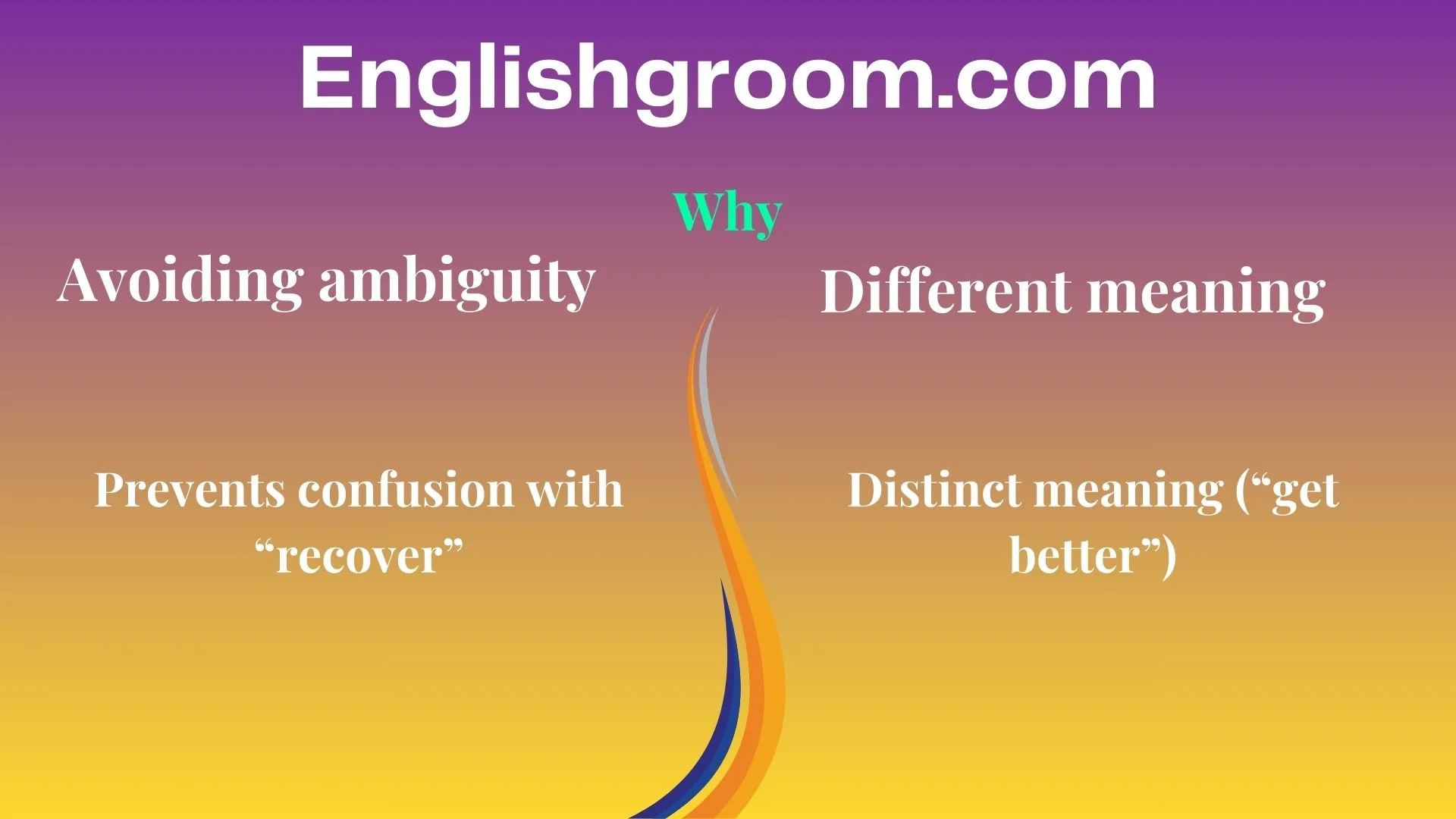
| Situation | Example | Correct Form | Why |
|---|---|---|---|
| Common modern word | reorder | ✅ No hyphen | Clear meaning, widely accepted |
| Avoiding ambiguity | re-cover (cover again) | ✅ Hyphen | Prevents confusion with “recover” |
| Different meaning | recover | 🚫 No hyphen | Distinct meaning (“get better”) |
In short:
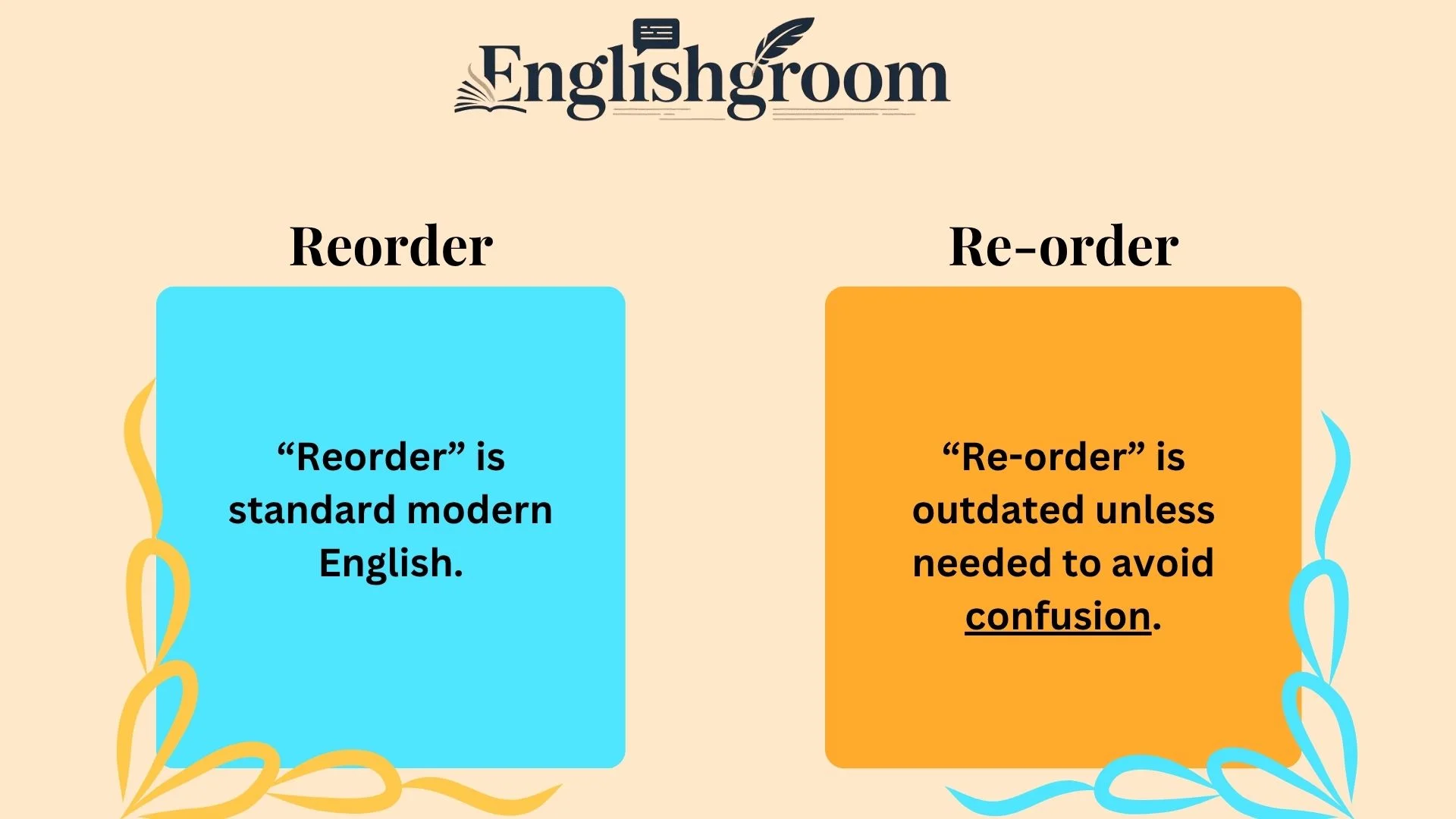
- “Reorder” is standard modern English.
- “Re-order” is outdated unless needed to avoid confusion.
Let’s see what major style guides say about this.
The Role of Style Guides in Hyphenation
Style guides exist to maintain consistency across writing — from newsrooms to publishing houses.
The two most respected English-language style authorities are:
- Associated Press (AP) Stylebook — used by journalists, marketers, and bloggers.
- Chicago Manual of Style (CMOS) — used in publishing, academic writing, and books.
Both provide specific rules on using prefixes like “re–”.
AP Style Guidelines on “Re–” Words
The AP Stylebook has a clear rule:
“Use a hyphen with ‘re–’ only if the word would otherwise be confusing.”
In plain terms — don’t over-hyphenate.
AP Style Examples
| Word | Correct AP Form | Reason |
|---|---|---|
| reorder | ✅ No hyphen | No confusion |
| re-sign | ✅ Hyphen | Prevents confusion with “resign” |
| re-create | ✅ Hyphen | Avoids confusion with “recreate” |
| reopen | 🚫 No hyphen | Clear meaning |
| reelect | 🚫 No hyphen | Pronunciation is obvious |
AP Style prioritizes readability and clarity. So, for everyday writing — marketing, news, blogs — “reorder” is always correct.
Chicago Manual of Style’s Approach
The Chicago Manual of Style (CMOS) generally agrees with AP but adds nuance.
According to CMOS:
“Hyphenate a prefix before a capitalized word, a numeral, or to prevent misreading.”
In other words, CMOS leans toward closed compounds, but with flexibility for readability.
CMOS Examples
| Word | Correct CMOS Form | Why |
|---|---|---|
| reorder | ✅ No hyphen | Standard, clear |
| re-enter | ✅ Hyphen | Prevents awkward double vowels |
| re-form | ✅ Hyphen | Avoids confusion with “reform” |
| re-cover | ✅ Hyphen | Distinguishes from “recover” |
| re-create | ✅ Hyphen | Avoids misreading |
So both AP and CMOS agree — “reorder” stays unhyphenated in nearly every case.
When Hyphenation Is Necessary: The Key Exceptions
Sometimes a hyphen saves you from a total misunderstanding. Let’s look at the main exceptions.
Avoiding Confusion with Other Words
Certain “re–” words form completely new meanings without a hyphen. Adding it clarifies intent.
| With Hyphen | Without Hyphen | Meaning Difference |
|---|---|---|
| re-cover | recover | “Cover again” vs. “get better” |
| re-sign | resign | “Sign again” vs. “quit a job” |
| re-creation | recreation | “Creating again” vs. “leisure activity” |
A single hyphen can change everything. Always double-check words that sound or look similar.
Preventing Misreading or Awkward Pronunciation
If joining the prefix and base word creates double vowels (like reenter, reeducate), add a hyphen.
Without it, the word looks messy and confuses readers.
Examples:
- ✅ re-enter
- ✅ re-educate
- ✅ re-establish
Think of the hyphen as a breathing space — it helps the reader’s eye move smoothly.
Proper Nouns and Numerals
When a prefix like “re–” comes before a proper noun or number, use a hyphen.
Examples:
- re-COVID (referring to pandemic recovery efforts)
- re-2020 plan (a campaign restart from that year)
This prevents awkward capitalization or numeric merging.
Common Mistakes with “Reorder” and Similar Words
Despite clear rules, many writers still trip over “re–” words.
Common Errors
- Over-hyphenating: Writing re-order when it’s not necessary.
- Ignoring context: Using recover when you mean re-cover.
- Inconsistency: Mixing “re-order” and “reorder” in the same piece.
Tips to Avoid Mistakes
- Check the meaning first — does removing the hyphen change interpretation?
- Follow one style guide consistently.
- Use trusted dictionaries like Merriam-Webster or Cambridge to confirm.
- Don’t rely on spell check alone — it often ignores subtle meaning differences.
American vs. British English: Do the Rules Differ?
English isn’t universal. Hyphenation sometimes differs between American and British usage.
American English
- Prefers closed compounds — fewer hyphens overall.
- “Reorder” is the standard spelling across US writing.
- Examples: reopen, reestablish, reelect.
British English
- Tends to keep the hyphen in older or formal terms.
- You might still see re-order, re-enter, or re-educate in UK publications.
- Over time, though, even British usage is shifting toward the American style.
| Word | American English | British English |
|---|---|---|
| reorder | reorder | re-order (also accepted) |
| reenter | reenter or re-enter | re-enter (preferred) |
| reopen | reopen | reopen |
Both are technically correct depending on your audience, but for global communication — “reorder” wins for simplicity.
Hyphenation in Titles and Headings
Writers often wonder if capitalization or title formatting changes hyphen rules. It doesn’t.
AP Style
- Follow normal hyphenation rules.
- Capitalize the first word and any proper nouns.
- Example: Re-enter the Market with Confidence.
CMOS
- Keep rules consistent whether in text or titles.
- Example: Reordering Our Priorities (no hyphen).
In short: title case affects capitalization, not hyphenation.
Practical Tips for Writers and Editors
Hyphenation isn’t just grammar — it’s about reader experience. Misusing it can make text look awkward or even misleading.
Here are practical strategies:
- ✅ Stick to one style guide. Don’t mix AP and CMOS.
- ✅ Trust reputable dictionaries for up-to-date usage.
- ✅ Prioritize clarity over rules when in doubt.
- ✅ Reread aloud. If a word sounds confusing, the reader will stumble too.
- ✅ Keep it consistent throughout your document.
💡 Pro Tip: If you naturally pause between “re” and the base word while speaking, consider adding a hyphen for readability.
Case Study: How a Hyphen Changed Meaning
Scenario: A marketing team wrote an email subject line —
“We’ll help you resign your contract today!”
They meant re-sign (sign again), but without the hyphen, it read as quit your contract.
Result? Several clients misunderstood the offer — and unsubscribed.
Lesson: Never underestimate a hyphen’s power to change meaning. Clarity always beats consistency.
Why “Reorder” Is the Modern Standard
Let’s settle the debate once and for all.
- “Reorder” is accepted by all major dictionaries (Oxford, Cambridge, Merriam-Webster).
- Both AP and CMOS recommend the unhyphenated form.
- It appears in all modern publications, websites, and professional documents.
The hyphenated “re-order” is only correct if you’re following an older British style or trying to emphasize pronunciation in rare cases.
So, unless your editor insists otherwise — “reorder” is always the right choice.
FAQs About “Reorder” vs. “Re-order”
Is “reorder” or “re-order” correct?
Both are technically correct, but “reorder” (no hyphen) is preferred in modern English according to AP and Chicago style guides.
When should I use “re-order”?
Use “re-order” only when needed for clarity or emphasis, such as avoiding misreading in rare contexts or following an older British style.
Does AP Style prefer “reorder” or “re-order”?
AP Style prefers “reorder”. The rule is simple: don’t hyphenate unless confusion exists.
Is “reorder” one word or two?
“Reorder” is one word — a single verb meaning “to order again.”
Are there similar words that require hyphens?
Yes — when the meaning changes without one:
- re-sign (vs. resign)
- re-cover (vs. recover)
- re-create (vs. recreate)
Learn More English With These Best Articles:
Thus Far vs So Far The Clear Guide to Mastering These Common Phrases
Stick a Fork in It Meaning Origins and Modern Use
A Piece of Work Meaning Usage and Cultural Implications
Tortuous vs Torturous The Confusing Pair Explained Simply
Sorry for Bothering You vs Sorry to Bother You The Subtle Difference That Changes Everything
Conclusion
English evolves, and so do its spelling conventions. The safest, cleanest, and most professional form today is “reorder.”
Reserve “re-order” only when clarity or readability absolutely demands it — or when following a specific regional or house style that still uses it.
When in doubt, follow this rule of thumb:
If the meaning doesn’t change, drop the hyphen.
Write naturally, check your sources, and keep your writing simple and reader-friendly. Hyphens are tools, not decorations — use them wisely.

Hi! I’m Sami, a 28-year-old content writer with a love for words and storytelling. Writing has always been my way of expressing ideas, sharing knowledge, and connecting with people. I enjoy creating engaging and well-researched content—whether it’s blogs, articles, or social media posts—that not only informs but also inspires readers. My goal is to turn complex ideas into clear, creative, and meaningful pieces of writing that leave a lasting impact.