Last updated on February 14th, 2026 at 07:24 am
Choosing the right word can make a huge difference in writing, professional communication, and even casual conversation. Many people confuse patron and benefactor, assuming they’re interchangeable.
While both involve support, their meanings, usage, and connotations differ in important ways. This guide will break it all down and give you clear examples, tables, case studies, and expert insights to help you master the distinction.
Language matters. Using patron when you mean benefactor, or vice versa, can misrepresent relationships, the scale of support, or the tone of recognition.
While a patron often implies ongoing, supportive involvement, a benefactor usually conveys significant, sometimes life-changing contributions, often financial.
Understanding the nuances ensures your writing is precise, credible, and contextually accurate.
In this post, you’ll learn:
- The exact definitions of patron and benefactor
- Real-world contexts where each word fits
- How to decide which word to use in your writing
- Common misconceptions to avoid
- Practical case studies and expert quotes
By the end, you’ll confidently choose the right word every time.
Defining “Patron”
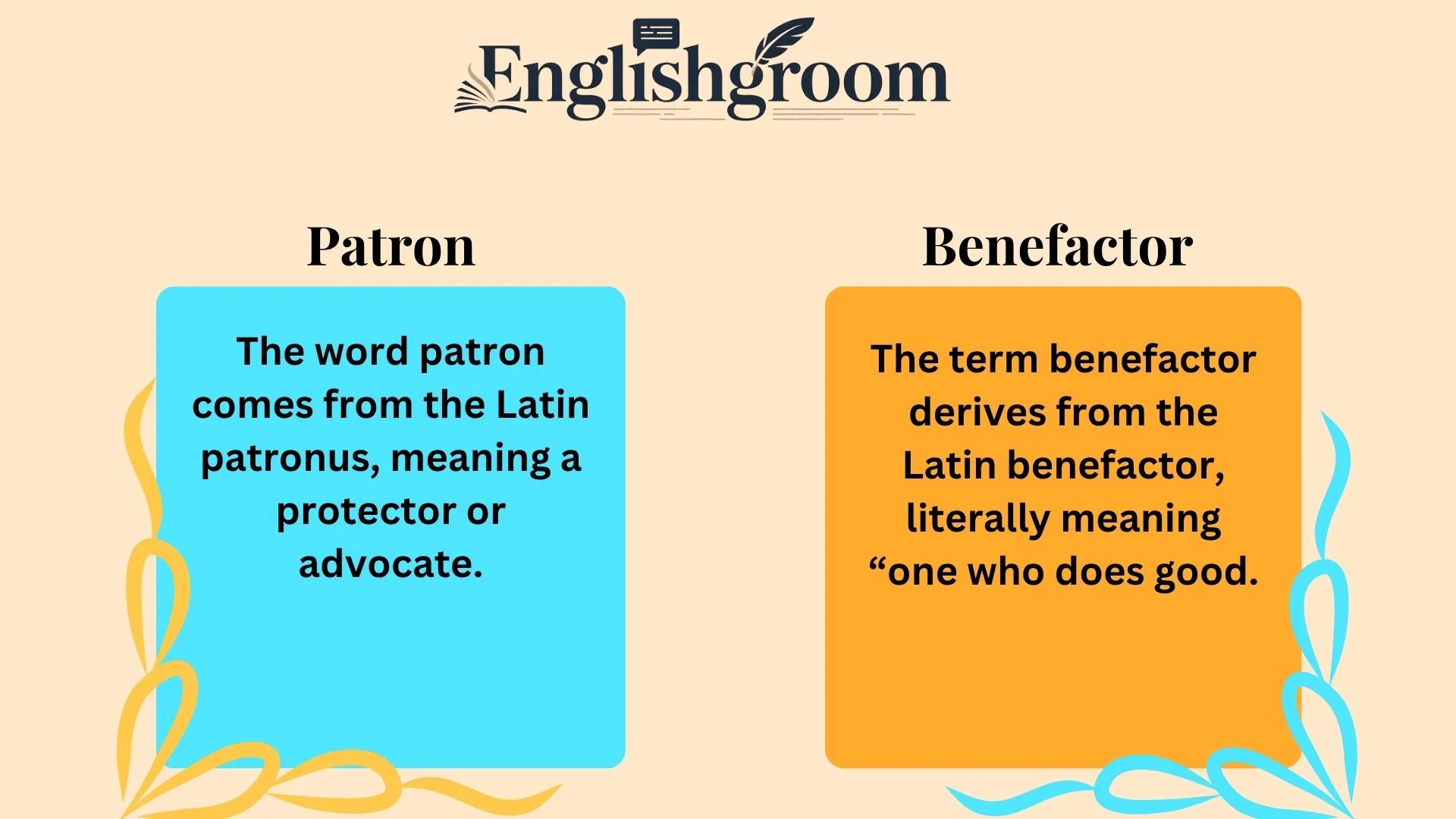
The word patron comes from the Latin patronus, meaning a protector or advocate. Historically, patrons supported artists, writers, and public institutions, providing resources or influence without always being formally recognized.
Modern Usage
Today, a patron is someone who:
- Supports an artist, museum, business, or cause regularly
- Contributes time, money, or advocacy
- May not receive formal recognition
- Often maintains a long-term, loyal relationship
Example sentences:
- “The local museum appreciates its loyal patrons who visit every month.”
- “Artists rely on patrons to fund their exhibitions and projects.”
- “Restaurants honor their patrons with loyalty programs and VIP events.”
Connotation
A patron suggests:
- Ongoing involvement rather than one-time donation
- Personal connection or loyalty
- Subtle recognition, usually informal
Quick Fact: In historical Europe, patrons were crucial to the flourishing of Renaissance art. Without their support, iconic masterpieces might never have existed.
Defining “Benefactor”
The term benefactor derives from the Latin benefactor, literally meaning “one who does good.” Unlike patrons, benefactors typically provide substantial support, often financial, and may be formally recognized for their contribution.
Modern Usage
A benefactor usually:
- Provides large-scale financial or resource support
- Is recognized formally by institutions, such as universities, hospitals, or charitable foundations
- Has influence over the project or initiative due to the size of the contribution
Example sentences:
- “The university named its new library after the generous benefactor who funded its construction.”
- “Hospitals often rely on benefactors to create scholarships or endow research programs.”
- “He acted as a silent benefactor, contributing anonymously to local charities.”
Connotation
A benefactor implies:
- Significant contribution (financial, influential, or otherwise)
- Formal acknowledgment, often public
- A more institutional or serious tone than patron
Quick Fact: Large benefactors like Andrew Carnegie and Bill Gates have funded global education, libraries, and public health initiatives.
Patron vs. Benefactor: Direct Comparison
Understanding the differences is simpler when you see them side by side:

| Feature | Patron | Benefactor |
|---|---|---|
| Origin | Latin patronus | Latin benefactor |
| Scale of Support | Small to moderate, often ongoing | Large, significant, transformative |
| Recognition | Often informal | Usually formal |
| Connotation | Loyalty, advocacy | Generosity, philanthropy |
| Common Contexts | Arts, culture, restaurants, local businesses | Universities, hospitals, charities, foundations |
| Time Frame | Recurring support | Can be one-time or recurring |
Overlap: Some patrons can become benefactors if their contributions increase in size or impact.
Real-World Usage Contexts
Arts & Culture
- Patrons: Regular museum visitors, gallery supporters, arts club members
- Benefactors: Major donors funding exhibitions, art restoration, or galleries
Example:
- A museum may honor a benefactor by naming a wing after them, while a patron might simply enjoy exclusive previews or membership benefits.
Education & Philanthropy
- Benefactors dominate this sphere, often funding scholarships, buildings, or research grants.
- Patrons may participate by attending events, mentoring, or smaller donations.
Example:
- “The Johnson Foundation, a prominent benefactor, funded the university’s new engineering complex.”
- “Alumni who support annually are considered patrons, not benefactors.”
Business & Community Support
- Patrons: Loyal customers who regularly buy or subscribe
- Benefactors: Investors or sponsors who significantly influence operations
Example Table:
| Role | Example Actions | Recognition |
|---|---|---|
| Patron | Membership, repeat visits | Loyalty program |
| Benefactor | Large donations, funding projects | Named acknowledgment, public thanks |
Media & Literature
- Publications often distinguish the two: patron for regular supporters, benefactor for major funders.
- Example: “The theater relies on its patrons for ticket revenue, but its renovation was made possible by a single benefactor.”
How to Choose the Right Word
When writing or speaking, consider:
- Audience: Formal documents may favor benefactor; casual mentions may suit patron.
- Magnitude of Support: Large donations or transformative influence = benefactor. Recurring support or loyalty = patron.
- Tone: Friendly, ongoing support = patron. Formal, substantial generosity = benefactor.
Decision Flowchart:
Is the support ongoing? ──Yes──> Patron
                       ──No──> Is it significant? ──Yes──> Benefactor
                                             ──No──> Patron
Common Misconceptions
- Misconception 1: Patrons always provide money
Fact: Patrons may contribute time, loyalty, or advocacy without financial input. - Misconception 2: Benefactors are only institutions
Fact: Individuals can be benefactors if their contribution is substantial. - Misconception 3: The terms are interchangeable
Fact: Tone, scale, and recognition differentiate them. - Misconception 4: Patrons are less valuable than benefactors
Fact: Both play vital roles; the value depends on context. - Misconception 5: Benefactors always want recognition
Fact: Some prefer anonymity, focusing on impact instead of publicity.
Case Studies
Case Study 1: Museum Patronage
- Scenario: A local museum receives monthly donations from 200 patrons averaging $50 each.
- Impact: Patrons help cover operational costs and attend exclusive previews.
- Benefactor Contribution: A single benefactor donates $500,000 to fund a new wing.
- Lesson: Patrons sustain daily operations; benefactors enable large-scale projects.
Case Study 2: University Benefactors
- Scenario: An alum donates $2 million to create scholarships.
- Impact: Hundreds of students benefit annually, the donor receives formal recognition, and a building is named in their honor.
- Patron Role: Alumni giving $100–$500 annually contribute as patrons, supporting smaller projects and events.
Expert Quote:
“Understanding the distinction between patrons and benefactors is crucial for institutions. Both are invaluable, but their recognition and roles differ significantly.” – Dr. Anne Matthews, Philanthropy Researcher
Expert Opinions & Authority Quotes
- “A patron nurtures a cause; a benefactor transforms it.” – Linguistic Society of America
- “In modern philanthropy, the word benefactor carries legal and formal weight that patrons rarely do.” – Philanthropy Journal

FAQs
What is the main difference between a patron and a benefactor?
A patron offers ongoing support, often smaller or informal; a benefactor provides significant or transformative contributions, usually formally recognized.
Can someone be both a patron and a benefactor?
Yes, if their support grows in magnitude or impact, a patron can become a benefactor.
Are patrons always financial supporters?
No, patrons can support through loyalty, advocacy, or non-monetary contributions.
Do benefactors always want recognition?
Not necessarily. Some prefer to remain anonymous while still contributing significantly.
Which term is better for casual contexts?
“Patron” is more suitable for informal or ongoing support, whereas “benefactor” feels formal and weighty.
Learn More English With These Best Articles:
Unlocking the Power of Verb Roots An In-Depth Guide with Clear Examples
Is Hence Why Grammatically Correct? The Truth About This Common English Mistake
What Does “Deem Fit” Mean? The Complete Guide to This Formal Phrase
“When I Can” vs. “When Can I”: The Ultimate Usage Guide for Fluent English Speakers
“At the House” vs. “In the House”: The Subtle Grammar Rule Everyone Gets Wrong
Conclusion
Choosing between patron and benefactor comes down to understanding nuance, scale, and context. Patrons represent loyalty and recurring support, often quietly sustaining arts, businesses, and institutions.
Benefactors carry weight, offering substantial contributions that transform projects, institutions, or communities.
By grasping these distinctions, you can communicate with clarity, respect, and precision.
Whether writing an acknowledgment, a report, or a casual article, the right word ensures your meaning shines through.

Hi! I’m Sami, a 28-year-old content writer with a love for words and storytelling. Writing has always been my way of expressing ideas, sharing knowledge, and connecting with people. I enjoy creating engaging and well-researched content—whether it’s blogs, articles, or social media posts—that not only informs but also inspires readers. My goal is to turn complex ideas into clear, creative, and meaningful pieces of writing that leave a lasting impact.