
Last updated on February 11th, 2026 at 07:12 am
If you’ve ever paused mid-sentence wondering whether to say passersby, passerbyers, or passerby, you’re not alone.
English has plenty of odd plural forms, but this one tends to trip up even fluent speakers.
Let’s settle the confusion once and for all — with examples, explanations, and grammar insights that make sense.
Why This Confusion Exists
Language evolves. Words blend, meanings shift, and plural forms often follow unpredictable patterns. That’s what makes “passerbyers” seem almost logical — after all, we add “-ers” to words like runner or worker. So why not passerbyer?
Because English doesn’t always play by the same rules.
You might hear someone say:
“A few passerbyers helped push the car.”
It sounds natural in speech, but grammatically, it’s incorrect. To understand why, we need to look at how “passerby” is built.
Understanding the Root Word “Passerby”
The word passerby means a person who happens to be passing by. It’s a compound noun, made up of two parts:
- Passer → someone who passes
- By → a preposition showing movement past something
In other words, a passerby is literally a passer who is by. The compound structure matters because it determines how the plural is formed.
When compound nouns include a preposition like by, in, on, or of, the plural usually attaches to the main noun, not the preposition. Think of it like this:
| Singular | Plural |
|---|---|
| mother-in-law | mothers-in-law |
| attorney general | attorneys general |
| passerby | passersby |
So just like you wouldn’t say mother-in-laws, you shouldn’t say passerbyers.
The Incorrect Form: “Passerbyers”
Let’s address the elephant in the room — or in this case, the passerbyer in the sentence.
Why “passerbyers” is wrong:
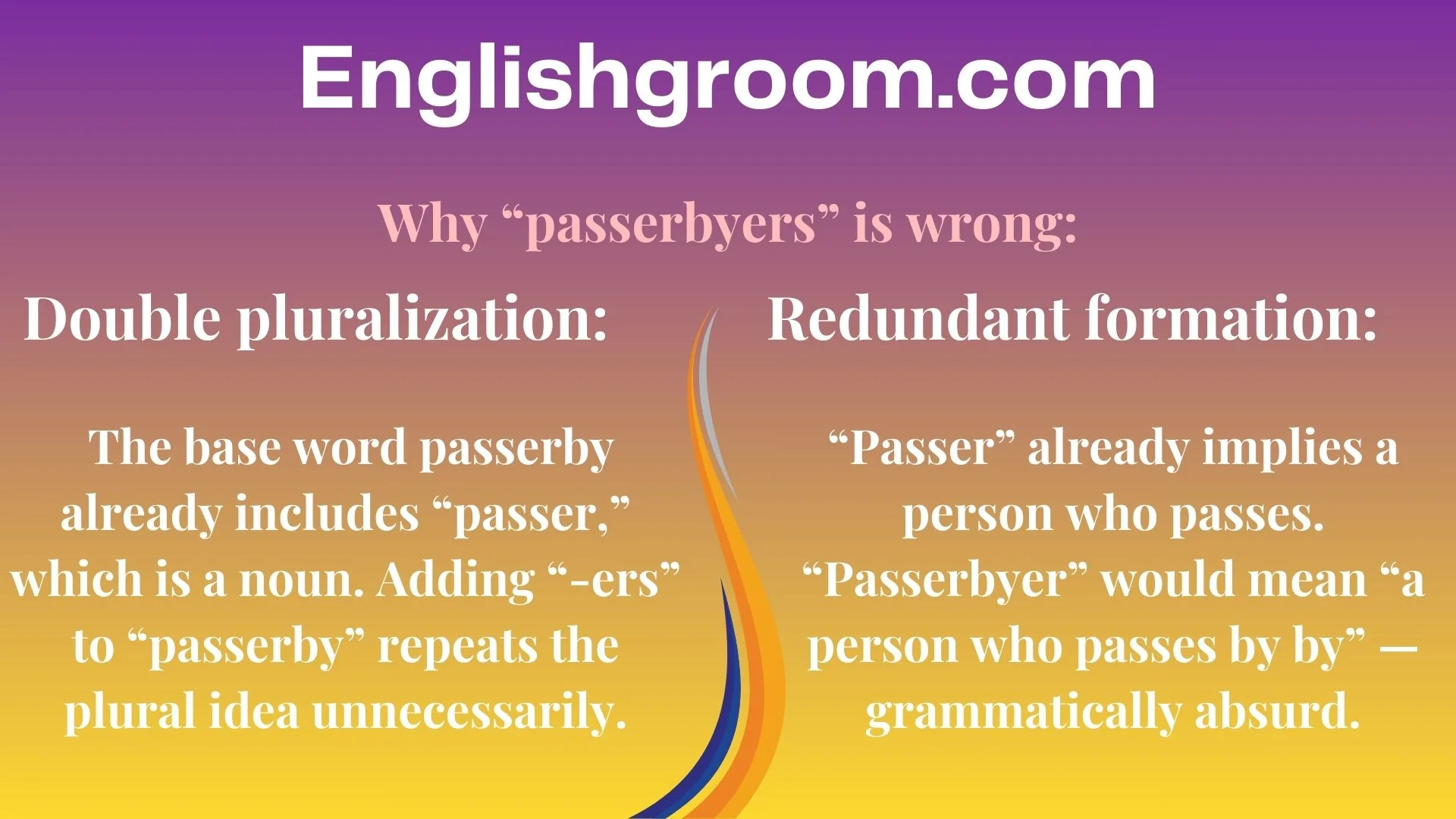
- Double pluralization: The base word passerby already includes “passer,” which is a noun. Adding “-ers” to “passerby” repeats the plural idea unnecessarily.
- Not recognized by dictionaries: No reputable dictionary lists “passerbyers.” You’ll only find passerby and passersby.
- Redundant formation: “Passer” already implies a person who passes. “Passerbyer” would mean “a person who passes by by” — grammatically absurd.
Common Mistake Example
❌ Several passerbyers reported the incident.
✅ Several passersby reported the incident.
This mistake likely arises because “passersby” feels counterintuitive. But the rule stems from older English compound forms.
Correct Plural Form: “Passersby”
Now that we’ve cleared the incorrect form, let’s focus on the correct one — passersby.
Grammar Rule in Action
The plural attaches to the first word — the main noun — rather than the preposition or adverb.
- One passerby walked past.
- Two passersby stopped to help.
It’s the same pattern you see with phrases like:
- Attorneys general, not attorney generals
- Brothers-in-law, not brother-in-laws
English tends to pluralize the core noun that carries the meaning, not the attached prepositions or modifiers.
“Passers-by” vs. “Passersby”: Hyphenation and Style
Here’s where things get interesting. You’ll see both passers-by and passersby in print. So which is right?
Traditional Form: Passers-by
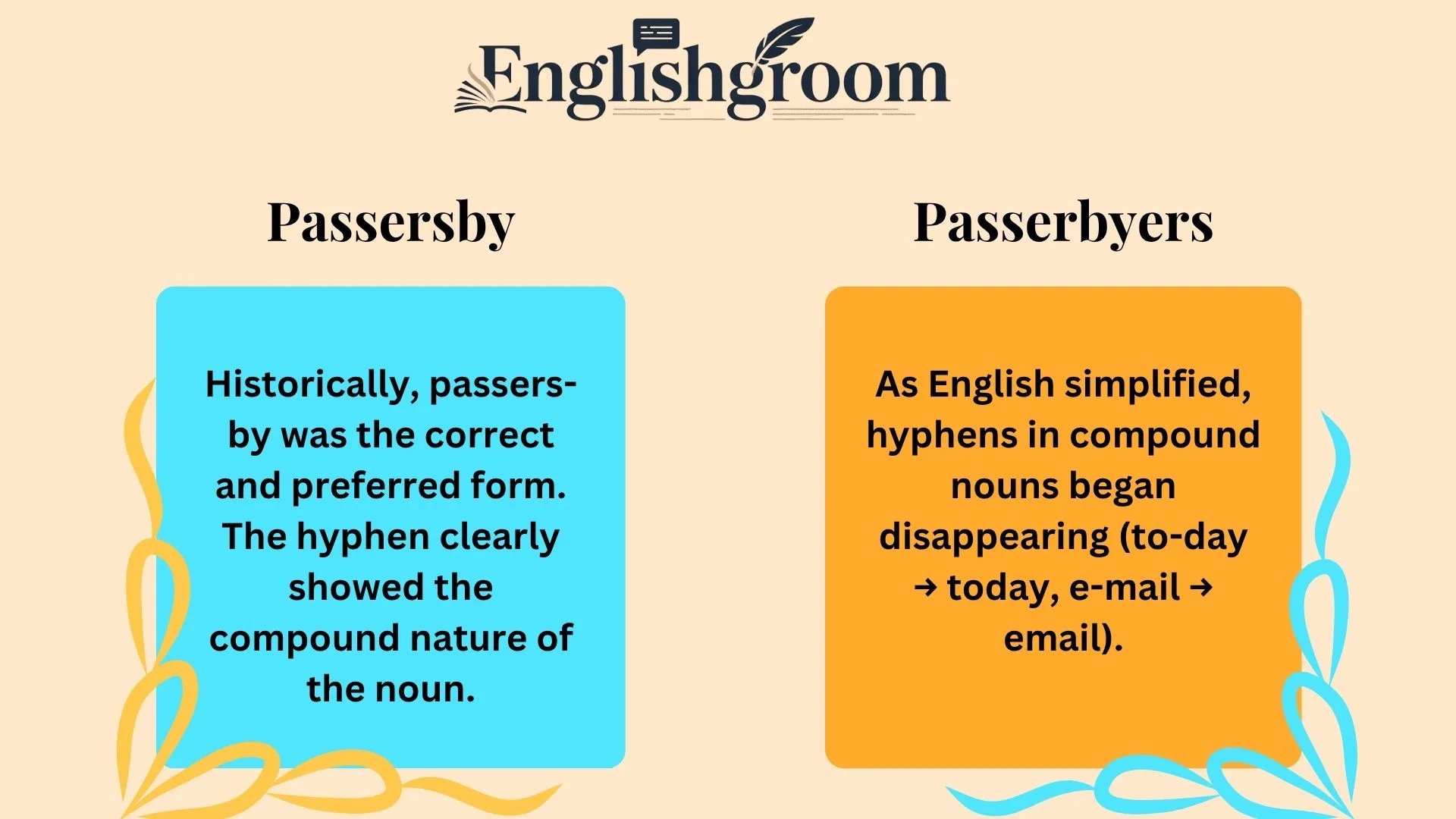
Historically, passers-by was the correct and preferred form. The hyphen clearly showed the compound nature of the noun.
Older style guides like early editions of The Chicago Manual of Style and Oxford English Dictionary favored passers-by.
Modern Form: Passersby
As English simplified, hyphens in compound nouns began disappearing (to-day → today, e-mail → email).
Modern dictionaries, including Merriam-Webster and Cambridge, now list passersby as the primary form.
Example: “Curious passersby gathered around the street artist.”
Style Guide Consensus
| Style Guide | Preferred Form | Notes |
|---|---|---|
| AP Stylebook | passersby | Closed compound |
| Chicago Manual of Style | passersby | Hyphen optional, closed preferred |
| Oxford English Dictionary | passers-by | Traditional form, still valid |
| Merriam-Webster | passersby | Standard modern form |
Recommendation:
Use passersby for all modern writing — it’s cleaner, widely accepted, and aligns with current usage trends.
Real-World Usage and Frequency
To get a sense of how people actually write and speak, linguists often turn to corpus data — collections of real-world text from books, news, and online sources.
According to data from Google Books Ngram Viewer, passersby overtook passers-by in frequency around the mid-20th century. The term “passerbyers” doesn’t appear in reliable linguistic databases at all.
Usage Examples from Publications
- “Several passersby rushed to the scene to help the injured cyclist.” — The Guardian
- “Police interviewed two passersby who witnessed the event.” — The New York Times
- “Artists often capture the fleeting expressions of curious passersby.” — Smithsonian Magazine
The trend is clear: passersby dominates modern English, both in print and speech.
The Evolution of Language and Compound Nouns
Language changes over time, adapting to how people actually use it. Compound nouns are a perfect example of that evolution.
How Compound Nouns Evolve
Originally, English compounds often began with hyphens. Over time, as words became more familiar, they fused into single words.
| Old Form | Modern Form |
|---|---|
| to-day | today |
| web-site | website |
| passers-by | passersby |
Why “Passersby” Stuck
English plural rules for compounds like passersby come from Middle English patterns where modifiers and prepositions stayed fixed while the main noun changed form.
It’s part of what makes English quirky and unpredictable — yet also beautifully flexible.
Fun fact: The first recorded use of passerby dates back to 1568, showing it’s been in the language for centuries!
Common Mistakes to Avoid
Even seasoned writers make errors when pluralizing compound nouns. Here’s how to avoid the most frequent pitfalls:
1. Adding “-ers” to “passerby”
❌ passerbyers
✅ passersby
2. Forgetting the plural in “passersby”
❌ passerby (when referring to multiple people)
✅ passersby (plural)
3. Mixing forms in the same sentence
❌ Several passerby and passers-by were there.
✅ Several passersby were there.
4. Using “passerby” as an adjective
“Passerby” functions as a noun, not an adjective.
❌ The passerby crowd gathered quickly.
✅ A crowd of passersby gathered quickly.
Quick Reference Table: Correct vs. Incorrect Forms
| Word | Correct? | Usage Notes |
|---|---|---|
| passerby | ✅ | Singular; use for one person |
| passersby | ✅ | Standard plural form |
| passers-by | ✅ | Acceptable but less common |
| passerbyers | ❌ | Incorrect; not a real word |
Case Study: How “Passersby” Appears in Modern Writing
To see this word in real action, let’s analyze examples from various contexts:
1. Journalism
“Passersby alerted the authorities after noticing smoke rising from the building.”
Here, passersby describes bystanders — ordinary people, not officials.
2. Literature
“She smiled at the passersby, hoping someone would return her warmth.”
Writers often use it to describe fleeting, anonymous encounters that add realism.
3. Marketing & Advertising
“Our window displays attract curious passersby every weekend.”
Brands use it to describe potential customers drawn in by visual appeal.
Insight:
The term fits naturally in storytelling, news, and even commercial contexts — one more reason why “passersby” has endured while “passerbyers” never took hold.
Language Tip: How to Remember It
If “passersby” still feels awkward, here’s a simple trick:
Rule of Thumb:
The people (passers) move; the preposition (by) stays.
So the “s” belongs to passers, not to “by.”
FAQs
Is “passerbyers” ever acceptable in informal speech?
No. While some people might use it casually, it’s grammatically incorrect. Stick to passersby even in casual writing.
Is “passers-by” still correct?
Yes. It’s still acceptable, especially in British English or formal writing. But passersby is the modern standard.
How do you pronounce “passersby”?
It’s pronounced /ˈpæsərz baɪ/ — the same as saying passers + by.
What’s the plural of “standby”?
Different compounds have different rules. The plural of standby is standbys, not standsby. Always check the head word.
Why does English pluralize this way?
Because “passerby” follows a historic compound structure. English inherited these irregular plural rules from older forms of the language.
Final Thoughts
English can be full of traps, and passerby is one of them. But now you know the rule:
One passerby, many passersby. Never passerbyers.
Language evolves, but clarity never goes out of style. Whether you’re writing fiction, news, or social posts, using the correct plural adds polish to your writing — and shows mastery of one of English’s most curious quirks.

Hi! I’m Sami, a 28-year-old content writer with a love for words and storytelling. Writing has always been my way of expressing ideas, sharing knowledge, and connecting with people. I enjoy creating engaging and well-researched content—whether it’s blogs, articles, or social media posts—that not only informs but also inspires readers. My goal is to turn complex ideas into clear, creative, and meaningful pieces of writing that leave a lasting impact.