English has a funny way of tripping people up.
You know the rules. Then a phrase like “on Tuesday morning” sneaks in and suddenly everything feels shaky.
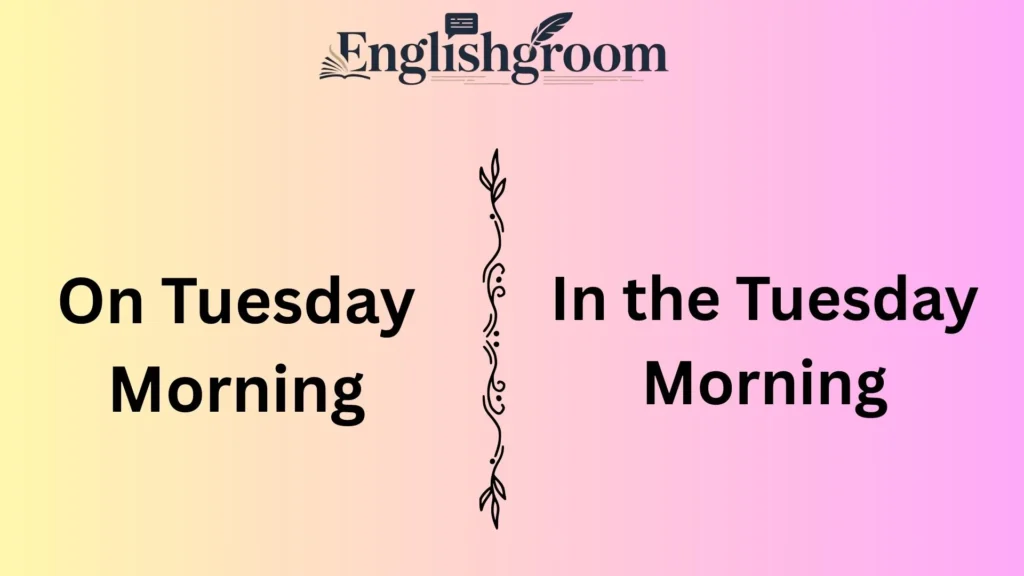
Is it on Tuesday morning?
Could it be in the Tuesday morning?
Why does one sound right while the other sounds… off?
If you’ve ever paused mid-sentence to second-guess yourself, you’re not alone.
This guide breaks it all down in plain English. No fluff.
No theory overload. Just real rules, real examples, and explanations that actually stick.
By the end, you won’t hesitate again.
The Real Question Behind “On Tuesday Morning”
Most people aren’t confused about Tuesday.
They aren’t confused about morning either.
The confusion starts when English asks you to combine a day and a part of the day. That’s where instinct fails and overthinking begins.
Here’s the core issue:
English treats “Tuesday morning” as one complete unit of time, not two separate ideas.
Once you understand that, everything else clicks into place.
How English Really Handles Time Expressions
English uses three main prepositions of time:
| Preposition | Used For | Examples |
|---|---|---|
| At | Exact points in time | at 7 a.m., at noon |
| On | Specific days and dates | on Tuesday, on July 4 |
| In | General periods | in the morning, in July, in 2026 |
Sounds simple, right?
The problem appears when categories overlap.
Where does “Tuesday morning” belong?
It belongs to specific time, not general time.
Even though morning feels broad, the moment you attach Tuesday, the phrase becomes precise. English responds by using on, not in.

Why “On Tuesday Morning” Is Correct
“On Tuesday morning” follows the same logic as:
- on Monday night
- on Friday afternoon
- on Sunday evening
In all these cases, the day controls the preposition.
Why this works grammatically
- “Tuesday morning” functions as a single time expression
- English uses on for named days
- Native speakers hear it as one block of time
Real-life examples
The meeting is scheduled on Tuesday morning.
I felt better on Tuesday morning after resting.
She called me on Tuesday morning before work.
Nothing feels forced. Nothing feels academic. That’s how you know it’s right.
Why “In the Tuesday Morning” Sounds Wrong
This phrase doesn’t just break a rule.
It breaks how English sounds.
What goes wrong here
- In is for general time periods
- The adds unnecessary specificity
- The phrase fights against natural rhythm
Native speakers never say this casually. When they hear it, it signals a learner error instantly.
Why learners make this mistake
- Direct translation from other languages
- Overgeneralizing “in the morning”
- Assuming articles improve accuracy
In this case, they do the opposite.
Is “In Tuesday Morning” Ever Correct?
Short answer? No.
Removing the doesn’t solve the issue.
The problem isn’t the article. It’s the preposition.
Why it still fails
- “Tuesday” makes the time specific
- In doesn’t pair with specific days
- Native speakers never use it
You might see it in student writing.
You won’t hear it in real conversation.
What About “In the Morning of Tuesday”?
This one is interesting.
Yes, it can be grammatically correct.
No, it’s not what people normally say.
When it works
- Formal writing
- Historical accounts
- Legal or literary contexts
In the morning of Tuesday, the council convened.
That sentence works.
It also sounds stiff.
Why it’s usually a bad choice
- Longer than necessary
- Unnatural in speech
- Easily replaced by “on Tuesday morning”
If clarity and fluency matter, keep it simple.
Why “At Tuesday Morning” Doesn’t Work
At has one job: precision.
It works with:
- at 6 a.m.
- at sunrise
- at midnight
But morning isn’t precise enough.
❌ at Tuesday morning
✅ at 8 a.m. on Tuesday morning
That’s the difference.
The One Rule That Prevents All These Mistakes
Here’s the rule that saves time and sanity:
If a time expression includes a specific day, use “on.”
That’s it.
No charts needed.
No exceptions worth memorizing.
Quick decision test
Ask yourself:
- Is a named day present?
- Yes → on
- No → consider in or at
Common Mistakes and Clean Fixes
Mistake patterns
- Overusing in with days
- Adding the unnecessarily
- Translating directly from native language
Quick fixes table
| Incorrect | Correct |
|---|---|
| in the Tuesday morning | on Tuesday morning |
| in Tuesday morning | on Tuesday morning |
| at Tuesday morning | on Tuesday morning |
| in the morning of Tuesday | on Tuesday morning (preferred) |
Simple changes. Big improvement.
Real-World Examples in Context
Professional setting
The presentation will begin on Tuesday morning at 9 a.m.
Casual conversation
I felt exhausted on Tuesday morning after the trip.
Planning and scheduling
Let’s meet on Tuesday morning before lunch.
Storytelling
On Tuesday morning, everything finally changed.
This is how native English flows.
No awkward pauses. No second-guessing.
On Tuesday vs. On Tuesday Morning
Both are correct.
They don’t mean the same thing.
Key difference
- On Tuesday → the whole day
- On Tuesday morning → a specific part of that day
Example
I called him on Tuesday.
(Any time that day.)
I called him on Tuesday morning.
(Early hours only.)
Precision changes meaning.
That’s why this distinction matters.
Fast Grammar Recap
- Correct: on Tuesday morning
- Incorrect: in the Tuesday morning
- Rare but grammatical: in the morning of Tuesday
- Rule: named day = on
Lock that in and move on.
FAQs Before the Conclusion
### Is “on Tuesday morning” always correct?
Yes. It’s the standard and most natural form in modern English.
### Why is “in the Tuesday morning” wrong?
Because in doesn’t work with specific days, and the adds unnecessary specificity.
### Can I ever say “in Tuesday morning”?
No. Native speakers don’t use it.
### Is “in the morning of Tuesday” outdated?
Not outdated, but formal and rarely used in speech.
### Why don’t native speakers debate this phrase?
Because it follows instinctive time-preposition patterns learned through use.
Final Takeaway
If you remember one thing, remember this:
When a sentence includes a specific day and a part of the day, use “on.”
On Tuesday morning is correct.
In the Tuesday morning isn’t.
Once you stop separating the words and start treating them as a single unit, English suddenly feels easier. Like it should.

Hi! I’m Sami, a 28-year-old content writer with a love for words and storytelling. Writing has always been my way of expressing ideas, sharing knowledge, and connecting with people. I enjoy creating engaging and well-researched content—whether it’s blogs, articles, or social media posts—that not only informs but also inspires readers. My goal is to turn complex ideas into clear, creative, and meaningful pieces of writing that leave a lasting impact.