It’s easy to confuse marquee and marquis. They look almost identical, and sometimes, they even sound alike. But their meanings couldn’t be more different.
One belongs to theaters, tents, and major events — the other to nobility, castles, and centuries of aristocratic history.
Let’s clear up the confusion once and for all.
Why People Mix Up “Marquee” and “Marquis”
English borrows heavily from French. Over centuries, spelling and pronunciation changes blurred the lines between words that once sounded distinct.
Both marquee and marquis came from the French word “marquise”, but they evolved separately. Today, they differ by context, pronunciation, and usage — yet their visual similarity keeps tripping up even fluent speakers.
If you’ve ever hesitated mid-sentence, wondering whether to use marquee or marquis, you’re in the right place.
What Is a Marquee? Modern and Historical Meanings
Definition of Marquee
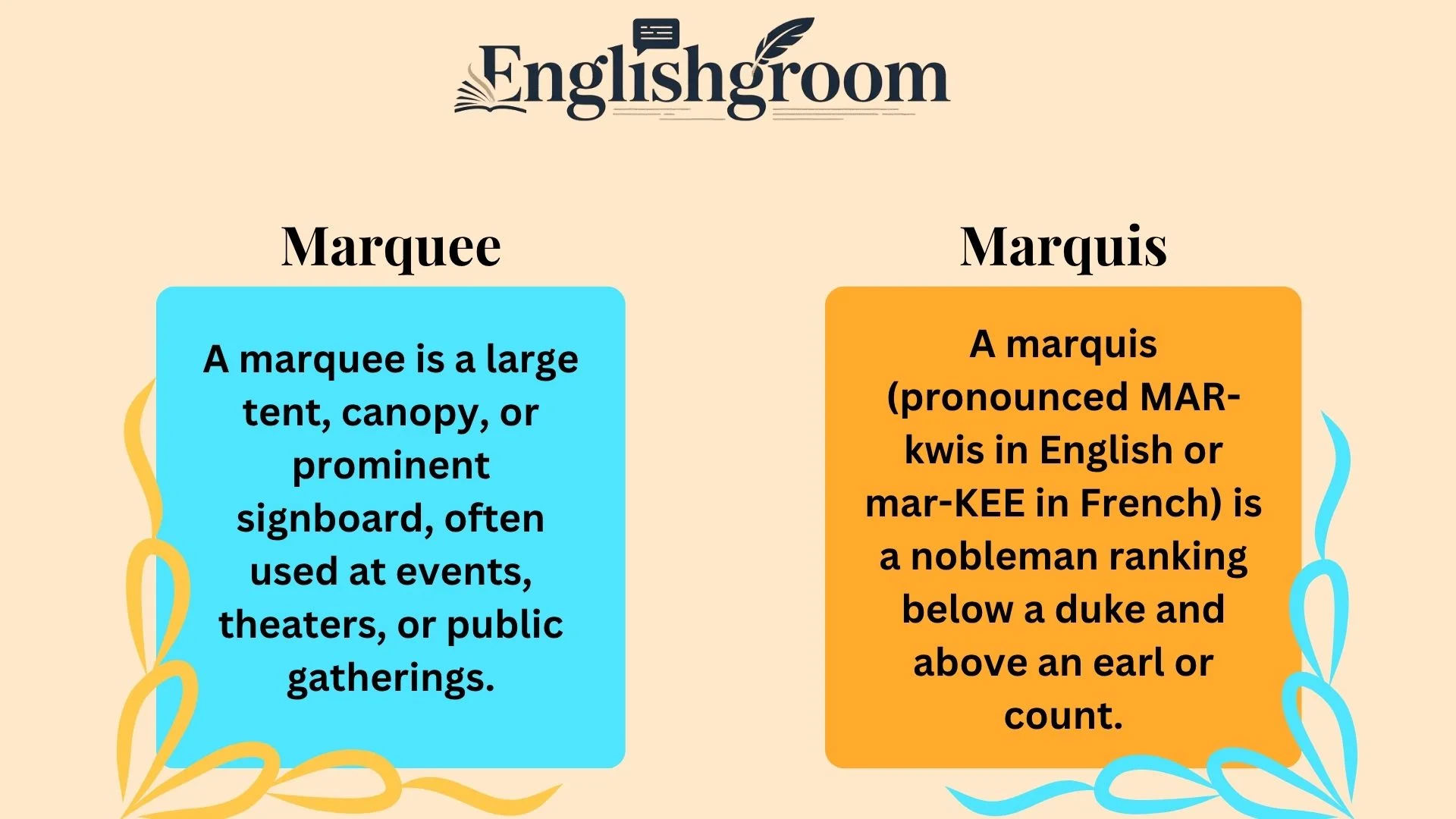
A marquee is a large tent, canopy, or prominent signboard, often used at events, theaters, or public gatherings.
In British English, it usually means a tent set up for social events like weddings or festivals.
In American English, it often refers to a theater signboard or something that’s famous and high-profile, as in a “marquee event” or a “marquee player.”
Here’s how dictionaries frame it:
Marquee (noun): a large tent for outdoor events or a sign above a theater or venue showing its name or attractions.
Etymology
The word marquee comes from the French marquise, meaning a kind of canopy over a door. When English adopted it in the 17th century, it evolved to describe both protective canopies and large tents.
Marquee in British English
In the UK, the word marquee almost always refers to a tent or temporary structure. You’ll hear it in phrases like:
- They held their reception in a marquee by the river.
- The charity event took place under a massive white marquee.
Common British uses:
- Wedding marquee: Elegant tents for receptions and ceremonies.
- Festival marquee: Covered stages or refreshment areas at music or cultural events.
- Corporate marquee: Branded tents used for trade shows or fairs.
Fun fact: Marquee hire is a booming business across the UK, generating millions annually during wedding season.
Marquee in North American English
In the U.S. and Canada, marquee means something quite different. It usually refers to a large sign or billboard above a theater entrance, displaying the name of a movie or performance.
The movie title “Casablanca” once glowed in bright lights across the Broadway marquee.
From there, marquee took on a figurative sense — describing anything prestigious, high-profile, or attention-grabbing.
Examples:
- The Super Bowl is a marquee sporting event.
- Tom Brady was a marquee player for the Patriots.
- The company hosted a marquee conference for investors.
This figurative usage reflects prominence, fame, and prestige — ideas once associated with the flashing lights of theater signs.
Real-Life Examples of Marquee Usage
| Context | Example Sentence | Meaning |
|---|---|---|
| Event | Guests danced under a beautifully lit wedding marquee. | Tent or canopy |
| Theater | The play’s title glowed across the Broadway marquee. | Theater signage |
| Figurative | She’s one of the company’s marquee speakers. | High-profile or prominent |
What Is a Marquis? Rank, Nobility, and Heritage
Definition of Marquis
A marquis (pronounced MAR-kwis in English or mar-KEE in French) is a nobleman ranking below a duke and above an earl or count.
This title originated in medieval Europe, where marquises (or marchers) ruled frontier territories — hence the connection to “march,” meaning borderland.
Marquis (noun): a hereditary nobleman of high rank, traditionally governing border territories in Europe.
Historical Context and Cultural Relevance
During feudal times, marquises were lords of border regions, responsible for defending their territories from invasion. Their strategic importance gave them status just below dukes.
Notable historical marquises:
- Marquis de Lafayette – French aristocrat and hero of the American Revolution.
- Marquis de Sade – Controversial French writer known for his libertine philosophy.
- Marquis of Queensberry – Famous for the “Queensberry Rules,” the foundation of modern boxing.
Even today, the title persists in aristocratic circles, especially in the UK, France, and Spain, although mostly as a ceremonial or honorary rank.
Marquis vs. Marquess: Regional Variations
Both words describe the same rank, but region determines spelling.
| Region | Preferred Term | Pronunciation | Example |
|---|---|---|---|
| United Kingdom | Marquess | MAR-kwis | The Marquess of Bath hosted the royal visit. |
| France & Other Europe | Marquis | mar-KEE | The Marquis de Lafayette fought in the American Revolution. |
The British “marquess” emphasizes English orthography, while “marquis” retains its French form.
Their female counterpart is the marchioness (MAR-shuh-ness), or marquise in French.
Examples of Marquis in Context
- The Marquis de Lafayette played a pivotal role in securing French aid for the American colonies.
- The British marquess ranks below a duke but above an earl.
- A marquise diamond ring features an oval shape with pointed ends — named for a noblewoman’s smile.
Marquee vs. Marquis: How to Tell Them Apart Instantly
Despite their similar spellings, these two words come from different social worlds — one festive, the other aristocratic.
Key Spelling and Pronunciation Differences
| Word | Pronunciation | Meaning | Common Context |
|---|---|---|---|
| Marquee | mar-KEE | Large tent or theater sign | Events, signage, entertainment |
| Marquis | MAR-kwis (Eng.) / mar-KEE (Fr.) | Noble title | History, nobility |
Quick Tip:
If you’re reading about events, sports, or theaters, you want marquee.
If you’re reading about lords, royalty, or titles, it’s marquis.
Context Clues That Reveal the Correct Word
- Talks about parties, weddings, or tents → marquee
- Mentions dukes, titles, or European nobility → marquis
- Describes prestige or high status (figuratively) → marquee event
Memory Tricks
- Double E → Event → marquee
- IS → Important Status → marquis
Common Mistakes and How to Avoid Them
Even experienced writers mix these two up. Here are typical pitfalls and how to sidestep them.
Mistake 1:
They hosted the gala in a marquis on the lawn.
✅ Correction: They hosted the gala in a marquee on the lawn.
Mistake 2:
He was titled Marquee de Lafayette.
✅ Correction: He was titled Marquis de Lafayette.
Mistake 3:
The company’s marquis speaker will headline the event.
✅ Correction: The company’s marquee speaker will headline the event.
How to Avoid Them:
- Visualize the setting: If it’s a tent or event, it’s marquee.
- Think of titles: If it’s historical or noble, it’s marquis.
- Remember usage regions: American → marquee (signs/events); British/French → marquis (titles).
Usage in Modern Writing and Media
In modern usage, marquee appears far more frequently than marquis.
The former has expanded metaphorically; the latter remains mostly historical.
Examples in Media:
- ESPN often calls top athletes marquee players.
- Film festivals highlight marquee premieres for big-budget films.
- Newspapers describe headline concerts as marquee events.
In contrast, marquis appears mainly in historical texts, biographies, and fiction. Unless you’re writing about European nobility, marquis will rarely appear in contemporary writing.
Summary: The Quick-Reference Takeaway
| Term | Origin | Modern Use | Example |
|---|---|---|---|
| Marquee | From French marquise (canopy) | Event tent, theater sign, high-profile metaphor | A marquee concert drew thousands. |
| Marquis | From French marchis (lord of the border) | Noble rank, historical title | The Marquis led his troops across the frontier. |
In short:
- Marquee = Events, entertainment, or prestige
- Marquis = Nobility and history
Practical Tips for Writers and Communicators
- Check context: Is the sentence about events or titles?
- Use pronunciation tools: For audio learners, hearing “marquee” (mar-KEE) vs. “marquis” (MAR-kwis) helps reinforce memory.
- Proofread intentionally: These two words pass spellcheck — you must catch the context yourself.
- Practice with examples:
- He rented a marquee for the outdoor gala.
- The Marquis de Sade was known for his radical writings.
- Bookmark a style guide: Sources like Merriam-Webster or Oxford Dictionaries clarify regional preferences.
Frequently Asked Questions (FAQs)
What’s the difference between Marquee and Marquis?
Marquee refers to a tent or a sign for events, while Marquis is a title of nobility. The former is modern and practical; the latter is historical and aristocratic.
Is Marquis pronounced the same as Marquee?
Not always. In French, both sound like mar-KEE, but in English, marquis is pronounced MAR-kwis while marquee remains mar-KEE.
Is Marquee British or American?
Both use it, but with different meanings. In British English, it means a tent. In American English, it means a theater sign or headline event.
What is the female equivalent of Marquis?
In French, it’s Marquise. In British peerage, the feminine form is Marchioness.
How can I remember the difference easily?
Think “Double E for Event” — that’s marquee.
And “IS for Important Status” — that’s marquis.
Learn More English With These Best Articles:
Ingrained or Engrained? Which One’s Right and Why It Matters
Attain vs Obtain The Subtle Difference Most People Miss
Thus Far vs So Far The Clear Guide to Mastering These Common Phrases
Gluing or Glueing Which Spelling Sticks the Right Way?
A Chip off the Old Block Meaning Origin & Modern Significance
Final Thoughts
Words like marquee and marquis reveal how English evolves, absorbing meanings and reshaping them across cultures. What began as one French root branched into two entirely different worlds — one of celebration and spectacle, the other of heritage and hierarchy.
The next time you see a glowing theater sign or read about a noble title, you’ll know exactly which word to use. Precision isn’t just good grammar — it’s good communication.

Hi! I’m Sami, a 28-year-old content writer with a love for words and storytelling. Writing has always been my way of expressing ideas, sharing knowledge, and connecting with people. I enjoy creating engaging and well-researched content—whether it’s blogs, articles, or social media posts—that not only informs but also inspires readers. My goal is to turn complex ideas into clear, creative, and meaningful pieces of writing that leave a lasting impact.