Last updated on January 29th, 2026 at 08:41 am
English loves to trip people up with tiny words that carry big meaning. Few pairs cause as much confusion as “its self” and “itself.” You’ve seen both online or maybe even written the wrong one once or twice. Don’t worry — you’re far from alone.
This guide will make sure you’ll never mix them up again. You’ll learn what each term means, when to use them, how context can shift meaning, and why only one of them is almost always right.
Quick Answer: Which Is Correct — “Its Self” or “Itself”?
The short answer: “Itself” is correct in 99.9% of situations.
“Its self” is technically possible but extremely rare and used only in philosophical or poetic contexts.
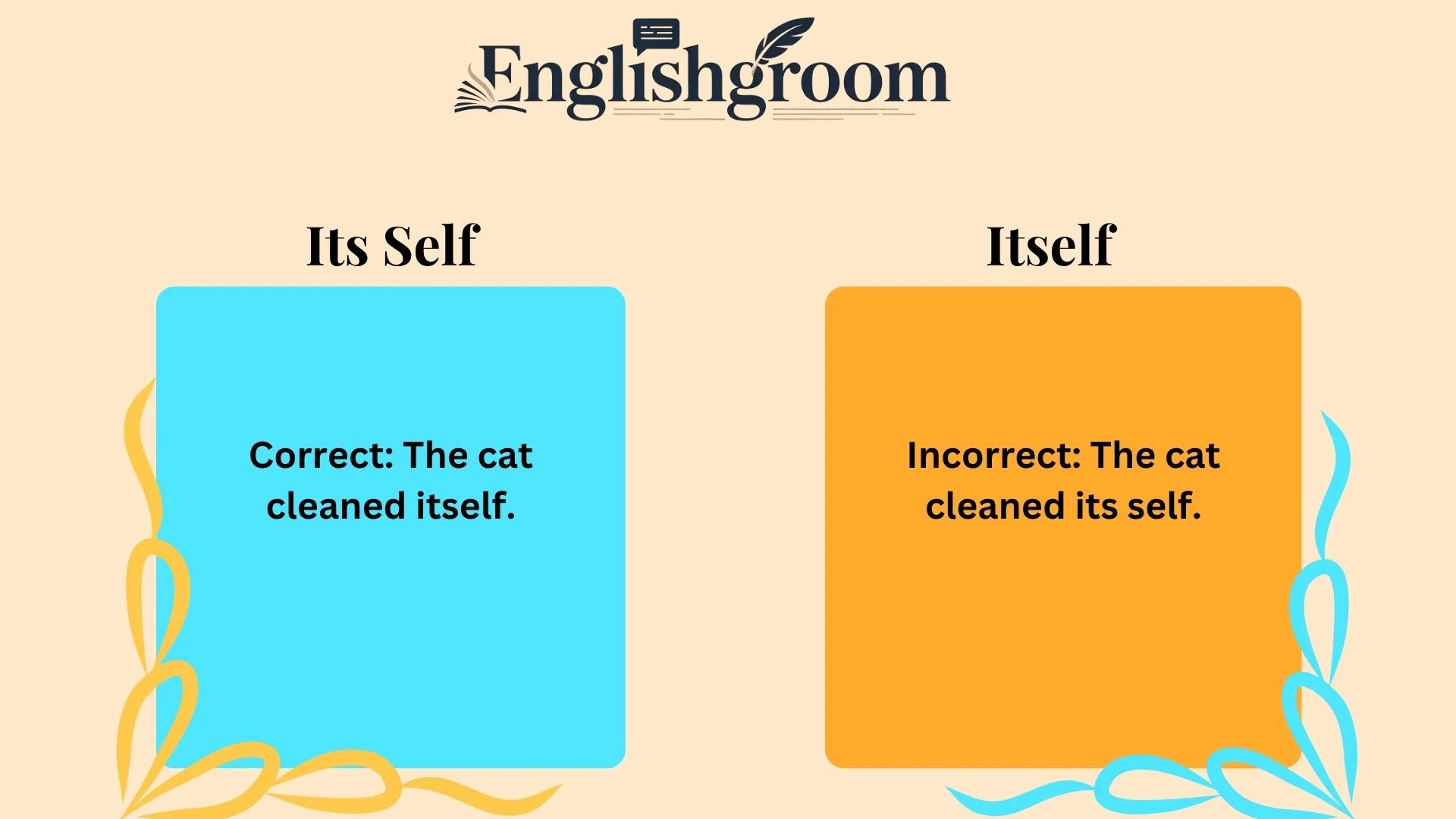
✅ Correct: The cat cleaned itself.
❌ Incorrect: The cat cleaned its self.
So why does “its self” even exist? Let’s dig deeper.
At a Glance: Comparison Table

| Term | Type | Meaning | Common Usage | Example Sentence |
|---|---|---|---|---|
| Itself | Reflexive pronoun | Refers back to it (used when the subject and object are the same) | Common, correct | The computer shut itself down. |
| Its self | Possessive + noun | Refers to the “self” belonging to “it” (philosophical or poetic) | Rare | The mind examined its self-awareness. |
Key takeaway: If you’re writing anything formal, academic, or conversational, use “itself.” Only use “its self” if you’re writing about consciousness, identity, or philosophy.
Understanding “Itself”: The Reflexive Pronoun
To master this, let’s start with what a reflexive pronoun actually is.
Reflexive pronouns are words that refer back to the subject of the same sentence. In other words, the action “reflects” back onto the doer.
Common Reflexive Pronouns
| Singular | Plural |
|---|---|
| myself | ourselves |
| yourself | yourselves |
| himself | themselves |
| herself | — |
| itself | — |
Example Sentences
- The dog bit itself on the tail.
- The machine turned itself off after midnight.
- The company prides itself on innovation.
“Itself” emphasizes that the same entity is performing and receiving the action. It can also add emphasis to highlight importance:
- The idea itself was revolutionary.
- The painting itself, not the fame, drew attention.
Tip: Reflexive pronouns always refer to the same subject. If you can replace “itself” with “it” and still make sense, it’s probably wrong.
What “Its Self” Actually Means (and Why You Rarely Need It)
Now let’s look at the odd one — “its self.”
At first glance, it seems plausible. After all, “its” shows possession and “self” is a noun. But in normal English, we treat “itself” as a single word, not two separate ones.
So when could “its self” ever be correct?
When “Its Self” Is Acceptable
There are only a few very specific cases:
- Philosophical writing:
“The mind struggles to understand its self.”
Here, “self” is being treated as a concept or entity that “it” possesses. - Psychological or spiritual contexts:
“The AI became aware of its self and its purpose.” - Poetic or artistic writing:
“The forest lost its self in the fire.”
Even in these examples, “its self” is stylistically deliberate, not grammatically required. In everyday writing, it looks like an error.
Rule of thumb: Unless you’re writing about identity, consciousness, or metaphysical “selfhood,” stick with “itself.”
Common Mix-Ups: Its, It’s, Itself, and Its Self
These small variations can make even skilled writers pause. Let’s clear up the confusion once and for all.
| Word | Type | Meaning | Example |
|---|---|---|---|
| Its | Possessive adjective | Belongs to it | The dog wagged its tail. |
| It’s | Contraction | “It is” or “It has” | It’s raining outside. |
| Itself | Reflexive pronoun | Refers back to it | The lamp turned itself off. |
| Its self | Noun phrase | “The self” belonging to it (rare) | The AI explored its self-awareness. |
Quick Grammar Test
Ask yourself:
- Can I replace “it’s” with “it is”?
If yes → use it’s. - Is the sentence showing ownership?
If yes → use its. - Is “it” doing something to itself?
If yes → use itself.
Pro tip: “It’s” with an apostrophe never shows possession. That’s one of the most common grammar traps online.
Context Matters: How Meaning Shifts with Usage
Context is everything in English. The way you use “itself” or “its self” changes the tone, style, and meaning of your sentence.
Everyday Context
- The company rebranded itself.
- The app updated itself automatically.
Here, “itself” reflects the normal reflexive structure — something acting on itself.
Philosophical Context
- The consciousness became aware of its self.
This sentence talks about “the self” as a concept — not an action. It’s about identity, not reflexive grammar.
Technical Context
In artificial intelligence research or psychology, “its self” occasionally appears:
- The neural network adjusted its self-model.
But even here, modern writers often merge it into “itself.”
Bottom line: “Itself” is universal. “Its self” is rare, specialized, and should be used only with intent.
Test Yourself: Spot the Correct Sentence
Let’s put your knowledge to work.
Choose the correct version in each example.
| Example | A | B | Correct Answer |
|---|---|---|---|
| The cat washed ___ after eating. | its self | itself | ✅ B |
| The robot shut ___ down at midnight. | its self | itself | ✅ B |
| The AI analyzed ___ awareness patterns. | its self | itself | ✅ A (philosophical use) |
| The door closed ___ silently. | its self | itself | ✅ B |
| The organization reinvented ___ over the years. | its self | itself | ✅ B |
Score: If you picked “itself” for 4 out of 5, you’ve mastered it. The rare “its self” only works in deep conceptual writing.
Real-World Usage: Media, Literature, and Everyday Speech
Let’s look at some authentic examples where these words appear.
Examples Using “Itself”
- “The universe is under no obligation to make sense to you.” – Neil deGrasse Tyson
(Meaning: The universe exists independently — it “is itself.”) - “The machine will protect itself when overheated.” – Tech documentation
- “History repeats itself.” – Common idiom
Examples Using “Its Self” (Rare)
- “The mind contemplates its self in the mirror of awareness.” – Adapted from Jungian psychology
- “The AI began to question its self.” – Science fiction writing
- “Nature finds its self again after destruction.” – Poetic use
Fact: A search of major English corpora (COCA, BNC) shows “itself” is used millions of times, while “its self” appears only a few hundred — almost always in philosophical texts.
Writing Tips: How to Always Get It Right
Let’s wrap up with actionable strategies you can apply instantly.
✅ Proofreading Checklist
- Check for apostrophes: “It’s” = it is
- Verify possession: “Its” = belonging to it
- Check reflexive structure: “Itself” = subject acts on itself
- Avoid splitting “its” and “self” unless deliberately philosophical
💡 Memory Tricks
- Reflexive = Reflection:
When something does an action to itself, the reflection clue works. - Possession Pointer:
If it owns something, drop the apostrophe. The tree shed its leaves. - Emphasis Marker:
To stress an idea, use “itself” for focus.
Example: The idea itself sparked change.
✍️ Pro Writing Tip
If you’re unsure, read the sentence aloud.
If “its self” sounds awkward or forced, it’s probably wrong.
Natural rhythm almost always favors “itself.”
Case Study: AI and the Rise of “Its Self” in Modern Writing
Interestingly, as technology advances, the phrase “its self” has gained slight traction again — mainly in AI literature and philosophy of mind.
For instance:
“An autonomous system capable of recognizing its self as distinct from others may demonstrate self-awareness.”
In this case, “its self” refers to the entity’s concept of self, not a grammatical reflexive. It’s the same “self” that humans talk about in psychology — identity, ego, awareness.
So while you might see it in research papers or speculative fiction, it’s not creeping into everyday English anytime soon.
Fun fact: Early philosophers like Hume and Kant discussed “the self” extensively. But even they didn’t separate “its” and “self” except for stylistic emphasis.
Conclusion
In plain English — use “itself.”
“Its self” has a niche life in philosophy and psychology, but outside those fields, it’s almost always a mistake. When in doubt, remember:
Simple writing is clear writing.
Clarity beats cleverness every single time.
So next time you write, trust your ear. If it sounds natural, it’s probably right.
FAQs: “Its Self” vs. “Itself”
Is “its self” ever grammatically correct?
Yes, but rarely. It can appear in philosophical or poetic writing when “self” is treated as a separate concept — like consciousness or identity.
Why do people confuse “its self” and “itself”?
Because “its” is possessive, people assume “its self” must be logical. However, English treats “itself” as a single reflexive pronoun.
Is “itself” one word or two?
Always one word. “Itself” functions as a reflexive pronoun. Splitting it changes the meaning.
Can I use “itself” for emphasis?
Absolutely. “The book itself was worth the trip.” Here, it emphasizes the noun.
How can I remember when to use each?
If something acts on itself → use “itself.”
If you’re writing about identity or philosophy → maybe “its self.”

Hi! I’m Sami, a 28-year-old content writer with a love for words and storytelling. Writing has always been my way of expressing ideas, sharing knowledge, and connecting with people. I enjoy creating engaging and well-researched content—whether it’s blogs, articles, or social media posts—that not only informs but also inspires readers. My goal is to turn complex ideas into clear, creative, and meaningful pieces of writing that leave a lasting impact.