You’ve probably seen people write “He was deeply envolved in the project” online — and maybe you wondered if that’s correct. Spoiler alert: it’s not.
Only “involved” is a legitimate English word. “Envolved” doesn’t exist in any credible dictionary, but it keeps popping up because of how English sounds.
This guide breaks down why the confusion happens, what “involved” truly means, and how to use it correctly in every context — emotional, professional, grammatical, and beyond.
Why “Involved” Is the Correct Word
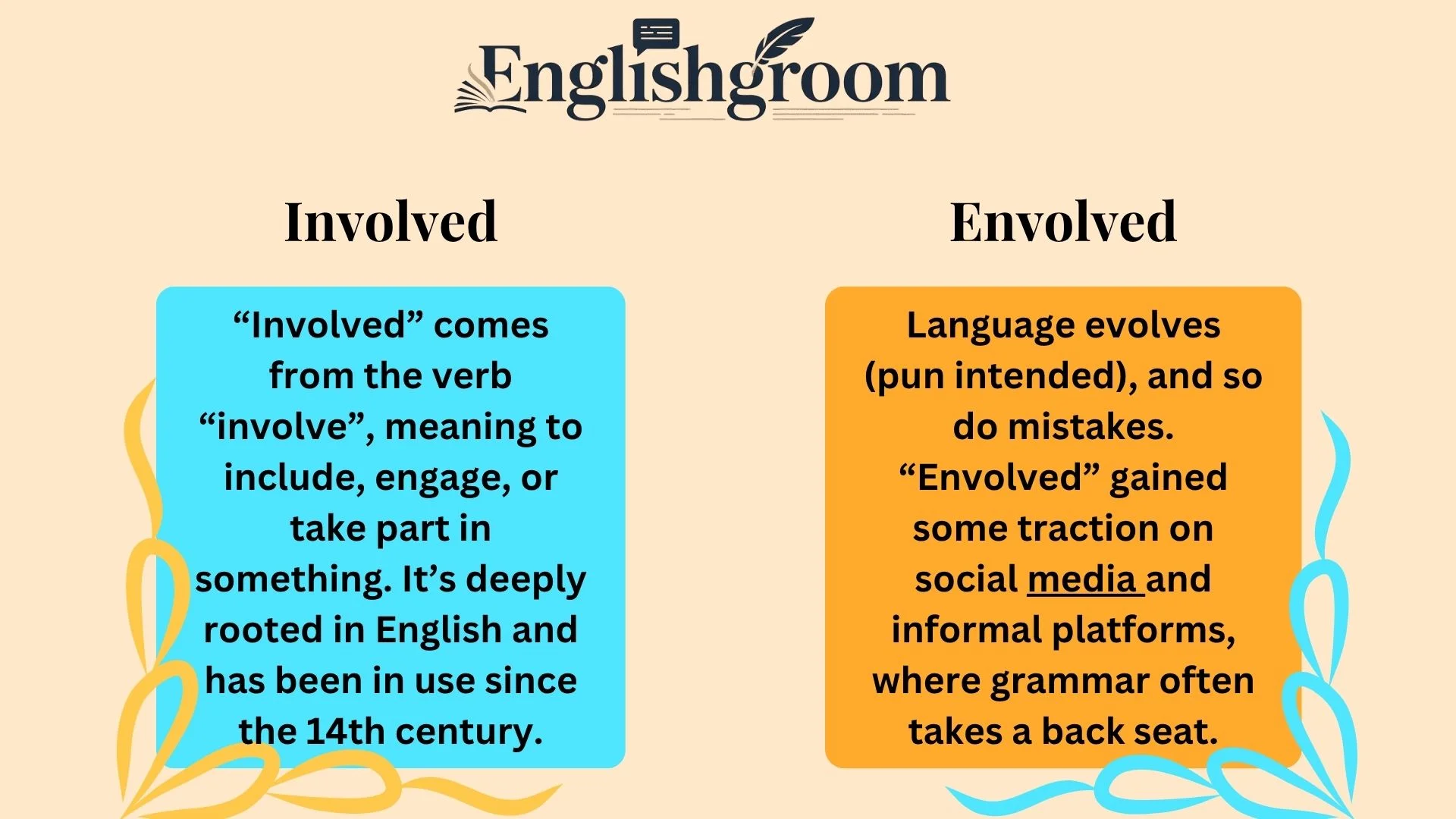
“Involved” comes from the verb “involve”, meaning to include, engage, or take part in something. It’s deeply rooted in English and has been in use since the 14th century.
The word traces back to Latin involvere, which means to roll into or entangle. That image says a lot — being “involved” means you’re rolled into or entangled with a situation, activity, or emotion.
“Envolved,” on the other hand, isn’t recognized in standard English. It likely appeared because of:
- Phonetic confusion with “evolved” (which is a real word).
- Autocorrect errors on mobile devices.
- Regional mispronunciations or poor spell-check habits.
Key takeaway:
“Involved” is the only correct spelling. “Envolved” is an error — avoid it in all formal or professional writing.
The Myth of “Envolved” — Why It’s a Common Error
Language evolves (pun intended), and so do mistakes. “Envolved” gained some traction on social media and informal platforms, where grammar often takes a back seat. But credible sources like Cambridge Dictionary, Merriam-Webster, and the Oxford English Dictionary confirm:
❌ Envolved is not an English word.
So why do people still use it?
1. Phonetic Mix-ups
English is tricky — “involved” and “evolved” sound similar, especially when spoken quickly. That’s how “envolved” sneaks in.
2. Typographical Errors
Fast typing and auto-correct tools often replace “involved” with “envolved,” especially on mobile devices.
3. Misunderstanding Word Roots
Because “en-” is a common prefix (as in enrich, enable, engulf), people assume “envolve” fits the same pattern. But it doesn’t exist.
4. Lack of Awareness
Many simply don’t realize “envolved” is wrong. It looks legitimate at first glance.
The Grammar of “Involved”
“Involved” serves two main grammatical functions — as a verb and as an adjective. Understanding these distinctions helps you use it naturally and precisely.
As a Verb (Past Tense of “Involve”)
When “involved” acts as a verb, it shows that something included or engaged something else.
Examples:
- The manager involved the entire team in the discussion.
- The teacher involved parents in the school event.
- The investigation involved multiple agencies.
Here, “involved” means included or brought into participation.
As an Adjective
As an adjective, “involved” describes something complicated, detailed, or emotionally engaged.
Examples:
- It’s an involved process that requires precision.
- He’s too involved to remain neutral.
- They’re involved in a long-distance relationship.
Usage Tip:
When you describe emotional, relational, or complex situations, “involved” usually acts as an adjective.
The Many Shades of Meaning for “Involved”
“Involved” is a versatile word. It adapts based on context — complexity, emotion, participation, or connection.
Let’s unpack each one.
1. Complexity or Detail
When describing something detailed or complicated, “involved” suggests that it’s not simple or straightforward.
Examples:
- The plot of the movie was quite involved.
- He wrote an involved report on climate change.
Synonyms: intricate, complex, elaborate.
2. Emotional Engagement
“Involved” often carries emotional depth. It means someone is deeply connected or invested.
Examples:
- She’s too emotionally involved to make a fair decision.
- They got deeply involved after working together for months.
3. Active Participation
It can also indicate taking part in or being engaged in an activity.
Examples:
- Students were actively involved in the project.
- Local residents got involved in community cleanups.
4. Relationships and Connections
When describing personal or romantic relationships, “involved” shows ongoing connection or intimacy.
Examples:
- They’ve been involved for over two years.
- He doesn’t want to get involved with anyone right now.
Quote:
“Being involved isn’t just about participation. It’s about connection — emotional, intellectual, or moral.” — Anonymous
“Involved” in Everyday and Professional Contexts
You’ll find “involved” across fields — from workplaces to relationships to politics.
In Work and Projects
- The board was heavily involved in decision-making.
- Involved employees are more productive and satisfied.
In Education
- Parental involvement improves student outcomes.
- Teachers should involve students in hands-on learning.
In Relationships
- They’re romantically involved.
- She’s emotionally involved with her partner’s goals.
In Law and Politics
- He was involved in a corruption scandal.
- The minister denied being involved in the issue.
In Hobbies and Volunteering
- She’s involved in animal rescue projects.
- They stay involved with local sports clubs.
“Involved” in Literature and Media
A quick glance through books, newspapers, and media shows that “involved” dominates, while “envolved” is almost nonexistent.
| Word | Mentions (Google Books Corpus) | Dictionary Status |
|---|---|---|
| Involved | Over 25 million | ✅ Official word |
| Envolved | Less than 1,000 (mostly errors) | ❌ Not recognized |
Observation:
Authors and journalists use “involved” to portray engagement, detail, or entanglement — never “envolved.”
Example from Literature:
“He became deeply involved in the political movement of his time.”
— George Orwell, Essays
Correct vs. Incorrect Usage Table
| Sentence | Correct Form | Explanation |
|---|---|---|
| She got deeply envolved in charity work. | She got deeply involved in charity work. | “Envolved” is incorrect. |
| The project envolved multiple teams. | The project involved multiple teams. | Correct past tense of “involve.” |
| It’s an envolved process. | It’s an involved process. | “Involved” means complicated. |
| They are envolved in a dispute. | They are involved in a dispute. | Correct adjective form. |
Real-Life Case Study: The Business Report Blunder
A marketing manager once submitted a client proposal saying:
“Our team was deeply envolved in the development process.”
The client flagged it immediately. Though minor, the typo made the proposal look unprofessional and unpolished.
Lesson: Even small spelling mistakes can affect credibility — especially in business or academic writing. Proofread for accuracy.
Memory Trick to Avoid the “Envolved” Error
Try this simple mental cue:
“If you’re part of something, you’re in it — so you’re involved, not ‘envolved.’”
The prefix “in-” means inside or within, while “en-” often means to make or put into.
You’re not making yourself involved — you’re already in something.
Quick Reference: Synonyms and Related Words
| Context | Synonyms | Example |
|---|---|---|
| Emotional | attached, connected, engaged | She’s emotionally attached to her work. |
| Professional | committed, participating, contributing | All departments were participating in the event. |
| Complexity | detailed, intricate, elaborate | It’s an intricate procedure that requires patience. |
| Legal | implicated, associated | He was implicated in the investigation. |
Common Mistakes to Avoid
- Writing “envolved” instead of “involved.”
- Using “involve” and “evolve” interchangeably — they have unrelated meanings.
- Forgetting that “involved” can describe both people and things.
Why Choosing the Right Word Matters
Language is the foundation of communication. Using the correct form shows attention to detail and professionalism.
Reasons why accuracy counts:
- It strengthens credibility.
- It ensures clarity.
- It reflects education and care in writing.
- It prevents misinterpretation in formal contexts.
Quote:
“Precision in language is precision in thought.” — Aristotle
Using “involved” correctly communicates seriousness, intelligence, and authenticity.
FAQs — Involved vs. Envolved
Is “Envolved” a Real Word?
No. “Envolved” is not recognized in any English dictionary. It’s a common misspelling of “involved.”
What Does “Involved” Mean Exactly?
“Involved” means included, engaged, entangled, or connected. It can describe both actions and relationships.
Can “Involved” Be Used as Both a Verb and Adjective?
Yes. As a verb, it’s the past tense of involve. As an adjective, it describes complexity or engagement.
Why Do People Confuse “Involved” with “Evolved”?
Because they sound similar. “Evolved” means developed or changed gradually, while “involved” means engaged or included.
How Can I Remember the Difference?
Think:
You’re in a situation → you’re involved.
You grow or change → you’ve evolved.
Conclusion
English has its quirks, but this one’s clear-cut. “Involved” is correct, meaningful, and widely used. “Envolved” isn’t a word — it’s just a typo that sneaks into writing when we’re careless.
Whether you’re writing emails, essays, or reports, accuracy matters. The right word builds trust and reflects confidence.
So next time you’re tempted to type “envolved,” stop, reread, and remember:
“If you’re part of it — you’re involved.”

Hi! I’m Sami, a 28-year-old content writer with a love for words and storytelling. Writing has always been my way of expressing ideas, sharing knowledge, and connecting with people. I enjoy creating engaging and well-researched content—whether it’s blogs, articles, or social media posts—that not only informs but also inspires readers. My goal is to turn complex ideas into clear, creative, and meaningful pieces of writing that leave a lasting impact.