Last updated on January 29th, 2026 at 08:41 am
Language evolves faster than we realize. One day, a word feels wrong, and the next, it’s trending online or part of a company name. That’s exactly what happened with “Invision” and “Envision.”
These two terms look and sound almost identical, but only one is a true English word — the other is a popular misspelling turned into a brand name. Let’s dig into the confusion, understand where it came from, and see how you can use “envision” correctly every time.
Understanding the Mix-Up: “Invision” vs “Envision”
The confusion between “invision” and “envision” isn’t new. It’s one of those mix-ups that happens because our brains process sound faster than spelling. When you say both words out loud, they sound nearly the same.
But here’s the key difference:
| Word | Real English Word? | Meaning | Example Usage |
|---|---|---|---|
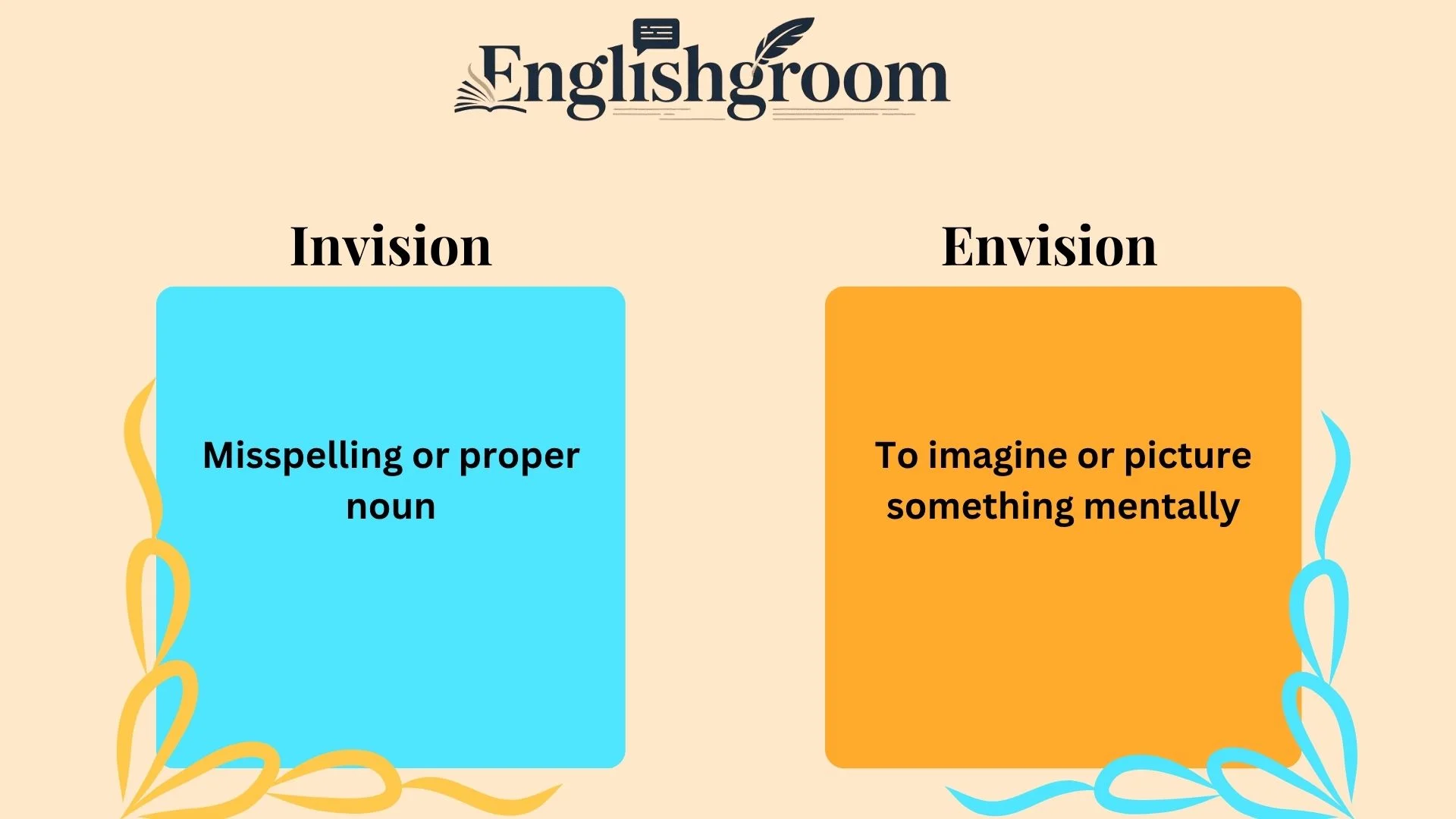
| Envision | ✅ Yes | To imagine or picture something mentally | I envision a future where clean energy powers every home. |
| Invision | ❌ No (unless referring to a brand name) | Misspelling or proper noun | InVision is a digital product design platform. |

The real English word is “envision.” It means to imagine, picture, or foresee something in your mind.
“Invision” only exists as a brand name — most famously as InVision, the design collaboration platform used by UI/UX designers worldwide.
This brand recognition has made the misspelling seem “normal” to many, but in formal writing or professional contexts, using invision instead of envision would be incorrect.
The Origin and Evolution of “Envision”
To truly understand why “envision” is correct, we need to look at where it came from.
The Etymology
The word “envision” was first recorded in the mid-17th century. It’s derived from the French term “envisager”, which means “to look in the face of” or “to consider.”
- “En” means “to put into” or “cause to be.”
- “Vision” refers to seeing or perceiving.
So, “envision” literally means to put into vision or to see in the mind’s eye.
The Evolution
Over centuries, “envision” evolved to represent the act of mentally picturing something that doesn’t yet exist — a goal, a future, or an idea. It became a staple word in psychology, business, art, and innovation.
“The best way to predict the future is to envision it.” — Peter Drucker
That quote alone captures the essence of what the word means — seeing something clearly in your imagination before bringing it to life.
Why “Invision” Persists Online
Even though invision isn’t correct in English, it refuses to fade away. Why? Branding and digital culture.
The Brand Effect
The company InVision, founded in 2011, became a global leader in digital design collaboration tools. Millions of designers use it daily, so the name InVision appears on countless portfolios, blog posts, and tutorials.
This brand visibility created what linguists call a semantic drift — when a word or spelling changes meaning due to frequent use in a new context.
So, while “invision” still isn’t an English word, many people associate it with creativity, innovation, and design because of the brand.
Digital Reinforcement
Search engines and social media algorithms also play a role.
When people search for “Invision app,” Google’s autocomplete and results pages reinforce the spelling.
It’s a subtle psychological loop:
- You see “InVision” online.
- You type it out the same way.
- The web confirms it’s valid — even though, linguistically, it’s not.
How Language Evolution Affects Spelling
Language isn’t static. Words morph as culture and technology shift. Misspellings can even become mainstream.
Examples of Spelling Shifts
Here are some examples where incorrect or altered spellings became accepted over time:
| Old Form | Modern Accepted Form | Notes |
|---|---|---|
| “connexion” | “connection” | Simplified spelling adopted by American English. |
| “to-day” | “today” | The hyphen disappeared over time. |
| “e-mail” | “email” | Hyphen dropped due to common use. |
Similarly, invision could eventually enter dictionaries — but only if it gains enough independent meaning outside the brand.
For now, it remains a corporate name, not a word.
Correct Usage of “Envision” in American and British English
Both American and British English recognize “envision” as the correct form. However, subtle differences appear in usage and tone.
American English
In the US, envision is widely used in business, tech, and motivational writing. Americans often use it to express innovation or strategic thinking:
“We envision a company culture that thrives on creativity.”
British English
In the UK, writers sometimes prefer “visualize” or “imagine” in casual speech, though envision remains grammatically correct.
“She envisaged a new beginning after the move.”
(Note: “envisage” is the British counterpart to “envision.”)
Common Grammatical Patterns
| Structure | Example |
|---|---|
| envision + noun | I envision success in this venture. |
| envision + verb-ing | He envisions leading a global team someday. |
| envision + as + noun | They envision her as the next team leader. |
Synonyms and Contextual Usage
Using the right word adds precision to your message. Here’s how “envision” compares to similar words:
| Word | Nuance | Example |
|---|---|---|
| Imagine | Focuses on creative thought or fantasy | Imagine a world without limits. |
| Visualize | Emphasizes creating a mental image | Athletes visualize success before competing. |
| Foresee | Implies prediction or anticipation | Experts foresee major shifts in technology. |
| Conceive | Suggests forming a new idea | She conceived the project from scratch. |
| Envision | Combines imagination with purpose | He envisions a cleaner, more sustainable city. |
When you use “envision,” you’re not just dreaming — you’re picturing something with intent and clarity. That’s what separates it from simple imagination.
How to Remember the Right Spelling
It’s easy to mix up “invision” and “envision,” but these memory tricks help:
- Think “en” as in “enable.” You enable your vision — you don’t inable it.
- Mnemonic: You need “en”ergy to envision success.
- Sound it out: “En-vision” has a clear en start, not in.
Another way to remember is this:
If you’re talking about imagining something, it’s envision.
If you’re talking about a design company, it’s InVision.
Common Mistakes and How to Avoid Them
Even experienced writers slip up with “invision” vs “envision.” Here’s how to stay accurate:
Common Mistakes
- Relying on autocorrect: Some tools miss the error because of the brand name.
- Copying from design websites: InVision’s dominance confuses context.
- Mixing dialects: Using envisage and envision interchangeably in the same piece.
Proofreading Tips
- Use Grammarly or Hemingway Editor to flag unknown words.
- Re-read sentences aloud — does invision sound awkward? It’s probably wrong.
- Keep a personal style sheet with tricky word pairs like effect/affect, compliment/complement, and envision/invision.
Real-World Example: Brand Influence on Spelling
Let’s look at a quick case study showing how branding shapes language.
Case Study: InVision App
InVision, founded by Clark Valberg in 2011, is a product design collaboration tool used by companies like Airbnb, Netflix, and Amazon.
Its success made “InVision” a household name in tech and design. Designers started saying, “Let’s upload it to InVision” — giving the name verb-like status.
This mirrors what happened with Google (“to google something”) and Photoshop (“to photoshop an image”). Over time, brand names can become verbs or common nouns, a process called genericide in linguistics.
However, this doesn’t change spelling rules for everyday English.
So while InVision (capitalized) is correct for the company, invision (lowercase) remains a spelling error.
How Branding Shapes Perception
Language experts note that repeated exposure changes what “looks right.”
When people constantly see “InVision” in logos and headlines, their brains register it as valid spelling.
This phenomenon is called orthographic priming — where frequent visual patterns affect what feels natural to write or read.
So if you’ve ever typed “invision” by mistake, don’t worry. Your mind is just following visual cues it’s seen repeatedly online.
FAQs about “Invision” vs “Envision”
What does “envision” mean?
Envision means to imagine, picture, or mentally visualize something that doesn’t exist yet. It’s often used when describing goals, ideas, or future outcomes.
Is “invision” a real word?
No. “Invision” is not recognized in standard English dictionaries. It’s only valid as a brand name (e.g., InVision App).
Can I use “invision” in professional writing?
Not unless you’re referring to the company name. Otherwise, it’s considered a misspelling of “envision.”
Is “envision” the same as “envisage”?
Almost. “Envisage” is more common in British English, while “envision” is preferred in American English. Both mean to imagine or foresee something.
How can I remember the correct spelling?
Think of “envision” as “enable your vision.” The prefix “en” means to cause or make happen — that’s the version you want.
Conclusion
At the end of the day, “envision” is your go-to word when expressing imagination, foresight, or goal-setting.
“Invision” belongs only in the world of brands and design tools.
The confusion between the two reminds us how language evolves — and how technology shapes the way we write and think. But clarity always wins.
So the next time you write a pitch, article, or creative idea, remember:
You can envision your future, but you can’t invision it.

Hi! I’m Sami, a 28-year-old content writer with a love for words and storytelling. Writing has always been my way of expressing ideas, sharing knowledge, and connecting with people. I enjoy creating engaging and well-researched content—whether it’s blogs, articles, or social media posts—that not only informs but also inspires readers. My goal is to turn complex ideas into clear, creative, and meaningful pieces of writing that leave a lasting impact.