Ever wondered why you see “Introduction to Artificial Intelligence” but also “Introduction of New Policies”? At first glance, both seem correct — and they are — but their meanings couldn’t be more different.
This guide dives deep into how and when to use “Introduction To” vs “Introduction Of” correctly.
We’ll explore grammar, history, usage, and real examples so you’ll never hesitate again.
Why “Introduction To” vs “Introduction Of” Confuses Even Native Speakers
English prepositions can be sneaky. They often look interchangeable, yet they subtly change the meaning of a phrase.
Consider this:
- “Introduction to Psychology” – teaches or familiarizes you with a topic.
- “Introduction of New Rules” – announces or brings something new into existence.
See the difference? One guides you toward understanding something; the other brings something into the picture.
The Function of “Introduction” in English Grammar
The word introduction comes from the verb introduce, which means to bring into knowledge or use. As a noun, it usually refers to the act of presenting, beginning, or familiarizing.
It can represent:
- The first part of a text, lecture, or event.
- The process of bringing something new into existence.
- A presentation or acquaintance between people.
Examples:
- “The introduction of new laws changed the economy.”
- “The introduction to the course explains the syllabus.”
- “She made an introduction between her two friends.”
Choosing the right preposition — to or of — tells your reader whether you’re talking about learning or launching.
Understanding Prepositions: The Key to Accurate Meaning
Prepositions act like bridges. They link words and clarify relationships between ideas.
| Preposition | Function | Example | Meaning |
|---|---|---|---|
| To | Direction, connection, movement toward something | “Introduction to programming” | Learning or being guided toward understanding |
| Of | Belonging, origin, composition, cause | “Introduction of new taxes” | The act of presenting or bringing something new |
Prepositions aren’t interchangeable. They carry distinct shades of meaning that reshape entire sentences.
“Introduction To”: Meaning, Function, and Usage
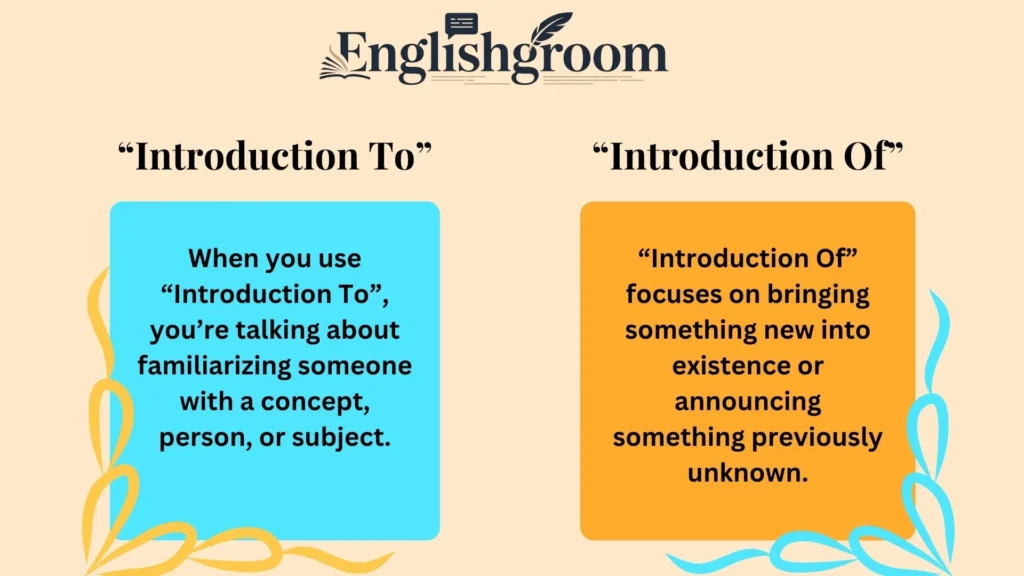
When you use “Introduction To”, you’re talking about familiarizing someone with a concept, person, or subject.
Meaning
It describes a connection or direction toward learning.
Common Contexts
- Education: Introduction to Biology, Introduction to Algebra
- Presentations: An introduction to our services
- Personal: Let me give you an introduction to the team
Examples
- “Welcome to your introduction to digital marketing.”
- “The professor gave an introduction to linguistics.”
- “He offered a brief introduction to his research work.”
Quick Tip
If your goal is to teach, acquaint, or familiarize, always use “introduction to.”
“Introduction Of”: Meaning, Function, and Usage
“Introduction Of” focuses on bringing something new into existence or announcing something previously unknown.
Meaning
It signifies initiation, launch, or implementation.
Common Contexts
- Business or Policy: Introduction of new policies
- Science or Technology: Introduction of new vaccines
- Media or Marketing: Introduction of a new product
Examples
- “The introduction of electric cars revolutionized the auto industry.”
- “We celebrate the introduction of renewable energy initiatives.”
- “The introduction of AI tools changed workplace dynamics.”
Quick Tip
If something didn’t exist before and is being brought into existence, use “introduction of.”
Semantic Comparison: “To” vs “Of” at a Glance
| Aspect | Introduction To | Introduction Of |
|---|---|---|
| Focus | Target or recipient | Subject or entity introduced |
| Meaning | Learning, exposure, or familiarization | Launch, announcement, or implementation |
| Common Use | Education, relationships, ideas | Products, laws, systems |
| Example | “Introduction to Chemistry” | “Introduction of New Legislation” |
| Implied Action | Movement toward understanding | Act of bringing something forth |
Both are correct, but they operate on different planes.
Think of “Introduction To” as teaching and “Introduction Of” as launching.
Historical and Etymological Context
The term “introduction” stems from the Latin intro (“within”) + ducere (“to lead”).
It literally means “to lead within” or “to bring inside.”
Early Use
- In Old English and Latin texts, introducere referred to the act of bringing a person into a group or place.
- Over time, English evolved to use “to” and “of” to express direction and creation.
Historical Example
“The introduction of printing hath altered learning forever.” — 16th-century scholar
By the 18th century, “introduction to” began appearing more frequently in academic writing as universities grew.
Frequency and Commonness in Modern English
Modern English favors “introduction to” by a large margin, especially in education, media, and literature.
Observations (Based on Corpus Studies)
- “Introduction to” appears 5–6 times more often than “introduction of.”
- Academic papers and course titles almost exclusively use “introduction to.”
- Government and corporate writing lean toward “introduction of.”
Common Domains
| Field | Preferred Phrase | Example |
|---|---|---|
| Education | Introduction to | “Introduction to Statistics” |
| Business | Introduction of | “Introduction of a new marketing strategy” |
| Law | Introduction of | “Introduction of new legislation” |
| Technology | Both | “Introduction to coding” / “Introduction of AI tools” |
Contextual Application: How to Choose Between Them
Choosing the right phrase depends on what you’re describing.
Here’s a quick rule of thumb:
- If it’s something you learn or get familiar with, use “Introduction To.”
- If it’s something being presented, launched, or implemented, use “Introduction Of.”
Decision Flow Example
| Question | Answer | Correct Phrase |
|---|---|---|
| Are you talking about learning or being guided toward something? | Yes | Introduction to |
| Are you talking about bringing something new into a system or context? | Yes | Introduction of |
Self-Check Trick
Try substituting “introduction” with another word:
- “Presentation to” (fits learning or audience)
- “Launch of” (fits release or innovation)
Example:
- “Presentation to the board” ✅
- “Launch of new rules” ✅
The logic remains consistent.
Formal and Academic Usage Tips
In academic and professional contexts, precision matters. Here’s how both forms fit:
Use “Introduction To” When
- Writing course titles: Introduction to Sociology
- Creating presentations: An Introduction to Our Brand Values
- Structuring reports: Introduction to the Methodology Section
Use “Introduction Of” When
- Announcing new initiatives: Introduction of Remote Work Policy
- Describing changes: Introduction of Advanced Security Systems
- Discussing history: Introduction of Modern Printing in Europe
Avoid Common Mistakes
| Incorrect | Correct | Why |
|---|---|---|
| Introduction for Chemistry | Introduction to Chemistry | Preposition mismatch |
| Introduction about the system | Introduction to the system | “About” isn’t used after “introduction” |
| Introduction with new software | Introduction of new software | Context requires “of” (launch) |
Other Prepositions with “Introduction” (Less Common but Useful)
While “to” and “of” dominate, other prepositions sometimes appear in specific contexts.
| Preposition | Usage | Example | Meaning |
|---|---|---|---|
| For | Audience-focused | “Introduction for beginners” | Tailored to a specific group |
| By | Attribution | “Introduction by the author” | Indicates who wrote or gave the introduction |
| With | Accompaniment | “Introduction with humor” | Describes the manner of introduction |
Example Use Cases
- “This book includes an introduction by the editor.”
- “We created an introduction for first-time investors.”
Quick Reference: Summary Table
| Phrase | Meaning | Example | Context |
|---|---|---|---|
| Introduction to | Familiarizing or guiding | “Introduction to Biology” | Academic, interpersonal |
| Introduction of | Announcing or implementing | “Introduction of new policies” | Professional, formal |
| Introduction for | Targeting a specific audience | “Introduction for kids” | Instructional |
| Introduction by | Attribution to author or speaker | “Introduction by Dr. Smith” | Literary |
| Introduction with | Describes style or tone | “Introduction with humor” | Creative, informal |
Case Study: Corporate Usage
Let’s look at how two companies used these phrases differently:
Case 1: “Introduction To” in Education Marketing
Coursera uses “Introduction to Python” as a gateway course for beginners. The phrase signals learning, familiarity, and entry-level access.
Case 2: “Introduction Of” in Corporate Policy
When Apple announced the introduction of new privacy features, it indicated a launch — something previously nonexistent.
Takeaway
One phrase invites learning, the other announces innovation. Both carry weight, but their intent defines their usage.
FAQs About “Introduction To” vs “Introduction Of”
What is the main difference between “introduction to” and “introduction of”?
“Introduction to” means familiarization or learning. “Introduction of” means launch or presentation of something new.
Can I say “introduction about”?
No. Native speakers never say “introduction about.” Use “introduction to” instead.
Is “introduction for” correct?
Yes, but it’s used for audiences. Example: “An introduction for beginners.”
Which is more common: “introduction to” or “introduction of”?
“Introduction to” is far more common, especially in education and writing titles.
Can “introduction of” be used for people?
Rarely. We usually say “introduction to someone.” Example: “Let me give you an introduction to my colleague.”
Conclusion
In English, prepositions shape meaning more than most learners realize.
- Use “Introduction to” when introducing a topic, subject, or person for learning or familiarity.
- Use “Introduction of” when introducing an object, rule, idea, or system into existence.
They sound similar but express entirely different motions — one toward understanding, the other into action.
Once you grasp this nuance, your English writing becomes sharper, more professional, and naturally fluent.
So next time you write a report, course title, or product announcement, you’ll know precisely which one to use — “to” or “of.”

Hi! I’m Sami, a 28-year-old content writer with a love for words and storytelling. Writing has always been my way of expressing ideas, sharing knowledge, and connecting with people. I enjoy creating engaging and well-researched content—whether it’s blogs, articles, or social media posts—that not only informs but also inspires readers. My goal is to turn complex ideas into clear, creative, and meaningful pieces of writing that leave a lasting impact.