Last updated on February 19th, 2026 at 09:25 am
Ever stumbled upon the words “ingrained” and “engrained” and wondered which is correct?
You’re not alone. These two spellings have confused countless writers, editors, and even native English speakers for centuries. Both look right, sound right, and seem to mean the same thing.
Yet, one spelling dominates modern English, while the other has quietly faded into linguistic history.
This article breaks down everything you need to know about “ingrained” vs. “engrained”—their meanings, origins, correct usage, and why one of them should stay in your vocabulary today.
Why “Ingrained” and “Engrained” Get Mixed Up
Confusion between ingrained and engrained often starts with sound and spelling. They’re pronounced the same—/ɪnˈɡreɪnd/—which makes it hard to tell them apart in speech.
There’s another reason too: English spelling hasn’t always been consistent. Words like color and colour, theater and theatre, or gray and grey show how regional preferences shape spelling conventions over time.
In the case of ingrained vs. engrained, the same story unfolds—but with a twist tied to history and etymology.
The Core Difference at a Glance
Here’s the truth: both words mean the same thing—deeply rooted, firmly established, or fixed in nature or habit. But modern English overwhelmingly favors ingrained.
Below is a quick comparison:

| Word | Meaning | Frequency in Use | Modern Preference | Example |
|---|---|---|---|---|
| Ingrained | Deeply rooted; firmly fixed | Very common | ✅ Preferred | “His ingrained habits were hard to change.” |
| Engrained | Variant spelling of ingrained | Rare | ❌ Outdated | “Her engrained beliefs shaped her worldview.” |
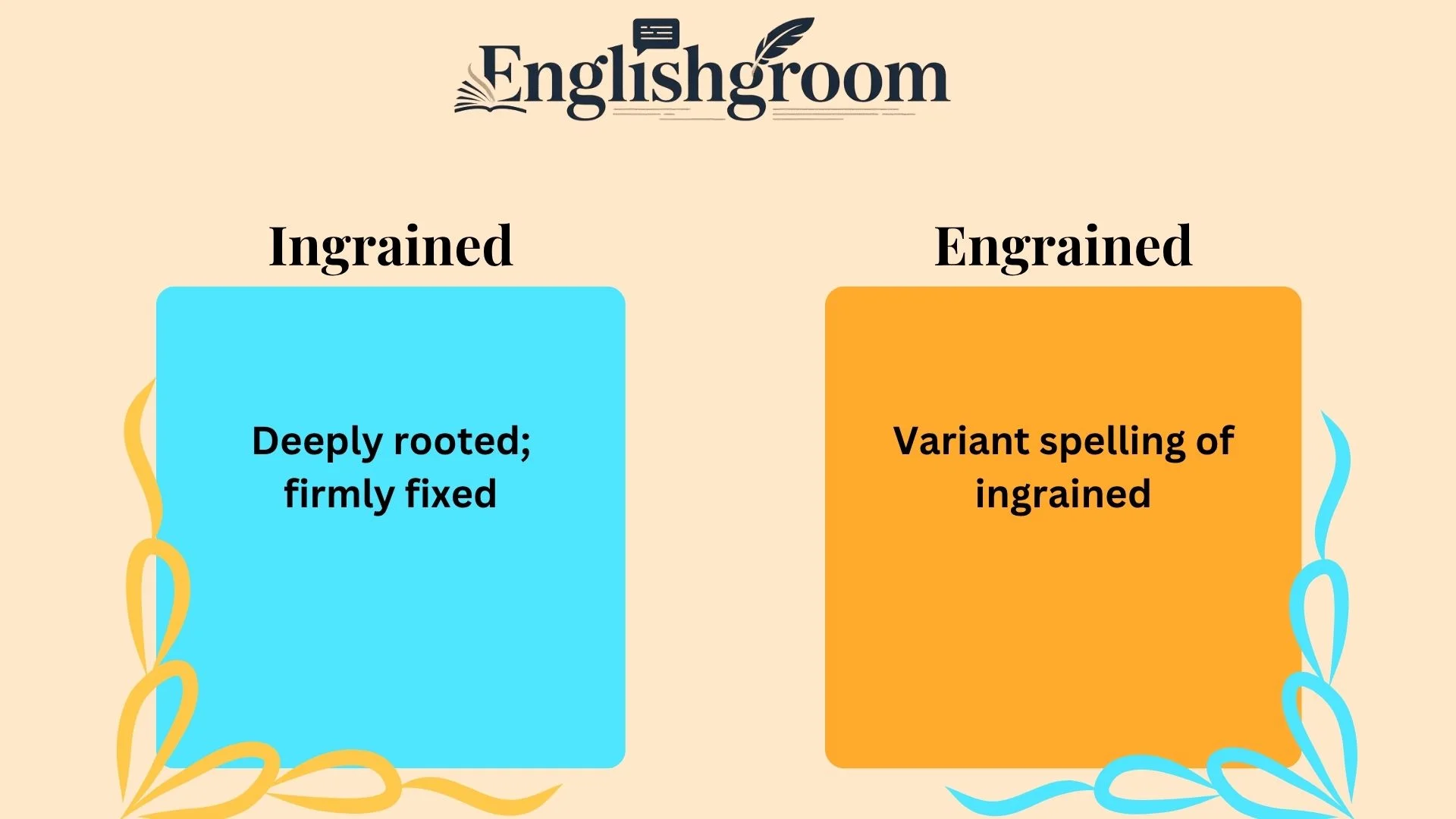
Takeaway: Ingrained is the standard modern spelling. Engrained is acceptable in historical or stylistic contexts but should be avoided in professional writing.
Why People Mix Up “Ingrained” and “Engrained”
People often mix these two up because of three main reasons:
- Historical overlap – In Early Modern English, spelling wasn’t standardized. Writers used both ingrain and engrain interchangeably.
- Phonetic similarity – Both sound identical, making it tricky to distinguish in conversation.
- Association with “engrave” – Since engrained looks similar to engraved, people sometimes assume the “e” version is correct when referring to something deeply embedded.
Even literary greats like Shakespeare and Milton lived in an era before dictionaries standardized English. Back then, spelling was more personal preference than rule.
What “Ingrained” Really Means
The word “ingrained” describes something deeply fixed or established—so deep that it’s nearly impossible to remove or change.
It can apply to:
- Beliefs or attitudes: “Prejudice can be an ingrained part of culture.”
- Habits or routines: “Daily reading became an ingrained habit.”
- Characteristics or emotions: “He had an ingrained sense of fairness.”
In all cases, ingrained carries the sense of something internalized and enduring.
Fun fact: the metaphor behind ingrained originally came from dyeing fabric so deeply that the color became a permanent part of the cloth—impossible to wash out.
Everyday Uses of “Ingrained”
You’ll often see ingrained in contexts involving psychology, behavior, or social values.
Here are common collocations (words frequently paired with ingrained):
- Ingrained habit – “Checking his phone before bed was an ingrained habit.”
- Ingrained belief – “Many hold ingrained beliefs about gender roles.”
- Ingrained prejudice – “The movie challenged ingrained prejudices.”
- Ingrained culture – “Respect for elders is ingrained in Japanese society.”
- Ingrained memory – “The day he left is ingrained in my memory.”
Tone and register: Ingrained works well in both formal and informal writing. It’s a favorite in psychology, sociology, and cultural discussions.
The Variant Form: Understanding “Engrained”
While ingrained reigns supreme today, engrained is its older cousin. It means the same thing but has nearly disappeared from modern usage.
You might still find engrained in:
- Historical texts or older literature
- British English sources before the 20th century
- Poetic or stylistic writing that aims for archaic charm
Example:
“The moral codes of the time were deeply engrained within society.” — 19th-century British literature
Today, most editors, style guides, and dictionaries—like Merriam-Webster, Cambridge, and Oxford English Dictionary—list ingrained as the preferred form.
Historical Roots: From Dyeing Cloth to Deeply Held Beliefs
The origin of both ingrained and engrained lies in the art of dyeing fabric. The root word traces back to the Old French term engrainer, which meant “to dye with cochineal or grain”.
This “grain” referred to Kermes insects, used to produce a rich red dye. The phrase “dyed in grain” described cloth dyed so deeply that the color couldn’t fade.
Over time, this physical process evolved metaphorically. “Dyed in grain” became synonymous with deeply fixed or permanent, giving birth to ingrained.
Etymology timeline:
| Period | Language | Word Form | Meaning |
|---|---|---|---|
| Old French (13th c.) | engrainer | to dye deeply | literal dyeing |
| Middle English (14th–15th c.) | engrained | dyed with grain dye | literal + metaphorical |
| Modern English (17th c. onward) | ingrained | deeply rooted | metaphorical only |
By the 17th century, ingrained had replaced engrained as the dominant form.
Verbs Behind the Adjectives: “Ingrain” vs. “Engrain”
Both adjectives—ingrained and engrained—come from their verb forms: to ingrain and to engrain.
Here’s what they mean:
- To ingrain: to fix deeply in the mind or nature.
- “Teachers try to ingrain good study habits in students.”
- To engrain: the same, but outdated.
- “They sought to engrain discipline in the troops.”
In modern writing, always choose ingrain and ingrained. They’re the accepted spellings in both American and British English today.
Which Word Wins Today: Usage Data and Linguistic Trends
Language data clearly shows ingrained dominates modern English.
If you check Google Ngram Viewer, ingrained has skyrocketed in use since the early 1900s, while engrained steadily declined.
Corpus evidence:
- In the Corpus of Contemporary American English (COCA), ingrained appears more than 500 times for every 1 instance of engrained.
- British sources follow the same trend, though engrained occasionally appears in older publications.
Visual summary:
| Year Range | Ingrained Usage | Engrained Usage | Notes |
|---|---|---|---|
| 1600–1700 | Moderate | Common | Both forms used |
| 1800–1900 | Increasing | Declining | Dictionaries start preferring “ingrained” |
| 1900–2020 | Dominant | Rare | “Ingrained” becomes global standard |
Verdict: Ingrained wins—by a landslide.
Real-World Examples of “Ingrained” in Action
To solidify your understanding, here are authentic examples from literature, journalism, and academia:
- “Racism is ingrained in many institutions.” — The Guardian
- “Her ingrained curiosity led her to explore science.” — National Geographic
- “These ingrained patterns of thought resist change.” — Psychology Today
- “Hard work and discipline were ingrained from childhood.” — Harvard Business Review
These real-world uses show ingrained appearing in formal, intellectual, and cultural contexts.
Frequent Mistakes and How to Avoid Them
Writers often trip over similar-looking or related words. Here’s how to steer clear:
Common Confusions
- Ingrained vs. Engraved
- Ingrained = deeply rooted
- Engraved = carved into a surface
- ❌ “The memory was engraved in his mind.” (Metaphorical misuse)
- ✅ “The memory was ingrained in his mind.”
- Overuse of “Ingrained”
- Don’t sprinkle ingrained everywhere. Use it when permanence or depth truly applies.
- Literal Use
- Avoid using ingrained for things that can change easily. It’s for permanent or habitual traits.
Style and Grammar Tips
If you’re unsure which to use, follow this rule of thumb:
Always choose “ingrained.”
It’s modern, standard, and recognized globally.
When “Engrained” Might Still Work
- Quoting historical texts: “The tradition was engrained in early English law.”
- Using poetic or vintage tone: “An engrained sadness haunted the old town.”
Quick Checklist for Writers
✅ Use ingrained in modern contexts
✅ Stick to ingrain for verb form
✅ Avoid engrained unless quoting
✅ Cross-check with a dictionary before publishing
FAQs About “Ingrained” vs. “Engrained”
Is “Engrained” wrong?
No, but it’s nonstandard. It’s technically correct but considered outdated. Use ingrained for modern clarity and consistency.
Is “Ingrained” American and “Engrained” British?
Not exactly. Both appear in British history, but ingrained dominates in the UK and the US alike today.
Can I use both interchangeably?
Grammatically yes, stylistically no. Readers may see engrained as a spelling mistake, so stick with ingrained.
Why does “Ingrained” look like “Grain”?
Because it comes from the old practice of dyeing cloth with grain-based dye, symbolizing something colored deeply and permanently.
Is “Ingrained” formal or casual?
It’s flexible. You can use it in essays, business writing, or everyday speech—it suits both formal and conversational tones.
Learn More English With These Best Articles:
Alright vs All Right What’s the Real Difference and When to Use Each
Tear vs Tare The Confusing Words You Need to Master
A Chip off the Old Block Meaning Origin & Modern Significance
Cartel vs Mafia The Battle for Power Profit and Global Influence
Die vs Dice The Definitive Guide to Correct Usage
Final Thoughts
At the end of the day, both ingrained and engrained share roots, meaning, and pronunciation. Yet, only one—ingrained—has survived the test of time.
It’s simple, elegant, and instantly recognized across the English-speaking world. Whether you’re writing an essay, article, or novel, make sure this rule stays ingrained in your mind:
Always spell it “ingrained,” never “engrained.”

Hi! I’m Sami, a 28-year-old content writer with a love for words and storytelling. Writing has always been my way of expressing ideas, sharing knowledge, and connecting with people. I enjoy creating engaging and well-researched content—whether it’s blogs, articles, or social media posts—that not only informs but also inspires readers. My goal is to turn complex ideas into clear, creative, and meaningful pieces of writing that leave a lasting impact.