Last updated on February 21st, 2026 at 06:57 am
Language is a curious thing. Two small words like “in” and “within” can look almost identical yet carry subtle differences that completely shift meaning.
You might hear both in conversation or read them in professional writing and wonder — which one should I use?
This guide unpacks that mystery. By the end, you’ll know exactly when to use in and when within fits better — naturally, confidently, and precisely.
Why “In” and “Within” Confuse Even Fluent Speakers
Even advanced English speakers get tangled up with these two. That’s because both describe position, time, or limits, and they often appear interchangeable.
But here’s the trick — they’re not the same.
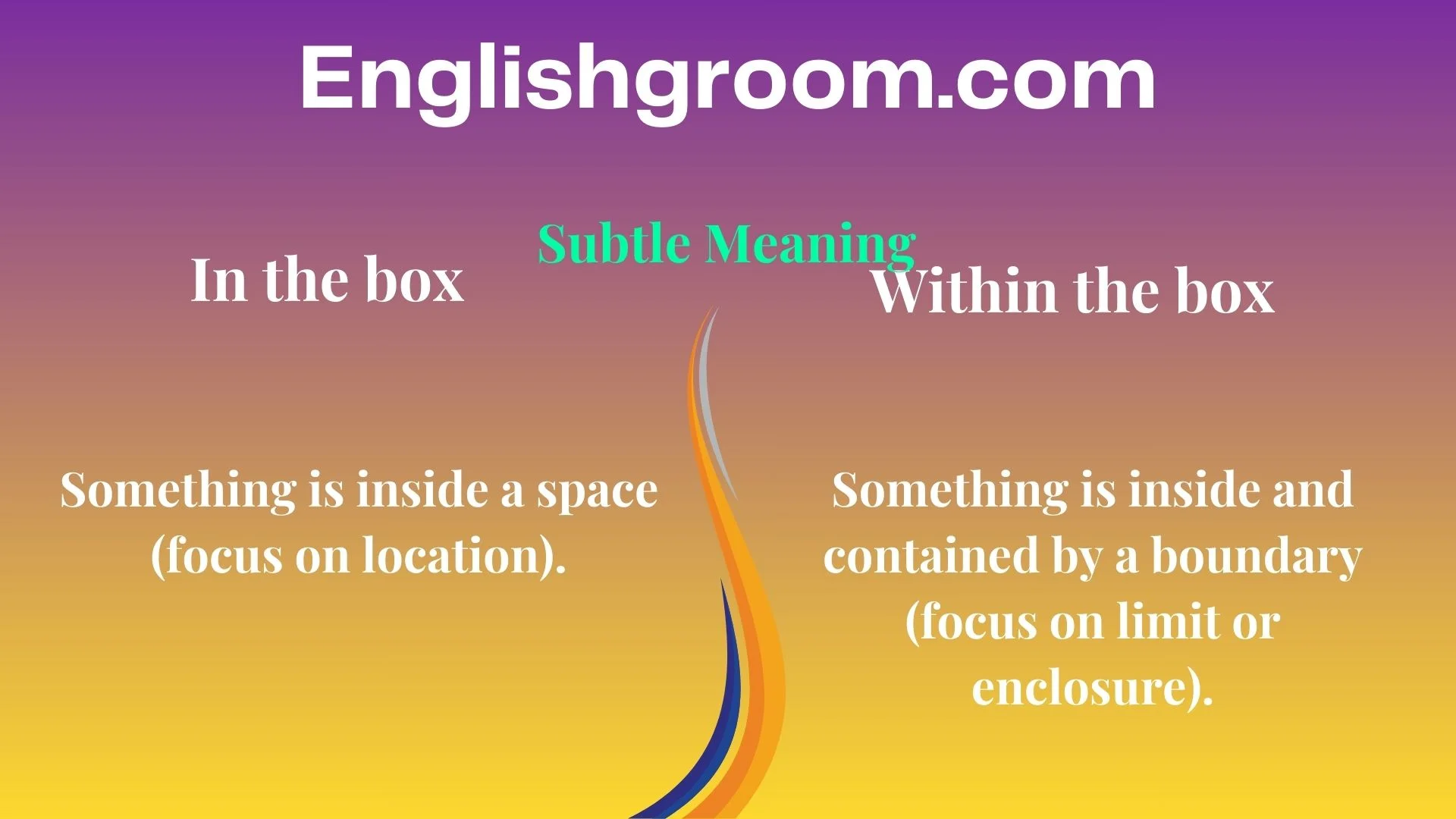
| Phrase | Subtle Meaning |
|---|---|
| In the box | Something is inside a space (focus on location). |
| Within the box | Something is inside and contained by a boundary (focus on limit or enclosure). |
👉 See the nuance?
While in focuses on where, within highlights boundaries or range.
Let’s break it down step by step.
Grasping the Core Difference Between “In” and “Within”
At its heart:

- “In” = inside something (spatial, temporal, or figurative).
- “Within” = inside and bounded by something, often implying control, limit, or precision.
Think of “within” as the deeper, more refined cousin of “in.”
For instance:
“The cat is in the house.” — It tells you where.
“The cat is within the house.” — It feels more formal and emphasizes containment or limits.
So while both can describe similar ideas, context and tone decide which word works best.
Understanding “In”: The Most Common Preposition
The preposition in is one of the most used words in the English language. It appears everywhere — in books, in speech, in business, in grammar lessons (see what happened there?).
Definition and Key Uses
“In” shows position, inclusion, or condition.
Here’s a quick look at its most common uses:
| Use Type | Example | Meaning |
|---|---|---|
| Location or position | She’s in the room. | Inside a physical space. |
| Inclusion | He’s in the team. | Part of a group or category. |
| State or condition | They’re in trouble. | Experiencing a situation. |
| Time | We’ll meet in an hour. | After a specific duration. |
| Motion (“into” sense) | She walked in the office. | Entering a space. |
💡 Tip: “In” often answers where, when, or how.
Everyday and Figurative Usage of “In”
You’ll find “in” in idioms, phrases, and metaphors all over English:
- in love
- in time
- in detail
- in charge
- in a hurry
These expressions show states or conditions, not physical locations.
Example:
“She spoke in detail.” — Not about place, but about how she spoke.
Common Mistakes with “In”
Even though “in” seems easy, it’s often overused where “within” or another preposition would sound more accurate.
❌ Incorrect: Submit your assignment in two days.
✅ Correct: Submit your assignment within two days.
The difference? “In two days” means after two days pass, while “within two days” means before the two-day period ends.
So if there’s a limit, go for within.
Unlocking “Within”: Precision, Boundaries, and Depth
Now let’s dive into the more refined side — within.
Definition and Nuance
“Within” means inside the limits of something. It conveys precision, containment, or scope — both physical and abstract.
| Context | Example | Meaning |
|---|---|---|
| Spatial | within the walls of the castle | Inside a physical boundary. |
| Temporal | within three hours | Before a deadline ends. |
| Abstract | within your control | Inside limits of ability or authority. |
Within carries a formal tone and is often used in academic, legal, or professional writing.
Example: “All tasks must be completed within the timeframe provided.”
It signals exactness — not a second late.
When to Use “Within” in Writing
Here’s where within shines:
- When describing boundaries or limits
- When expressing time constraints
- When emphasizing scope, thought, or conceptual limits
- When aiming for formal tone or precision
Examples:
- Stay within the lines.
- Act within the law.
- Deliver within 24 hours.
- Think within reason.
Formal and Professional Use
In professional settings — especially business, academic, and legal writing — “within” sounds cleaner and more authoritative.
| Context | “In” Example | “Within” Alternative | Tone |
|---|---|---|---|
| Business | Reply in 48 hours. | Reply within 48 hours. | Professional, precise |
| Legal | Changes in the agreement. | Changes within the agreement. | Formal, structured |
| Academic | Studies in psychology. | Studies within psychology. | Field-based nuance |
Using “within” helps writers sound confident and meticulous — ideal for reports, instructions, or policy documents.
Comparing “In” vs “Within” in Different Contexts
Let’s put them head-to-head in real scenarios.
Location
| Expression | Focus | Example |
|---|---|---|
| In | Presence inside a space | “He’s in the car.” |
| Within | Emphasis on boundaries or limits | “He’s within the car’s cabin.” |
Takeaway: “In” tells you where something is; “within” describes being contained or restricted inside something.
Time and Duration
| Phrase | Meaning | Example |
|---|---|---|
| In an hour | After an hour passes | “We’ll leave in an hour.” |
| Within an hour | Before the hour ends | “We’ll finish within an hour.” |
This subtle difference often changes how deadlines are interpreted — especially in contracts or instructions.
Abstract or Conceptual Use
| Example | Meaning |
|---|---|
| “In your heart” | Emotional location or feeling |
| “Within your heart” | Deep, poetic emphasis — emotional core or essence |
Here, “within” adds a sense of depth and introspection.
Quick Comparison Table: In vs Within
| Category | “In” | “Within” |
|---|---|---|
| Focus | Position or inclusion | Boundaries or limits |
| Tone | Informal, general | Formal, precise |
| Common Use | Everyday speech | Academic, business, legal |
| Time Meaning | After a time passes | Before a time ends |
| Example | “He’s in the house.” | “He’s within the house.” |
Avoiding Common Confusion
How can you quickly decide between “in” and “within”? Try this simple rule:
If there’s a limit, range, or deadline — use “within.”
If it’s about general location or condition — use “in.”
Mnemonic Trick:
🧠 Within = Walls or Window (boundaries).
So when you sense a boundary, pick “within.”
Advanced Usage and Stylistic Choices
Both “in” and “within” can work in creative or professional writing, but your tone and intent decide which to choose.
When “Within” Sounds Better
- To express refinement, structure, or containment.
- In formal writing like research, policies, or contracts.
- When describing internal states (within yourself, within reason).
When “In” Sounds More Natural
- In conversation or storytelling.
- For general states or everyday actions.
Example:
“He found peace within himself.” (Deep reflection)
“He found peace in his garden.” (Literal or simple context)
Tone and Rhythm in Writing
Choosing between “in” and “within” also affects the rhythm of your writing.
“Within” sounds softer and more measured, while “in” feels brisk and conversational.
Professional writers often switch between them intentionally for stylistic balance.
Case Study: Real-World Writing Examples
Let’s look at how word choice changes meaning across contexts.
1. Business Communication
Sentence A: “Please submit your report in 48 hours.”
Sentence B: “Please submit your report within 48 hours.”
Sentence B sounds more precise and professional, showing the deadline’s limit.
2. Legal Writing
Sentence A: “Any disputes arising in the agreement…”
Sentence B: “Any disputes arising within the agreement…”
“Within” clearly marks the scope of the agreement, which is critical in legal contexts.
3. Creative Writing
Sentence A: “The fire burned in her soul.”
Sentence B: “The fire burned within her soul.”
The second version evokes depth and emotional intensity.
Visual Summary: In vs Within
| Element | “In” | “Within” |
|---|---|---|
| Function | Position, state, or inclusion | Limits, range, or scope |
| Tone | Neutral or casual | Formal, structured |
| Formality | Common speech | Business/academic |
| Time Sense | After period | Before deadline |
| Emotion/Depth | Surface level | Deep or contained |
Final Tips for Confident Usage
Keep these quick reminders in your back pocket:
- If there’s a limit → “within.”
- If it’s about location → “in.”
- If tone is formal → “within.”
- If tone is conversational → “in.”
- Always read aloud. The ear catches what the eye misses.
Pro Tip: When unsure, rewrite the sentence both ways. Choose the version that sounds smoother and fits your audience.

FAQs About “In” vs “Within”
What’s the main difference between “in” and “within”?
“In” describes general inclusion or position. “Within” shows boundaries, limits, or a more formal tone.
Can “in” and “within” ever be used interchangeably?
Sometimes, yes — but it depends on context. In casual speech, “in the room” and “within the room” may sound similar, though the second feels more formal.
Is “within” more formal than “in”?
Absolutely. “Within” fits professional, legal, or academic contexts, while “in” is more natural in conversation.
Can I say “within the morning”?
Not typically. Use “in the morning.” “Within” fits when referring to deadlines (e.g., “within three days”).
Which is better: “within 24 hours” or “in 24 hours”?
Use “within 24 hours” when you mean “before the 24-hour limit ends.” Use “in 24 hours” to mean “after 24 hours pass.”
Learn More English With These Best Articles:
Marquee vs Marquis? The Clear Simple Difference Explained
What Does Hi There Mean? A Quick Guide to Tone, Context, and Connection
Some of Whom or Some of Who? The Grammar Rule Everyone Gets Wrong
Is Summer Capitalized? What About Summer Break? The Ultimate Grammar Guide
Worn vs Warn? The Ultimate Guide to Understanding These Tricky Words
Conclusion
Mastering “in” vs “within” may seem small, but it sharpens your communication dramatically.
- Use “in” for everyday language, general placement, or broad states.
- Use “within” for precision, deadlines, and formal contexts.
The beauty of English lies in these fine distinctions. When you start hearing the rhythm between “in” and “within,” you’ll write and speak with clarity that stands out — whether you’re crafting an email, a story, or a professional report.
“Good writing isn’t about knowing every rule — it’s about choosing every word with purpose.”

Hi! I’m Sami, a 28-year-old content writer with a love for words and storytelling. Writing has always been my way of expressing ideas, sharing knowledge, and connecting with people. I enjoy creating engaging and well-researched content—whether it’s blogs, articles, or social media posts—that not only informs but also inspires readers. My goal is to turn complex ideas into clear, creative, and meaningful pieces of writing that leave a lasting impact.