Last updated on February 11th, 2026 at 07:19 am
Language often hides its secrets in the smallest words. Take prepositions like “in” and “on.” They look simple, but when paired with street, they completely change the meaning of a sentence.
If you’ve ever wondered whether to say “kids are playing in the street” or “kids are playing on the street,” you’re not alone. Both sound correct at first, yet they convey different ideas.
This article breaks down the real difference between “in the street” and “on the street,” when to use each, and how context, geography, and even verb choice influence the right preposition.
Why the Preposition You Choose Changes the Meaning
Prepositions act like invisible bridges in English. They show how one thing relates to another — in space, time, or thought.
Choosing between “in the street” and “on the street” isn’t about grammar rules alone. It’s about perspective and imagery.
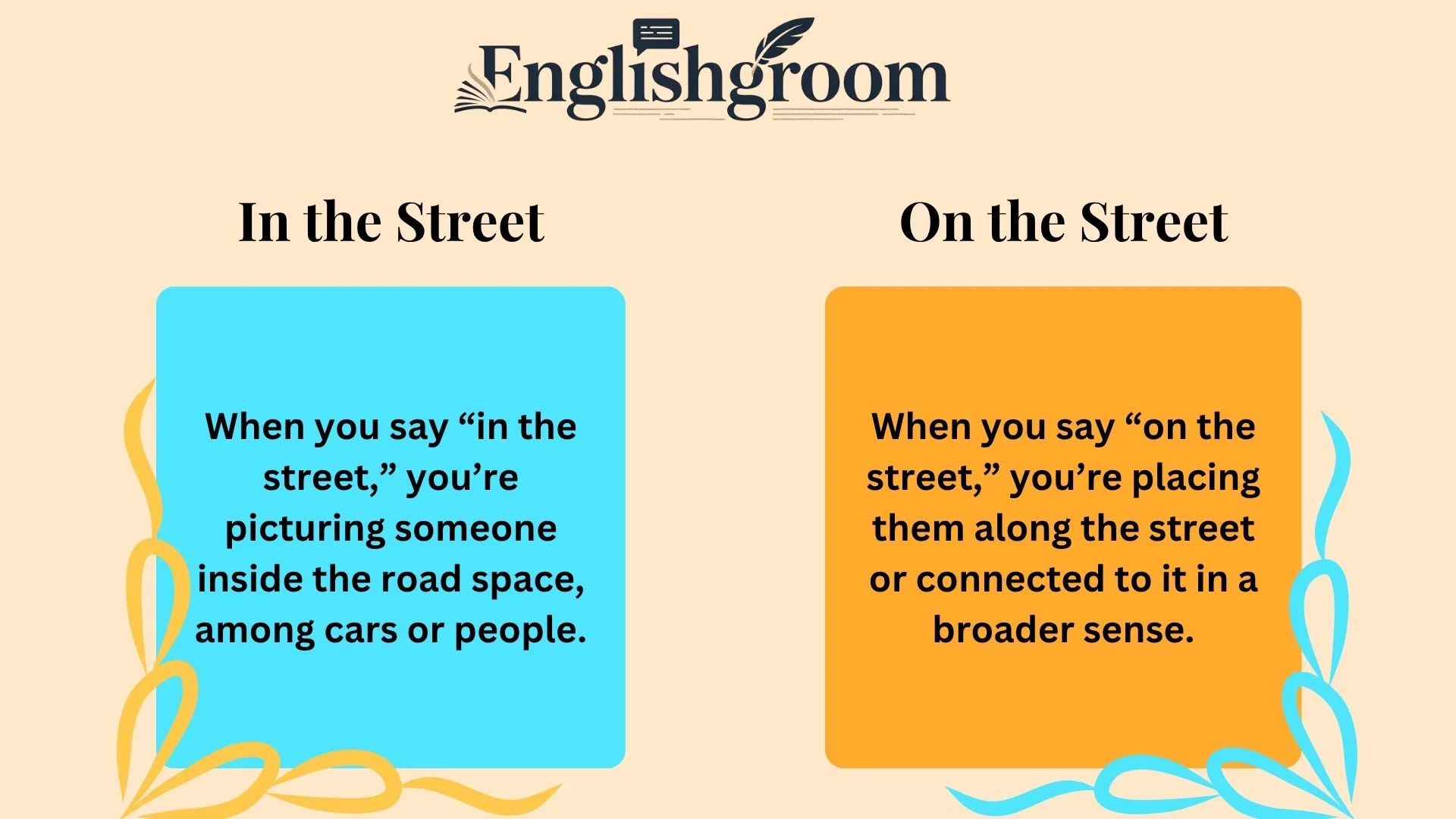
- When you say “in the street,” you’re picturing someone inside the road space, among cars or people.
- When you say “on the street,” you’re placing them along the street or connected to it in a broader sense.
👉 Think of it like this:
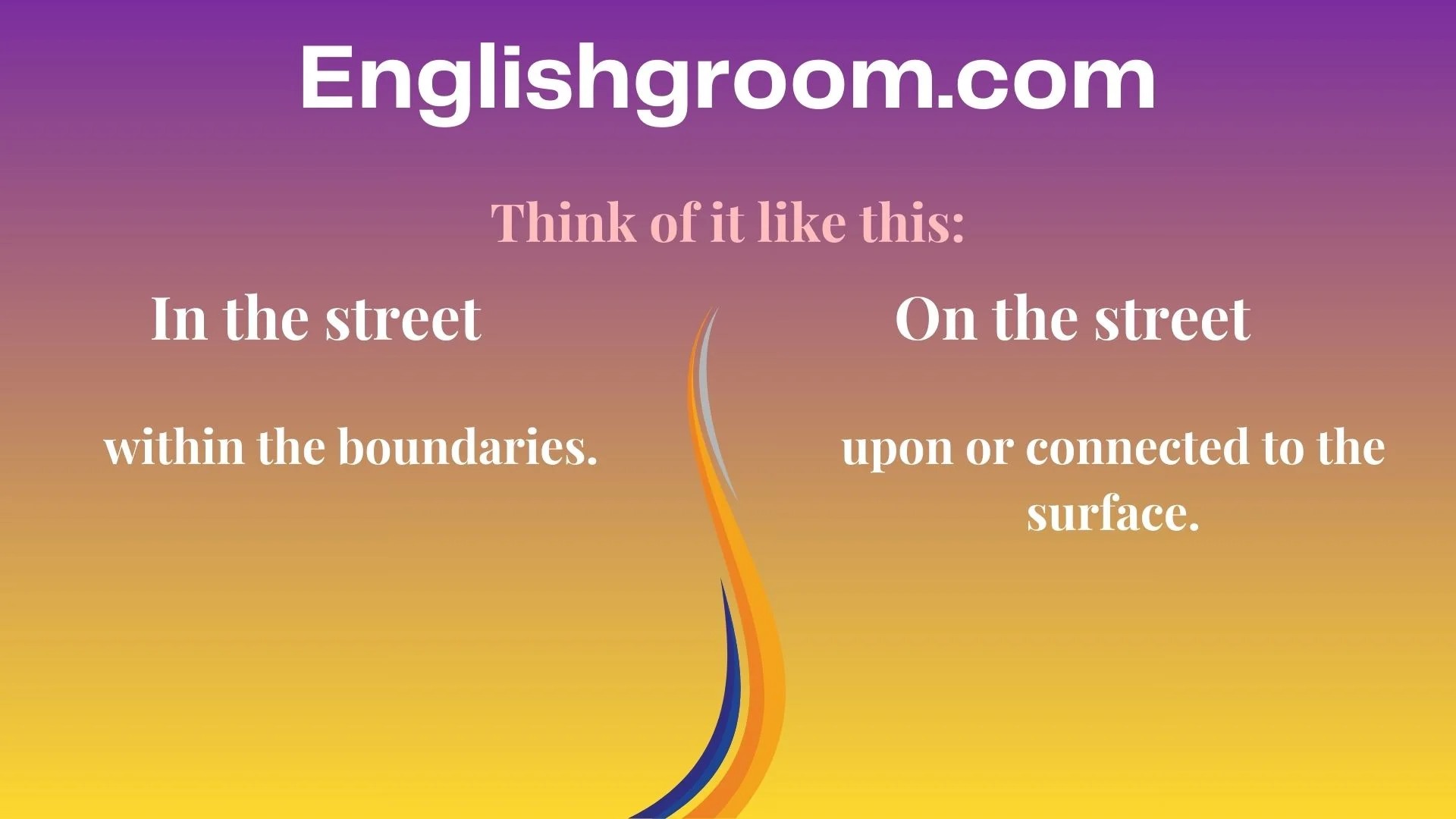
“In the street” = within the boundaries.
“On the street” = upon or connected to the surface.
It’s a small shift in words that can change your sentence from literal to figurative.
Quick Comparison: “In the Street” vs. “On the Street”
Here’s a side-by-side breakdown to help you visualize the difference quickly:
| Expression | Literal Meaning | Common Contexts | Emotional Tone |
|---|---|---|---|
| In the street | Inside the roadway | Traffic, protest, danger | Active, physical |
| On the street | Located along or connected with | Addresses, lifestyle, public life | Neutral, general |
“In the Street” — What It Actually Means
The phrase “in the street” points to being inside the boundaries of the road. It suggests a physical presence in a space used by traffic or pedestrians.
When to Use “In the Street”
- Physical activity or movement
- Children are playing in the street.
- A cyclist fell in the street.
- Crowds, protests, or parades
- Protesters gathered in the street demanding justice.
- Describing accidents or danger
- A car stopped in the street after hitting a cone.
Example Sentences
- A dog was lying in the street.
- People danced in the street during the festival.
- The taxi broke down in the middle of the street.
Visual Cue
🛣️ Picture yourself standing between cars or people, surrounded by traffic lines — that’s “in the street.”
Key Takeaway
Use “in the street” for direct, physical, and specific presence within the roadway. It conveys movement, immediacy, or even risk.
“On the Street” — The Broader, Everyday Use
The phrase “on the street” feels broader. It doesn’t always mean physically standing on asphalt. Instead, it refers to being alongside, near, or connected to the street.
Common Uses of “On the Street”
- Describing location or address
- There’s a bookstore on the street corner.
- She lives on Main Street.
- Referring to public life or the world outside
- You can feel the energy on the street today.
- Talking about homelessness or social life
- Many people are living on the street due to rising rent.
- Figurative or idiomatic meanings
- Word on the street is he got promoted.
Example Sentences
- You’ll find great coffee shops on the street near the station.
- The painter sells his art on the street every Sunday.
- She’s been living on the street since losing her job.
Broader Meanings
“On the street” often carries figurative meanings that extend beyond location. It can mean:
- Public opinion: Word on the street is there’s a new café opening.
- Street life or culture: He grew up on the streets of Chicago.
- General environment: Life on the street isn’t easy.
Diagram: “In the Street” vs. “On the Street”
[Sidewalk] [On the Street] [In the Street] [Traffic Lanes]
This simple visual helps you see that “in” puts you within the street, while “on” connects you to it.
Grammar Guidelines: Choosing “In” vs. “On”
Simple Rule
| Use Case | Correct Form | Example |
|---|---|---|
| Physical presence or activity | in the street | Children are playing in the street. |
| Location or address | on the street | The shop is on the street corner. |
| Figurative or social meaning | on the street | Word on the street is she’s back. |
Think spatially:
- Use “in” when something is inside or part of the street.
- Use “on” when something is connected to or located along the street.
Verb Influence on Preposition Choice
Certain verbs naturally pair with one preposition over another.
| Verb | Typical Preposition | Example | Meaning |
|---|---|---|---|
| Stand | in | He stood in the street waving at cars. | Physical presence |
| Live | on | They live on the street downtown. | Location |
| Sleep | on | He slept on the street for years. | Figurative/homelessness |
| March | in | Protesters marched in the street. | Group movement |
| Walk | in/on | Walk in the street (within) / Walk on the street (alongside) | Depends on context |
Tip:
Verbs describing action or movement tend to pair with “in.”
Verbs describing state or condition usually take “on.”
Can They Be Used Interchangeably? Sometimes — But Context Matters
Sometimes both phrases work, but they paint different pictures.
- Walking in the street — you’re among cars, possibly unsafe.
- Walking on the street — you’re along the street, near buildings or sidewalks.
- Playing in the street — physical activity, within the road.
- Playing on the street — general activity happening nearby.
Example Comparison Table:
| Sentence | Meaning | Impression |
|---|---|---|
| Children played in the street. | Inside the road itself. | Lively, risky. |
| Children played on the street. | Along or near the street. | Casual, safer. |
| Vendors stood in the street. | Blocking or inside the road. | Chaotic. |
| Vendors stood on the street. | Positioned beside the street. | Normal, expected. |
👉 Always ask: Am I describing something physically within the road or just nearby it? That answer determines your preposition.
What About “At the Street”?
“At the street” isn’t wrong — it’s just rare. It’s used in specific contexts like directions, boundaries, or meeting points.
When to Use “At the Street”
- Referring to an intersection or border:
Meet me at the street corner. - Specifying a location or end-point:
The taxi stopped at the street entrance.
When to Avoid It
Avoid “at the street” when describing general location, activity, or movement. It can sound unnatural or incomplete in everyday English.
| Correct | Incorrect |
|---|---|
| Let’s meet at the street corner. | She lives at the street. |
| Stop at the street before turning right. | Kids play at the street. |
British vs. American English: A Subtle Difference
Preposition use often varies by region, especially between British and American English.
| Region | Common Use | Example |
|---|---|---|
| British English | in the street (more frequent) | Children were playing in the street. |
| American English | on the street (more frequent) | There’s a new shop on the street. |
Explanation:
British speakers visualize street as a confined space — something you can be in.
Americans treat street as a surface — something you’re on.
Fun Fact
Even within the same sentence, the difference can show tone:
UK: People danced in the street.
US: People danced on the street outside the bar.
Both correct — just regional flavor.
Real-Life Usage: News & Pop Culture
Prepositions come alive in headlines, songs, and everyday speech.
Headlines
- “Protesters Flood in the Streets After Court Verdict.”
- “Homeless Families Survive on the Streets of Los Angeles.”
- “Fans Celebrate in the Streets After Championship Win.”
Pop Culture References
- 🎵 “Dancing in the Street” — Martha and the Vandellas
- Represents joy and unity during public celebration.
- 🎶 “On the Street Where You Live” — from My Fair Lady
- Reflects romantic connection to a place and feeling of belonging.
Quote from linguist David Crystal:
“Prepositions reveal how we perceive space — not just where we are, but how we imagine ourselves in it.”
Summary Table: When to Use Each
| Preposition | Core Meaning | Typical Context | Example |
|---|---|---|---|
| In the street | Inside the road space | Traffic, events, movement | Kids are playing in the street. |
| On the street | Along or related to the street | Addresses, lifestyle, public life | Shops on the street are closing early. |
| At the street | Specific point or border | Directions, junctions | Meet me at the street corner. |
FAQs About “In the Street vs. On the Street”
1. Can “in the street” and “on the street” mean the same thing?
Not exactly. In the street means within the road area, while on the street means along or beside it. Sometimes they overlap, but the imagery changes.
2. Why do Americans prefer “on the street”?
Because in American English, street is seen as a surface or line, so people naturally say on the street. British English treats it as a space, which leads to in the street.
3. Is “at the street” ever correct?
Yes, but rarely. It fits in directional contexts, like “Turn left at the street corner.” It’s not used for describing life or activity.
4. Can I say “on the streets” in plural form?
Absolutely. On the streets often refers to homelessness or public life. Example: Many people live on the streets of New York.
5. Which is more formal: “in the street” or “on the street”?
Neither is more formal. The right choice depends on context and meaning, not formality.
Final Thoughts
The difference between “in the street” and “on the street” might look tiny, but it shapes how your sentence feels and what image it paints.
- In the street → inside the road, physical and immediate.
- On the street → connected to the street, broader or figurative.
- At the street → boundary point, rarely used.
Understanding these nuances helps your English sound natural, confident, and contextually accurate.
💡 Quick Reminder:
- Think spatially.
- Match verb meaning to the right preposition.
- Watch for regional differences.
Master these subtleties, and you’ll never stumble over street prepositions again.

Hi! I’m Sami, a 28-year-old content writer with a love for words and storytelling. Writing has always been my way of expressing ideas, sharing knowledge, and connecting with people. I enjoy creating engaging and well-researched content—whether it’s blogs, articles, or social media posts—that not only informs but also inspires readers. My goal is to turn complex ideas into clear, creative, and meaningful pieces of writing that leave a lasting impact.