Last updated on January 28th, 2026 at 04:42 pm
Words can be tricky—especially when they look almost identical but mean completely different things. “Impatient” and “inpatient” are perfect examples of this.
One deals with emotions, while the other belongs to the medical world. Yet people often confuse them, sometimes with hilarious or even embarrassing results.
This comprehensive guide will clear up every bit of confusion. By the end, you’ll not only know the difference between impatient vs. inpatient, but you’ll also remember it forever.

Why People Confuse “Impatient” and “Inpatient”
These two words are often mixed up because they share nearly the same letters. However, their meanings, pronunciation, and usage couldn’t be more different.
Imagine this:
“I was an impatient patient waiting to see my doctor.”
Here, impatient describes a feeling, while patient (or inpatient) refers to a person in medical care. It’s easy to see why this pairing causes headaches for English learners—and even native speakers.
Common Real-Life Mix-Ups
- Job emails where someone writes, “I’m an inpatient for feedback,” when they mean impatient.
- Social media posts like, “The impatient ward was full today.”
- Health forms where inpatient is mistakenly written as impatient, leading to confusion.
Understanding both words deeply is the best way to avoid mistakes.
What “Impatient” Really Means
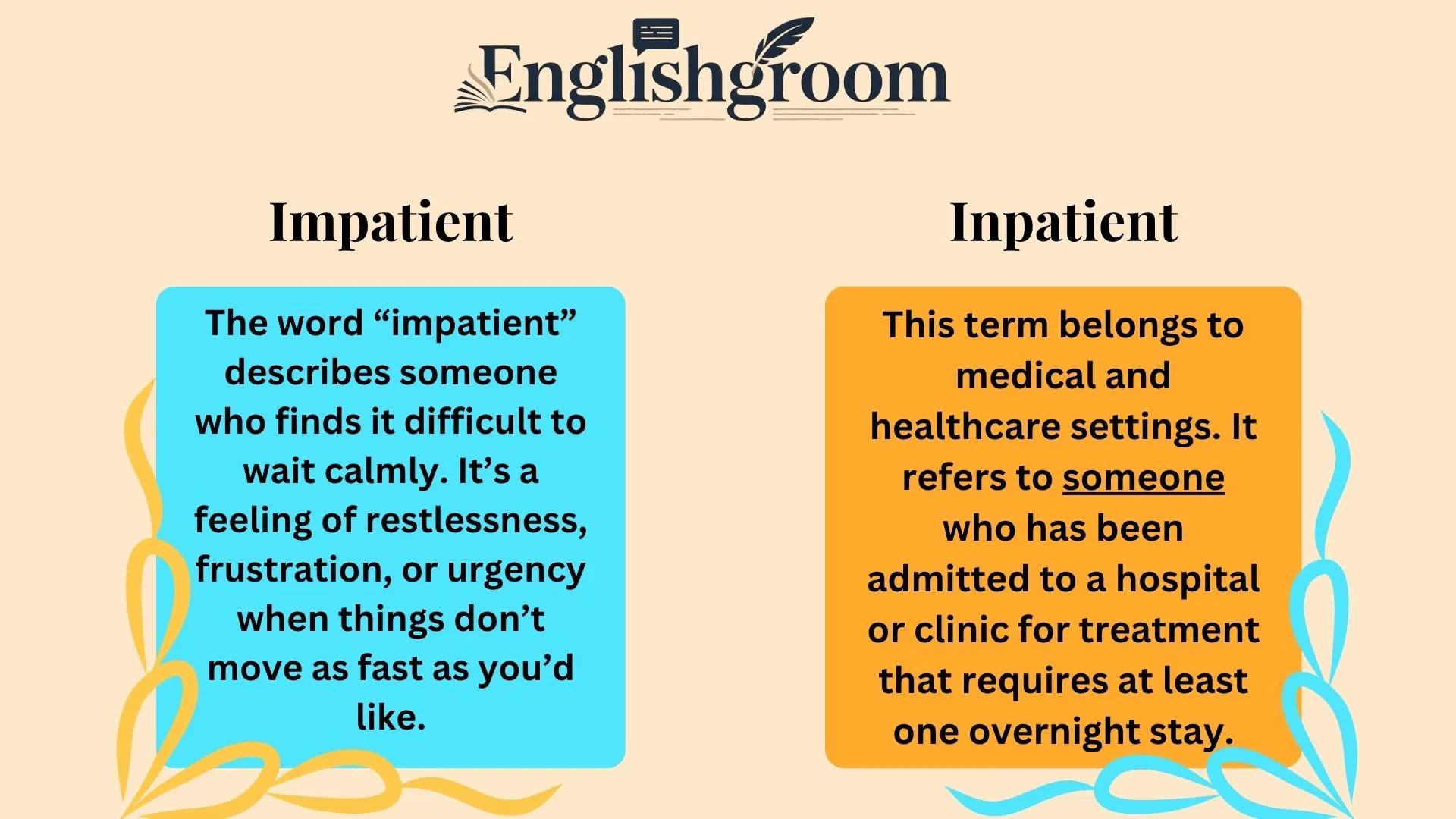
The word “impatient” describes someone who finds it difficult to wait calmly. It’s a feeling of restlessness, frustration, or urgency when things don’t move as fast as you’d like.
“She became impatient while waiting in the long checkout line.”
Emotional and Psychological Context
Being impatient often reveals a mix of emotions—anxiety, eagerness, and lack of tolerance. It can stem from personality traits, stress, or time pressure.
Common Causes of Impatience
- Delays: Slow traffic, long lines, waiting for results
- Technology: Slow internet, buffering videos, or lagging apps
- People: When others move or respond slowly
- Goals: Wanting quick success or instant gratification
A 2019 study in the Journal of Behavioral Science found that people with high impatience levels also experience higher stress. Impatience often leads to irritability, poor decision-making, and communication breakdowns.
Everyday Examples of “Impatient”
Here are situations where “impatient” fits naturally:
| Scenario | Sentence Example |
|---|---|
| Waiting for something | “He grew impatient waiting for his coffee.” |
| Teaching | “The teacher was impatient with the noisy class.” |
| Driving | “Drivers honked impatiently at the traffic jam.” |
| Online interactions | “People get impatient when websites load slowly.” |
You’ll notice that “impatient” always deals with feelings or attitudes, not places or people in medical care.
What “Inpatient” Actually Refers To
Now, let’s shift to “inpatient.” This term belongs to medical and healthcare settings. It refers to someone who has been admitted to a hospital or clinic for treatment that requires at least one overnight stay.
“The hospital admitted 20 inpatients after the storm.”
Inpatient vs. Outpatient
Understanding “inpatient” also means knowing its opposite—outpatient.
| Type | Definition | Example |
|---|---|---|
| Inpatient | A patient admitted to stay in a hospital for treatment | “She’s an inpatient recovering from surgery.” |
| Outpatient | A patient who receives medical care without being admitted overnight | “He visited the outpatient clinic for his check-up.” |
Inpatient can function as both a noun (“an inpatient”) and an adjective (“inpatient care”).
Real-World Usage of “Inpatient”
“Inpatient” appears frequently in:
- Hospital documents: “Inpatient services include room, meals, and nursing care.”
- Insurance forms: “Check if your plan covers inpatient surgery.”
- Healthcare discussions: “Inpatient rehab programs provide 24-hour supervision.”
Case Study: Inpatient Care Example
Case: John, 52, suffers from a heart condition.
Scenario: After a severe episode, doctors admit him for continuous monitoring and tests.
Outcome: John stays at the hospital for three nights.
Classification: John is an inpatient, because his treatment requires round-the-clock care.
Impatient vs. Inpatient: A Clear Comparison
| Feature | Impatient | Inpatient |
|---|---|---|
| Meaning | Feeling restless or short-tempered | Person admitted to a hospital |
| Part of Speech | Adjective | Noun / Adjective |
| Context | Emotions, behavior | Medicine, healthcare |
| Example Sentence | “She became impatient waiting for her turn.” | “The doctor is checking on the new inpatient.” |
| Root Words | in- (not) + patior (to endure) | in- (inside) + patient (person under care) |
| Common Pairing | “Impatient tone,” “impatient attitude” | “Inpatient ward,” “inpatient facility” |
Quick Summary:
If it describes a feeling, it’s impatient.
If it describes a hospital stay, it’s inpatient.
Etymology: The Origins of Both Words
Impatient
Derived from the Latin words in- (not) + patior (to endure or suffer).
So, “impatient” literally means “not enduring.”
Inpatient
Formed by combining in- (inside) + patient (a person receiving medical care).
Thus, “inpatient” means “a patient inside a medical facility.”
Even though both share “in-,” the prefixes come from different Latin roots and carry different meanings.
Common Mistakes and How to Avoid Them
People often make these simple errors:
| Mistake | Wrong Sentence | Correct Sentence |
|---|---|---|
| Confusing emotion with hospital term | “She’s an inpatient to see the movie.” | “She’s impatient to see the movie.” |
| Using wrong form in healthcare | “He’s an impatient at the hospital.” | “He’s an inpatient at the hospital.” |
| Mixing both | “The inpatient customer left angry.” | “The impatient customer left angry.” |
Pro Tip:
Spell-check won’t always catch this! Both are real words, so grammar tools might not flag them. Always read the sentence aloud—if it sounds emotional, use impatient. If it sounds medical, use inpatient.
How to Remember the Difference
Here are some quick and effective memory tricks to make sure you never mix them up again:
Mnemonics
- Impatient → “I’m emotional.”
Think of someone tapping their foot while waiting. - Inpatient → “In hospital.”
Imagine a patient lying in a hospital bed.
Visualization Trick
Picture this:
- Impatient = tapping your fingers on a table.
- Inpatient = lying in a hospital gown.
The clearer you visualize, the faster your brain remembers.
Grammar and Pronunciation Tips
| Word | Pronunciation | Stress | Usage |
|---|---|---|---|
| Impatient | /ɪmˈpeɪʃənt/ | Stress on the second syllable (PAY) | Always an adjective |
| Inpatient | /ˈɪnˌpeɪʃənt/ | Stress on the first syllable (IN) | Noun or adjective |
Grammar Tips
- Impatient never takes an article (“a” or “the”).
❌ “An impatient” → ✅ “An impatient person.” - Inpatient can take an article.
✅ “An inpatient was admitted.”
Pronouncing them carefully helps you hear the difference and avoid confusion when writing.
Common Questions People Ask
Can you be an impatient inpatient?
Yes, absolutely!
“The impatient inpatient demanded to see the doctor immediately.”
Here, the first describes emotion; the second describes hospital status.
Is “inpatient” ever hyphenated?
No. Always write it as one word. “In-patient” is outdated and rarely used in modern English.
Is “impatient” negative?
Not always. It can show eagerness or passion. For example:
“She’s impatient to start her new job.”
That’s excitement, not rudeness.
Is “inpatient” only for hospitals?
Mostly yes, but it can also apply to rehab centers or psychiatric facilities where overnight care is required.
What’s the plural of “inpatient”?
It’s inpatients. Example: “The hospital admitted 30 inpatients last night.”
FAQs
What is the main difference between impatient and inpatient?
Impatient refers to a feeling of restlessness or frustration, while inpatient refers to someone admitted to a hospital for treatment.
Can impatient be used as a noun?
No, “impatient” is always an adjective. You’d say “an impatient person,” not “an impatient.”
Is inpatient one or two words?
“Inpatient” is a single word. Avoid writing it as “in patient.”
How do I pronounce impatient vs. inpatient?
- Impatient: /ɪmˈpeɪʃənt/
- Inpatient: /ˈɪnˌpeɪʃənt/
Can I say someone is both impatient and an inpatient?
Yes! For example, “The impatient inpatient refused to wait for his lunch.”
Final Takeaway
When it comes to impatient vs. inpatient, the context determines everything.
- If it describes emotions or behavior, it’s impatient.
- If it refers to a person admitted for treatment, it’s inpatient.
Remember:
Feelings = impatient. Hospitals = inpatient.
Once you internalize that distinction, you’ll never second-guess yourself again.

Hi! I’m Sami, a 28-year-old content writer with a love for words and storytelling. Writing has always been my way of expressing ideas, sharing knowledge, and connecting with people. I enjoy creating engaging and well-researched content—whether it’s blogs, articles, or social media posts—that not only informs but also inspires readers. My goal is to turn complex ideas into clear, creative, and meaningful pieces of writing that leave a lasting impact.