Ever heard someone say, “I didn’t do nothing!” and wondered if that’s wrong?
Technically, it is — but it’s also a lot more interesting than a simple grammar mistake.
In this deep dive, you’ll learn why both “I didn’t do nothing” and “I didn’t do anything” exist, what makes one standard and the other slang, and how dialects, history, and context shape how we use them.
By the end, you’ll not only know which phrase to use — you’ll understand why it matters.
Why This Phrase Sparks Confusion
“I didn’t do nothing” sounds wrong to anyone taught formal grammar. Yet, millions of native speakers use it naturally.
So what’s happening here?
This phrase sits at the crossroads of grammar rules, regional speech, and linguistic evolution. It’s a small example of how English bends — and sometimes breaks — its own rules.
Understanding Negation in English
Let’s start with the basics.
Negation is how we turn a positive statement into a negative. We usually add words like not, no, never, or nothing to flip the meaning.
| Type | Example | Meaning |
|---|---|---|
| Positive | I did something. | You took an action. |
| Negative | I didn’t do anything. | You took no action. |
In English grammar, one negative marker is usually enough to make a sentence negative. When we use two, they often cancel each other out, turning the sentence positive — at least in formal English.
That’s where double negatives come into play.
What Double Negatives Really Mean
A double negative happens when two negative words appear in the same clause:
❌ I didn’t do nothing.
Here, didn’t (negative) + nothing (negative) technically equal a positive, so the literal meaning becomes I did something.
But that’s not how people actually use it.
In real-world speech, especially in some dialects, double negatives intensify the negative meaning. Instead of cancelling out, they reinforce it:
“I didn’t do nothing” → “I really didn’t do anything.”
That’s why context is crucial.
A Bit of History
Double negatives weren’t always taboo. In Middle English, they were normal. Writers like Chaucer and Shakespeare used them freely:
“Nor never none shall mistress be of it.” — Shakespeare, Love’s Labour’s Lost
Back then, piling negatives made speech more emphatic. The “rule” against double negatives came later, as grammarians tried to standardize English in the 18th century.
The Grammar Behind “Anything”
To understand the difference between “nothing” and “anything,” you need to know how indefinite pronouns work.
| Pronoun | Type | Example | Usage |
|---|---|---|---|
| Anything | Negative / Question | I didn’t do anything. | Used with a negative or question word. |
| Nothing | Negative only | I did nothing. | Used without another negative word. |
In short:
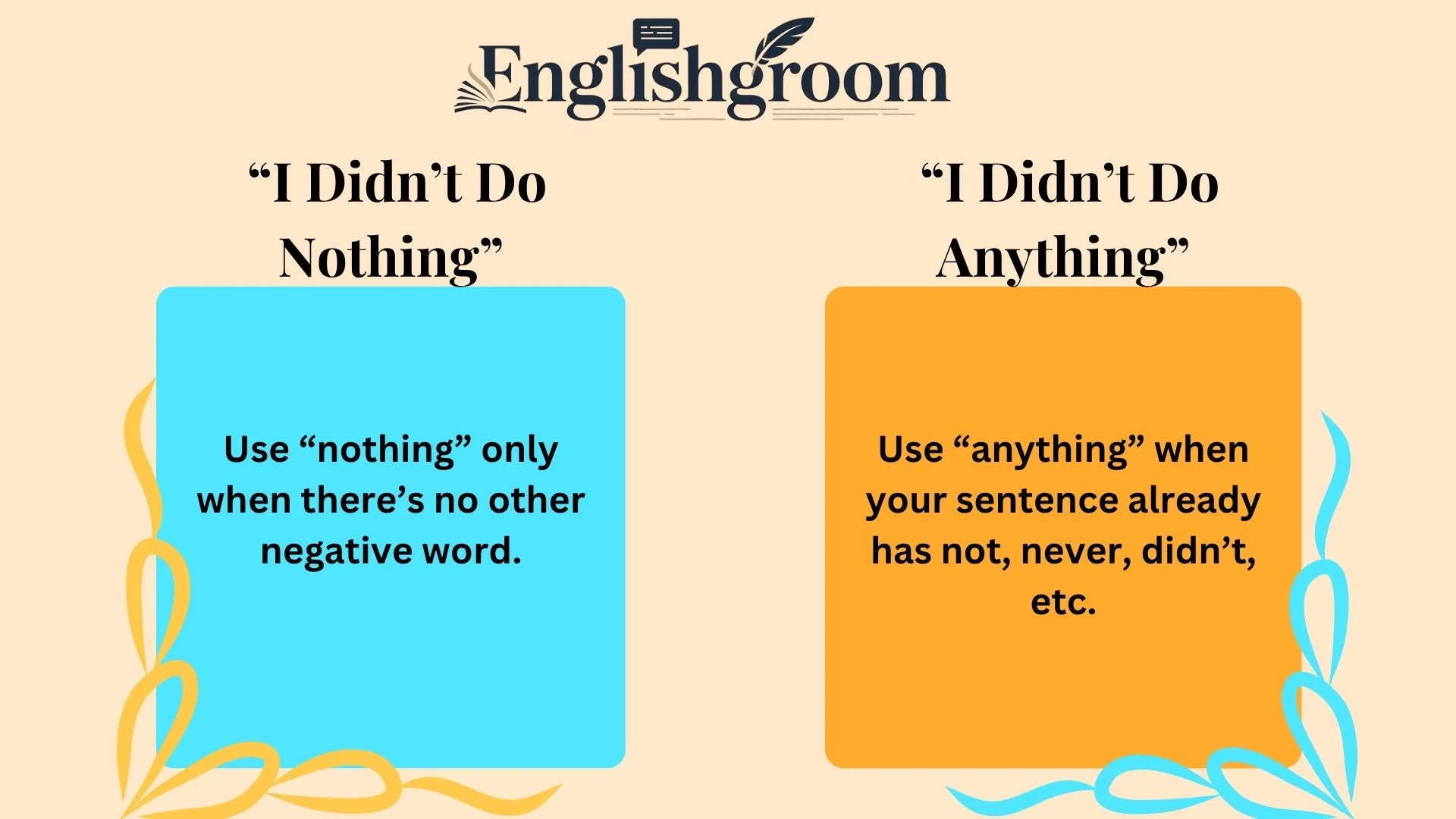
- Use “anything” when your sentence already has not, never, didn’t, etc.
- Use “nothing” only when there’s no other negative word.
Examples:
- ✅ I didn’t do anything.
- ✅ I did nothing.
- ❌ I didn’t do nothing.
So “anything” fits naturally with negative verbs, while “nothing” stands on its own.
Slang, Dialect, and the Real-World “I Didn’t Do Nothing”
Now, here’s where grammar meets culture.
Double negatives like “I didn’t do nothing” show up often in African American Vernacular English (AAVE), Southern American English, working-class British dialects, and urban slang.
In these varieties, the double negative doesn’t cancel — it emphasizes.
“I ain’t got no money.” → means “I have absolutely no money.”
Linguists call this negative concord — when multiple negatives express a single negative meaning.
It’s not “wrong.” It’s just different.
Cultural Context
- In AAVE, negative concord is a stable grammatical rule, not a mistake.
- In Southern English, it adds emphasis or emotion.
- In British Cockney, it’s part of local identity.
Quote: “Language isn’t just rules; it’s identity, rhythm, and history.” — Dr. Lisa Green, Linguist
So, “I didn’t do nothing” is nonstandard, but linguistically valid — it belongs to the people who use it.
Why “I Didn’t Do Anything” Is the Standard
Formal English, however, favors single negation for clarity.
That’s why “I didn’t do anything” is grammatically correct and universally accepted — in writing, academia, journalism, and professional settings.
Reasons It’s Preferred
- Clarity: No risk of misinterpretation.
- Consistency: Follows standard grammar rules.
- Professionalism: Expected in formal communication.
- Universality: Understood by all English speakers worldwide.
When writing emails, essays, or reports, “I didn’t do anything” keeps your tone neutral and correct.
Example:
“I didn’t do anything to cause the issue.” sounds clear and responsible.
“I didn’t do nothing to cause the issue.” sounds defensive or informal.
Common Misconceptions About Double Negatives
Many believe double negatives are “wrong English.” That’s a myth.
Here’s the truth: they’re ungrammatical in Standard English but grammatical in many dialects.
| Statement | Standard English | Dialectal English | Meaning |
|---|---|---|---|
| I didn’t do anything. | ✅ Correct | ✅ Correct | You did nothing. |
| I didn’t do nothing. | ❌ Incorrect | ✅ Acceptable | You did nothing (emphatic). |
Languages like Spanish, Italian, and Russian also use negative concord — multiple negatives to strengthen meaning:
- Spanish: No vi nada (“I didn’t see nothing”).
- Italian: Non ho fatto niente (“I didn’t do nothing”).
So English’s aversion to double negatives isn’t universal — it’s historical and cultural, not logical.
How Double Negatives Can Shift Meaning
Here’s where things get tricky — meaning depends on context and intonation.
| Sentence | Literal Meaning | Intended Meaning |
|---|---|---|
| I didn’t see nothing. | I saw something. | I saw nothing (emphatic). |
| I didn’t do nothing wrong. | I did something wrong. | I did nothing wrong. |
| I can’t get no rest. | I can get rest. | I can’t get any rest. |
When used in standard writing, double negatives confuse readers. But in speech, tone and rhythm clarify intention.
Case Study:
In 2018, a viral tweet read:
“I didn’t do nothing wrong but somehow I’m always blamed.”
Thousands resonated with it emotionally — not grammatically. The phrase conveyed frustration, not confusion.
That’s the difference between grammar and communication.
Regional and Cultural Influence
Language reflects geography and identity. The way you speak often says where you’re from.
Regional Usage
| Region | Example | Usage |
|---|---|---|
| Southern US | “Ain’t got no time.” | Common informal speech. |
| AAVE | “Didn’t do nothing.” | Grammatically consistent in dialect. |
| British (Cockney) | “I ain’t done nothing.” | Cultural marker. |
Sociolinguistic Note
- Double negatives can mark solidarity or group belonging.
- They’re often stigmatized by outsiders but perfectly normal within the group.
- Correctness is contextual, not absolute.
Quote: “Language isn’t broken; it’s just different.” — John McWhorter, Linguist and Author
Communicating Clearly in Any Context
So how do you decide when to say “I didn’t do nothing” or “I didn’t do anything”?
It depends on where, why, and to whom you’re speaking.
Professional and Academic Contexts
- Always choose “I didn’t do anything.”
- Keeps writing formal and clear.
- Avoids confusion and preserves credibility.
Casual or Cultural Contexts
- “I didn’t do nothing” can sound natural or emphatic in informal settings.
- Works fine in songs, movies, and personal conversations.
Quick Tips for Clarity
- ✅ Use “anything” in writing or formal speech.
- ✅ Use “nothing” alone (without another negative) when speaking plainly.
- ⚠️ Use double negatives only when stylistically intentional.
Example:
“I didn’t do nothing, officer!” — emotionally expressive, informal
“I didn’t do anything wrong.” — precise, professional
The choice depends on your audience and your goal.
Key Takeaways
- “I didn’t do anything” = grammatically correct, standard English.
- “I didn’t do nothing” = informal, dialectal, or emphatic.
- Double negatives once were normal in English.
- Some dialects still use them naturally today.
- In writing or formal speech, stick with single negatives for clarity.
Final Thought:
Learn the rules. Then decide when to bend them.
FAQs About “I Didn’t Do Nothing” vs “I Didn’t Do Anything”
Is “I didn’t do nothing” grammatically wrong?
In standard English, yes — it’s a double negative. But in dialects like AAVE or Southern English, it’s grammatical and expresses emphasis.
Why do people use double negatives?
They often use them to stress or strengthen the negative meaning. It’s a feature of natural speech in many dialects, not ignorance of grammar.
Did people always avoid double negatives?
No. In older English, they were perfectly acceptable. The ban came around the 18th century when grammarians standardized language rules.
Can I use “I didn’t do nothing” in writing?
Use it only in creative writing, dialogue, or when reflecting authentic speech. For formal writing, stick with “I didn’t do anything.”
Do other languages use double negatives?
Yes — Spanish (No tengo nada), Italian (Non ho visto niente), and French (Je n’ai rien fait) all use multiple negatives for one negative idea.
Conclusion
The difference between “I didn’t do nothing” and “I didn’t do anything” runs deeper than grammar.
One follows the rules; the other breaks them for expression, identity, and emphasis.
English isn’t static — it shifts with culture, region, and emotion. Knowing both forms helps you communicate clearly, write confidently, and understand people across dialects.
So next time you hear “I didn’t do nothing,” don’t rush to correct it.
Listen. It might be saying more than grammar ever could.

Hi! I’m Sami, a 28-year-old content writer with a love for words and storytelling. Writing has always been my way of expressing ideas, sharing knowledge, and connecting with people. I enjoy creating engaging and well-researched content—whether it’s blogs, articles, or social media posts—that not only informs but also inspires readers. My goal is to turn complex ideas into clear, creative, and meaningful pieces of writing that leave a lasting impact.