Last updated on February 12th, 2026 at 07:03 am
English can twist your tongue and test your patience. Words that sound identical but mean completely different things—like heard, herd, and hurd—often confuse even native speakers.
If you’ve ever paused mid-sentence wondering whether to write heard or herd, you’re not alone.
In this guide, you’ll discover exactly what each word means, why they sound the same, and how to remember them for good. Let’s clear the fog around these three homophones once and for all.
Why These Words Confuse So Many People
The confusion between heard, herd, and hurd comes down to sound. In most English dialects, they’re pronounced identically: /hɜːrd/. So, while your ears can’t tell the difference, your brain—and your writing—definitely should.
Let’s see why this happens.
Why Confusion Happens
Homophones Explained Simply
Homophones are words that sound alike but have different meanings and spellings. Think of to, too, and two—they sound identical, yet they’re used differently.
In English, homophones exist because our language borrows from many others: Old English, Latin, French, and Greek. Over centuries, words evolved in sound but not always in spelling. That’s how you end up with identical-sounding terms like heard, herd, and hurd.
The Root Cause: History and Sound Shifts
Old English had a tighter link between spelling and pronunciation. But as sounds shifted (the “Great Vowel Shift” between the 15th and 18th centuries), many words began sounding the same while keeping different spellings.
For instance, heard comes from the Old English “hierde”, while herd originated from “heord”. Their sounds merged over time, though their meanings stayed distinct.
Fun Fact Box: More Tricky Homophones
| Common Pair | Example | Meaning Difference |
|---|---|---|
| Their / There / They’re | “They’re going to their house over there.” | Possession / Location / Contraction |
| To / Too / Two | “I went to the store too, and bought two apples.” | Preposition / Also / Number |
| Piece / Peace | “Give me a piece of peace.” | Part of something / Calmness |
| Right / Write | “Write the right answer.” | Correct / To form letters |
Homophones are a normal part of English—but they demand attention in writing.
“Heard”: Meaning, Usage, and Examples
Let’s start with the most familiar one: heard.
Definition & Grammar Role
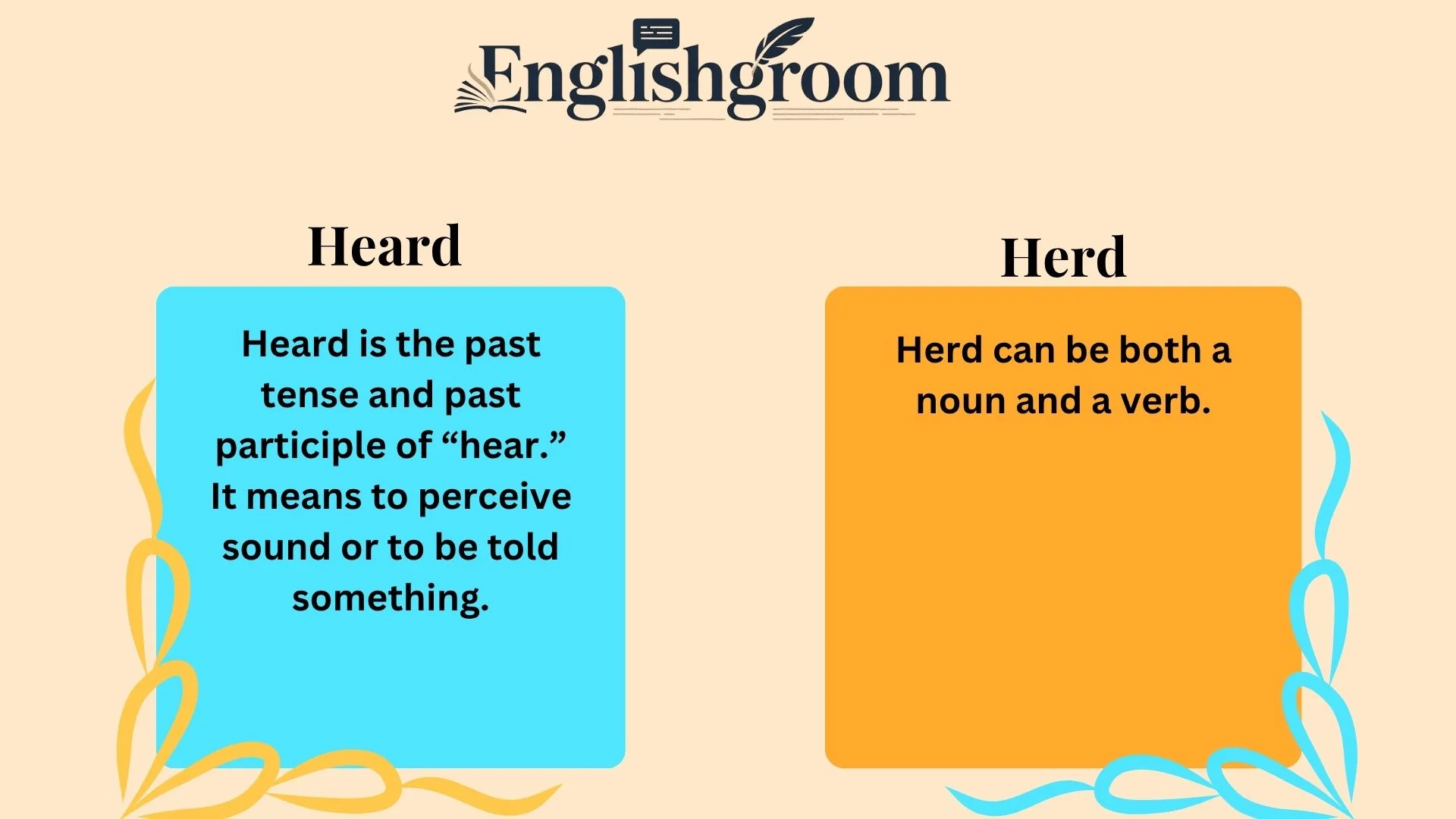
Heard is the past tense and past participle of “hear.”
It means to perceive sound or to be told something.
Examples:
- I heard a strange noise last night.
- She heard the news about the promotion.
- Have you heard from him lately?
You use heard when you’re talking about sound, listening, or information received through hearing.
Idioms and Common Phrases Using “Heard”
English is full of expressions using “heard.” Here are a few you’ll run into:
- “Heard it through the grapevine” — learned gossip or unofficial news.
- “Be heard” — to have your voice or opinion acknowledged.
- “You heard me” — used to emphasize certainty or confidence.
- “Loud and clear” — confirming understanding: “I heard you loud and clear.”
These idioms emphasize hearing as understanding—a subtle but powerful idea in communication.
Common Mistakes
Many people type herd instead of heard, especially when using voice-to-text or autocorrect. But remember this:
If it involves your ears or sound—it’s “heard.”
Quick Tip
Think of heard as containing ear. It’s literally about hearing.
hEARd → ear → sound.
“Herd”: More Than Just Cows
Now for herd, a word that paints vivid images of grazing animals or bustling crowds.
Definition & Grammar Role
Herd can be both a noun and a verb.

- As a noun: A large group of animals (or sometimes people).
- As a verb: To gather, move, or manage animals or people in a group.
Examples:
- The herd of elephants crossed the river.
- The teacher herded the students back into the classroom.
- Investors often follow the herd mentality during market booms.
Broader Meanings Beyond Animals
The term “herd” goes far beyond the farm.
- In business: “Herd behavior” describes how investors act collectively—often emotionally—rather than rationally.
- In society: “Following the herd” refers to conforming without independent thought.
- In psychology: “Herd mentality” explores why groups influence individual decisions.
Quote to remember:
“When you follow the herd, you step in what they leave behind.” – Anonymous
It’s a witty reminder that blind conformity can lead to poor choices.
Cultural Insight: Maasai Herders of East Africa
For the Maasai communities of Kenya and Tanzania, herding is central to life. Cattle aren’t just livestock—they’re wealth, status, and survival.
Maasai herders guide their cattle across wide plains, ensuring they find water and grass. Their deep bond with animals shows that herding is not just economic—it’s cultural and spiritual.
This real-world example reminds us that “herd” represents both livelihood and heritage.
Quick Tip
Link herd to herbivore. Both connect to animals, grass, and nature.
“Hurd”: The Rare but Real Word
You may not encounter hurd every day, but it’s a legitimate term.
Is “Hurd” a Real Word?
Yes. Though uncommon, “hurd” exists in English dictionaries. It has two main meanings.
Dictionary Meaning
- Plant Material:
Hurd (noun) refers to the woody inner core of flax or hemp stalks, used for building, insulation, and animal bedding.
Example: The factory processed hemp hurd for eco-friendly construction. - Surname:
It’s also a last name, found in English-speaking countries.
Example: Michael Hurd (1928–2006), British composer and author.
Why It Causes Confusion
Since hurd is rare in daily conversation, many assume it’s a typo for “herd” or “heard.” The identical pronunciation doesn’t help either.
Real-Life Usage Example
Hemp hurds (also called shives) are used in making hempcrete, a natural building material known for strength and sustainability. Farmers separate the hemp fibers from the hurd to create eco-friendly bricks.
Quick Tip
Think of hurd as hard—it refers to the solid, woody part of a plant.
hurD → harD core.
Pronunciation Breakdown
Even though heard, herd, and hurd have completely different meanings, they share identical pronunciation in most accents.
| Word | Phonetic (IPA) | Sounds Like | Example |
|---|---|---|---|
| Heard | /hɜːrd/ | “Hurd” | I heard the music. |
| Herd | /hɜːrd/ | “Hurd” | The herd moved west. |
| Hurd | /hɜːrd/ | “Hurd” | Hemp hurd is used for building. |
Why They Sound the Same
The vowel sound /ɜːr/ in American English neutralizes words like herd, bird, word, and heard. This “er” sound dominates regardless of spelling.
Regional Notes
In some British accents, “heard” may have a slightly softer vowel, but in most dialects—especially American—it’s identical across all three words.
Audio Tip
Read these aloud in a short sentence:
“I heard the herd stepped over the hurd.”
Hearing them in context helps you distinguish meaning, even when the sound doesn’t change.
Mnemonics & Memory Tricks
Learning homophones doesn’t need to be boring. Here are quick tricks to remember the difference:
| Word | Clue | Meaning | Example |
|---|---|---|---|
| Heard | Ear | Past of “hear” | I heard the bell ring. |
| Herd | Cows | Group or move | The herd gathered by the river. |
| Hurd | Hard | Plant fiber / surname | Hemp hurd is used in eco-building. |
Visual Trick
- Picture an ear inside “heard.”
- Picture a herd of cows in a field.
- Picture a hard plant stalk for “hurd.”
Quick Mnemonic
Heard with your ear,
Herd with the cow,
Hurd with the plant now.
When Mixing Them Up Actually Matters
Confusing these words might seem harmless—but it can cause problems in certain situations.
In Business
Writing “We herd about your company” in an email looks unprofessional. It signals carelessness and can damage credibility.
In Education
Students who confuse “heard” and “herd” lose marks in grammar exams or essays. Teachers often deduct points for misuse in context.
In Tech
Voice-to-text software often mishears “heard” as “herd,” creating embarrassing typos in texts, transcriptions, and captions.
Case Study: When Autocorrect Goes Wild
A company once sent an internal memo:
“We herd everyone’s suggestions about the new project.”
The typo went viral on social media, drawing jokes about employees being treated like cattle. A tiny mistake turned into a PR mishap—proof that homophones can matter more than you think.
Quick Reference Chart
| Word | Part of Speech | Meaning | Example | Common Use Area |
|---|---|---|---|---|
| Heard | Verb | Past of “hear” | I heard music playing. | Communication, Listening |
| Herd | Noun/Verb | Group or move animals/people | The herd crossed the field. | Agriculture, Sociology |
| Hurd | Noun | Plant fiber or surname | The factory processed hemp hurd. | Industry, Names |
Mastering the Difference
Practice Tips
- Write short sentences using all three words together.
Example: “I heard the herd running near the hemp hurd plant.” - Create flashcards—one side shows the word, the other its meaning.
- Use them in daily writing—comments, messages, notes.
- Read aloud—context is the key to clarity.
Mini Quiz: Pick the Right Word
| Sentence | Choose the Correct Word |
|---|---|
| I ___ the good news yesterday. | Heard |
| The ___ of sheep grazed peacefully. | Herd |
| The hemp ___ is useful for eco-construction. | Hurd |
| She ___ her students into the hall. | Herded |
| Have you ___ what he said? | Heard |
FAQs About Heard vs Herd vs Hurd
What is the difference between “heard” and “herd”?
Heard relates to sound—it’s the past tense of “hear.”
Herd refers to a group of animals or the act of gathering them.
Is “hurd” actually a real English word?
Yes. “Hurd” means the woody core of flax or hemp plants, and it’s also a surname.
Why do “heard,” “herd,” and “hurd” sound the same?
They all share the same vowel sound /ɜːr/ in American English, which neutralizes their pronunciation.
What are common phrases that use “heard”?
Examples include “heard it through the grapevine,” “be heard,” and “you heard me.”
How can I remember the difference easily?
Use this rule:
- Heard → Ear (sound)
- Herd → Cows (group)
- Hurd → Hard (plant)
Final Takeaway
Understanding the difference between heard, herd, and hurd is about more than grammar—it’s about clarity and confidence. English is full of sound-alike traps, but once you learn their meanings, you’ll write and speak with precision.
Next time you type one of these words, pause for a split second. Ask yourself: Am I talking about sound, animals, or hemp? That one question will always point you to the right choice.

Hi! I’m Sami, a 28-year-old content writer with a love for words and storytelling. Writing has always been my way of expressing ideas, sharing knowledge, and connecting with people. I enjoy creating engaging and well-researched content—whether it’s blogs, articles, or social media posts—that not only informs but also inspires readers. My goal is to turn complex ideas into clear, creative, and meaningful pieces of writing that leave a lasting impact.