If you’ve ever paused mid-sentence and wondered “Is it gluing or glueing?”, you’re not alone. This tiny spelling difference trips up students, writers, editors, DIY bloggers, and even professionals. It looks harmless. It feels logical. Yet one version is correct and the other quietly undermines your credibility.
This guide removes the doubt completely.
You’ll learn why “gluing” is correct, why “glueing” keeps showing up anyway, how English spelling rules actually work, and how to remember the right form without second-guessing yourself again.
No fluff. No filler. Just real grammar, real examples, and real clarity.
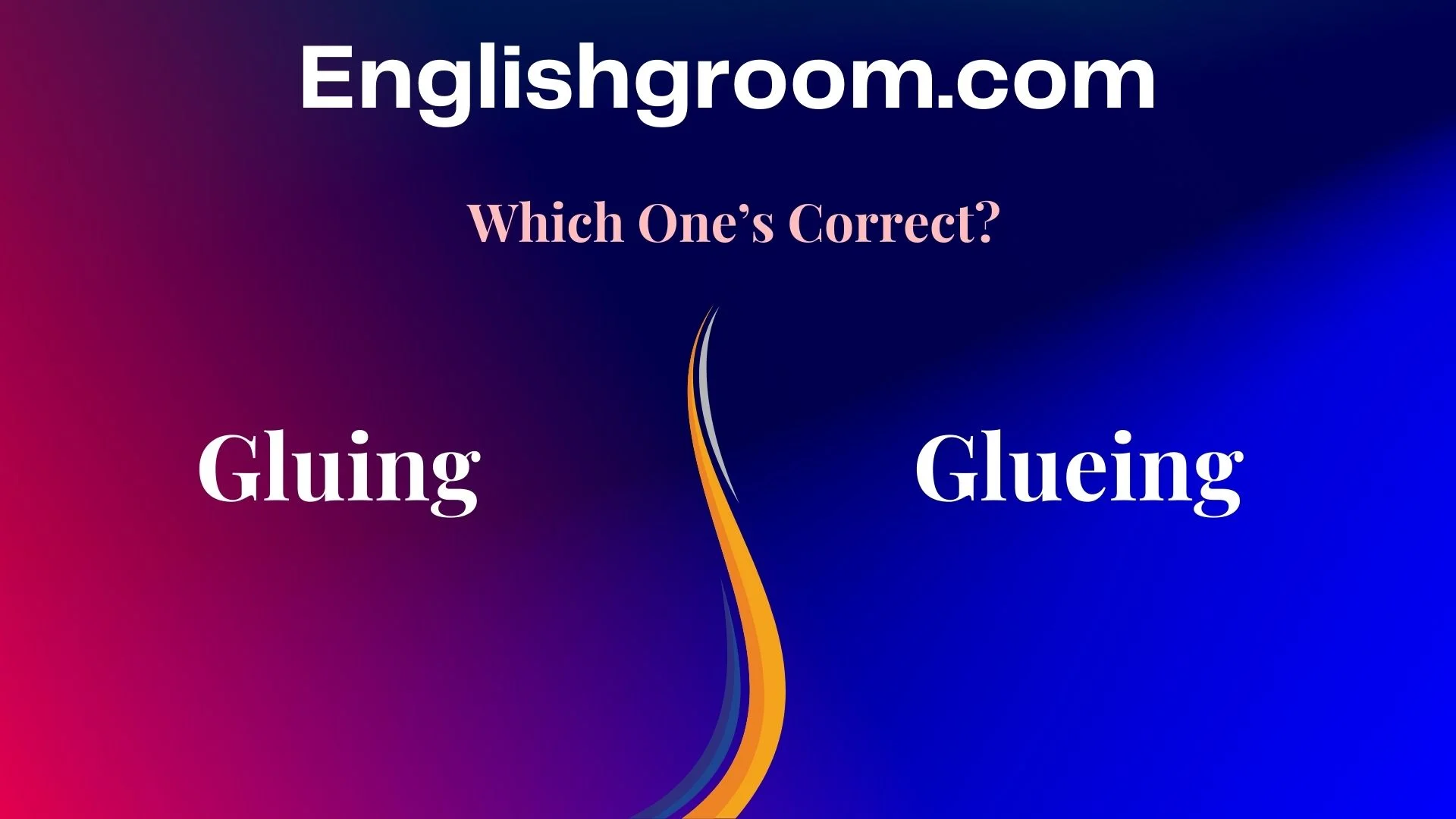
Gluing vs Glueing: The Quick Answer You Came For
Let’s clear the air immediately.

“Gluing” is correct.
“Glueing” is incorrect.
There are no regional differences, no style guide disagreements, and no modern exceptions. Every major dictionary and grammar authority agrees on this point.
If you remember nothing else, remember this:
Drop the silent “e” before adding “-ing.”
That single rule solves the problem entirely.
What “Gluing” Actually Means
Gluing is the present participle of the verb glue. It describes the action of joining materials using an adhesive.
You’ll see it used across many real-world contexts:
- Construction and carpentry
- Crafting and hobbies
- Manufacturing and packaging
- Writing and metaphorical language
Examples of correct usage
- I’m gluing the broken handle back onto the mug.
- They’re gluing panels together on the assembly line.
- She spent the afternoon gluing photos into a scrapbook.
In every case, gluing follows standard English spelling rules. Nothing unusual happens here.
What “Glueing” Looks Like — and Why It Feels Right
Here’s where confusion sneaks in.
The base word glue already ends with an “e.” Many writers assume that keeping the “e” preserves pronunciation. Visually, glueing feels safer. It looks complete.
But English spelling doesn’t work that way.
This same instinct causes mistakes like:
- makeing instead of making
- writeing instead of writing
- comeing instead of coming
Your brain wants symmetry. English wants rules.
Spellcheck sometimes misses glueing because it resembles valid word structures. That false sense of approval lets the error spread quietly.
Correct vs Incorrect Usage Side by Side
Seeing the difference makes everything click.
| Sentence | Correct? | Why |
|---|---|---|
| I am gluing the pieces together. | ✅ Yes | Silent “e” dropped |
| I am glueing the pieces together. | ❌ No | Extra “e” breaks rule |
| She finished gluing the model. | ✅ Yes | Standard verb formation |
| He spent hours glueing wood panels. | ❌ No | Not recognized spelling |
Once your eye adjusts, glueing starts to look wrong. That’s a good sign.
The Grammar Rule Behind Gluing vs Glueing
This entire debate comes down to one fundamental spelling rule.
Dropping the Silent “E” Before Adding “-ing”
In English, when a verb ends in a silent “e,” you remove that “e” before adding “-ing.”
Examples you already use without thinking:
- make → making
- write → writing
- hope → hoping
- drive → driving
Glue follows the same pattern.
- glue → gluing
No special handling. No exceptions triggered.
Why This Rule Exists in English
English spelling aims to preserve pronunciation clarity and visual efficiency.
Keeping the “e” in glueing adds nothing useful. The pronunciation stays the same. The extra letter only complicates the word.
Historically, English simplified these forms to:
- Reduce redundant letters
- Standardize verb endings
- Improve reading flow
That’s why modern English prefers gluing over glueing every time.
When You Keep the “E” — And Why Glue Isn’t One of Those Words
There are moments when English keeps the final “e” before “-ing.” This is where people get confused.
Legitimate exceptions include words like:
- dye → dyeing
- cue → cueing
- eye → eyeing
In these cases, dropping the “e” would change pronunciation or meaning.
- dying ≠ dyeing
- cuing could confuse readers
Why glue does not qualify
Dropping the “e” from glue does not change pronunciation.
Gluing still sounds exactly like glue-ing.
That’s why the exception does not apply.
Historical Usage: Did “Glueing” Ever Exist?
You might see claims that “glueing” appeared in older texts. That’s technically true. It doesn’t help its case.
Before spelling became standardized, writers spelled words phonetically. Variants existed everywhere.
During the 18th and 19th centuries:
- Dictionaries began enforcing consistency
- Printing required standard spellings
- Grammar rules solidified
As a result, gluing became the accepted form and glueing faded out.
Modern usage does not recognize glueing as valid.
American English vs British English: Same Rule, Same Result
This confusion often sparks a regional myth.
Let’s settle it clearly.
- American English: gluing
- British English: gluing
- Canadian English: gluing
- Australian English: gluing
There is no dialect where glueing is correct today.
The rule transcends regional spelling differences like color vs colour or organize vs organise.
What Major Style Guides Say About Gluing vs Glueing
Professional writing leaves no room for debate here.
All major authorities agree on one spelling.
Accepted by:
- Merriam-Webster Dictionary
- Oxford English Dictionary
- Chicago Manual of Style
- Associated Press Stylebook
They list gluing as correct and glueing as a misspelling.
Editors treat glueing the same way they treat alot or definately.
Why “Glueing” Is Considered a Spelling Error Today
Modern English relies on consistency. Words that fall outside recognized rules raise red flags.
Using glueing can signal:
- Weak grammar fundamentals
- Overreliance on phonetic spelling
- Lack of professional editing
In academic, technical, and commercial writing, that single extra letter can quietly erode trust.
Real-World Case Study: One Letter That Cost Credibility
A packaging manufacturer once published assembly instructions with the phrase:
“Begin glueing the flaps together.”
Customers noticed. Complaints followed. The error spread across product reviews.
Why did it matter?
- The company sold precision-engineered products
- Spelling mistakes suggested carelessness
- Trust dropped over something small but visible
After revising the documentation to gluing, the issue disappeared.
Details matter. Readers notice.
Related Words With Tricky “-ing” Forms
Learning patterns beats memorization.
| Base Word | Correct “-ing” Form | Rule Applied |
|---|---|---|
| Glue | gluing | Drop silent “e” |
| Make | making | Drop silent “e” |
| Dye | dyeing | Keep “e” to preserve meaning |
| Cue | cueing | Keep pronunciation |
| Age | aging | Drop silent “e” |
| True | truing | Drop silent “e” |
Once you see the pattern, gluing becomes automatic.
Memory Tricks That Actually Work
Forget mnemonics that don’t stick. Use logic instead.
Visual trick:
Picture the word glue melting slightly. The “e” slides off as action begins.
Rule shortcut:
If removing the “e” doesn’t change how the word sounds, remove it.
Sound check:
Say it out loud.
Gluing.
Not glue-ing.
Your ear already knows the answer.
Quick Reference Table: Gluing vs Glueing
| Form | Status | Reason |
|---|---|---|
| Gluing | ✅ Correct | Follows standard rule |
| Glueing | ❌ Incorrect | Unnecessary extra “e” |
FAQs About Gluing vs Glueing
Is it gluing or glueing?
Gluing is the correct spelling. Glueing is incorrect in modern English.
Why is glueing wrong?
It violates the rule that removes silent “e” before adding “-ing.”
Do Americans and Brits spell it differently?
No. Both use gluing exclusively.
Are there any exceptions for glue?
No. Glue does not qualify for any “keep the e” exception.
How can I remember the correct spelling?
Drop the silent “e” unless removing it changes pronunciation.
Final Takeaway
English spelling feels chaotic at times. This isn’t one of those moments.
Gluing is correct. Glueing is not.
Once you understand the silent “e” rule, the confusion disappears. You’ll spot the mistake instantly. More importantly, you’ll never make it again.
Small details shape how readers perceive your writing. Getting them right builds confidence without saying a word.

Hi! I’m Sami, a 28-year-old content writer with a love for words and storytelling. Writing has always been my way of expressing ideas, sharing knowledge, and connecting with people. I enjoy creating engaging and well-researched content—whether it’s blogs, articles, or social media posts—that not only informs but also inspires readers. My goal is to turn complex ideas into clear, creative, and meaningful pieces of writing that leave a lasting impact.