Last updated on February 19th, 2026 at 09:22 am
When you’re polishing your writing, a tiny spelling choice can make a big difference. “Forgo” and “forego” look almost identical, sound the same, and even share historical roots.
Yet, their meanings have diverged over time—and using the wrong one can make your writing feel off-key.
This guide will clear up the confusion once and for all. You’ll learn the true difference between forgo and forego, see real examples, explore their origins, and master simple tricks to remember which one fits your sentence.
Quick Overview: Why “Forgo vs. Forego” Matters
Most people use forgo and forego interchangeably. But in professional writing—legal, academic, or journalistic—accuracy matters. These two verbs carry distinct meanings:
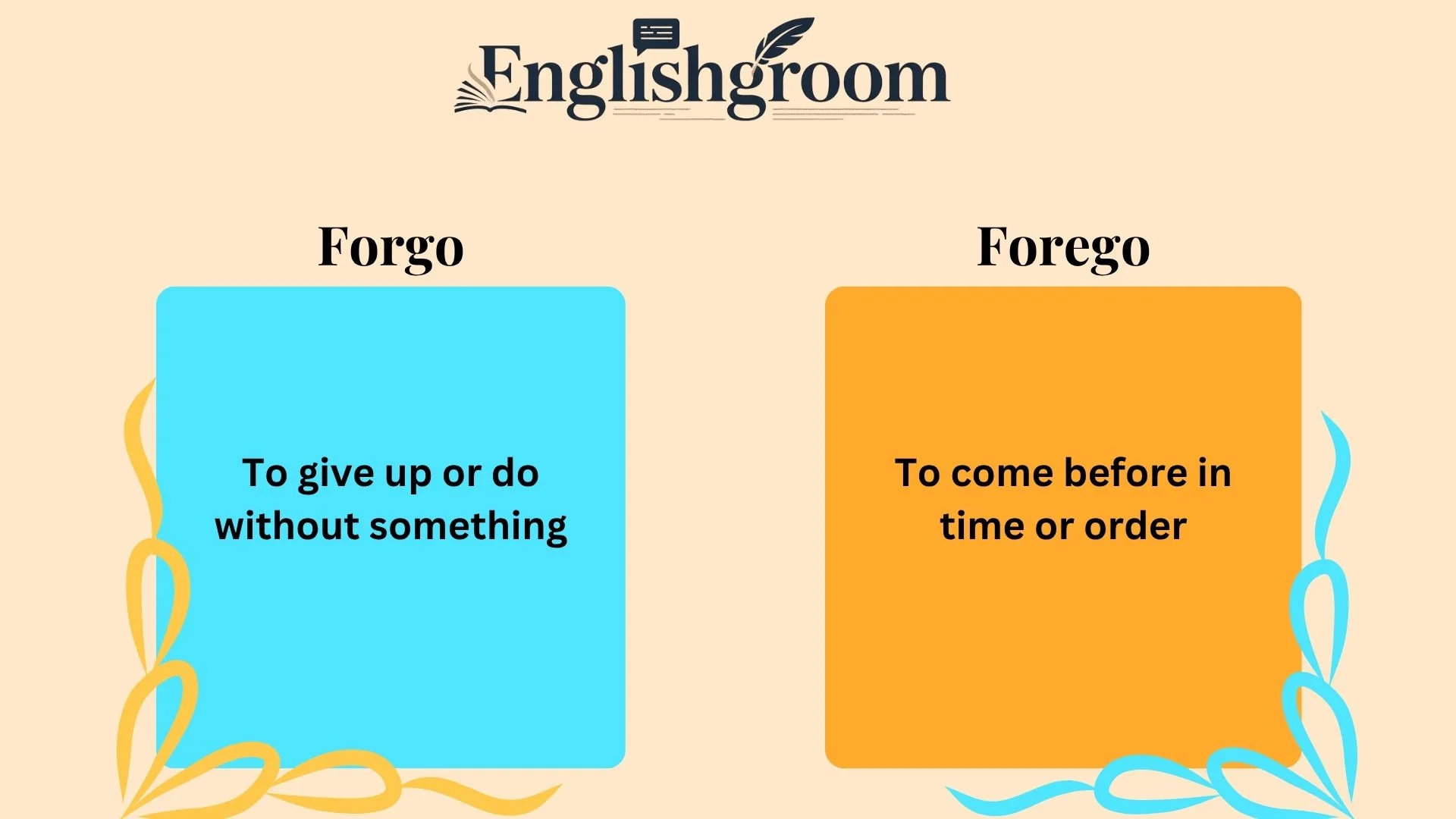
| Word | Meaning | Example |
|---|---|---|
| Forgo | To give up or do without something | She decided to forgo dessert after dinner. |
| Forego | To come before in time or order | The introduction foregoes the main argument. |

At first glance, that one little e might seem harmless. But just like mixing up affect and effect, it can change your entire sentence.
In short: forgo = give up, forego = precede.
Definitions and Core Meanings
Let’s unpack both words in detail.
Forgo — The Act of Giving Up
Forgo means to abstain from, go without, or give up something voluntarily. It often involves self-control or sacrifice.
Examples:
- I’ll forgo my vacation this year to save money.
- They chose to forgo the bonus in favor of more time off.
You’ll mostly find “forgo” in contexts of restraint—like skipping, declining, or refraining.
Synonyms include:
- Skip
- Abstain from
- Relinquish
- Waive
- Renounce
Forego — To Come Before
Forego means to go before or to precede in time or order. It’s about sequence, not sacrifice.
Examples:
- The discussions that forego the conference are essential for preparation.
- Several studies forego the main research paper.
Synonyms include:
- Precede
- Anticipate
- Lead
- Go before
Even though both words share pronunciation, their functions differ sharply—one is about time (forego) and the other about choice (forgo).
Etymology: How the Words Split
To understand their modern meanings, it helps to trace their origins.
| Word | Origin | Root Meaning |
|---|---|---|
| Forgo | Old English forgān (“to pass over, go without”) | for- meaning “away” + gān (“go”) |
| Forego | Old English foregān (“to go before”) | fore- meaning “before” + gān (“go”) |
Both share the root gān (“to go”), but their prefixes—for- and fore-—give them opposite senses.
Over centuries, the similar pronunciation blurred the line between them. By the 1600s, some writers even used them interchangeably. But by the late 19th century, grammarians began insisting on separate spellings, giving us today’s clear distinction.
Usage Evolution: Modern vs. Historical Preferences
Language evolves, and so does spelling preference. Historically, forego was more common in both meanings. However, by the 20th century, English speakers began favoring forgo for the “give up” sense.
Modern Usage Trends:
- “Forgo” dominates everyday and academic writing.
- “Forego” survives mainly in idioms like foregone conclusion.
- Major dictionaries (Merriam-Webster, OED) mark forego as a separate, time-related verb.
Example from literature:
“I will forgo the comforts of the city for the wilderness.” — Jack London
Example from historical use:
“The feast that did forego the war.” — William Shakespeare
Today, you’ll rarely see forego outside of specific phrases or formal prose.
When to Use Each: Practical Grammar Rules
When in doubt, apply this simple rule:
| Context | Use | Example |
|---|---|---|
| Giving up, skipping, or abstaining | Forgo | I decided to forgo caffeine for a week. |
| Describing something preceding another | Forego | The speeches that forego the event were brief. |
Grammar Rule of Thumb:
If it means go without, choose forgo.
If it means go before, choose forego.
You can also remember that fore- relates to before, while for- often signals away or off.
Mnemonics to Remember the Difference
Here are a few easy tricks that actually work:
- Forgo = Forget or Give up.
Both start with for-, meaning you’re letting something go. - Forego = Before.
Both share fore-, meaning “earlier” or “in front.” - Visual Memory Trick:
Picture two roads:- One foregoes the other—it goes before.
- One forgoes something—it goes without it.
Real-World Examples and Sentence Comparison
Let’s put both into context so you can spot them instantly.
| Sentence | Correct Word | Explanation |
|---|---|---|
| He decided to ___ dessert. | Forgo | He’s giving it up. |
| The ceremonies that ___ the main event were long. | Forego | They came before. |
| She chose to ___ her salary for equity. | Forgo | She’s foregoing (giving up) salary. |
| The remarks that ___ the meeting set the tone. | Forego | They precede the meeting. |
Case Study: A Corporate Email
Incorrect: “Please forego your breaks during this rush period.”
Correct: “Please forgo your breaks during this rush period.”
(You’re not asking them to come before breaks, you’re asking them to skip breaks.)
The Expression “Foregone Conclusion” Explained
You’ve probably heard the phrase “a foregone conclusion.”
It’s one of the few surviving cases where “forego” (or its past participle foregone) retains its original form.
Meaning:
A result that’s certain to happen; an inevitable outcome.
Example:
- It’s a foregone conclusion that they’ll win the election.
Origin:
The phrase comes from Shakespeare’s Othello (1604):
“’Tis a foregone conclusion.”
In that line, foregone literally means gone before—a decision already made before events unfold.
Note:
You’ll never see “forgone conclusion” in standard English. It’s always foregone conclusion because it refers to something that has come before.
Related Terms and Synonyms
Here’s a reference list to help you switch up your vocabulary:
| For Forgo | For Forego |
|---|---|
| Skip | Precede |
| Relinquish | Anticipate |
| Waive | Lead |
| Abstain | Go before |
| Surrender | Herald |
These synonyms work depending on tone. Forgo often shows restraint, while forego feels more formal or chronological.
Common Mistakes and Misconceptions
Even experienced writers mix these up. Here’s why—and how to avoid it.
1. Spelling Confusion
Because both sound the same, autocorrect often replaces one with the other. Always double-check.
2. Misusing “forego” for “forgo”
Many people think “forego” looks fancier. But in modern writing, using it incorrectly can signal poor editing.
3. Regional Differences
Both American and British English prefer “forgo” for give up. The distinction is consistent worldwide.
4. Mixing Up Verb Forms
| Base | Past | Participle |
|---|---|---|
| Forgo | Forgoed / Forgone | Forgone |
| Forego | Forewent | Foregone |
Example:
- She has forsworn caffeine → wrong (different verb).
- She has forgone caffeine → correct.
5. Overlooking Context
Think about what you’re describing:
- If you’re talking about time order, use forego.
- If you’re talking about sacrifice, use forgo.
Frequently Asked Questions
What’s the simplest way to tell “forgo” and “forego” apart?
Remember: Forgo = Give up, Forego = Come before. If your sentence involves skipping or abstaining, it’s “forgo.” If it’s about sequence, it’s “forego.”
Is “forego” becoming obsolete?
Not obsolete, but rare. You’ll mostly see it in fixed expressions like foregone conclusion or formal writing.
Can I write “foregoing dessert”?
Yes, if you mean giving up dessert—but that’s actually “forgoing dessert.” “Foregoing dessert” would technically mean the dessert that came before.
Are “forgone” and “foregone” the same?
No. Forgone is the past participle of forgo, meaning given up. Foregone is from forego, meaning gone before.
Which is correct: “foregone opportunity” or “forgone opportunity”?
Forgone opportunity. It means a missed or given-up opportunity.
Quick Reference Summary
To make it foolproof, here’s your decision table:
| Meaning | Word | Example |
|---|---|---|
| Give up / skip / abstain | Forgo | I decided to forgo lunch. |
| Go before / precede | Forego | Introductory remarks forego the speech. |
| Expression | Foregone conclusion | It’s a foregone conclusion they’ll win. |
Pro Tip: Add this rule to your grammar checklist—just like affect/effect or then/than. Mastering it instantly makes your writing look more polished.
Additional Resources for Deep Dives
If you want to explore this topic further, these references will deepen your understanding:
- Merriam-Webster Dictionary
- Oxford English Dictionary
- Grammarly Grammar Blog
- The Chicago Manual of Style — Sections on word choice and common confusions
- Garner’s Modern English Usage — Discussion on homophones and variant spellings
Learn More English With These Best Articles:
Unselect vs Deselect: What’s the Right Word to Use in UX and Everyday Writing?
Brite vs Bright: What’s the Real Difference and When to Use Each?
Invision vs Envision: Why People Confuse Them and What You Should Really Use
By Which or In Which? The Complete Grammar Guide You’ll Never Forget
“At the House” vs. “In the House”: The Subtle Grammar Rule Everyone Gets Wrong
Final Thoughts
Choosing between forgo and forego isn’t about pedantry—it’s about precision. Good writing lives in the details. When you use the right word, readers instantly trust your authority.
Next time you’re unsure, ask:
Am I talking about giving something up, or about something that came before?
If it’s the first, forgo it.
If it’s the second, forego it.
It’s a small choice that shows big command of language—and your readers will notice.

Hi! I’m Sami, a 28-year-old content writer with a love for words and storytelling. Writing has always been my way of expressing ideas, sharing knowledge, and connecting with people. I enjoy creating engaging and well-researched content—whether it’s blogs, articles, or social media posts—that not only informs but also inspires readers. My goal is to turn complex ideas into clear, creative, and meaningful pieces of writing that leave a lasting impact.