Last updated on February 21st, 2026 at 07:02 am
Have you ever paused mid-sentence wondering whether to say extensible or extendible? You’re not alone. These two words look similar, share the same root, and even sound almost identical—but they don’t mean the same thing. The distinction matters, especially in professional writing, engineering, and software development.
This guide dives deep into the real difference between extensible and extendible—their origins, contexts, and usage in modern English. You’ll see how choosing the right one shapes clarity, accuracy, and credibility in your writing.
Why These Two Words Cause Confusion
At first glance, extensible and extendible appear to be twins—both derived from “extend.” Yet one belongs mostly to the world of software, systems, and technology, while the other fits best in physical, tangible contexts.
Most confusion stems from modern English simplifying spellings and pronunciations. People assume they’re interchangeable, but professionals know that in tech, a misused term can signal inexperience.
In short:

- Extensible = capable of expanding in capability or function.
- Extendible = capable of lengthening in size or reach.
Let’s dig into how that distinction evolved.
Etymology and Historical Context
Both words trace back to the Latin verb extendere, meaning to stretch out. From this root, English developed “extend,” “extension,” and later “extensible” and “extendible.”
| Word | Origin | Earliest Recorded Use | Common Context |
|---|---|---|---|
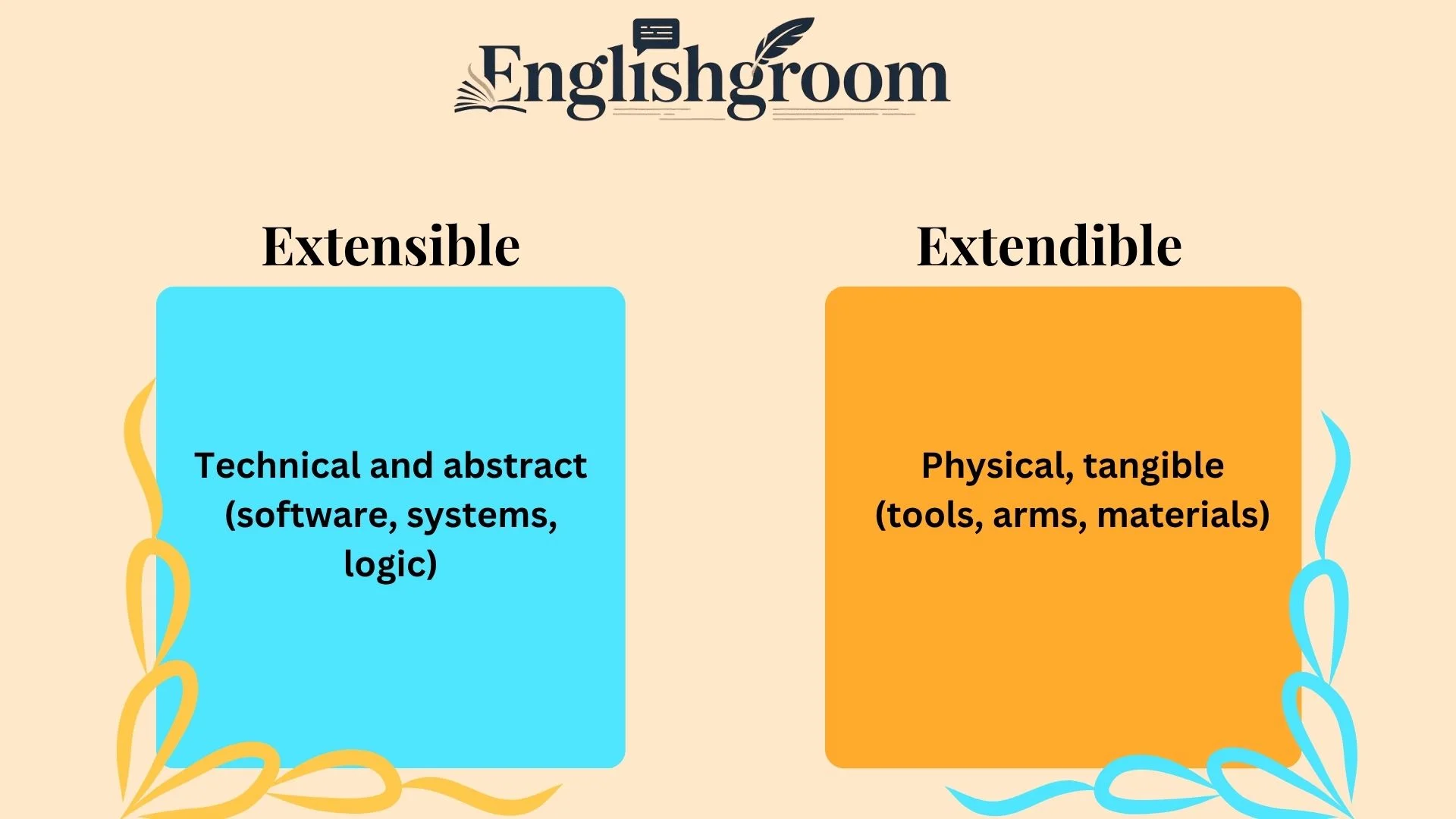
| Extensible | From Latin extendere + suffix -ible (capable of) | 15th century | Technical and abstract (software, systems, logic) |
| Extendible | Variant of the same Latin root | 16th century | Physical, tangible (tools, arms, materials) |
As the English language evolved, both forms survived but took separate paths:
- Extensible became common in technical writing and systems design, especially during the computer revolution of the 20th century.
- Extendible remained in engineering, physics, and mechanics, describing literal extension.
Interestingly, both forms are grammatically correct—but usage decides which feels right.
Definitions and Core Meanings
Here’s a quick look at how major dictionaries define these terms:
| Term | Definition | Typical Context | Example |
|---|---|---|---|
| Extensible | Capable of being extended in scope or functionality. | Software, programming, systems, frameworks | “The app is extensible through third-party plug-ins.” |
| Extendible | Capable of being physically lengthened or stretched. | Tools, devices, materials, mechanics | “The extendible ladder can reach up to 12 feet.” |
Both words express growth or expansion—but in different dimensions:
- Extensible = functional expansion (non-physical growth).
- Extendible = spatial expansion (physical growth).
Key Differences at a Glance
| Feature | Extensible | Extendible |
|---|---|---|
| Focus | Expansion of features, capabilities, or functionality | Expansion of length, reach, or size |
| Common Fields | Software, information systems, APIs, architecture | Mechanics, product design, tools |
| Nature | Abstract or digital | Physical or tangible |
| Example | “Extensible markup language” | “Extendible handle of a suitcase” |
| Formality Level | Common in technical documentation | Common in industrial and engineering contexts |
| Associated Concept | Modularity and adaptability | Flexibility and mobility |
Extensibility in Software, Systems, and Design
What Is Extensibility?
In technology, extensibility refers to the design principle that allows a system to grow without major structural changes. It means developers can add new features or modules without rewriting existing code.
Think of an extensible system like a house with extra rooms ready for future expansion. You can add a new wing without tearing down the original walls.
How Extensibility Works
Extensibility in software typically involves:
- Plug-in architectures (e.g., WordPress, VS Code extensions)
- APIs (Application Programming Interfaces)
- Modular code design
- Dynamic data models
Each of these allows systems to grow seamlessly as new requirements arise.
Case Study: XML — The Extensible Markup Language
When XML was created, its name itself showcased its purpose: extensible.
XML allows developers to define new tags and structures to suit different data formats. This flexibility is why XML became foundational for web development, document storage, and data interchange.
Benefits of Extensibility
- Future-proofing: Easier to adapt to new requirements.
- Customizability: Users can add features to meet specific needs.
- Cost-effectiveness: Reduces redevelopment costs.
- Interoperability: Supports third-party integrations.
“Extensible systems grow with their users, not against them.”
Extendibility in Physical and Mechanical Contexts
While extensible dominates the digital world, extendible rules the physical one.
What Is Extendibility?
Extendibility refers to an object’s ability to stretch, elongate, or lengthen physically without losing integrity or functionality.
Common Applications
- Tools and Equipment: Extendible ladders, mops, antennas.
- Engineering and Robotics: Extendible arms in manufacturing robots.
- Everyday Objects: Extendible selfie sticks or telescopic fishing rods.
Each example involves physical extension, not abstract expansion.
Real-World Example
Consider an extendible camera tripod. It can expand from 2 feet to 5 feet, adapting to different shooting needs. The term “extensible tripod” would sound wrong—it’s not adding features, it’s just getting longer.
Technical Insight
Extendible objects must maintain:
- Structural integrity when extended.
- Durability after repeated expansions.
- Portability for user convenience.
That’s why manufacturers specify extendible range or extension capacity in product specs.
Linguistic Nuances and Modern Usage Trends
Dictionary Entries
Both extensible and extendible appear in Oxford, Cambridge, and Merriam-Webster. While they define both similarly, context determines preference.
- Merriam-Webster: “Extensible – capable of being extended or protruded.”
- Oxford: “Extendible – able to be extended in length or scope.”
In tech documentation, extensible dominates because it implies functional expansion. In product manuals or patents, extendible remains standard.
Corpus and Usage Data
Analyzing modern English corpora shows:
- “Extensible” is used 5x more often in software and computing contexts.
- “Extendible” remains common in mechanical and physical design.
Regional Differences
- British English: Slightly prefers extendible in both abstract and physical contexts.
- American English: Distinguishes clearly—extensible for software, extendible for physical.
Subtle Overlaps
Sometimes, either term could fit. For example:
- A robotic arm can be described as extendible because it lengthens physically, or extensible if it supports new attachments or functions.
- The context dictates which nuance dominates.
Choosing the Right Term
Using the correct term signals expertise. Here’s a quick guide:
| If You’re Talking About… | Use Extensible | Use Extendible |
|---|---|---|
| Software architecture | ✅ | ❌ |
| Programming frameworks | ✅ | ❌ |
| Application plug-ins | ✅ | ❌ |
| Ladders, rods, arms | ❌ | ✅ |
| Telescopic tools | ❌ | ✅ |
| APIs or code modules | ✅ | ❌ |
Common Mistakes
- ❌ “The ladder is extensible.”
- ✅ “The ladder is extendible.”
- ❌ “We built an extendible API.”
- ✅ “We built an extensible API.”
These nuances may seem small, but they matter. Using the wrong term in documentation can confuse readers or undermine your professional credibility.
Summary Table: Extensible vs. Extendible
| Aspect | Extensible | Extendible |
|---|---|---|
| Meaning | Capable of being expanded or enhanced | Capable of being lengthened or stretched |
| Used In | Software, architecture, design | Physical tools, products, mechanics |
| Type of Expansion | Functional or modular | Physical or spatial |
| Example | Extensible software platform | Extendible antenna |
| Synonyms | Scalable, modular, adaptable | Adjustable, telescopic, lengthening |
FAQs
What does “extensible” mean in software?
It refers to a system designed to be easily expanded with new features, modules, or plug-ins without major changes to the original code.
Can I use “extendible” instead of “extensible” in tech writing?
Not recommended. “Extendible” usually refers to physical length, while “extensible” is the accepted term for digital or logical expansion.
Is one word more correct than the other?
Both are correct English words. The distinction depends on context—technical vs. physical.
Why is XML called “Extensible Markup Language”?
Because XML lets users define new tags and structures—it’s built to expand functionally, not physically.
Are the two words interchangeable in everyday use?
Only rarely. In casual speech, people might not notice, but in professional writing, the distinction matters.
Conclusion
Language thrives on precision. Extensible and extendible both describe expansion, yet in different realms—one digital, one physical.
In technology, extensibility defines how software grows intelligently with user needs. In engineering, extendibility defines how tools stretch or lengthen to reach farther. Misusing them might not break your sentence, but it could chip away at your credibility.
So next time you write about scalable software or an adjustable ladder, you’ll know exactly which term to choose—and why it matters.

Hi! I’m Sami, a 28-year-old content writer with a love for words and storytelling. Writing has always been my way of expressing ideas, sharing knowledge, and connecting with people. I enjoy creating engaging and well-researched content—whether it’s blogs, articles, or social media posts—that not only informs but also inspires readers. My goal is to turn complex ideas into clear, creative, and meaningful pieces of writing that leave a lasting impact.