Last updated on February 11th, 2026 at 07:09 am
Language shapes how people think, communicate, and express emotions. Sometimes two words sound so similar that they seem interchangeable, but they’re not.
That’s the case with “emasculate” and “demasculate.”
If you’ve ever seen someone use demasculate online and wondered if it’s a real word—you’re not alone.
Let’s break down what these terms actually mean, where they come from, and how to use them correctly without confusing your readers or embarrassing yourself in formal writing.
Why Word Choice Matters: “Emasculate” vs. “Demasculate”

Every word carries weight. Choosing the wrong one can twist your meaning or make your writing sound awkward.
The confusion between emasculate and demasculate comes from how both look and sound. They share the root “mascul,” referring to masculinity, and both seem to describe the act of taking away manliness or power.
However, only emasculate is correct in standard English. Demasculate may appear in memes or social media posts, but it’s not a recognized English word according to any major dictionary.
“Precision in language reflects precision in thought.” – Aristotle
When it comes to clear communication, your word choice can make or break understanding.
Quick Comparison: “Emasculate” vs. “Demasculate”
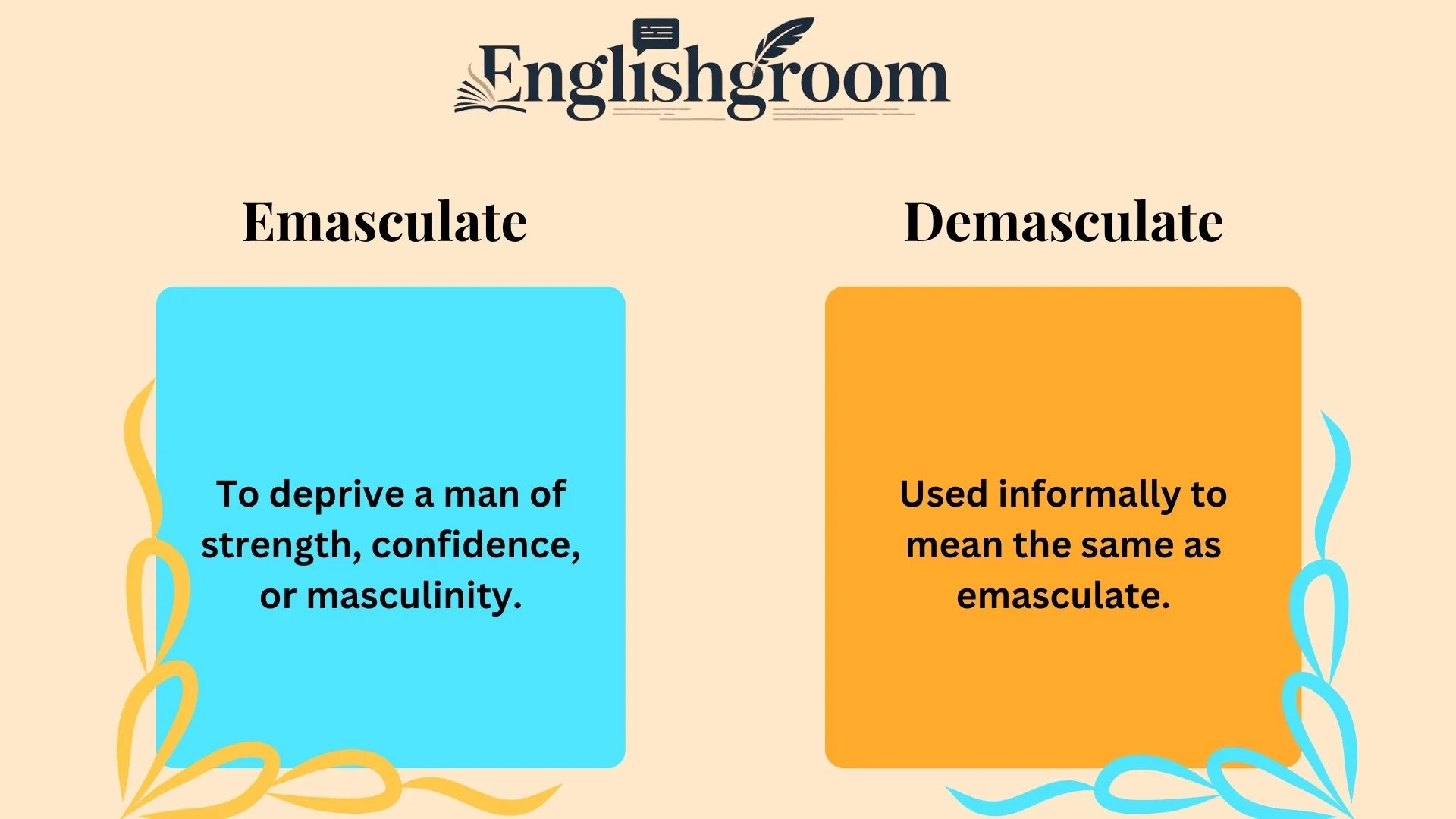
| Term | Part of Speech | Meaning | Common Usage | Accepted in English |
|---|---|---|---|---|
| Emasculate | Verb | To deprive a man of strength, confidence, or masculinity. | “The film explores how power struggles can emasculate men.” | ✅ Yes |
| Demasculate | Verb (nonstandard) | Used informally to mean the same as emasculate. | “He felt demasculated by her comments.” | ❌ No |
So, while demasculate might look right at first glance, it’s not grammatically valid or dictionary-approved.
What “Emasculate” Really Means
The word emasculate traces back to the Latin emasculare, meaning “to castrate.” Historically, it had a literal sense—removing male sexual organs—but its modern meaning evolved into a figurative one.
Today, “emasculate” is used to describe emotional or psychological weakening, especially involving the loss of perceived masculinity, confidence, or authority.
Common Modern Uses
- Relationships: “She emasculated her husband by mocking him in public.”
- Social commentary: “Modern society often emasculates men through unrealistic expectations.”
- Workplace dynamics: “The constant criticism emasculated his confidence.”
Key Insight:
“Emasculate” isn’t just about men losing masculinity—it’s often symbolic of losing control, strength, or self-worth.
Example Sentences
- “The debate emasculated his argument completely.”
- “He felt emasculated after being overruled by his junior colleagues.”
- “Cultural norms sometimes emasculate men who express vulnerability.”
Visual Cue
Imagine a simple concept diagram:
Power → Confidence → Emasculation = Loss of Identity
It’s not about physicality—it’s about authority, pride, and self-image.
What “Demasculate” Means — and Why It’s Problematic
While “demasculate” circulates online, it isn’t part of standard English. The word appears occasionally in social media, rap lyrics, or informal blogs, often as a creative twist. However, no major dictionary (Oxford, Merriam-Webster, Cambridge) lists it as a valid word.
Why It Sounds Logical but Isn’t
The prefix “de-” often means “reverse” or “remove” (as in deactivate or devalue). So, people assume demasculate means “remove masculinity.” But the proper prefix is “e-,” not “de-.”
The confusion happens because “emasculate” already includes “e-,” a form of “ex-,” meaning “out of” or “from.” Adding “de-” would be redundant and grammatically incorrect.
Incorrect Example
“He felt demasculated by her comment.”
Correction: “He felt emasculated by her comment.”
Fact:
If a word doesn’t appear in credible dictionaries or academic texts, avoid using it in serious writing. “Demasculate” fails that test.
Linguistic Reasoning: Prefix Power Explained
Understanding prefixes helps you decode word origins. Here’s how it works:
| Prefix | Meaning | Example | Explanation |
|---|---|---|---|
| de- | Reverse or remove | devalue, deactivate | Remove value or function |
| e- (from Latin ex-) | Out of / from | emasculate, emit | Take away or expel |
“Emasculate” makes perfect sense because “e-” expresses taking out masculinity.
“Demasculate,” on the other hand, mixes prefixes incorrectly.
Why “Demasculate” Persists
- Informal media influence: Memes and TikTok slang spread errors quickly.
- Phonetic similarity: “De-” feels natural to English speakers due to other “remove” words.
- Language evolution: People coin new terms, but that doesn’t make them legitimate.
In short, “demasculate” is a pseudo-word—it exists socially but not linguistically.
Real-World Usage: Where You’ll See Each Term
Emasculate in Journalism and Academia
“Emasculate” frequently appears in social commentary, gender studies, and media analysis. It describes the loss of traditional male power, both emotionally and symbolically.
Examples from Publications:
- “Political correctness has emasculated modern debate.”
- “The film’s protagonist feels emasculated by societal pressure.”
Demasculate in Online Culture
You’ll mostly find “demasculate” in:
- Twitter threads
- YouTube comment sections
- TikTok captions
- Rap lyrics
It’s informal, catchy, and expressive—but grammatically shaky.
Headlines Using Emasculate:
- “How Work Stress Emasculates the Modern Man”
- “Emasculation in Pop Culture: A Growing Theme in Cinema”
Pop Culture References:
- In Fight Club (1999), Tyler Durden’s rebellion symbolizes men fighting against emasculation by consumer culture.
- In The Simpsons, Homer often faces scenarios that emasculate him comically.
“Powerless men turn to humor to reclaim their lost masculinity.” – Social Behavior Journal
Grammar and Usage Guidelines
Use “Emasculate” When:
- Describing someone’s loss of power, confidence, or masculinity.
- Discussing figurative weakness or psychological humiliation.
- Writing formal, academic, or professional content.
Avoid “Demasculate” Because:
- It’s nonstandard and not recognized by dictionaries.
- It weakens your writing credibility.
- It confuses readers who expect accuracy.
Better Alternatives to Emasculate
| Synonym | Context | Example |
|---|---|---|
| Weaken | General reduction in strength | “The decision weakened his authority.” |
| Undermine | Gradual loss of support or confidence | “The scandal undermined his influence.” |
| Belittle | Make someone seem less significant | “Her words belittled his effort.” |
| Humiliate | Cause deep embarrassment | “He was humiliated in front of peers.” |
Choosing the right alternative depends on whether you’re describing emotional, social, or professional “loss.”
Are “Emasculate” and “Demasculate” Ever Interchangeable?
In short: No, not in formal writing.
They might seem interchangeable in slang, but only “emasculate” has linguistic legitimacy.
Context Makes the Difference
- Formal: “The manager’s criticism emasculated his confidence.”
- Informal: “That joke totally demasculated me, bro.”
The second sentence might appear in conversation or memes, but not in a research paper or publication.
Think of demasculate as an internet-born cousin—popular, but not legitimate.
British vs. American English: Any Difference?
No major difference exists between British and American use of emasculate.
Both use it identically in writing and speech. “Demasculate” remains nonstandard globally. British dictionaries like Collins and Cambridge confirm only emasculate as valid.
Fact:
The Oxford English Dictionary first recorded emasculate in 1602. Demasculate has zero historical citations.
Summary Table: “Emasculate” vs. “Demasculate”
| Criteria | Emasculate | Demasculate |
|---|---|---|
| Recognized Word | ✅ Yes | ❌ No |
| Dictionary Presence | ✅ Major dictionaries | ❌ None |
| Common Usage | Formal, informal | Internet slang |
| Meaning | To deprive of strength, manhood, or confidence | Intended same meaning, incorrect |
| Origin | Latin emasculare | Invented variant |
| Preferred Usage | Academic, professional, everyday | Avoid in writing |
Case Study: How Misuse Impacts Credibility
Scenario
A lifestyle blogger wrote:
“The show demasculates traditional men.”
Readers immediately commented, asking if “demasculate” was even a real word. The writer’s authority dropped because of one incorrect term.
Correction
“The show emasculates traditional men.”
This simple change restored grammatical accuracy and credibility.
Lesson:
Even small language errors can weaken trust. When writing publicly, check your word usage carefully.

5 Common FAQs About “Emasculate” vs. “Demasculate”
Is “Demasculate” a Real Word?
No. It’s a nonstandard term that appears online but isn’t recognized by dictionaries like Oxford or Merriam-Webster.
Can I Use “Demasculate” in Informal Speech?
You can, but it’s not grammatically correct. Use “emasculate” if you want to sound credible.
Does “Emasculate” Always Refer to Men?
Usually yes, but it can describe any person who feels stripped of confidence or power.
What’s the Opposite of “Emasculate”?
Words like empower, strengthen, or encourage serve as opposites depending on context.
Why Do People Confuse the Two?
Because “de-” often means “remove,” people assume demasculate makes sense. But the correct prefix is e- (from ex-).
Final Thoughts
“Emasculate” is a powerful, historically rooted word that’s both linguistically valid and widely understood. “Demasculate,” while catchy, remains a linguistic illusion—popular on the internet but incorrect in professional writing.
When clarity, precision, and credibility matter, stick to emasculate. It communicates loss of power and identity with cultural and emotional depth that “demasculate” simply doesn’t possess.
Remember: words shape perception. Using the right one can strengthen your message and your voice.

Hi! I’m Sami, a 28-year-old content writer with a love for words and storytelling. Writing has always been my way of expressing ideas, sharing knowledge, and connecting with people. I enjoy creating engaging and well-researched content—whether it’s blogs, articles, or social media posts—that not only informs but also inspires readers. My goal is to turn complex ideas into clear, creative, and meaningful pieces of writing that leave a lasting impact.