Many people are confused when it comes to “dysfunction” vs “disfunction.” You may have seen both words used online, in articles, or even in professional writing.
But only one of them is correct. Using the wrong term can make your writing look sloppy or unprofessional. This guide will explain the origins, usage, differences, and common mistakes, giving you the confidence to use the correct word every time.
The Origins of “Dysfunction”
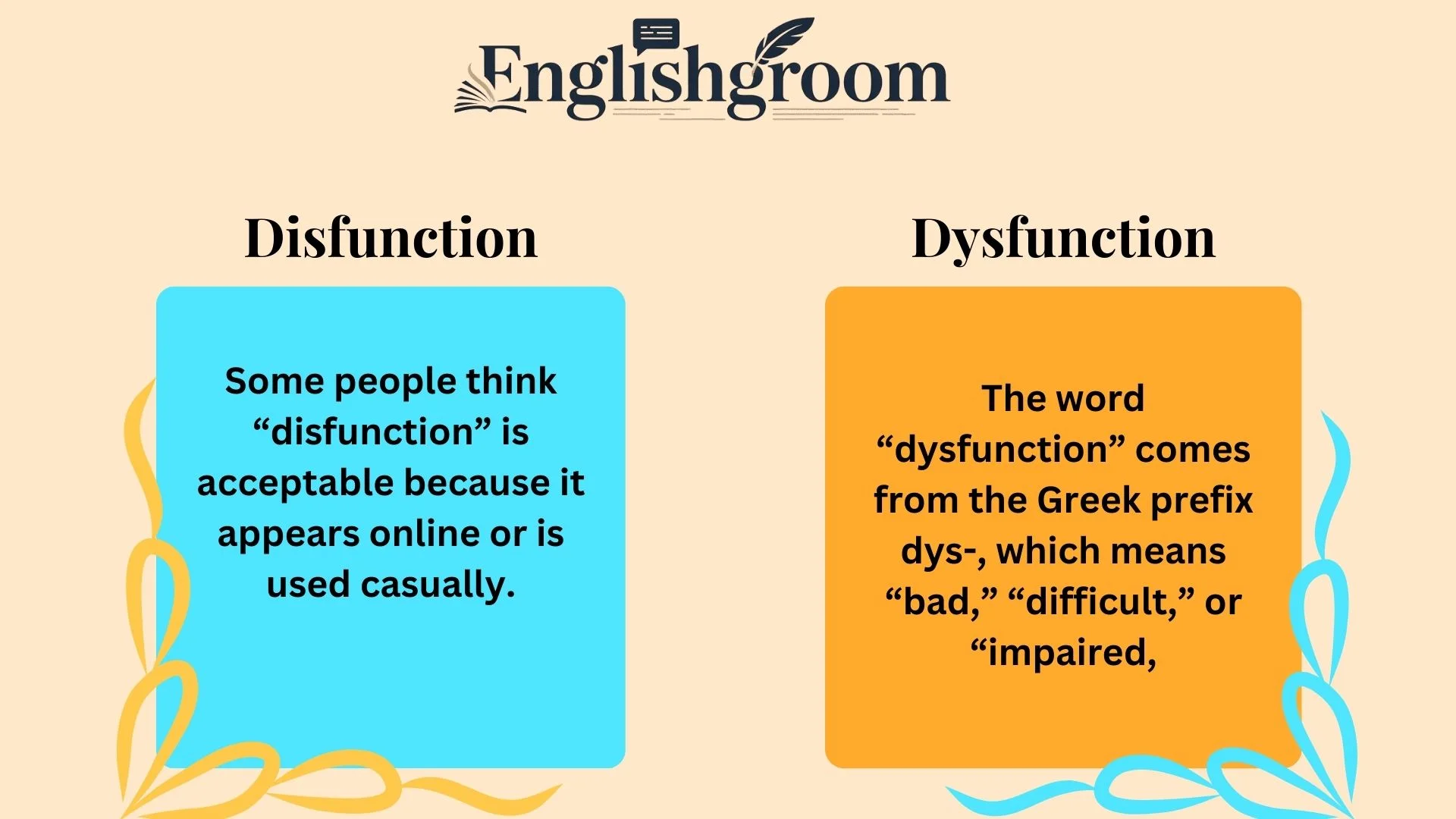
The word “dysfunction” comes from the Greek prefix dys-, which means “bad,” “difficult,” or “impaired,” combined with the Latin root function, meaning “purpose or activity.” It first appeared in medical literature to describe abnormal functioning of organs or body systems.
Over time, the term expanded into social, psychological, and organizational contexts. For instance, researchers in the 20th century began discussing family dysfunction or organizational dysfunction to describe patterns of ineffective behavior.
Key Fact:
- Dys- vs Dis-: Dys- indicates abnormality or impairment. Dis- usually means “apart” or “not,” which changes the meaning entirely.
“Disfunction” is not recognized by authoritative dictionaries and is considered a misspelling or mistaken formation.
Why “Disfunction” is Incorrect
Many writers mistakenly use “disfunction”, thinking it is an alternate spelling of dysfunction. This is incorrect because:
- Linguistic rules: The prefix dis- doesn’t convey “abnormality” like dys- does.
- Dictionary evidence: Standard English dictionaries do not list “disfunction” as a valid word.
- Common errors: Some blogs, social media posts, and informal writing may use “disfunction,” but it is widely regarded as incorrect.
Example of incorrect use:
“The disfunction in the team caused poor performance.”
Correct version:
“The dysfunction in the team caused poor performance.”
Tip: Whenever you mean abnormal or impaired function, always use dysfunction.
The Prevalence of “Dysfunction” in Modern Usage
“Dysfunction” has become a widely accepted term in multiple fields. Here’s why it dominates modern usage:
- Medical literature: Doctors and researchers consistently use dysfunction to describe impaired organs or systems.
- Social sciences: Psychologists and sociologists use dysfunction to describe unhealthy behaviors in families, communities, or organizations.
- Online content: Even casual discussions on social media often use “dysfunction” rather than “disfunction.”
Fact: According to Google Books Ngram Viewer, the term dysfunction appears exponentially more often than “disfunction” in published texts.
Examples of Modern Usage
Medical Contexts
In medicine, dysfunction is precise and specific. It refers to any abnormal or impaired functioning of an organ, system, or process.
Common examples:
- Cognitive dysfunction: Impaired thinking or memory, often associated with aging or neurological disorders.
- Renal dysfunction: Reduced kidney function due to disease or injury.
- Cardiac dysfunction: Heart’s inability to pump blood effectively.
Table: Common Medical Dysfunctions
| Dysfunction Type | Description | Example Condition |
|---|---|---|
| Cognitive | Impaired memory or thinking | Alzheimer’s disease |
| Organ | Dysfunction of a specific organ | Liver dysfunction |
| Hormonal | Imbalance of hormones | Thyroid dysfunction |
| Sexual | Impaired sexual function | Erectile dysfunction |
Case Study:
A 52-year-old patient experienced renal dysfunction due to prolonged hypertension. Early detection and proper management helped restore normal kidney function, highlighting the importance of using precise terminology.
Social and Organizational Contexts
Outside medicine, dysfunction is also widely used in social sciences and organizational studies. It describes systems or relationships that fail to work effectively.
Examples:
- Family dysfunction: Poor communication, unresolved conflicts, or unhealthy behavioral patterns.
- Organizational dysfunction: Ineffective management, poor teamwork, or lack of clarity in roles.
- Societal dysfunction: Crime, inequality, or breakdown of social norms.
Quote:
“A dysfunctional family is not defined by conflict, but by the inability to cope with it constructively.” – Dr. Virginia Satir
Tip: Always pair dysfunction with the context (medical, social, or organizational) for clarity.
Common Misconceptions About “Disfunction”
Some people think “disfunction” is acceptable because it appears online or is used casually. Let’s clarify:
- Myth: “Disfunction” is a British English spelling.
- Reality: No credible dictionary supports this.
- Impact: Using “disfunction” in professional or academic writing can undermine credibility.
Quick Rule: If the context implies impaired or abnormal function, always use dysfunction.
Dysfunction vs Dysfunctional: Understanding the Difference
Dysfunction and dysfunctional are related but distinct:
- Dysfunction (noun): Refers to the state of being impaired.
- Example: “The patient’s liver dysfunction requires immediate attention.”
- Dysfunctional (adjective): Describes something exhibiting dysfunction.
- Example: “The organization is dysfunctional due to poor leadership.”
Table: Noun vs Adjective Usage
| Term | Part of Speech | Example |
|---|---|---|
| Dysfunction | Noun | “Dysfunction of the heart can be fatal.” |
| Dysfunctional | Adjective | “Dysfunctional relationships cause stress.” |
Tip: Ask yourself if you are describing a state (noun) or a characteristic (adjective).
Identifying When to Use “Dysfunction”
Here are practical guidelines:
- Use “dysfunction” when talking about conditions, systems, or processes.
- Correct: “Renal dysfunction can lead to serious health issues.”
- Use “dysfunctional” when describing people, organizations, or objects exhibiting dysfunction.
- Correct: “The team’s dysfunctional culture caused repeated failures.”
Quick Checklist:
- Does it describe a state or condition? → Use dysfunction
- Does it describe a behavior or quality? → Use dysfunctional
Correcting Misuse of “Disfunction” in Writing
If you encounter “disfunction” in your writing or documents, here’s how to correct it:
- Identify the error: Check if “disfunction” is used.
- Assess the context: Determine if it describes a state (noun) or behavior/quality (adjective).
- Replace it:
- Noun → dysfunction
- Adjective → dysfunctional
- Proofread: Double-check all instances.
- Use tools: Spellcheckers and Grammarly can catch common errors, but manual review ensures accuracy.
Common Pitfalls to Avoid:
- Using “disfunction” in professional reports
- Confusing dysfunction with unrelated words like “malfunction” (malfunction implies mechanical failure, dysfunction often applies to systems or relationships)
FAQs
What is the correct spelling: dysfunction or disfunction?
Answer: The correct spelling is dysfunction. “Disfunction” is incorrect.
Why is it “dysfunction” and not “disfunction”?
Answer: The prefix dys- means “abnormal or impaired.” Dis- does not convey this meaning.
What does dysfunction mean in medical terms?
Answer: It refers to abnormal or impaired functioning of an organ, system, or process.
How is “dysfunctional” different from “dysfunction”?
Answer: Dysfunction is a noun (the state). Dysfunctional is an adjective (describing something exhibiting dysfunction).
Can “dysfunction” be used in social contexts?
Answer: Yes, it applies to families, organizations, or societies showing impaired or ineffective patterns.
Conclusion
Using dysfunction correctly is essential for clear communication in medical, social, and organizational contexts. Avoid the common mistake of writing disfunction. Remember:
- Dysfunction = noun, describes a state
- Dysfunctional = adjective, describes a behavior or quality
By understanding the origins, proper usage, and common errors, you can write confidently and precisely. Whether in medical reports, academic papers, or everyday writing, choosing the correct term elevates clarity and professionalism.

Hi! I’m Sami, a 28-year-old content writer with a love for words and storytelling. Writing has always been my way of expressing ideas, sharing knowledge, and connecting with people. I enjoy creating engaging and well-researched content—whether it’s blogs, articles, or social media posts—that not only informs but also inspires readers. My goal is to turn complex ideas into clear, creative, and meaningful pieces of writing that leave a lasting impact.