Texting and chatting have become a universal way to communicate. But sometimes, short phrases, abbreviations, or single words leave us scratching our heads. One phrase that people often encounter online is “decoding meaning in text.”
Whether you’re scrolling through WhatsApp, Instagram DMs, or TikTok comments, understanding the hidden intent behind a message is more important than ever.
In this guide, we’ll break down what decoding meaning in text actually means, explore its origins, and show you how it varies across platforms. We’ll also cover examples, common misconceptions, and even the psychological undertones behind messages.
By the end, you’ll be able to read between the lines with confidence, respond naturally, and never misinterpret digital conversations again.
Meaning & Definition
Decoding meaning in text refers to interpreting the intent, tone, or hidden message behind written digital communication. Unlike face-to-face conversation, texts lack body language, voice tone, or facial expressions.
Primary meaning:
- Understanding the literal and implied meaning of a text message.
Secondary meaning:
- Interpreting emotional cues, humor, sarcasm, or subtext from abbreviations, emojis, or punctuation.
Example:
- Text: “K…”
- Literal: “Okay”
- Implied: Could be annoyed, dismissive, or neutral depending on context.
Quick fact: Studies show that up to 40% of misunderstandings in digital conversations arise from misinterpreting tone or intent.
Background & Origin
The concept of decoding meaning isn’t new. In linguistics, decoding refers to interpreting symbols or signs to extract meaning. With texting becoming popular in the early 2000s, users needed to adapt traditional language interpretation to a digital format.
Key points:
- Early SMS limited messages to 160 characters → shorthand and abbreviations emerged.
- Emojis introduced visual cues to reduce ambiguity.
- Internet slang (LOL, BRB, SMH) added layers to meaning.
Origin Timeline:
| Era | Development |
|---|---|
| 1990s | SMS shorthand grows |
| Early 2000s | Instant messaging popularizes abbreviations |
| 2010s | Emojis and GIFs add nonverbal cues |
| 2020s | AI & algorithms help predict tone and intent |
Usage in Different Contexts
Decoding meaning varies depending on the conversation type.
- Casual chat: Friends use sarcasm, memes, or inside jokes.
- Social media: Comments often mix emojis, GIFs, or slang that require context.
- Professional fields: Emails or Slack messages may have formal or passive-aggressive undertones.
Examples:
- Friend: “Sure… 😏” → playful teasing or skepticism
- Colleague: “Noted” → neutral acknowledgment or subtle annoyance
- Online comment: “Literally dying 😂” → exaggeration for humor
Decoding helps you avoid miscommunication, maintain relationships, and respond appropriately.
Meanings Across Platforms
Different platforms influence tone and interpretation.
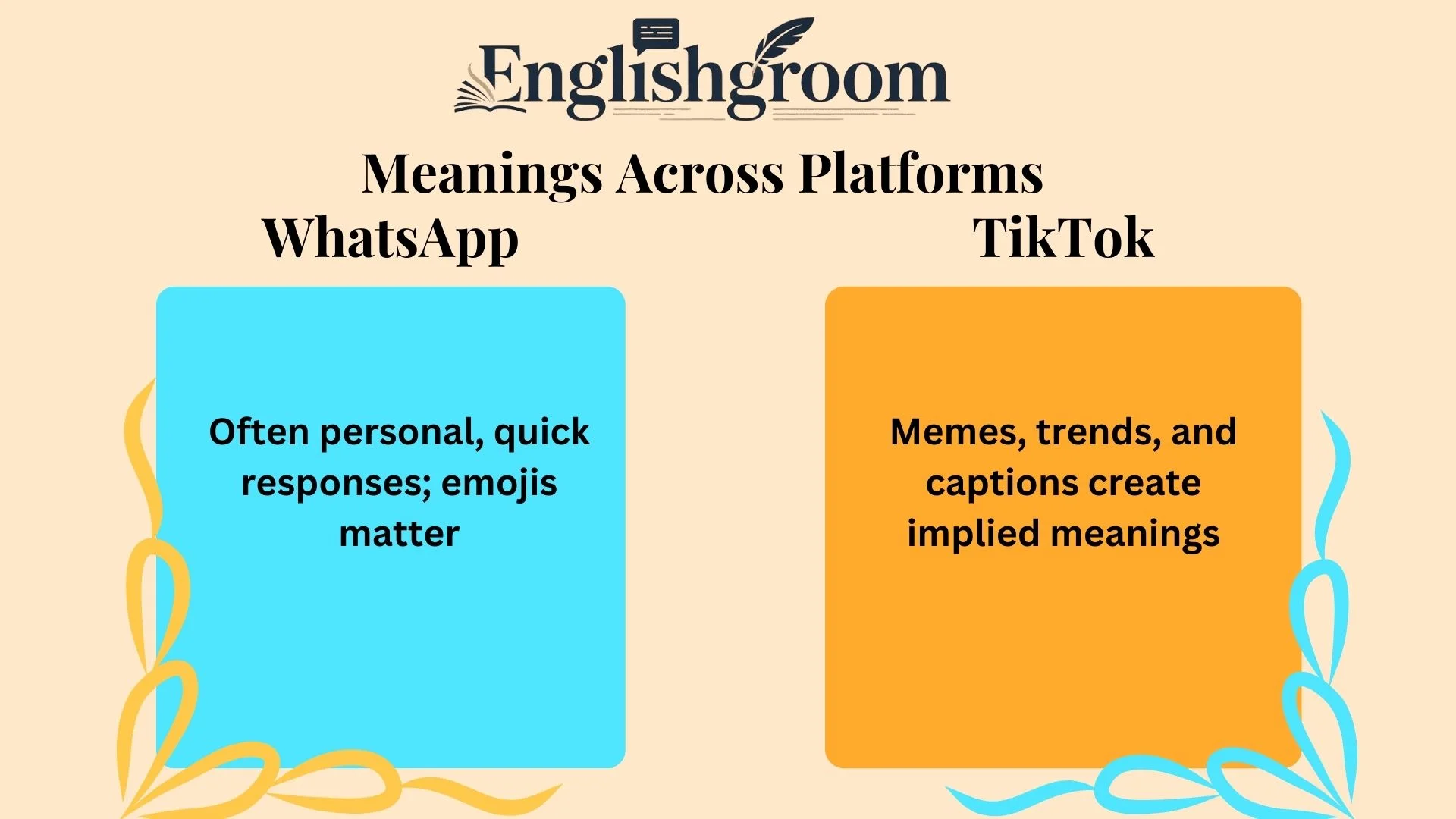
| Platform | Interpretation Tips |
|---|---|
| Often personal, quick responses; emojis matter | |
| Public comments may be humorous or sarcastic; likes reinforce tone | |
| TikTok | Memes, trends, and captions create implied meanings |
| Snapchat | Casual, ephemeral; streaks indicate ongoing engagement |
Quick Tip: Platform context helps decode meaning. A “lol” on Snapchat might be lighter than on email.
Examples in Real Conversations or Memes
- “idk 🤷” → I don’t know; may show casual indifference
- “sure 😬” → Hesitation or mild discomfort
- Meme context: Doge saying “Much wow” → excitement but sarcastic tone
These examples illustrate why decoding is necessary beyond literal interpretation.
Cultural or Regional Interpretations
Tone and word choice can vary by region:
- US texting: Direct, with frequent abbreviations (LOL, OMG)
- UK texting: Sarcasm and understatement are common (“Yeah, right”)
- Asia: Emojis or stickers convey emotions more than words
Cultural knowledge is essential to decode meaning correctly.
Other Fields
Interestingly, decoding meaning is used in technical fields too:
- Physics: Interpreting data from experiments or signals
- Medical: Decoding patient reports, charts, or lab results
- Aircraft & Engineering: Signal decoding and telemetry
Even though unrelated to texting, the underlying principle—interpreting hidden information—is similar.
Common Misconceptions & Mistakes
- Misconception 1: Emoji meaning is universal → False; context matters.
- Misconception 2: Short replies are rude → False; could be time-limited.
- Misconception 3: All caps = shouting → Sometimes just emphasis.
Tip: Always consider context, sender, platform, and relationship.
Psychological or Emotional Meaning Behind It
Texts convey more than words. Tone, emoji use, and punctuation reveal emotions.
- “I guess…” → uncertainty or passive aggression
- “😂😂😂” → genuine laughter or nervous laughter
- “…” → hesitation, suspense, or tension
Decoding meaning improves emotional intelligence and digital empathy.
Similar Terms & Alternatives
| Term | Meaning | Usage Context |
|---|---|---|
| Interpret | Understand meaning from context | General |
| Infer | Draw conclusions from hints | Subtle texts |
| Read between the lines | Detect hidden intent | Sarcasm, humor |
| Contextualize | Place text in situation | Formal communication |
Is It Offensive or Friendly?
Decoding helps identify tone:
- Friendly: emojis, playful text, affirmations
- Potentially offensive: abrupt, sarcastic, or misleading phrasing
Example:
- “K” → Neutral or dismissive
- “K 😒” → Likely annoyed
Famous Quotes or Lines Using the Term
“To understand someone’s words, you must first decode the spaces between them.” – Linguist Unknown
“Texting is the art of conveying emotion without a voice.” – Digital Communication Expert
Grammar or Linguistic Insights
- Punctuation alters meaning: “Sure.” vs “Sure…”
- Abbreviations and acronyms shape subtext: “brb” = casual; “FML” = serious
- Emoji placement often emphasizes or softens meaning
How to Respond to It
Practical replies to decode meaning:
- Text: “K…”
- Response: “Everything okay? 🤔”
- Text: “Sure 😬”
- Response: “Do you want to talk about it?”
- Text: “idk 🤷”
- Response: “No worries! We can figure it out later.”
- Text: “😂😂😂”
- Response: “Glad you liked it! 😄”
Differences From Similar Words
| Term | Key Difference |
|---|---|
| Decode | Focus on interpreting hidden meaning |
| Interpret | Broader, can include literal and implied meaning |
| Analyze | Focus on detailed breakdown, technical or literary |
| Understand | General comprehension without nuance focus |
Relevance in Online Conversations & Dating Apps
- Online chats and dating messages often use subtle hints.
- Decoding meaning prevents misinterpretation in flirting, humor, or serious discussions.
- Example: “lol” in dating chat could be playful or sarcastic → decoding is crucial.
Popularity & Trends Over Time
- Google Trends shows rising searches for “text meaning” and “decode messages” since 2015.
- Social media increases the need for decoding meaning due to new abbreviations and emojis.
- Younger users often rely on contextual cues, memes, and AI-based emoji suggestions.
FAQs
What does decoding meaning in text mean?
It means interpreting the intent, tone, or hidden message behind digital communication.
Why is decoding meaning important?
It prevents miscommunication and ensures you respond appropriately in chats or professional messages.
Can emojis change the meaning of a text?
Yes, emojis can signal tone, emotion, or sarcasm, altering how the message is interpreted.
Is decoding meaning the same as reading between the lines?
Essentially, yes. Both involve understanding implied or hidden intent beyond literal words.
Are certain platforms harder to decode than others?
Yes, platforms like TikTok or Instagram often rely on memes and trends, requiring cultural and contextual knowledge.
Learn More English With These Best Meanings:
🧩 What Does “DND” Mean in Text? (Full Guide + Real Examples)
💬 What Does “HYB” Mean in Text? (Full Guide with Examples & Usage)
🧠 What Does “MS” Mean in Text? (Complete Guide With Examples)
💬 What Does “KK” Mean in Text? (A Complete Guide to Its Real Meaning & Use)
🗣️ What Does “PSA Meaning in Text” Really Mean? (Full Guide With Examples)
Conclusion
Decoding meaning in text is an essential skill in the digital age. Words alone don’t always convey tone or emotion, so understanding the nuances of abbreviations, emojis, and punctuation is key.
By paying attention to context, platform, and subtle cues, you can communicate effectively, avoid misunderstandings, and respond with confidence.
Whether it’s casual chatting, social media comments, or professional messaging, mastering decoding meaning in text makes your digital conversations smoother, smarter, and more enjoyable.

Hi! I’m Sami, a 28-year-old content writer with a love for words and storytelling. Writing has always been my way of expressing ideas, sharing knowledge, and connecting with people. I enjoy creating engaging and well-researched content—whether it’s blogs, articles, or social media posts—that not only informs but also inspires readers. My goal is to turn complex ideas into clear, creative, and meaningful pieces of writing that leave a lasting impact.