Last updated on February 15th, 2026 at 01:41 pm
Ever heard someone say, “I’m taking a day off,” while another groans, “I’m having an off day”?
Both phrases sound nearly identical, but they carry completely opposite meanings.
English is full of these small-but-mighty word pairs that flip meaning when reversed. “Day off” and “off day” are a perfect example. Understanding their difference helps you sound natural, avoid awkward mix-ups, and even grasp the emotional tone behind everyday English.
In this guide, we’ll explore what each phrase really means, how native speakers use them, and why the order of two tiny words can change the whole story.
Why “Day Off” and “Off Day” Confuse So Many People
At first glance, “day off” and “off day” look like twins. They use the same words and even sound similar when spoken. Yet, they describe completely different experiences.
The confusion happens because English word order defines function. Change the sequence, and meaning shifts from rest to regret.
Let’s break it down:
- Day off → a scheduled or chosen break from work or routine.
- Off day → an unplanned bad day when things just don’t go right.
Both include the word off, but one’s about rest, the other’s about rhythm — or losing it.
Quick Comparison: “Day Off” vs. “Off Day” at a Glance
| Feature | Day Off | Off Day |
|---|---|---|
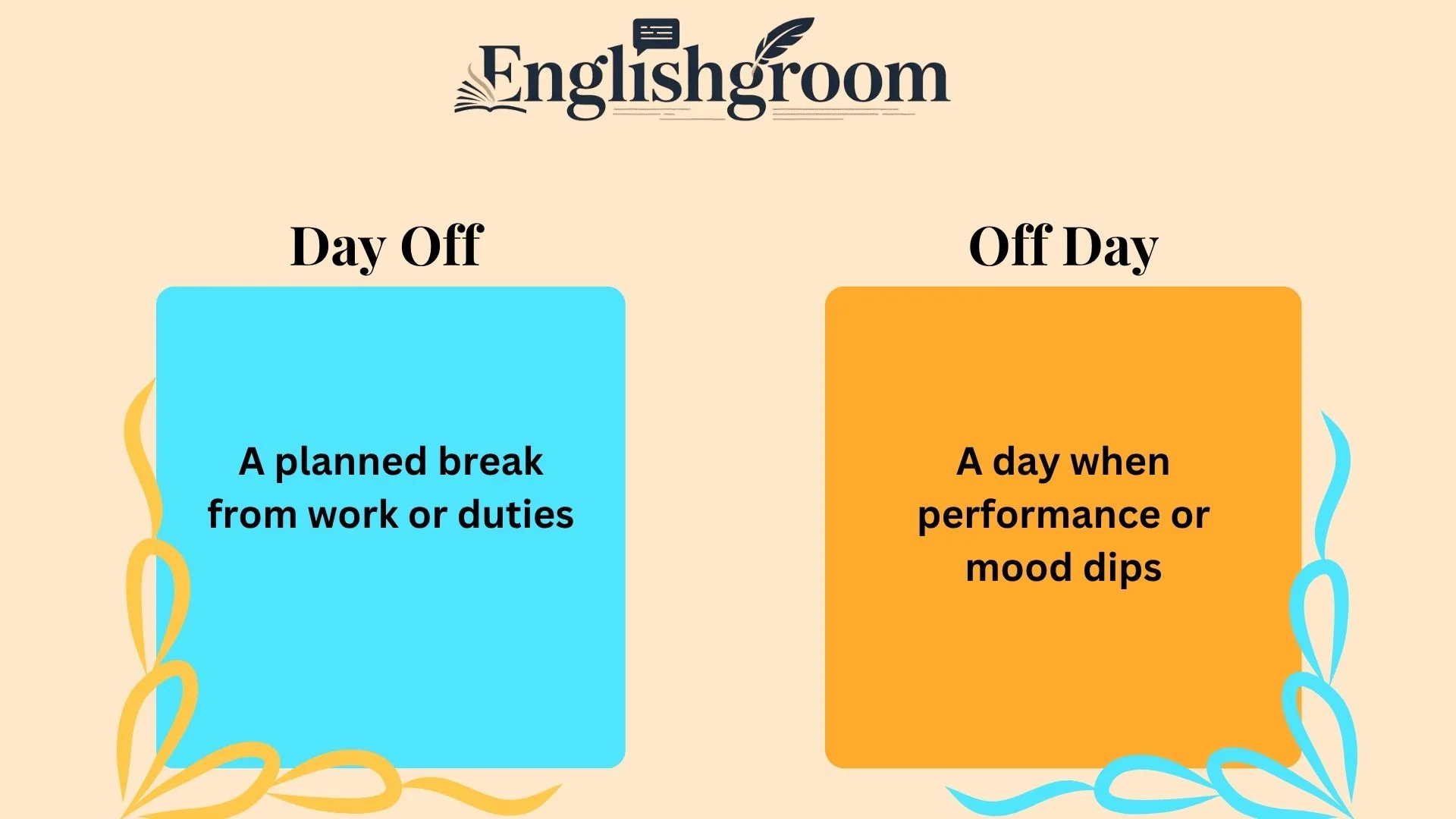
| Meaning | A planned break from work or duties | A day when performance or mood dips |
| Grammar Type | Noun phrase | Idiomatic phrase |
| Tone | Neutral to positive | Negative or self-critical |
| Context | Work, school, leisure | Emotions, sports, productivity |
| Example | “Friday is my day off.” | “I’m having an off day.” |
| Associated Feeling | Relaxed, relieved, content | Frustrated, drained, off balance |

What “Day Off” Really Means
A day off is the time you officially step away from your job, classes, or responsibilities. It’s your permission to pause.
You might spend it sleeping in, visiting family, or satiate-watching Netflix. It’s not an “off day” because something’s wrong; it’s a “day off” because you’ve earned a break.
Common Usage Scenarios
You’ll hear “day off” most often in:
- Workplaces: “I’m taking Tuesday as my day off.”
- Schools: “We get a day off for the national holiday.”
- Everyday life: “I use my day off to run errands and relax.”
Tone and Emotional Implication
“Day off” carries a neutral-to-positive tone. It implies rest, reward, or relief.
Example:
“After working 12 days straight, my day off felt like heaven.”
It often comes with feelings of joy, relief, or even pride — because you’ve earned that downtime.
Grammatical Use
“Day off” is a noun phrase that usually comes after possessive pronouns like my, your, his, or their.
✅ Correct: “Tomorrow is my day off.”
❌ Incorrect: “Tomorrow is an off day for me.” (unless you mean you’re having a rough day!)
Plural form:
“We get two days off every week.”
Synonyms and Alternatives
Formal equivalents:
- Rest day
- Leave day
- Holiday
Casual alternatives:
- Break day
- Day to myself
- Chill day
These can vary by culture — for instance, British English often uses “day’s leave,” while American English prefers “day off.”
Real-Life “Day Off” Examples
Workplace Email Example:
“Hi team, I’ll be on leave Monday since it’s my regular day off. Please send urgent matters to John.”
Social Media Example:
“Finally sleeping in without guilt — it’s my day off! 😴”
News Example:
“Most healthcare workers say they rarely get a proper day off between long shifts.”
Every version implies a break, not burnout.
What “Off Day” Really Means
Switch the word order, and you step into an entirely different mood.
An off day means a day when things don’t go right. You feel off your game — unfocused, moody, or just not yourself.
It’s not about being free from work; it’s about being out of sync.
Common Usage Scenarios
- Sports: “The pitcher had an off day — his fastballs were all over the place.”
- Work: “I can’t concentrate today. Must be an off day.”
- Personal life: “Sorry if I was snappy earlier. I’m having an off day.”
These examples show the phrase’s emotional depth. “Off day” humanizes imperfection — it’s what people say when they’re struggling but self-aware.
Emotional and Tonal Meaning
Unlike “day off,” which feels freeing, “off day” conveys frustration, self-compassion, or even vulnerability.
It’s often used to express empathy, especially when comforting others.
Example:
“Don’t worry about the mistake — everyone has an off day sometimes.”
Grammar and Structure
“Off day” is idiomatic, not literal.
You’ll usually find it after verbs like have or be having:
- “I’m having an off day.”
- “She had an off day at the office.”
It’s never used like “day off” (noun phrase) because its meaning isn’t tangible — it’s abstract and emotional.
Synonyms and Related Expressions
Synonyms:
- Bad day
- Rough day
- Down day
- Slump
Figurative alternatives:
- Feeling off
- Not myself today
- Out of sorts
- Off my game
Each carries a slightly different tone but all reflect emotional imbalance or low performance.
Etymology: Where Did These Phrases Come From?
“Day off” traces back to the Industrial Revolution, when factory workers first began receiving designated rest days. Labor reforms introduced the idea of scheduled time away from work — what we now call days off.
“Off day,” on the other hand, likely emerged from early 20th-century sports slang. When an athlete underperformed, commentators called it “an off day.” The phrase eventually entered everyday speech to describe any unproductive or emotionally tough day.
This evolution explains why “day off” = planned rest, and “off day” = unplanned struggle.
Key Contextual Differences
Let’s summarize the difference in meaning, tone, and intent.
| Aspect | Day Off | Off Day |
|---|---|---|
| Definition | Planned rest from duties | Unplanned low-performance day |
| Tone | Relaxed, positive | Disappointed, reflective |
| Timing | Intentional | Accidental |
| Grammar | Noun phrase | Idiomatic phrase |
| Example | “Tomorrow’s my day off.” | “I’m having an off day.” |
| Emotion | Relief | Frustration or sadness |
🎯 Quick Rule of Thumb:
- If you planned it → It’s a day off.
- If it just happened → It’s an off day.
Real-Life Contexts and Examples
“Day Off” in Context
Workplace:
“Employees are encouraged to use their day off for rest and recovery.”
Social Media:
“Day off = pajamas, snacks, and zero responsibilities!”
News Example:
“Retail workers often use their day off to catch up on chores instead of rest.”
“Off Day” in Context
Sports Coverage:
“Even top players have off days — that’s part of the game.”
Mental Health Blog:
“It’s okay to have an off day. What matters is how you bounce back.”
Casual Conversation:
“Sorry I’m quiet today, just having an off day.”
Notice how “off day” always connects to mood, focus, or emotional state — not to schedules or breaks.
Common Mistakes and How to Avoid Them
| Mistake | Why It’s Wrong | Correct Usage |
|---|---|---|
| “I’m taking an off day tomorrow.” | Sounds like you’re feeling bad on purpose | “I’m taking a day off tomorrow.” |
| “I had a day off today at work.” (meaning a bad day) | “Day off” means rest, not poor performance | “I had an off day at work.” |
| “She’s been on off days lately.” | Unnatural phrasing | “She’s been having off days lately.” |
✅ Tip: Think of “day off” as something you schedule, and “off day” as something you experience.
Alternative Expressions and Native Speaker Insights
Instead of “Day Off”
- “Personal day”
- “Leave day”
- “Taking time off”
- “On vacation”
Instead of “Off Day”
- “Feeling off”
- “Having a rough one”
- “Not my best day”
- “In a slump”
Native Speaker Insights
Native English speakers often use context and emotion to choose between the two:
- If you say, “I need a day off,” people assume you’re tired or overworked.
- If you say, “I’m having an off day,” they assume you’re struggling emotionally or mentally.
Understanding this nuance helps you sound natural and emotionally intelligent in English.
Quick Recap: Spot the Difference Instantly
Day Off = Delightful Pause
You’re resting, recharging, or rewarding yourself.
Off Day = Disappointing Performance
You’re struggling, tired, or not yourself.
Here’s a simple mnemonic to remember:
If you planned it → Day Off.
If it surprised you → Off Day.
FAQs
What’s the main difference between “day off” and “off day”?
A day off is a planned rest day. An off day is when you’re not feeling or performing your best.
Can I say “I’m taking an off day”?
No. That sounds unnatural. Say “I’m taking a day off” if you’re resting, or “I’m having an off day” if you’re not at your best.
Is “off day” slang?
It began as slang in sports but is now standard idiomatic English.
Can “off day” mean “holiday”?
Never. “Off day” always describes mood or performance, not rest.
How do British and American English differ here?
Both use the same distinction, though Brits may also say “day’s leave” for “day off.”
Learn More English With These Best Articles:
24 Hours Notice or 24 Hour’s Notice or 24 Hours’ Notice?
Stick a Fork in It Meaning Origins and Modern Use
Run Like the Wind Meaning Uses & Powerful Impact
A Piece of Work Meaning Usage and Cultural Implications
Aging vs Ageing Understanding the Difference and Using Them Correctly
Final Thoughts
In English, small word shifts can change the emotional meaning completely. “Day off” celebrates rest and reward, while “off day” accepts imperfection and struggle.
Everyone deserves both — days off to recover, and the grace to forgive their off days.
Next time you hear someone mix them up, you’ll know exactly which kind of “off” they mean — the restful kind or the rough one.
“We all have off days, but that’s why days off exist.” 🌿

Hi! I’m Sami, a 28-year-old content writer with a love for words and storytelling. Writing has always been my way of expressing ideas, sharing knowledge, and connecting with people. I enjoy creating engaging and well-researched content—whether it’s blogs, articles, or social media posts—that not only informs but also inspires readers. My goal is to turn complex ideas into clear, creative, and meaningful pieces of writing that leave a lasting impact.