Language has a funny way of tripping people up — especially when a single missing letter changes everything. One of the most common spelling confusions on the internet is “Continuous vs Contious.”
You’ve probably seen both words floating around online. But here’s the truth: “Contious” isn’t a real word. It’s a misspelling of “Continuous.”
In this guide, we’ll break down the difference, why the mistake happens, how to use “continuous” correctly, and simple memory tricks to keep it straight for good.
Understanding the Core Difference
Let’s start with the basics.
| Word | Meaning | Part of Speech | Correct? |
|---|---|---|---|
| Continuous | Something happening without interruption or nonstop | Adjective | ✅ Yes |
| Contious | ❌ Not a real English word. Common typo or mispronunciation. | — | ❌ No |
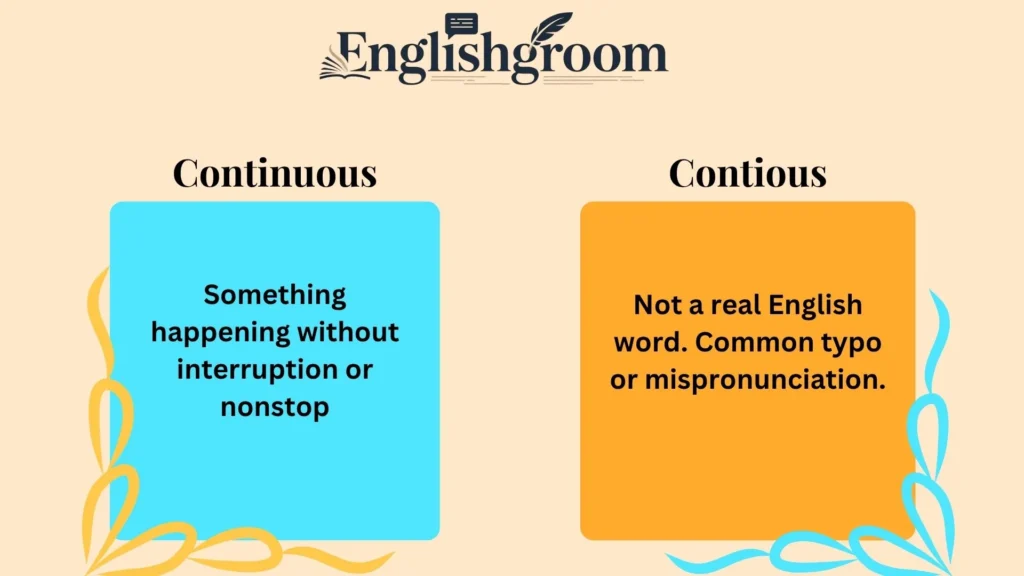
The difference is simple but critical. Only “continuous” has meaning and grammatical correctness.
Example:
- ✅ The rain was continuous throughout the night.
- ❌ The rain was contious throughout the night.
“Continuous” describes something unbroken, steady, or ongoing — from a machine running non-stop to a class that continues weekly. “Contious,” on the other hand, simply doesn’t exist in English dictionaries, textbooks, or professional writing.
The Origin and Meaning of “Continuous”
To really understand why “continuous” is the correct form, it helps to trace where it came from.
Etymology
The word “continuous” stems from the Latin continuus, meaning “unbroken” or “joined together.”
It later entered Middle English through Old French, retaining the sense of “without pause or gap.”
Modern Meaning
Today, “continuous” means:
Ongoing, unceasing, or forming an unbroken whole.
You’ll often hear it in scientific, technical, and everyday speech:
- Science: continuous data, continuous process.
- Technology: continuous integration, continuous deployment.
- Education: continuous assessment, continuous learning.
Related Forms
| Form | Word Type | Meaning |
|---|---|---|
| Continuously | Adverb | In an unbroken or constant manner |
| Continuity | Noun | The state of being continuous |
| Continuation | Noun | The act of resuming or prolonging |
Each variation circles back to one central idea — something that keeps going without interruption.
Why “Contious” Appears — Common Causes of the Error
So why does “contious” keep showing up everywhere?
There are several real-world reasons behind this common slip-up:
1. Typing Omission
The “nu” in “continuous” is easy to skip when typing fast — contious can slip by unnoticed.
2. Phonetic Confusion
When people pronounce “continuous” quickly, it can sound like “contious,” especially in casual speech.
3. Predictive Text Errors
Autocorrect or predictive typing tools sometimes replace the unfamiliar “continuous” with a guessed version.
4. Lack of Familiarity
Non-native speakers or early learners may never have seen the correct spelling enough times to remember it.
Quote:
“Spelling errors rarely come from ignorance — they come from speed.”
Once you understand that “contious” isn’t just wrong but nonexistent, you’ll spot it instantly.
Examples: Correct vs Incorrect Usage
Let’s look at some real-world examples to cement the difference.
| Incorrect (Contious) | Correct (Continuous) |
|---|---|
| The contious sound annoyed everyone. | The continuous sound annoyed everyone. |
| Our company runs on contious improvement. | Our company runs on continuous improvement. |
| She spoke in a contious tone. | She spoke in a continuous tone. |
| The process must be contious to succeed. | The process must be continuous to succeed. |
In summary: Every time you think of “contious,” replace it with “continuous.”
Real-World Usage of “Continuous”
“Continuous” isn’t just a dictionary word — it’s deeply embedded in modern life, business, and technology.
1. In Technology
- Continuous Integration (CI): Developers regularly merge code into a shared repository.
- Continuous Deployment (CD): Updates automatically roll out without interruption.
- Continuous Delivery: Software changes are always ready for release.
These practices keep the digital world running smoothly.
2. In Science
- Continuous Data: Data measured on a scale, such as time, height, or temperature.
- Continuous Flow Reaction: A chemical process where substances react as they flow through a system.
These ideas revolve around constant movement and measurement — no breaks, no pauses.
3. In Education
- Continuous Assessment: Students are evaluated regularly, not just through exams.
- Continuous Learning: The belief that learning never stops — even outside formal schooling.
4. In Everyday Life
You might use “continuous” to describe:
- Continuous noise from a city street.
- Continuous rain during monsoon season.
- Continuous improvement in personal goals or fitness.
It’s a versatile word that describes anything steady and unbroken.
Table: Correct Usage in Different Contexts
| Context | Phrase | Meaning / Example |
|---|---|---|
| Technology | Continuous Integration | Regular code merging and testing |
| Manufacturing | Continuous Production | Non-stop process flow to increase efficiency |
| Science | Continuous Data | Measurements without gaps (like time or weight) |
| Education | Continuous Assessment | Ongoing evaluation instead of single exams |
| Business | Continuous Improvement | Constant effort toward better performance |
| Personal Growth | Continuous Learning | Lifelong process of acquiring knowledge |
What To Do If You See “Contious”
Spotting “contious” online or in text isn’t uncommon. Here’s what to do when it appears:
1. Recognize It as a Typo
Don’t assume it’s a new term. “Contious” is always an error.
2. Replace It Immediately
Change “contious” → “continuous.” This small correction keeps writing professional and accurate.
3. Use Grammar Tools
Tools like Grammarly, Hemingway, or even Word’s built-in checker catch this instantly.
4. Educate Others
If you’re editing someone else’s work, kindly point it out. Many people don’t realize it’s wrong until told.
Why Getting This Right Matters
Spelling mistakes may seem harmless, but they can carry real-world consequences — especially in professional or academic contexts.
1. Professional Credibility
Writers, educators, developers, and students lose trust when readers spot basic spelling errors.
2. Academic Accuracy
Exams, research papers, and theses demand correct spelling. Using “contious” could cost marks.
3. SEO and Digital Writing
Search engines index based on correct words. “Contious” has zero search relevance, while “continuous” ranks in thousands of legitimate queries.
Fact:
On Google, “continuous” appears in over 600 million indexed results.
“Contious”? Barely a few thousand — almost all typos.
Getting it right improves visibility, professionalism, and clarity.
Tips to Remember the Correct Spelling
Here are smart, simple ways to remember “continuous” forever.
1. Mnemonic Trick
“Continuous has N-U because it’s Never-Ending and Unbroken.”
The “NU” stands for what it means — never unbroken.
2. Visual Pattern
Think of continuous as con-tin-u-ous — four flowing syllables, just like something that never stops.
3. Association Method
Relate it to continue.
If something continues, it’s continuous.
→ continue → continuous → continuity
4. Repetition Practice
Write 10 sentences daily using “continuous.” The brain memorizes patterns through usage, not memorization.
5. Real-Life Application
Every time you encounter an ongoing process (like Wi-Fi running 24/7), mentally label it as continuous.
Quote:
“We remember what we connect with reality. The mind stores meaning, not just spelling.”
Quick Recap
Let’s wrap up the core lessons before diving into FAQs.
- ✅ Continuous = correct, means ongoing or unbroken.
- ❌ Contious = incorrect, not a valid word.
- Origin: Latin continuus → “unbroken.”
- Use it in science, business, tech, and daily life.
- Remember “NU” stands for Never Unbroken.
FAQs About Continuous vs Contious
What does “continuous” mean?
“Continuous” means something that happens without stopping or interruption, like a continuous sound or a continuous line.
Is “contious” a word?
No. “Contious” isn’t an English word. It’s just a misspelling of “continuous.”
How do I remember the spelling of continuous?
Think of “continuous” as continue + us — something that keeps going with us, without a break.
Can I use “continuous” and “continual” interchangeably?
Not exactly.
- Continuous = unbroken, without pause.
- Continual = happens repeatedly but with breaks.
Example: - Continuous rain (never stops)
- Continual meetings (happen again and again)
Why does spelling matter in professional writing?
Because it reflects credibility. Misspelling common words like “continuous” makes writing appear rushed or careless — especially in resumes, research, and websites.
Learn More English With These Best Articles:
“Introduction To” vs “Introduction Of” — What’s the Real Difference?
In the Street vs. On the Street: What Native Speakers Really Mean
Passersby or Passerbyers? The Right Way to Say It
Emasculate vs. Demasculate: What’s the Real Difference and Why It Matters
Is It Correct to Say “Day Well Spent”? A Complete Grammar & Usage Guide
Final Thoughts
Getting small details right — like the difference between continuous and contious — shows care, intelligence, and professionalism.
Every industry relies on continuous effort — from continuous improvement in business to continuous learning in life. The extra “nu” in the middle of the word isn’t just a few letters; it symbolizes consistency, persistence, and flow.
So next time you see “contious,” remember — it’s not just a typo; it’s a chance to improve your precision.

Hi! I’m Sami, a 28-year-old content writer with a love for words and storytelling. Writing has always been my way of expressing ideas, sharing knowledge, and connecting with people. I enjoy creating engaging and well-researched content—whether it’s blogs, articles, or social media posts—that not only informs but also inspires readers. My goal is to turn complex ideas into clear, creative, and meaningful pieces of writing that leave a lasting impact.