Language evolves, and so do the rules that shape how we communicate. One small hyphen can spark endless debate—especially when it comes to terms like “company-wide” and “companywide.”
You’ve probably seen both forms in emails, reports, and press releases. So, which one’s correct? Does it even matter?
Spoiler: it does, especially if you care about professional consistency, credibility, and style alignment.
This guide dives deep into the difference between “company-wide” and “companywide”, exploring their history, grammatical function, professional perception, and real-world usage—so you’ll never hesitate again.
The Hyphen Dilemma in Modern English
Hyphens might look small, but they play a huge role in keeping meaning clear. In American English, they often connect words that work together to modify a noun.
For example:
- Well-known author (not “well known author”)
- High-speed internet (not “high speed internet”)
Without the hyphen, readers could misinterpret your meaning. Still, as language modernizes, many hyphenated words have merged into closed compounds—like “email” (once “e-mail”) or “website” (once “web-site”).
The same evolution is happening with “company-wide.”
Hyphens in American English: What They Actually Do
Hyphens serve one core function—clarity. They link words that act together to describe something.
Here’s how hyphens operate in different grammatical contexts:
| Type | Example | Explanation |
|---|---|---|
| Compound adjectives before a noun | A company-wide policy | “Company” and “wide” form one descriptive unit |
| Compound nouns | Editor-in-chief | The hyphen clarifies relationship |
| Numbers and fractions | Twenty-one, two-thirds | Standard rule in English |
| Prefix words (sometimes) | Re-enter, co-founder | Used to avoid confusion or double vowels |
In each case, the hyphen makes reading smoother. But when a term becomes familiar enough, the hyphen eventually disappears—just like “email.”
Historical Development of “Company-wide”
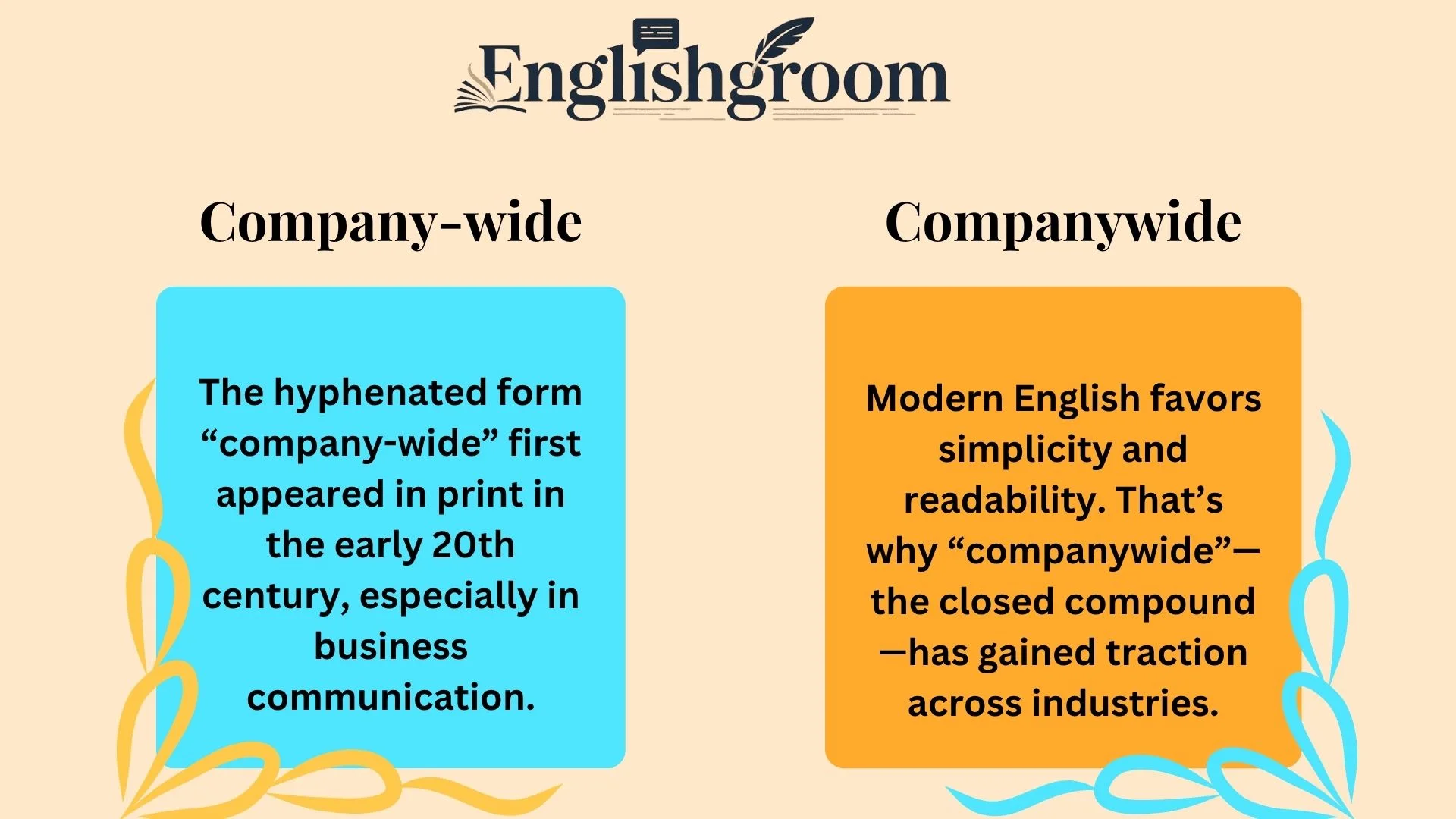
The hyphenated form “company-wide” first appeared in print in the early 20th century, especially in business communication. It reflected how editors treated compound modifiers during that period—clear, formal, and precise.
In old corporate documents and newspaper archives from the 1930s–1960s, “company-wide” dominated. The hyphen helped readers recognize it as a single modifier rather than two unrelated words.
However, language never stays static. By the 1990s, writers and editors began dropping unnecessary hyphens, mirroring broader stylistic trends toward simplification.
“The hyphen is a bridge—but when everyone knows the way across, the bridge is no longer needed.”
— Anonymous Copy Editor, Associated Press Desk, 2003
Today, that bridge is no longer essential. Most professionals, dictionaries, and style guides now recognize “companywide” as the preferred form.
“Companywide” Emerges: The Modern, Simplified Variant
Modern English favors simplicity and readability. That’s why “companywide”—the closed compound—has gained traction across industries.
This trend follows a natural linguistic pattern:
- E-mail → Email
- Web-site → Website
- Data-base → Database
- Company-wide → Companywide
As readers grow comfortable with familiar compound forms, the hyphen becomes unnecessary.
Today, major dictionaries like Merriam-Webster, Oxford English Dictionary, and Cambridge all list “companywide” as a single word—without a hyphen.
Here’s what that shift looks like:
| Source | Listed Form | Notes |
|---|---|---|
| Merriam-Webster | companywide | Primary accepted form |
| Oxford English Dictionary | companywide | Treated as standard |
| Cambridge Dictionary | companywide | Hyphenated version noted as less common |
| Collins Dictionary | companywide | Marks “company-wide” as older usage |
So, while “company-wide” isn’t wrong, it’s considered dated. The modern workplace—and most publishing outlets—prefer companywide for consistency and style.
Grammar and Style Authority: What the Experts Say
Language professionals and style manuals often guide corporate and journalistic writing. Here’s what they say about “company-wide” vs. “companywide”:
| Authority | Recommendation | Example Usage |
|---|---|---|
| AP Stylebook | Use companywide (no hyphen) | “The companywide initiative will start next quarter.” |
| Chicago Manual of Style | Prefers closed compounds like companywide | “A companywide strategy ensures alignment.” |
| Merriam-Webster | Lists companywide as standard entry | “Companywide support is essential.” |
| APA / MLA | Accept either; prioritize internal consistency | “The company-wide effort improved morale.” |
| Oxford University Press | Prefers companywide, notes shift from hyphenated form | “Companywide restructuring led to innovation.” |
Summary: Both are correct in a technical sense, but companywide is now overwhelmingly dominant in modern professional English.
Hyphenation Rules for Compound Adjectives
Let’s clear up when to keep or drop the hyphen.
Keep the hyphen if:
- The compound adjective precedes a noun and could cause confusion without it.
- A high-risk investment
- A well-known speaker
Drop the hyphen if:
- The term has become a recognized compound word.
- Companywide initiative
- Nationwide campaign
Examples:
✅ Correct:
- The companywide meeting starts at noon.
- New policies were rolled out companywide.
❌ Incorrect:
- The company wide meeting starts at noon.
- Company-wide initiatives were delayed (according to AP style).
Remember: “companywide” can function both as an adjective and adverb, which is why it fits naturally in either structure without needing a hyphen.
Common Mistakes and Misinterpretations
Even professional writers slip up when it comes to compound modifiers. Here are frequent errors related to “companywide”:
1. Using “company wide” as two words
This is never correct. English doesn’t recognize “company” and “wide” as two separate modifiers in this context.
2. Mixing styles within one document
Switching between “company-wide” and “companywide” looks inconsistent.
👉 Choose one and stick with it—preferably companywide.
3. Assuming hyphenation adds formality
Some assume that “company-wide” looks more polished. In reality, it looks outdated.
Modern editorial standards favor brevity and readability—qualities that align with companywide.
4. Over-hyphenating other compounds
Avoid adding unnecessary hyphens to similar terms. Examples:
- ❌ “organization-wide” → ✅ “organizationwide”
- ❌ “industry-wide” → ✅ “industrywide”
- ❌ “system-wide” → ✅ “systemwide”
The principle applies broadly: if the compound has gained general acceptance, close it up.
Usage in Real-World Contexts
Different industries and writing contexts influence which form appears more often.
Corporate Communication
Companies often use companywide to signal professionalism and modernity.
Example: “Our companywide sustainability initiative reduced waste by 35%.”
Human Resources
HR policies and memos adopt companywide for clarity.
Example: “This companywide policy applies to all employees, regardless of department.”
Marketing & Branding
Marketers prefer consistency—“companywide” ensures a clean, contemporary voice.
Academic and Historical Writing
Older documents or formal research may retain “company-wide,” especially if quoting legacy material.
Example: “Company-wide reforms in the 1960s reshaped corporate management.”
Quick Reference Table: “Company-wide” vs. “Companywide”
| Usage Context | Preferred Form | Example Sentence |
|---|---|---|
| Modern Business Writing | companywide | “We launched a companywide initiative.” |
| Academic / Historical Context | company-wide | “Company-wide efforts were recorded in early studies.” |
| Two Separate Words | ❌ Incorrect | “Company wide” (never acceptable) |
Pro Tip: Always verify with your organization’s style guide or editorial policy before finalizing. Consistency beats correctness every time in professional writing.
Case Study: AP Style Update and Industry Adoption
When the Associated Press Stylebook updated its compound word rules in 2019, editors noted that many previously hyphenated words could now stand alone. This mirrored trends in digital communication, where speed and readability take priority.
Within a year, corporate blogs, press releases, and HR materials from major companies like IBM, Microsoft, and Amazon had adopted companywide exclusively.
A quick look at their press archives shows that:
- IBM uses companywide in ESG reports and press materials.
- Microsoft’s newsroom articles follow the same convention.
- Amazon’s policy pages mirror the AP’s no-hyphen rule.
This consistency reinforces brand professionalism and keeps writing aligned with evolving language norms.
FAQs About “Company-wide” vs. “Companywide”
Is “companywide” one word or two?
One word. “Companywide” is the standard modern form recognized by major dictionaries and style guides.
Is “company-wide” still correct?
Yes, but it’s considered old-fashioned. You may see it in older documents or formal academic writing.
What about “company wide” (two words)?
Never correct. Always write it as companywide or company-wide (depending on your style guide).
Which is used in AP Style?
The AP Stylebook prefers companywide (no hyphen).
Can I use “companywide” as an adverb?
Absolutely. Example: “Policies apply companywide.”
Conclusion: Keep It Simple and Consistent
In the ongoing battle between company-wide and companywide, there’s no strict loser—but there is a clear winner for modern use.
If you want your writing to sound current, concise, and aligned with industry standards, use companywide. Reserve company-wide only for historical or academic contexts.
Here’s the takeaway:
- “Companywide” = modern, professional, preferred.
- “Company-wide” = older, still correct but fading.
- “Company wide” = incorrect, always avoid.
Language evolves because readers evolve. The best communicators move with it.

Hi! I’m Sami, a 28-year-old content writer with a love for words and storytelling. Writing has always been my way of expressing ideas, sharing knowledge, and connecting with people. I enjoy creating engaging and well-researched content—whether it’s blogs, articles, or social media posts—that not only informs but also inspires readers. My goal is to turn complex ideas into clear, creative, and meaningful pieces of writing that leave a lasting impact.