Last updated on February 15th, 2026 at 05:26 pm
Language can be tricky. Two words that sound the same can mean very different things depending on how they’re used. One of the most common examples is “checkup” vs. “check up.”
If you’ve ever hesitated before writing an email or a report wondering which one to use — you’re not alone. Even native speakers confuse these two forms daily.
This guide breaks it all down, with examples, grammar explanations, and even a quick decision checklist so you’ll never mix them up again.
Checkup vs. Check Up — The Core Difference
The simplest way to remember the difference is this:
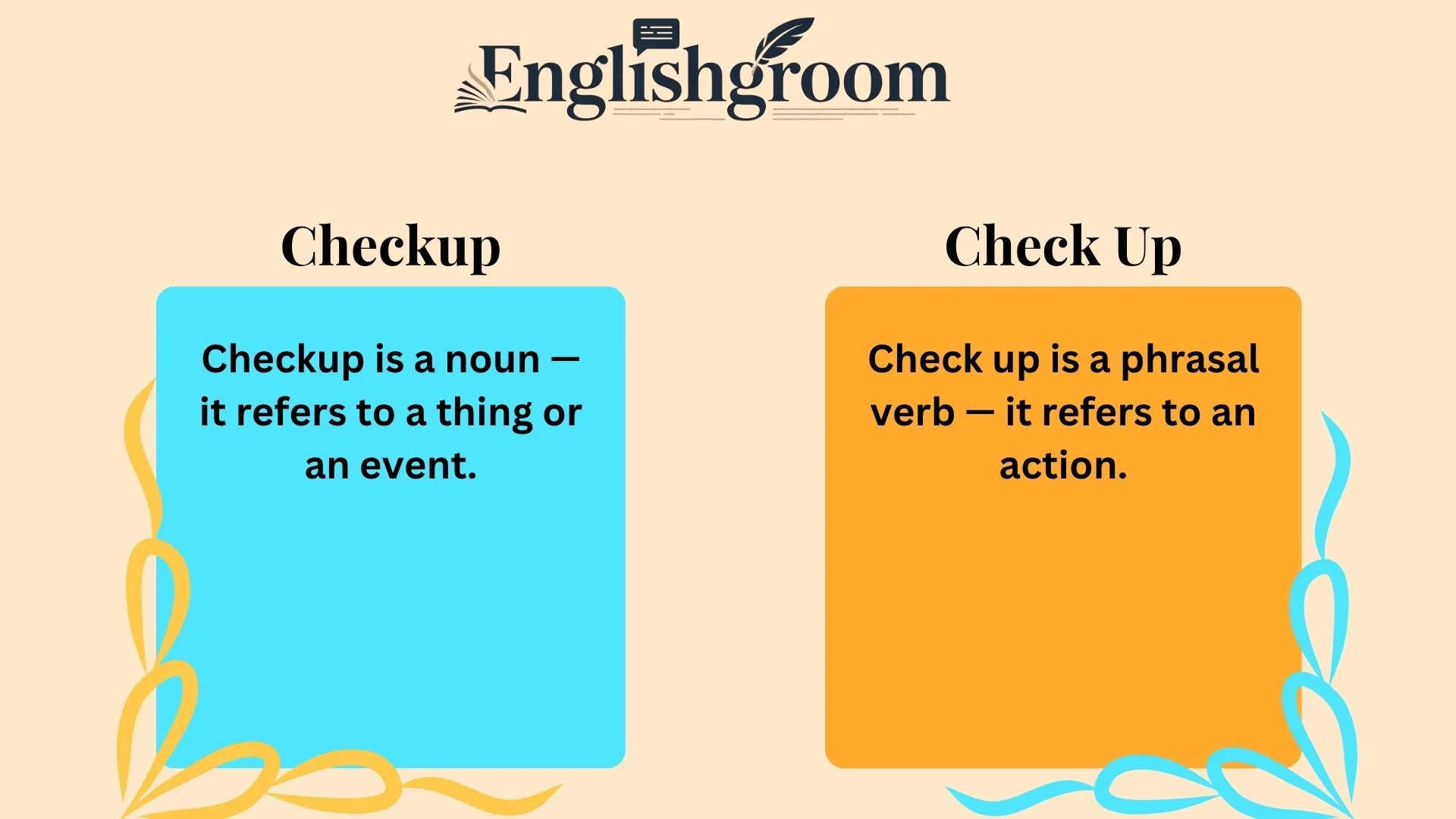
- Checkup is a noun — it refers to a thing or an event.
- Check up is a phrasal verb — it refers to an action.
In short:
“I went for my checkup today.” ✅
“I’ll check up on that tomorrow.” ✅
Both are correct, but they serve completely different grammatical roles. Let’s look deeper.
Comparison Table: Checkup vs. Check Up

| Feature | Checkup | Check Up |
|---|---|---|
| Part of Speech | Noun | Phrasal Verb |
| Definition | A routine examination or review | To investigate, verify, or monitor |
| Examples | “I had my annual checkup.” | “She’ll check up on the project later.” |
| Used In | Health, maintenance, performance reviews | Actions, supervision, investigation |
| Common Mistake | Using “check-up” (hyphenated) | Using it as a noun |
| Tone | Neutral or professional | Context-dependent (can sound caring or suspicious) |
Understanding “Checkup” as a Noun
The word “checkup” functions as a noun, meaning it names something — typically a routine examination or assessment.
You’ll most often hear it in healthcare settings, but it’s also used in mechanical or academic contexts.
Common Contexts
- Medical: “I went for my dental checkup.”
- Performance: “The team had a project checkup before the deadline.”
- Maintenance: “Schedule a vehicle checkup every 10,000 miles.”
Linguistic Roots
“Checkup” evolved from the verb phrase “check up,” which originally meant “to examine.” Over time, language users began treating it as a single concept — the event of examination — leading to the one-word noun we now use.
Real-World Frequency
According to linguistic data from major corpora such as the Corpus of Contemporary American English (COCA), checkup appears far more often than “check-up” or “check up” when referring to a medical exam.
For example:
“Doctors recommend a checkup every year after age 40.”
That’s short, natural, and immediately clear — something every good writer aims for.
Exploring Common “Checkup” Examples
Let’s see how “checkup” works across different contexts:
| Context | Sentence Example |
|---|---|
| Health | “He scheduled a yearly checkup with his cardiologist.” |
| Education | “Teachers conduct a reading checkup mid-semester.” |
| Business | “The audit served as a financial checkup for the company.” |
| Automotive | “My car needs a checkup before the road trip.” |
Quick Tip:
If you can put “a” or “the” before it, you’re likely dealing with a noun, so checkup (one word) is the correct form.
Understanding “Check Up” as a Phrasal Verb
Unlike “checkup,” “check up” is a verb phrase — a combination of “check” (the base verb) and “up” (an adverb). Together, they describe the action of investigating or verifying something or someone.
How It’s Used
“Check up” often appears with the preposition “on.” For instance:
- “The teacher checked up on her students’ homework.”
- “He checked up on his investment portfolio.”
This adds the sense of supervision or ensuring everything’s okay.
Grammar & Structure
Here’s how it fits grammatically:
- Base form: check up
- Present participle: checking up
- Past tense: checked up
Examples:
- “I’m checking up on your request.”
- “They checked up on the issue yesterday.”
Common Scenarios for Using “Check Up”
1. Health Monitoring & Caregiving
Used when someone ensures another person’s wellbeing.
Example:
“After surgery, the nurse checked up on the patient every hour.”
2. Workplace and Project Oversight
Used to describe progress or supervision.
Example:
“The project manager checked up on the design team.”
3. Parenting & Relationships
Used to show concern or curiosity.
Example:
“Parents often check up on their kids’ social media accounts.”
The Hyphenated “Check-Up”: Still in Use?
You might have seen “check-up” written with a hyphen — especially in older books or outdated forms. But is it correct today?
Current Style Standards
Modern English style guides have largely dropped the hyphen:
| Source | Preferred Form |
|---|---|
| Merriam-Webster | checkup |
| Oxford English Dictionary | checkup |
| AP Stylebook | checkup |
| Chicago Manual of Style | checkup |
Verdict: The hyphenated “check-up” is outdated. Use “checkup” in modern writing.
Why the Change?
As compound nouns become more familiar, English tends to merge them into single words over time — just like website (once “web site”) and email (once “e-mail”).
So while “check-up” isn’t wrong, it’s old-fashioned.
Real Sentence Examples: Checkup vs. Check Up
| Correct Usage | Incorrect Usage |
|---|---|
| “I went for my annual checkup.” | “I went for my annual check up.” |
| “Let’s check up on that later.” | “Let’s have a checkup on that later.” |
| “The mechanic performed a quick checkup.” | “The mechanic checked up of my car.” |
Key takeaway:
Use checkup when referring to an event or examination.
Use check up when referring to the act of verifying or monitoring.
Common Errors & Proofreading Tips
Even experienced writers slip up with this pair. Here’s how to avoid common pitfalls:
Frequent Mistakes
- Mixing noun and verb forms:
❌ “I need to checkup on the kids.”
✅ “I need to check up on the kids.” - Adding unnecessary hyphens:
❌ “I had a check-up yesterday.”
✅ “I had a checkup yesterday.” - Using “check up” without ‘on’ when needed:
❌ “She checked up her employees.”
✅ “She checked up on her employees.”
Proofreading Tips
- Read your sentence aloud. Does it describe doing something? Use “check up.”
- Does it describe a thing or an appointment? Use “checkup.”
- If you can replace it with “appointment” and it still works, the noun form is correct.
UK vs. US Spelling and Usage Differences
While both British and American English use the same basic rule, there are subtle trends:
| Region | Common Preference | Notes |
|---|---|---|
| US English | “Checkup” (one word) | Standard in health, business, and writing. |
| UK English | “Check-up” or “check up” | “Check-up” still appears more frequently in UK media. |
| Global English | “Checkup” gaining dominance | Digital media and American usage influence have made “checkup” the default. |
So if you’re writing for an international audience, “checkup” is your safest choice.
Quick Decision Flow: Which One to Use
Here’s a simple flowchart-style checklist to guide you:
Is it an action?
   ↓
Yes → check up (verb)
No → checkup (noun)
Or think of it this way:
- Talking about doing something → “check up.”
- Talking about the thing itself → “checkup.”
Example:
- “I need to check up on my friend.” (action)
- “I’m going for a checkup next week.” (thing)
Mini Case Study: Language in Real Use
Let’s compare how these words appear in real-world sources.
Case Study 1: Healthcare Context
“Patients should have a dental checkup twice a year.” — American Dental Association
Here, checkup acts as a noun representing a routine exam.
Case Study 2: Corporate Environment
“Supervisors regularly check up on team productivity.” — Harvard Business Review
Here, check up on shows action — ongoing supervision.
Case Study 3: Everyday Speech
“I checked up on you because I was worried.”
Tone varies here — it can sound caring, curious, or suspicious, depending on context.
Expert Quote on Usage
“When you’re talking about an event, say ‘checkup.’ When you’re talking about the act, say ‘check up.’ It’s one of those pairs where function defines form.”
— Dr. Anne Curzan, Professor of Linguistics, University of Michigan
This simple rule of thumb can save you from most errors.
Quick Recap
- Checkup = noun (the thing)
- Check up = verb phrase (the action)
- Check-up = outdated spelling
- Tip: Replace it with appointment or investigate to test your choice.
That’s the easiest way to ensure accuracy every time you write.

FAQs
1. Is “check-up” still correct in modern writing?
Technically yes, but it’s outdated. Most modern style guides recommend “checkup” as a single word.
2. Can I say “I’ll checkup later”?
No. That’s incorrect. You should say “I’ll check up later” or “I’ll check up on it later.”
3. What’s the plural of checkup?
It’s checkups.
Example: “Regular checkups help catch health problems early.”
4. Is there any difference in pronunciation?
No, both “checkup” and “check up” sound almost identical in speech — context reveals the difference.
5. How can I remember which to use?
Use this trick:
If it’s a thing → “checkup.”
If it’s an action → “check up.”
Learn More English With These Best Articles:
Same Difference Meaning Origin and Real-Life Examples Explained
“Input” vs “Imput” The Real Difference Explained
Passersby or Passerbyers? The Right Way to Say It
What Are Staccato Sentences? The Writer’s Secret to Sharp, Powerful Prose
Propose vs Purpose: The Real Difference You Need to Know
Final Thoughts
Getting “checkup” and “check up” right isn’t just about grammar — it’s about writing clearly and professionally. Whether you’re drafting a business report, a medical note, or an email to your boss, these two forms communicate different meanings.
Remember:
- Checkup is a noun — your annual doctor’s visit.
- Check up is a verb phrase — what you do when verifying something.
Keep this guide handy, and soon you’ll spot the difference instinctively.

Hi! I’m Sami, a 28-year-old content writer with a love for words and storytelling. Writing has always been my way of expressing ideas, sharing knowledge, and connecting with people. I enjoy creating engaging and well-researched content—whether it’s blogs, articles, or social media posts—that not only informs but also inspires readers. My goal is to turn complex ideas into clear, creative, and meaningful pieces of writing that leave a lasting impact.