Last updated on February 15th, 2026 at 01:48 pm
Few criminal empires have shaped the modern underworld like the cartel and the mafia. Both operate in secrecy, command immense wealth, and wield influence across nations.
Yet their roots, methods, and philosophies differ sharply.
This article unpacks those differences with facts, case studies, and historical context—cutting through myths to reveal how these two criminal giants evolved into global powerhouses.
Understanding the Underworld: Cartel vs Mafia
Both cartels and mafias operate as organized crime networks, but their origins and motives set them apart.
What Is a Mafia?
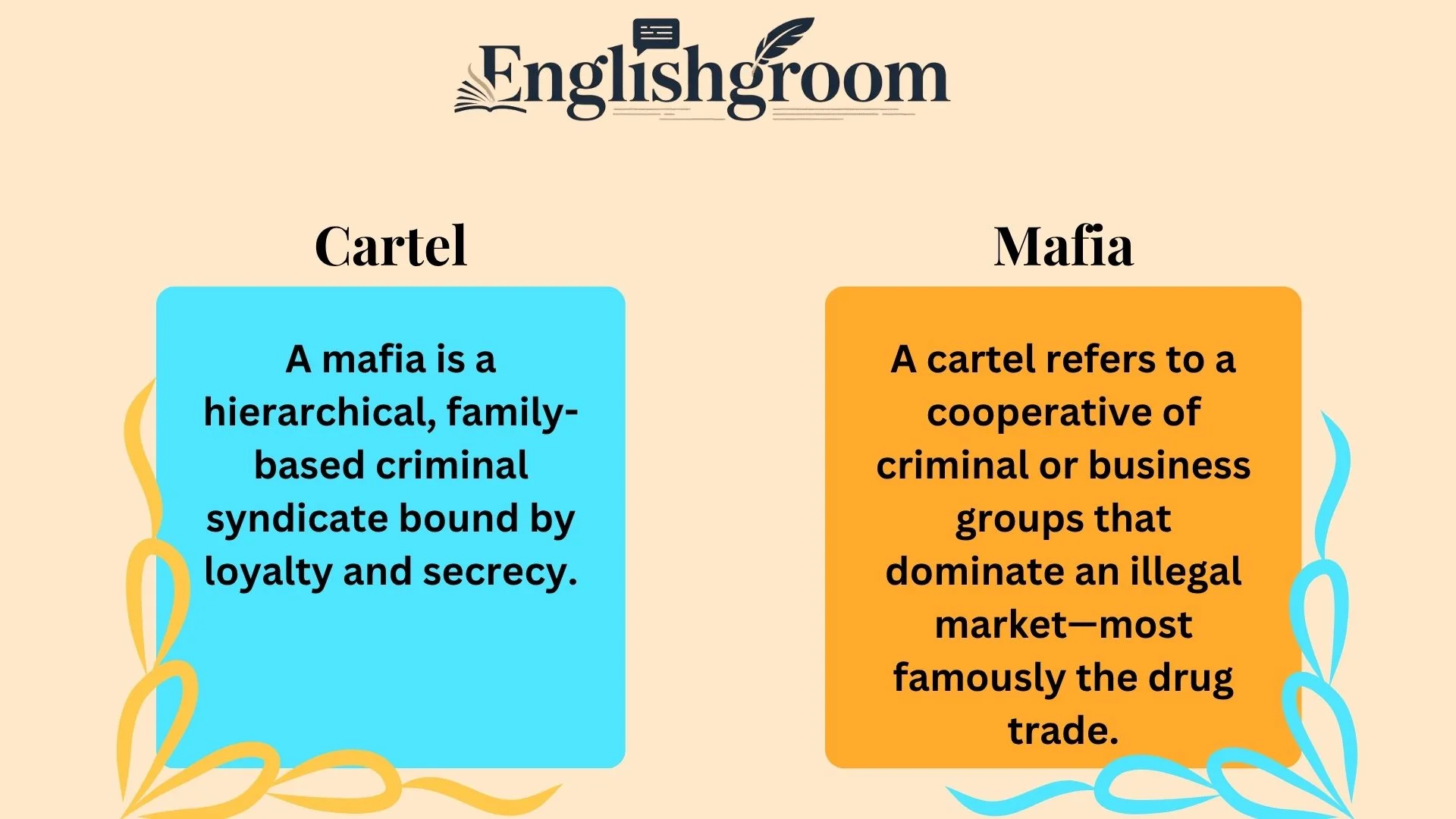
A mafia is a hierarchical, family-based criminal syndicate bound by loyalty and secrecy.
- Originated in Sicily, Italy during the 19th century.
- Built on codes of honor (Omertà) and structured ranks.
- Focuses on control of territory, protection rackets, and political influence.

What Is a Cartel?
A cartel refers to a cooperative of criminal or business groups that dominate an illegal market—most famously the drug trade.
- Born in Latin America, especially Mexico and Colombia.
- Operates as a network of decentralized cells instead of one rigid hierarchy.
- Prioritizes product control, market dominance, and supply chains.
Key Difference:
Mafias are about power and loyalty, while cartels are about profits and logistics.
Origins and Evolution
The Mafia’s Sicilian Legacy
The mafia’s story begins in Sicily in the mid-1800s. Amid social chaos, landowners relied on local “men of honor” to protect property and enforce order. These protectors evolved into Cosa Nostra, an organization that demanded payment for “protection.”
By the early 1900s, Italian immigrants carried these traditions to America, birthing the American Mafia. Prohibition (1920–1933) transformed them from small gangs into economic empires, running bootleg liquor operations worth billions in today’s money.
“Power wears out those who don’t have it.” — Giulio Andreotti, Italian statesman rumored to have mafia ties.
The Birth of Cartels
Cartels rose much later. The Medellín Cartel of Colombia, led by Pablo Escobar, and Mexico’s Guadalajara Cartel in the 1980s shaped the modern drug trade. They built smuggling networks spanning the Americas, using violence and bribery to dominate markets.
After Escobar’s death in 1993, Mexican organizations like Sinaloa and Jalisco New Generation (CJNG) took control. Unlike the mafia, cartels focused on export logistics—producing, transporting, and distributing drugs on a global scale.
Power Structures and Internal Systems
Both mafias and cartels thrive on order, but their internal mechanics differ drastically.
Mafia Hierarchy
Mafias run like corporations with military discipline.
| Rank | Role | Description |
|---|---|---|
| Boss (Don) | Supreme leader | Commands all operations and decisions. |
| Underboss | Deputy leader | Manages day-to-day affairs and disputes. |
| Consigliere | Advisor | Provides counsel and maintains neutrality. |
| Caporegime (Captain) | Mid-level manager | Supervises soldiers and reports to the boss. |
| Soldier | Foot soldier | Executes orders and runs street-level crime. |
| Associate | Outsider collaborator | Handles finances, smuggling, or contracts. |
Loyalty is sacred. Betrayal often ends in execution. The Omertà code forbids cooperation with authorities.
Cartel Networks
Cartels function more like multinational corporations—fluid, dynamic, and decentralized.
Typical structure:
- Leadership Core: Oversees international logistics and finances.
- Lieutenants: Manage territories known as plazas.
- Sicarios (Hitmen): Handle enforcement and assassinations.
- Financial Teams: Launder profits through shell companies.
- Smugglers & Couriers: Move drugs across borders.
Comparison Table
| Feature | Mafia | Cartel |
|---|---|---|
| Structure | Hierarchical | Networked |
| Main Focus | Territory & loyalty | Trade & logistics |
| Enforcement | Internal discipline | Extreme violence |
| Revenue Source | Racketeering, gambling, extortion | Drug trade, oil theft, human trafficking |
| Corruption Tactics | Political infiltration | Narco-terrorism & bribery |
Criminal Enterprises: How They Make Money
Both groups profit from illegal markets, but their operations vary by geography and purpose.
Mafia Activities
- Racketeering: Forcing businesses to pay for protection.
- Loan Sharking: Lending money at high interest rates.
- Money Laundering: Using restaurants, clubs, and construction firms.
- Illegal Gambling: Controlling underground casinos.
- Political Corruption: Influencing elections and contracts.
The Italian ‘Ndrangheta alone controls 80% of Europe’s cocaine trade, earning over $60 billion annually—rivaling major corporations.
Cartel Activities
- Drug Trafficking: Cocaine, heroin, meth, and fentanyl dominate profits.
- Extortion: Charging “taxes” on businesses and migrants.
- Fuel Theft: Siphoning oil from pipelines (especially in Mexico).
- Human Smuggling: Moving people across borders for profit.
- Crypto Laundering: Using Bitcoin to hide transactions.
Cartels rely on global trade routes—shipping drugs from South America to Europe via Africa and the Caribbean.
Fun Fact:
Cartels often use narco-submarines, semi-submersible vessels that can carry up to 10 tons of cocaine undetected across oceans.
Image vs Reality: Myths and Misconceptions
The Mafia Mystique
Movies like The Godfather and Goodfellas romanticize the mafia as a brotherhood of honor. In truth, mafias are ruthless profit machines that rely on fear, not respect.
- Myth: Mafiosi only target enemies.
- Reality: Civilians often become collateral in power struggles.
- Myth: Loyalty guarantees safety.
- Reality: Betrayal and murder are common even within families.
The Cartel Reality
Cartels are often portrayed as chaotic or impulsive. But their operations are strategically managed—using accountants, lawyers, and logistics experts.
- Myth: Cartels are disorganized gangs.
- Reality: They function like international corporations.
- Myth: Violence is random.
- Reality: It’s calculated—used as a communication tool to maintain dominance.
“In the cartel world, terror is not madness—it’s marketing.” — Former DEA agent Javier Peña
Global Reach and Modern Influence
Mafia’s Modern Presence
The traditional mafia has evolved beyond guns and gambling.
Today, its power lies in finance and infiltration:
- The ‘Ndrangheta controls shipping routes from South America.
- The Camorra invests in waste management and construction.
- The American Mafia now focuses on white-collar crimes—cyber fraud, stock manipulation, and identity theft.
Mafia families operate across continents, laundering money through legitimate businesses in Germany, Canada, and Australia.
Cartel Expansion
Mexican cartels like Sinaloa and CJNG have expanded beyond Latin America.
Their operations now span:
- Europe: Cocaine distribution networks in Spain and the Netherlands.
- Asia: Chemical precursor imports for synthetic drugs.
- Africa: Transit routes through West African ports.
Cartels use encrypted apps, drones, and cryptocurrency to manage logistics.
Fact:
In 2023, global drug trade profits were estimated at over $400 billion, with cartels controlling most of it.
Case Studies
Sinaloa Cartel in Europe
The Sinaloa Cartel, once led by Joaquín “El Chapo” Guzmán, has built a European empire through partnerships with Balkan and Italian groups.
- Entry Point: Spain and the Netherlands via maritime routes.
- Alliances: Collaboration with the ‘Ndrangheta for cocaine distribution.
- Outcome: Created one of the most efficient transatlantic drug supply chains in history.
‘Ndrangheta’s Football Club Infiltration
Italian investigators uncovered that the ‘Ndrangheta laundered millions through football clubs.
- Method: Buying small clubs, manipulating ticket sales, and inflating player transfers.
- Impact: Blended criminal profits with legitimate sports investments.
- Example: 2018 investigations revealed over 30 clubs under suspicion in Italy and Spain.
Cross-Continental Cooperation
Evidence shows cartels and mafias sometimes collaborate.
- Example: Sinaloa shipped cocaine to Europe through mafia-controlled ports.
- Benefit: Mafias provided local logistics and protection; cartels supplied product.
- Result: A new hybrid model of transnational organized crime.
The Future of Organized Crime
As law enforcement tightens borders, both mafias and cartels adapt.
Emerging Trends
- Cybercrime: Cartels hack government systems and use ransomware.
- Synthetic Drugs: Fentanyl replaces cocaine as top profit source.
- Dark Web Sales: Anonymous online markets fuel global narcotics trade.
- Corruption Networks: Criminals invest in politics and law enforcement.
Law Enforcement Response
Global collaboration is increasing:
- Interpol & Europol: Target international trafficking and money laundering.
- DEA Operations: Focus on disrupting fentanyl supply chains.
- Technology Use: AI and blockchain tracing to track financial flows.
Still, for every cartel dismantled, another rises—leaner and more secretive.
Frequently Asked Questions (FAQs)
How is a cartel different from a mafia?
Cartels are networked organizations focused on the drug trade, while mafias are hierarchical groups rooted in family and territory control.
Which is more powerful today, cartels or mafias?
Cartels currently generate more revenue globally, but mafias remain deeply embedded in political and financial systems.
Do cartels and mafias ever work together?
Yes. They often cooperate on drug shipments, money laundering, and logistics—especially in Europe and Africa.
What is the richest cartel in the world?
The Sinaloa Cartel, with estimated earnings exceeding $3 billion annually, remains the wealthiest and most influential.
Can organized crime ever be fully eradicated?
Unlikely. As long as demand for illegal goods exists, new groups will fill the void, adapting to global markets.
Learn More English With These Best Articles:
Run Like the Wind Meaning Uses & Powerful Impact
Appal vs Appall Meaning Usage and the Real Difference Explained
What Does Reconnoiter Mean? Definition Usage & Real-World Examples
Mastering Having vs Having Had in English Grammar
The Ultimate Guide to Getting It Right
Conclusion
Both cartels and mafias represent different eras and ideologies of organized crime.
- The mafia thrives on loyalty, hierarchy, and territorial control.
- The cartel thrives on commerce, networks, and brutal efficiency.
Their evolution mirrors globalization itself—shifting from streets to cyberspace, from secrecy to strategy.
Understanding these forces isn’t just about crime stories; it’s about recognizing how power operates in the shadows of the world economy.

Hi! I’m Sami, a 28-year-old content writer with a love for words and storytelling. Writing has always been my way of expressing ideas, sharing knowledge, and connecting with people. I enjoy creating engaging and well-researched content—whether it’s blogs, articles, or social media posts—that not only informs but also inspires readers. My goal is to turn complex ideas into clear, creative, and meaningful pieces of writing that leave a lasting impact.