Last updated on February 12th, 2026 at 06:40 am
Have you ever paused mid-sentence wondering whether to say “as evidenced by” or “as evident by”? You’re not alone.
These two phrases look almost identical, yet only one is grammatically correct. The difference might seem tiny, but in writing—especially professional or academic—it makes a world of difference.
This guide breaks down everything you need to know about the correct usage, backed by grammar logic, examples, and memory tricks you’ll actually remember.
Introduction: The Confusion Between “Evidenced” and “Evident”
English can be tricky, especially when two words look and sound so similar. “As evidenced by” and “as evident by” both feel right, yet one will make a grammarian cringe.
Let’s look at two examples:
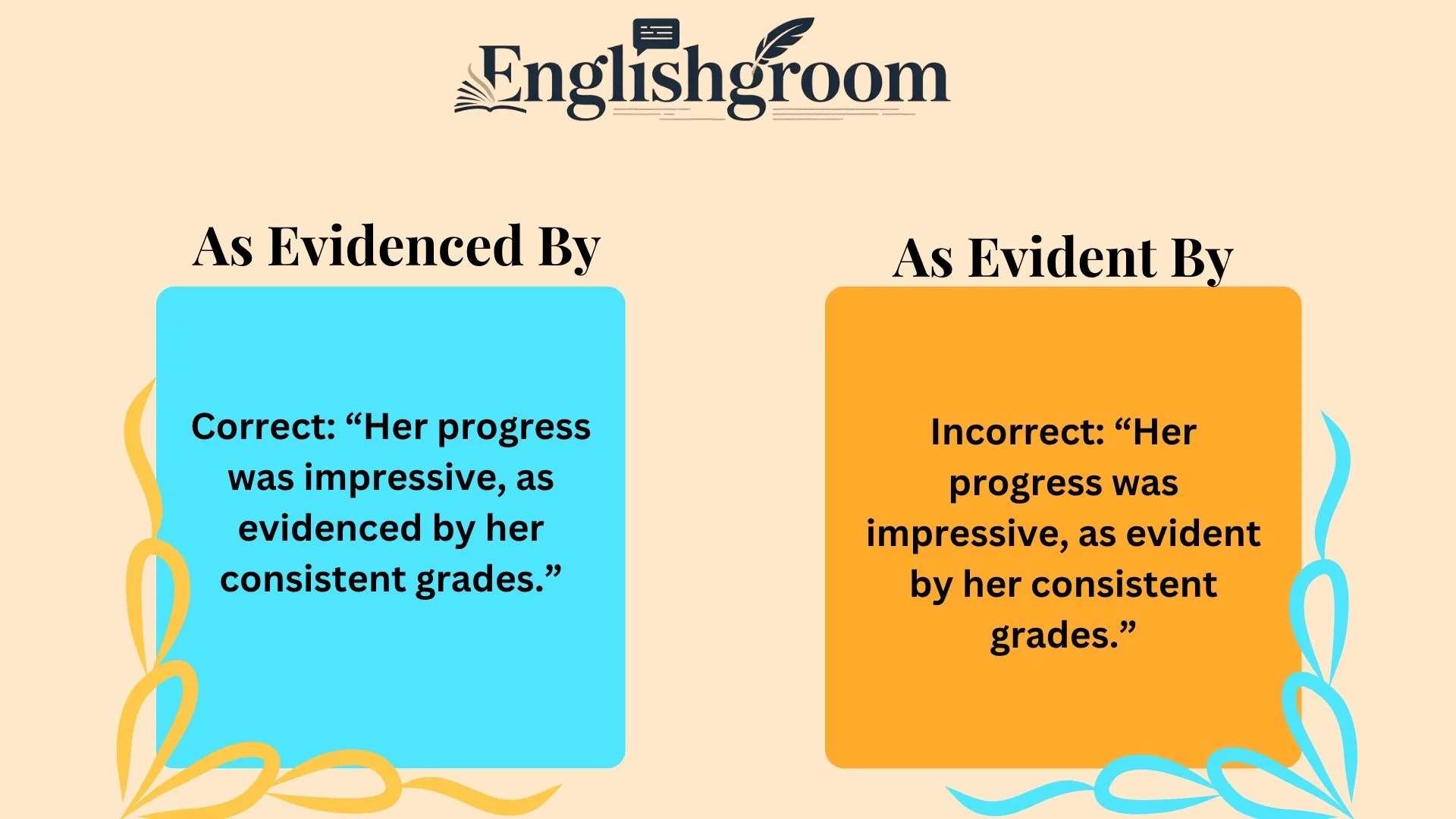
- ✅ Correct: “Her progress was impressive, as evidenced by her consistent grades.”
- ❌ Incorrect: “Her progress was impressive, as evident by her consistent grades.”
At a glance, the wrong version doesn’t sound disastrous—but it’s still incorrect. To understand why, you need to know what “evidenced” and “evident” really mean.
Breaking Down the Grammar
Understanding the parts of speech is key. Here’s how the two differ:
What “Evidenced” Means
“Evidenced” is the past participle of the verb “to evidence.”
That means it’s used in passive constructions, usually followed by “by.” It means “to show,” “to prove,” or “to demonstrate.”
Examples:
- “His leadership skills were evidenced by the team’s success.”
- “The problem is evidenced by the rising error rate.”
- “The claim was evidenced by multiple studies.”
👉 Notice how each sentence could also use “shown by” or “demonstrated by.”
In simple terms, “as evidenced by” means “as shown by.”
What “Evident” Means
“Evident” is an adjective. It describes something that is clear, obvious, or easily seen.
You’d use it like this:
- “His excitement was evident from his wide smile.”
- “The results are evident in the data.”
It can’t directly take “by,” because adjectives describe nouns—they don’t act on something. That’s why “as evident by” is grammatically wrong.
So:
- ✅ “As evident from the results…” → Correct
- ❌ “As evident by the results…” → Incorrect
Which Phrase Is Correct: “As Evidenced By” or “As Evident By”?
Let’s cut to the chase:
✅ The correct phrase is “as evidenced by.”
❌ The incorrect phrase is “as evident by.”
Here’s why:

| Phrase | Grammar Type | Usage | Correctness |
|---|---|---|---|
| As evidenced by | Passive verb phrase | Means “as shown by” | ✅ Correct |
| As evident by | Incorrect adjective + preposition | Breaks grammatical rule | ❌ Incorrect |
Grammar logic:
- “Evidenced” (verb) → Can link with “by.”
- “Evident” (adjective) → Links with “from” or “in,” not “by.”
Examples:
- ✅ “The company’s growth was strong, as evidenced by record profits.”
- ❌ “The company’s growth was strong, as evident by record profits.”
- ✅ “The company’s growth was evident from record profits.”
How to Use “As Evidenced By” Naturally in Sentences
This phrase often appears in formal or academic writing, but it’s useful elsewhere too. Here’s how to use it correctly depending on context.
In Academic Writing
Used to support evidence or connect data:
“The hypothesis was confirmed, as evidenced by consistent test results.”
In Business or Reports
Used to highlight results or achievements:
“Sales have improved this quarter, as evidenced by a 12% increase in revenue.”
In Everyday Speech
Even though it sounds formal, it fits in casual contexts too:
“He’s committed to fitness, as evidenced by his 5 a.m. runs.”
Alternatives to “As Evidenced By”
To avoid repetition or vary your tone, use these alternatives:
| Alternative Phrase | Tone | Example |
|---|---|---|
| As shown by | Neutral | “As shown by the report, performance improved.” |
| As demonstrated by | Formal | “As demonstrated by recent findings.” |
| As proven by | Strong, assertive | “As proven by scientific research.” |
| As indicated by | Professional | “As indicated by survey responses.” |
Common Mistakes and Misconceptions
Even seasoned writers mix this up. Here’s why:
1. Mishearing the Phrase
People hear “as evident by” in casual conversation and assume it’s correct. Spoken English often tolerates small grammatical slips.
2. Confusing Sound-Alikes
“Evident” and “evidenced” sound similar, so many assume they’re interchangeable. They’re not.
3. Forgetting Grammar Roles
Remember:
- “Evident” = Adjective (describes)
- “Evidenced” = Verb (acts)
4. Overusing “As Evidenced By”
While correct, it can sound stiff if used too often. Mix in alternatives for natural flow.
Quick Grammar Comparison Table
| Phrase | Part of Speech | Meaning | Correct? | Example |
|---|---|---|---|---|
| As evidenced by | Verb (past participle) | “As shown by” | ✅ Yes | “As evidenced by her dedication.” |
| As evident by | Adjective (incorrect use) | N/A | ❌ No | “As evident by her dedication.” |
| As evident from | Adjective + correct preposition | “As clear from” | ✅ Yes | “As evident from her tone.” |
“As Evident From” – The Closely Related but Correct Alternative
If you prefer to use “evident,” remember it pairs with “from” not “by.”
Examples:
- “Her passion is evident from her work ethic.”
- “The trend is evident from the data collected.”
Difference in tone:
- “As evidenced by” → More formal and analytical.
- “As evident from” → Slightly softer, observational.
When to Use Which
| Context | Recommended Phrase |
|---|---|
| Academic papers | As evidenced by |
| Research reports | As evidenced by |
| Everyday writing | As evident from |
| Emails, blogs | Either (depending on tone) |
Easy Memory Tricks to Remember the Difference
Grammar doesn’t have to be dull. Here are a few tricks to make it stick.
1. The “-ed” Rule
If a word ends in -ed, it usually acts like a verb or past participle.
➡️ “As evidenced by” = Verb phrase → Correct.
2. The “From” Fix
If you’re tempted to say “as evident by,” replace “by” with “from.”
➡️ “As evident from” = Correct.
3. The “Show” Test
Try replacing the word with “shown.”
If the sentence still works, “as evidenced by” is the right choice.
Example:
- “Her talent was shown by her results.” ✅ Works
- So, “as evidenced by her results” ✅ Correct
Case Study: Common Usage in Professional Writing
To see the difference in action, let’s look at how each phrase might appear in real writing.
Example 1: Academic Paper
“The effectiveness of the treatment was significant, as evidenced by a 35% reduction in symptoms.”
✅ Professional, clear, and grammatically correct.
Example 2: Business Report
“Employee satisfaction has improved, as evidenced by higher retention rates.”
✅ Correct, polished tone suitable for formal writing.
Example 3: Incorrect Usage
“Employee satisfaction has improved, as evident by higher retention rates.”
❌ Sounds casual but breaks grammatical rules.
Summary: The Takeaway
Let’s recap:
- “As evidenced by” → Correct, formal, and widely accepted.
- “As evident by” → Incorrect; use “as evident from” instead.
- “Evidenced” = Verb form of “evidence.”
- “Evident” = Adjective meaning clear or obvious.
If you remember nothing else, remember this:
“Evidenced” shows action; “evident” shows description.
Both come from the same root, but they play different roles. Using the right one strengthens your credibility and makes your writing sound professional.
FAQs
What does “as evidenced by” mean?
It means “as shown by” or “as demonstrated by.” It’s used to present supporting proof or examples.
Can I use “as evident by” in casual writing?
Grammatically, no. You can say “as evident from” instead if you want a softer tone.
Is “as evidenced by” formal?
Yes, it’s most common in formal writing—academic, legal, or professional contexts—but also fits in precise general writing.
What’s a simple alternative to “as evidenced by”?
Try “as shown by,” “as demonstrated by,” or “as proven by.” They mean the same thing and fit both formal and informal writing.
How can I remember which to use?
Think: “-ed = by.” Words ending in “-ed” (like “evidenced”) work with “by.” Adjectives like “evident” pair with “from.”

Hi! I’m Sami, a 28-year-old content writer with a love for words and storytelling. Writing has always been my way of expressing ideas, sharing knowledge, and connecting with people. I enjoy creating engaging and well-researched content—whether it’s blogs, articles, or social media posts—that not only informs but also inspires readers. My goal is to turn complex ideas into clear, creative, and meaningful pieces of writing that leave a lasting impact.