Have you ever paused mid-sentence wondering whether to say “Do you have any problem?” or “Do you have any problems?”
You’re not alone. Even advanced English learners and native speakers hesitate between the two.
At first glance, the difference looks minor — just an “s.” But that tiny letter shifts meaning, tone, and grammatical structure in ways that can change how natural or formal your sentence sounds.
This article breaks it all down: from grammar rules and tone to real-life examples and data from language trends. By the end, you’ll know exactly when to use “any problem” and when “any problems” fits best.
Understanding “Any” in English Grammar
Before we get into problem vs. problems, let’s unpack “any.”
“Any” is a determiner, sometimes an adverb, that means one or more or no matter which. It can appear with countable or uncountable nouns, and that flexibility is where confusion starts.
| Type of Noun | Example Phrase | Meaning |
|---|---|---|
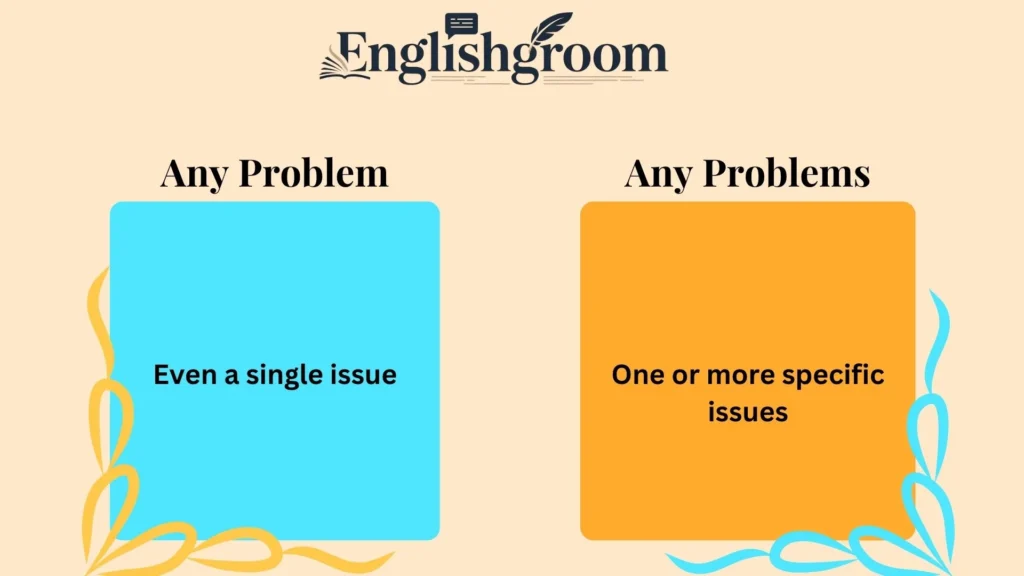
| Countable (plural) | “Any problems” | One or more specific issues |
| Singular (countable) | “Any problem” | Even a single issue |
| Uncountable | “Any advice” | Refers to a non-countable concept |
So, both “any problem” and “any problems” are grammatically correct. The context decides which one works better.
“Problem” — Countable or Uncountable?
Here’s where English gets tricky.
“Problem” is technically a countable noun, meaning you can have one problem, two problems, or a hundred problems. But it sometimes behaves like an uncountable noun when referring to general difficulty.
Consider these:
- “She doesn’t have any problem understanding him.” → Here, problem means difficulty (uncountable sense).
- “They didn’t report any problems after the update.” → Here, problems refers to specific issues (countable).
Tip: When referring to general or abstract difficulty, use the singular. When referring to multiple or concrete issues, use the plural.
When to Use “Any Problem”
You’ll most often see “any problem” in formal writing or official communication. It’s used when the speaker refers to a single type of issue, or wants to emphasize the absence of even one problem.
Use Cases
- When highlighting general difficulty or abstract issues:
- “If you face any problem accessing your account, contact us.”
- “He didn’t have any problem adjusting to the new city.”
- When formality is required:
- “Should you encounter any problem, please notify our support desk.”
- “There’s no problem too big to solve.”
Why It Sounds Formal
“Any problem” emphasizes the concept of trouble itself, rather than individual instances. That’s why it appears in emails, manuals, or polite requests.
Example from business context:
“If you experience any problem with payment processing, please reach out immediately.”
This phrasing focuses on preventing issues, not counting them.
When to Use “Any Problems”
Now let’s flip to “any problems.”
You’ll hear this phrase far more often in natural conversation. It refers to multiple or potential individual issues and sounds friendly, everyday, and conversational.
Use Cases
- When referring to specific issues that may arise:
- “Did you have any problems finding the hotel?”
- “They didn’t mention any problems during the meeting.”
- When talking about real-world situations:
- “Any problems with the delivery?”
- “Let me know if there are any problems with the system.”
Why It Sounds Natural
Native speakers use the plural because it aligns with how we experience life — multiple small issues rather than one grand “problem.”
Example from spoken English:
“Hey, any problems with your new phone?”
Sounds friendly, relaxed, and human.
Singular vs. Plural: Meaning and Tone
Let’s break down the nuance between the two forms.
| Aspect | “Any Problem” | “Any Problems” |
|---|---|---|
| Tone | Formal, Polite, Abstract | Informal, Natural, Conversational |
| Focus | General difficulty | Multiple specific issues |
| Usage Context | Business writing, instructions | Everyday conversation, informal speech |
| Example | “If you have any problem, contact HR.” | “Any problems logging in today?” |
Bottom Line:
- Use “any problem” when you’re talking formally or generally.
- Use “any problems” when chatting casually or describing several possible issues.
Tone, Register, and Audience
The difference between these two forms often depends on who you’re speaking to and how formal you want to sound.
Formal Settings
Use “any problem” in:
- Business emails
- Official letters
- Technical manuals
- Academic contexts
Example:
“Please inform us immediately if you experience any problem during the submission process.”
Informal or Spoken English
Use “any problems” in:
- Conversations
- Friendly messages
- Customer chats
Example:
“Any problems with your order?”
Regional Tendencies
- British English tends to favor the plural in casual contexts.
- American English uses both forms interchangeably, though the plural still feels more natural in speech.
Real-Life Usage: Insights from Native Speakers
To see how native speakers actually talk, let’s peek at a few real-world snippets from everyday English:
“Any problems so far?” — said by a supervisor checking progress.
“If you face any problem, let me know.” — heard in a workplace meeting.
“Did the app give you any problems?” — casual tech support talk.
Notice something?
In natural, spontaneous speech, “any problems” dominates. The singular form often appears in scripted or written English — manuals, policies, and customer communication.
Usage Trends: Insights from Google Ngram
Although we can’t display the chart here, studies using Google Ngram Viewer show that “any problems” began overtaking “any problem” in frequency from the late 20th century onward.
Why?
Because spoken English became more influential than written English in shaping everyday usage.
Key Insight:
Modern English favors plural expressions when referring to multiple possible occurrences, even if the actual count is unknown.
So while “any problem” isn’t incorrect, “any problems” feels more natural in contemporary communication.
Common Phrases and Idiomatic Expressions
“Problem” pops up in dozens of English idioms and set phrases. Knowing them helps you sound more fluent.
| Expression | Meaning | Example |
|---|---|---|
| No problem | Everything’s fine / You’re welcome | “Thanks for helping!” — “No problem!” |
| What’s your problem? | Confrontational phrase meaning “Why are you upset?” | “What’s your problem, dude?” |
| Problem solver | Someone who finds solutions | “She’s a natural problem solver.” |
| Big problem | Serious issue | “We’ve got a big problem with the code.” |
| Problem child | Someone who causes trouble | “That old car is a real problem child.” |
Pro Tip: Idioms often use “problem” in the singular, even when talking about general or plural situations. That’s because idiomatic language focuses on concepts, not counts.
Quick Reference Guide
Here’s a fast lookup table you can bookmark:
| Expression | Typical Use | Tone | Context | Example |
|---|---|---|---|---|
| Any problem | Refers to general difficulty | Formal | Writing, business, polite speech | “If you have any problem, let me know.” |
| Any problems | Refers to multiple specific issues | Informal | Conversation, casual tone | “Any problems with the app?” |
Case Study: Customer Support Communication
Let’s look at how these two forms appear in real communication.
Scenario 1: Formal Email from a Company
Dear Customer,
Thank you for your purchase. If you experience any problem during installation, please contact our technical support team immediately.
Best regards,
Customer Care Team
Why “any problem” works:
The company speaks formally and focuses on preventing issues. It feels polished and polite.
Scenario 2: Friendly Chat Support
User: Hey, I can’t log in again.
Support Agent: Oh, sorry about that! Any problems with the password reset link?
Why “any problems” works:
It’s conversational, direct, and human — perfect for customer chats or friendly service.
Common Mistakes to Avoid
- ❌ Saying “Do you have any problem?” in casual conversation — it sounds robotic or overly formal.
✅ Use “Do you have any problems?” instead. - ❌ Writing “If you find any problems, contact me” in an academic report — too informal.
✅ Use “If you encounter any problem” for a professional tone. - ❌ Mixing singular and plural forms in the same clause.
✅ Keep agreement consistent: “If you find any problems, report them.”
5 FAQs About “Any Problem” vs. “Any Problems”
Is “any problem” grammatically correct?
Yes, it’s grammatically correct. It’s used for general or abstract references, especially in formal writing.
Why does “any problems” sound more natural?
Because English speakers often think in plural when imagining potential issues — it fits normal conversation flow.
Can both forms appear in the same paragraph?
Yes, if the context shifts. For instance, you might discuss a general problem first, then mention specific problems.
Which is better for customer service emails?
Use “any problem” in formal, professional correspondence. Use “any problems” in friendly or chat-based customer support.
Are there regional preferences?
Slightly. British speakers use “any problems” more often in everyday talk, while Americans use both fairly equally depending on context.
Learn More English With These Best Articles:
Thus Far vs So Far The Clear Guide to Mastering These Common Phrases
Checkup or Check Up The Complete Guide to Using Them Correctly
Die vs Dice The Definitive Guide to Correct Usage
Continuous vs Contious The Real Difference Explained Clearly
In the Street vs. On the Street: What Native Speakers Really Mean
Final Takeaway
The key difference between “any problem” and “any problems” isn’t just about grammar. It’s about tone, context, and intent.
- Use “any problem” for formal, general, or abstract statements.
- Use “any problems” for casual, specific, or conversational talk.
Both are correct. What matters is how you sound — polished or natural.
So next time someone asks, “Any problems?” you’ll not only answer but know why that’s the right form.

Hi! I’m Sami, a 28-year-old content writer with a love for words and storytelling. Writing has always been my way of expressing ideas, sharing knowledge, and connecting with people. I enjoy creating engaging and well-researched content—whether it’s blogs, articles, or social media posts—that not only informs but also inspires readers. My goal is to turn complex ideas into clear, creative, and meaningful pieces of writing that leave a lasting impact.