Last updated on February 19th, 2026 at 09:17 am
Language evolves, and sometimes it does so in ways that confuse even native speakers. One of the most debated examples in English is the difference between “alright” and “all right.”
You’ve probably seen both forms used — in novels, emails, social media, and even academic writing. But which one is actually right? And does “alright” deserve the criticism it often gets from grammar purists?
Let’s settle this once and for all.
Why This Confusion Matters
The “alright vs. all right” debate isn’t just about spelling. It’s about tone, formality, and audience.
Language reflects how we connect. When you write, you’re choosing how formal, casual, or conversational you sound. Using “alright” versus “all right” can subtly change how readers perceive you.
Consider this:
- A student writes, “Everything will be alright.”
- A professor edits it to, “Everything will be all right.”
Same meaning, different vibe. The first sounds casual and emotional. The second feels polished and grammatically precise.
This isn’t just a stylistic quirk — it’s a reflection of how written English evolves with culture and technology.
The Core Difference Between “Alright” and “All Right”
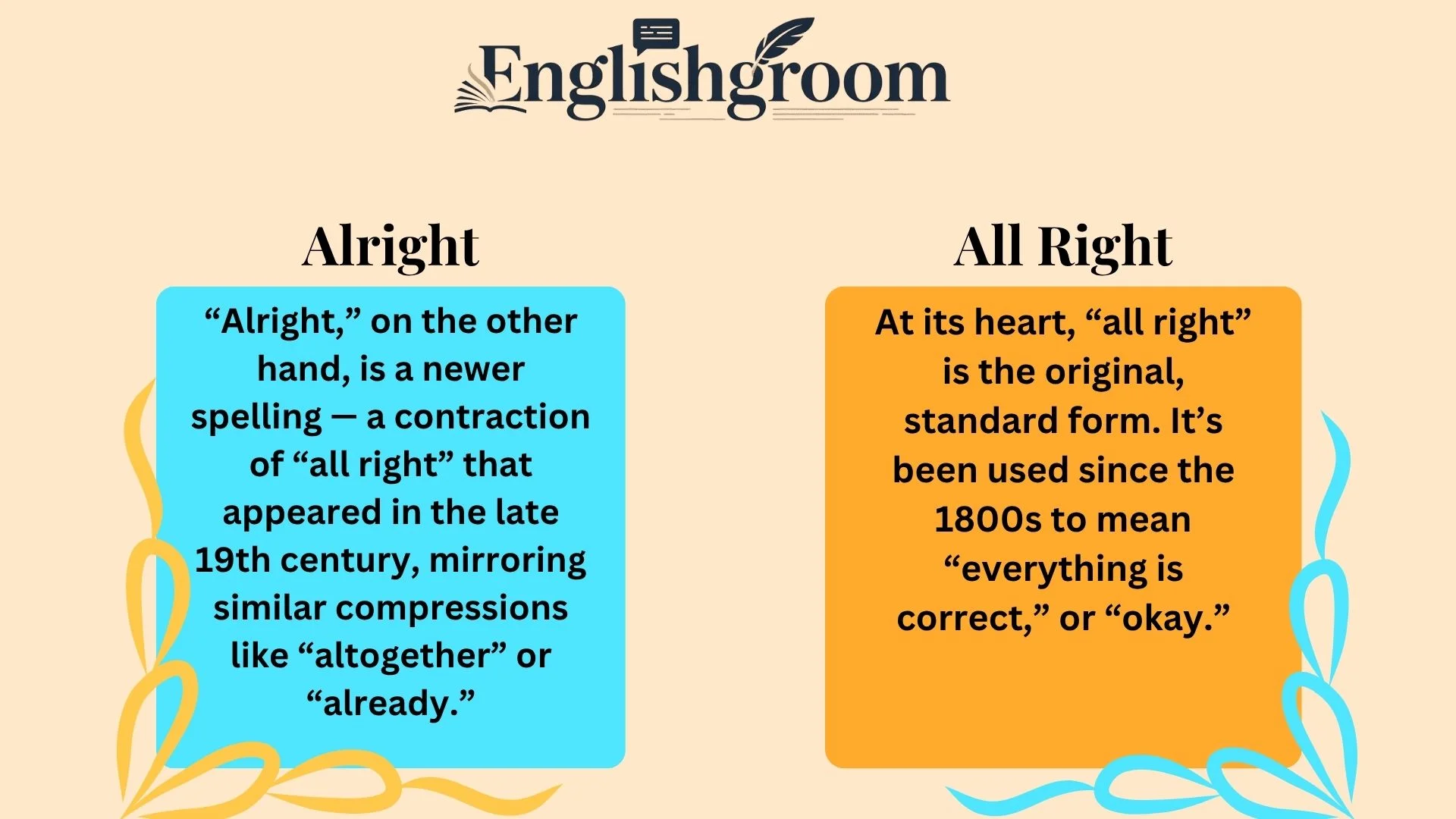
At its heart, “all right” is the original, standard form. It’s been used since the 1800s to mean “everything is correct,” or “okay.”
“Alright,” on the other hand, is a newer spelling — a contraction of “all right” that appeared in the late 19th century, mirroring similar compressions like “altogether” or “already.”
Here’s a quick comparison:
| Aspect | “All Right” | “Alright” |
|---|---|---|
| Origin | Older, traditional | Modern contraction |
| Accepted in formal writing | ✅ Yes | ❌ No (discouraged) |
| Common in casual writing | ✅ Yes | ✅ Yes |
| Tone | Polished, clear | Relaxed, conversational |
| Seen in literature | Common historically | Popular in 20th-century fiction |

In short:
“All right” is the standard form, while “alright” is a modern variant used mainly in informal or creative writing.
Is “Alright” Ever Grammatically Correct?
Here’s where things get interesting.
Traditional grammar guides argue that “alright” is technically incorrect, since “all right” already serves the purpose. But modern linguists and dictionaries take a softer stance.
According to Merriam-Webster, “alright” is an established variant, especially in informal contexts. The Oxford English Dictionary notes that while “alright” has existed for over a century, it’s still viewed as nonstandard in formal English.
“The form alright is frequently used in fictional dialogue and informal writing but remains unacceptable in more formal contexts.”
— Oxford English Dictionary
So, is “alright” wrong? Not exactly. It’s context-sensitive.
Use “alright” when your goal is a natural, conversational tone. Think of song lyrics, text messages, or friendly blog posts. But if you’re writing a business proposal, essay, or report, stick with “all right.”
Examples of Correct “Alright” Usage
- “Alright, let’s get started.”
- “It’s alright if you need more time.”
- “She said she’d be alright after a rest.”
In each case, the tone is informal, friendly, or emotional — all ideal environments for “alright.”
When “All Right” Is the Only Correct Option
Now, let’s flip the script.
There are cases where only “all right” fits grammatically and logically. Especially when the phrase doesn’t just mean “okay,” but literally “everything is correct.”
For instance:
- ✅ “Your answers were all right.” → means every answer was correct.
- ❌ “Your answers were alright.” → doesn’t make sense in this context.
In formal or professional communication, “all right” always wins. Business emails, essays, reports, and academic papers should never use “alright.” It appears unpolished and may even be marked wrong by grammar checkers.
Examples of Correct “All Right” Usage
- “Everything turned out all right in the end.”
- “Are you feeling all right?”
- “Her calculations were all right, not perfect, but solid.”
Remember this rule: if the phrase can mean “entirely correct” or “completely fine,” it must be “all right.”
Real-World Usage Examples
Here’s a side-by-side comparison to help you visualize which form fits where:
| Context | Preferred Form | Example Sentence |
|---|---|---|
| Texting a friend | Alright | “Alright, see you soon!” |
| Formal email | All right | “I hope everything is all right with the shipment.” |
| Song lyrics | Alright | “Everything’s gonna be alright.” |
| Academic essay | All right | “The data appear to be all right after adjustments.” |
| Dialogue in a novel | Alright | “‘Alright,’ he sighed, ‘I’ll do it.’” |
The takeaway? Match the tone to your purpose. “Alright” feels relaxed and personal; “all right” feels professional and proper.
How to Spot and Avoid Common Mistakes
Even experienced writers slip up. Here are a few common traps — and how to avoid them.
1. Overusing “Alright” in Formal Writing
It’s tempting to use “alright” because it looks tidy, but formal settings demand precision. Replace it with “all right” every time.
Wrong: “It’s alright to submit the report tomorrow.”
Right: “It’s all right to submit the report tomorrow.”
2. Mixing Up Meanings
Remember, “all right” can mean completely correct, while “alright” can’t.
Wrong: “Your math was alright.”
Right: “Your math was all right.”
3. Forgetting Tone
If you’re writing for print, academia, or business — formality wins. When writing for digital audiences, blogs, or dialogue — flexibility rules.
Pro Tip
When proofreading, ask:
“Would this sound natural in a conversation or professional on paper?”
If it’s conversational, “alright” might be fine. If not, choose “all right.”
Regional and Generational Preferences
Language shifts with geography and age. The same applies to “alright” and “all right.”
Regional Differences
- American English: “All right” dominates formal writing. “Alright” appears mostly in casual or artistic settings.
- British English: Slightly more tolerant of “alright,” especially in pop culture and newspapers.
- Australian English: Mirrors British trends, though schools still prefer “all right.”
Generational Trends
Younger generations — raised on texting and social media — use “alright” freely. It’s faster to type and feels informal.
Older generations, especially educators and editors, still view “alright” as slangish or lazy.
This linguistic shift is similar to the acceptance of words like “gonna,” “kinda,” or “wanna.” They began as informal speech, later accepted in creative contexts.
Case Study: Pop Culture’s Influence
Music and media have fueled the acceptance of “alright.”
Think about the global hit “Alright” by Kendrick Lamar or “It’s Alright” by The Impressions. These titles helped normalize the spelling — associating it with reassurance, resilience, and positivity.
Pop culture often leads where grammar lags behind.
A Simple Rule of Thumb
If you’re ever unsure, follow this foolproof rule:
Use “all right” in formal writing; use “alright” in casual or creative contexts.
This single guideline keeps your writing safe from criticism while letting you adapt naturally to tone and audience.
Here’s a quick reference:
| Situation | Best Choice |
|---|---|
| Academic writing | All right |
| Text message | Alright |
| Fiction dialogue | Alright |
| Resume or job email | All right |
| Social media post | Alright |
When in doubt, imagine your sentence being read aloud at a conference. If it feels too relaxed, swap “alright” for “all right.”
Quick Self-Test: Which One Should You Use?
Here’s a short checklist to keep you sharp:
✅ Is your audience formal or professional? → Use all right.
✅ Are you writing casual dialogue or social posts? → Use alright.
✅ Can “everything” or “completely” replace the phrase? → Use all right.
✅ Does it appear in a creative or emotional sentence? → “Alright” fits.
✅ Still unsure? Replace it with “okay.” If it fits naturally, “alright” is fine.
Example Test:
- “Is everything okay?” → “Is everything all right?” ✅
- “Okay, I’ll be there soon.” → “Alright, I’ll be there soon.” ✅
Frequently Asked Questions (FAQs)
Is “alright” a real word?
Yes. While traditional grammarians resist it, major dictionaries list “alright” as an informal variant of “all right.”
Can I use “alright” in academic writing?
No. Academic and professional settings still consider “alright” incorrect or informal. Always use “all right.”
Do native speakers use “alright”?
Absolutely. It’s common in everyday speech, fiction, and online writing, especially among younger speakers.
Is “alright” the same as “okay”?
In casual contexts, yes. Both convey reassurance or agreement. However, “all right” can also mean “entirely correct,” which “okay” cannot.
Why do grammar tools mark “alright” as wrong?
Because most grammar checkers follow formal writing conventions, where “all right” remains the accepted form.
Learn More English With These Best Articles:
Cartel vs Mafia The Battle for Power Profit and Global Influence
Patron vs Benefactor Understanding the Difference for Accurate Communication
Same Difference Meaning Origin and Real-Life Examples Explained
To Fast or Too Fast? Mastering One of English’s Most Confusing Grammar Rules
Passersby or Passerbyers? The Right Way to Say It
Final Thoughts
The battle between “alright” and “all right” is really a tug-of-war between tradition and evolution.
“All right” carries the weight of grammar rules and clarity. It’s safe, correct, and respected.
“Alright” captures modern rhythm — casual, expressive, and conversational.
Neither is wrong when used correctly. What matters is your audience, tone, and purpose.
So next time you write, don’t panic. You’re now all right — or maybe… alright. 😉

Hi! I’m Sami, a 28-year-old content writer with a love for words and storytelling. Writing has always been my way of expressing ideas, sharing knowledge, and connecting with people. I enjoy creating engaging and well-researched content—whether it’s blogs, articles, or social media posts—that not only informs but also inspires readers. My goal is to turn complex ideas into clear, creative, and meaningful pieces of writing that leave a lasting impact.