Last updated on February 17th, 2026 at 07:58 am
Have you ever read the words “accent” and “ascent” and done a double-take? You’re not alone.
These two words sound similar but carry very different meanings. To make things trickier, there’s also “assent,” a third term that often slips into the confusion.
This article breaks down every nuance of accent vs. ascent, including their origins, meanings, pronunciations, and how to use them correctly. By the end, you’ll never mix them up again.
Understanding the Words
Accent – Meaning and Usage
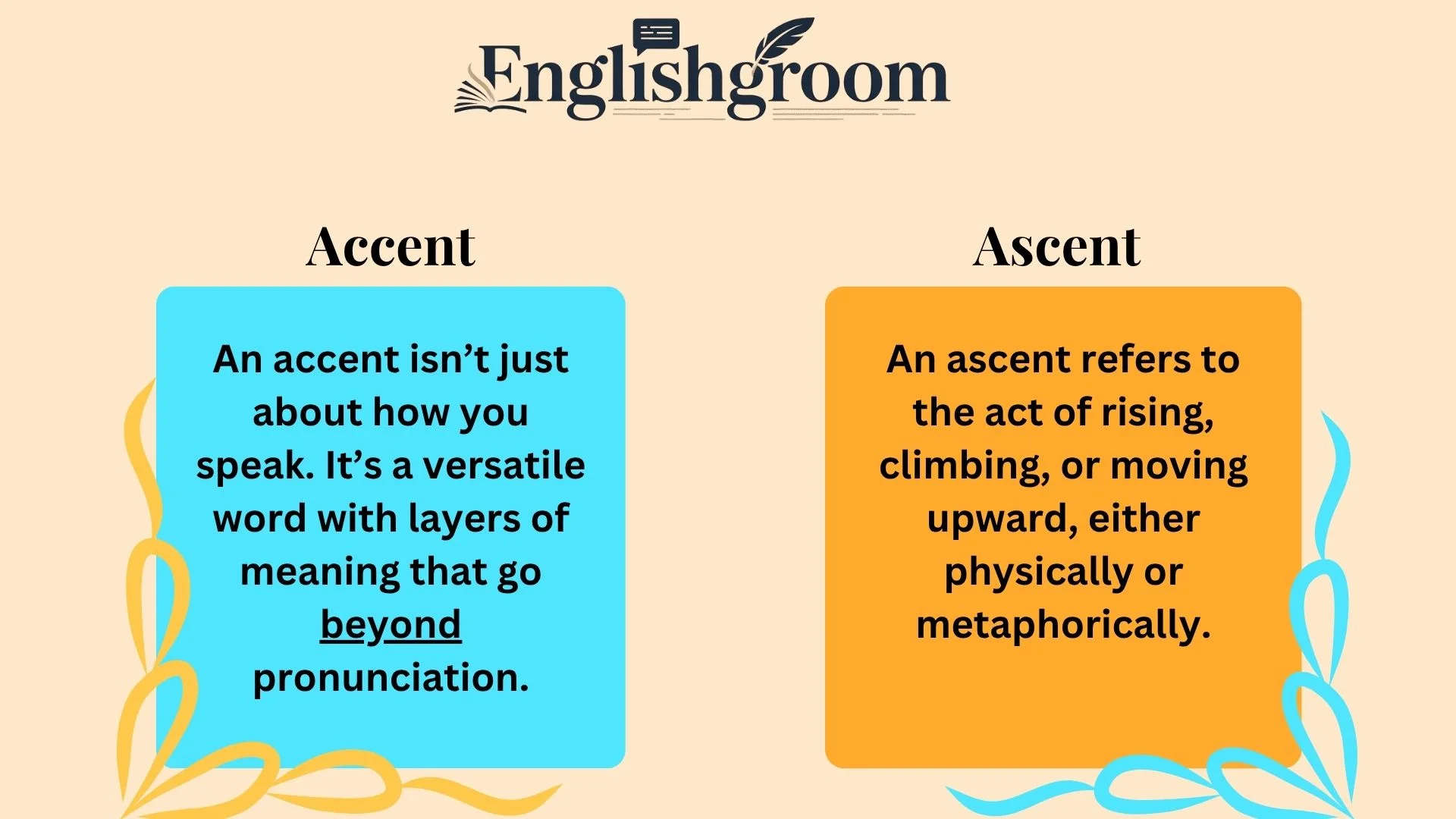
An accent isn’t just about how you speak. It’s a versatile word with layers of meaning that go beyond pronunciation.
Definition:
An accent is a distinctive way of pronouncing words that reflects a person’s region, background, or culture. It can also refer to emphasis—either in speech, writing, design, or music.
Origin:
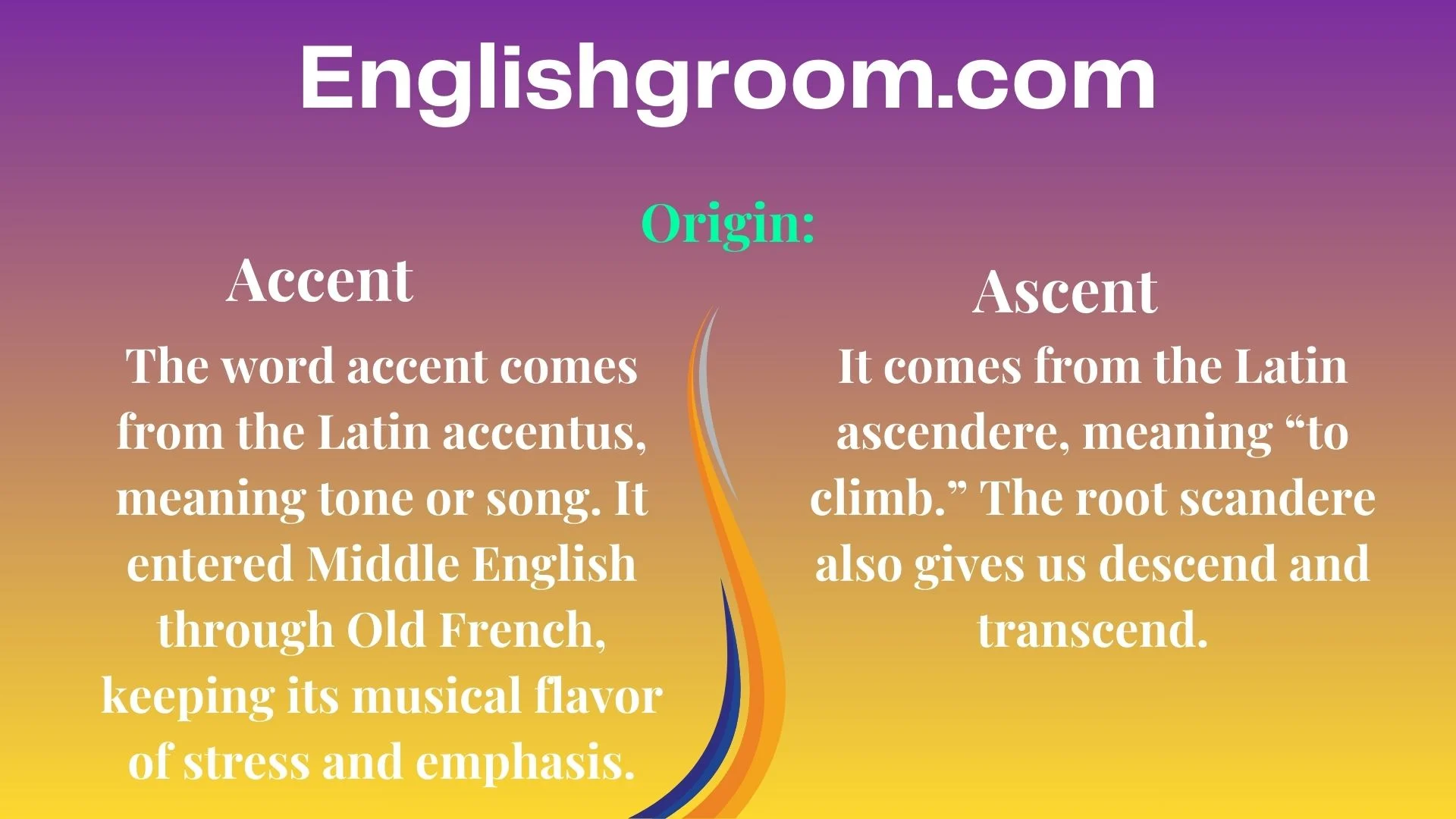
The word accent comes from the Latin accentus, meaning tone or song. It entered Middle English through Old French, keeping its musical flavor of stress and emphasis.
Common Uses of “Accent”:
- Linguistic Accent:
The most familiar sense of the word.- Example: “She has a beautiful Italian accent.”
- Usage Tip: Accents can indicate nationality, region, or even social class.
- Emphasis in Speech or Writing:
- Example: “Place the accent on the first syllable.”
- Meaning: Stress or emphasis on a particular part of a word.
- Design Accent:
- Example: “Add a few red accent pillows to brighten the room.”
- Meaning: A touch or feature that stands out for visual contrast.
- Musical Accent:
- Example: “The composer added an accent on the second beat.”
- Meaning: Stress on a note or chord for emphasis.
Quick Fact:
Linguists estimate there are more than 160 English accents across the world—from the clipped tones of British RP to the warm drawl of Southern American English.
Ascent – Meaning and Usage
Now let’s climb up to ascent—literally.
Definition:
An ascent refers to the act of rising, climbing, or moving upward, either physically or metaphorically.
Origin:
It comes from the Latin ascendere, meaning “to climb.” The root scandere also gives us descend and transcend.
Common Uses of “Ascent”:
- Physical Movement Upward:
- Example: “Their ascent of Mount Everest took weeks.”
- Meaning: The literal act of climbing upward.
- Figurative Progress or Achievement:
- Example: “Her quick ascent in the corporate world was impressive.”
- Meaning: Rise in status, power, or achievement.
- Scientific or Technical Contexts:
- Example: “The rocket’s ascent lasted six minutes before orbit.”
- Meaning: The upward trajectory or motion.
Interesting Fact:
The first recorded use of the word ascent dates back to the 1600s, often describing spiritual or mountain climbing journeys.
Assent – The Often-Confused Third Word
Before moving on, let’s clear up one more culprit: assent.
Definition:
Assent means agreement or approval, often formal or intellectual.
Origin:
From Latin assentire, meaning “to agree to” or “to feel with.”
Common Uses of “Assent”:
- Example: “The committee gave its assent to the proposal.”
- Example: “She nodded in silent assent.”
How It Differs:
While ascent involves rising upward, assent involves agreeing—mentally or verbally.
Quick Trick:
Think of “assent” as saying “yes” (it even has the double “s” for say yes).
Comparative Overview: Accent vs. Ascent vs. Assent
To make the distinction crystal clear, here’s a comparison table:
| Word | Part of Speech | Meaning | Common Contexts | Example |
|---|---|---|---|---|
| Accent | Noun / Verb | Pronunciation style or emphasis | Language, design, music | “She spoke with a French accent.” |
| Ascent | Noun | Act of rising or climbing | Mountains, careers, achievements | “Their ascent up the cliff was dangerous.” |
| Assent | Noun / Verb | Agreement or approval | Legal, academic, formal contexts | “He gave his assent to the terms.” |
Key Differences in Sound and Meaning
Even though they look similar, accent, ascent, and assent sound and feel different in speech.
| Word | Pronunciation (IPA) | Stressed Syllable | Sounds Like | Example Sentence |
|---|---|---|---|---|
| Accent | /ˈæk.sənt/ | First | “AK-sent” | “He has a strong Scottish accent.” |
| Ascent | /əˈsent/ | Second | “uh-SENT” | “The balloon’s ascent was breathtaking.” |
| Assent | /əˈsent/ | Second | “uh-SENT” | “The board gave its assent to the merger.” |
Tips for Pronunciation:
- Accent has a hard “k” sound at the start.
- Ascent and assent sound identical, so rely on context for meaning.
Fun Linguistic Note:
Homophones like ascent and assent are words that sound alike but differ in spelling and meaning. English has over 6,000 of them!
Tips to Remember the Differences
When similar-looking words trip you up, memory tricks help. Here are some easy ways to lock these terms in your mind.
1. Mnemonics to the Rescue
- Accent → has “cent” → think speech cent-er.
- Ascent → starts with “A” → think Ascending.
- Assent → double “ss” → think Say Yes.
2. Visual Associations
- Picture a mountain when you hear “ascent.”
- Imagine a speech bubble for “accent.”
- Visualize a checkmark or thumbs-up for “assent.”
3. Real-Life Practice Trick
Write a short story using all three words:
“During her ascent to the podium, her French accent charmed the crowd, and the audience showed their assent with applause.”
See how they fit together naturally once you understand their meanings?
Common Mistakes and Clarifications
Even native speakers stumble over these words. Let’s tackle the most frequent mix-ups.
Mistake 1: Using “Ascent” Instead of “Assent”
❌ “He gave his ascent to the plan.”
✅ “He gave his assent to the plan.”
Why it’s wrong:
You’re not climbing the plan; you’re agreeing to it.
Mistake 2: Using “Accent” When You Mean “Ascent”
❌ “Their accent up the mountain was slow.”
✅ “Their ascent up the mountain was slow.”
Why it’s wrong:
An accent relates to speech, not climbing.
Mistake 3: Forgetting Context
Accent = sound
Ascent = upward movement
Assent = agreement
If you’re unsure, plug in a synonym:
- Accent → tone / stress
- Ascent → climb / rise
- Assent → agreement / approval
Mistake 4: Mispronunciation
People often pronounce “ascent” like “accent.” Reading it aloud helps fix that.
Quick Recap Table
| Confused Word Pair | Correct Example | Incorrect Example | Tip |
|---|---|---|---|
| Accent vs. Ascent | “Her Irish accent was lovely.” | “Her Irish ascent was lovely.” | Speech vs. climb |
| Ascent vs. Assent | “His rapid ascent to fame.” | “His rapid assent to fame.” | Rise vs. agree |
| Accent vs. Assent | “He spoke with a deep accent.” | “He spoke with deep assent.” | Pronunciation vs. approval |
Case Study: Real-World Confusion in Media
Even major publications occasionally blur these words.
In 2018, a lifestyle blog wrote:
“Her ascent made her sound sophisticated.”
Readers quickly noticed the mistake—it should’ve been accent. A simple error, but it changed the meaning entirely. Instead of describing how she sounded, the sentence implied she climbed.
This shows how one misplaced vowel can alter tone and clarity.
Expert Insight
According to Dr. Helen Fraser, a linguist at the University of New England:
“Accent is more than sound—it’s identity. The way you pronounce words connects you to your community, your culture, and even your emotions.”
Meanwhile, the word ascent symbolizes growth, ambition, and perseverance—traits that drive progress. Both words, though distinct, share a common theme: elevation, whether of voice or of spirit.
FAQs About Accent vs. Ascent
What’s the main difference between accent and ascent?
Accent refers to the way you speak, while ascent means rising upward. One deals with sound; the other deals with motion.
Are “ascent” and “assent” pronounced the same?
Yes, both are pronounced uh-SENT, but they have very different meanings. Ascent means rise, while assent means agree.
Can “accent” be used as a verb?
Absolutely. You can say “The designer accented the room with gold tones.” Here, accented means emphasized or highlighted.
What’s an example of “ascent” in business writing?
“Her rapid ascent to CEO was due to her leadership and vision.” It means her upward movement in rank or success.
Think of it this way:
- Accent – speech or emphasis
- Ascent – climb or rise
- Assent – agreement or approval
Learn More English With These Best Articles:
Thus Far vs So Far The Clear Guide to Mastering These Common Phrases
Checkup or Check Up The Complete Guide to Using Them Correctly
Gluing or Glueing Which Spelling Sticks the Right Way?
A Chip off the Old Block Meaning Origin & Modern Significance
Is It Correct to Say I Am Very Much Looking Forward?
Conclusion
In English, words like accent, ascent, and assent sound deceptively similar but describe completely different ideas.
- Accent highlights how you speak or emphasize.
- Ascent focuses on rising or progressing upward.
- Assent shows agreement or consent.
Mastering these words doesn’t just improve your vocabulary—it sharpens your writing and makes your communication more precise.
So next time you climb a mountain (ascent), agree with a proposal (assent), or notice someone’s unique way of speaking (accent), you’ll know exactly which word to use—and why.

Hi! I’m Sami, a 28-year-old content writer with a love for words and storytelling. Writing has always been my way of expressing ideas, sharing knowledge, and connecting with people. I enjoy creating engaging and well-researched content—whether it’s blogs, articles, or social media posts—that not only informs but also inspires readers. My goal is to turn complex ideas into clear, creative, and meaningful pieces of writing that leave a lasting impact.