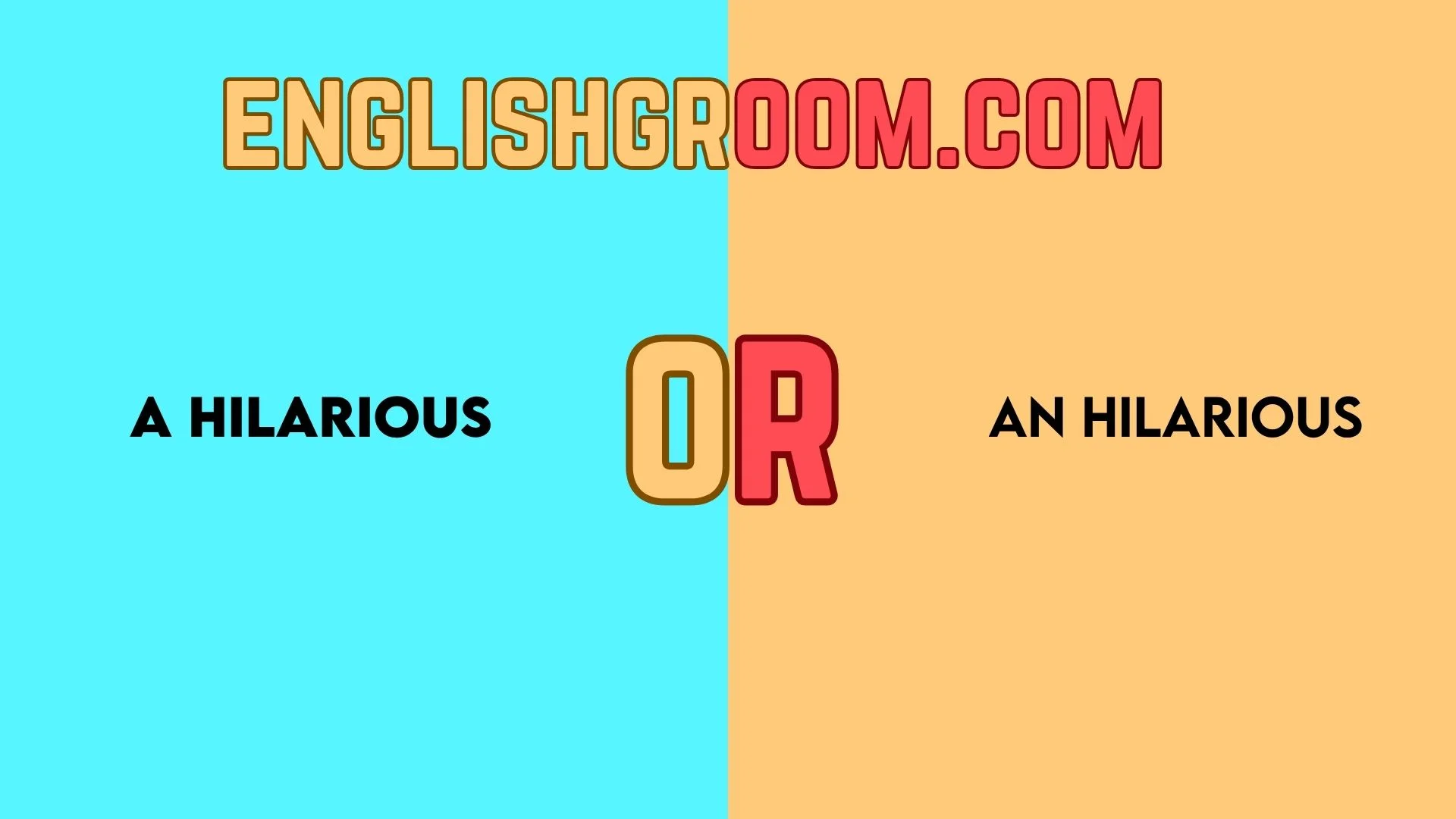
You’ve probably paused mid-sentence before, wondering—is it “a hilarious story” or “an hilarious story”?
You’re not alone. Even native English speakers stumble on this one because words starting with “H” can be tricky.
Let’s finally settle this debate once and for all.
Why This Tiny Grammar Rule Sparks Big Confusion
The English language loves exceptions. Just when you think you’ve got it, another “rule-bender” appears.
Choosing between “a” and “an” is one of those moments that make even confident writers hesitate.
Why the confusion?
Because people often rely on spelling instead of sound—and that’s where things go wrong.
By the end of this post, you’ll never second-guess yourself again. You’ll understand not just what to use, but why it works that way.
What Are Indefinite Articles?
Before diving into the debate, let’s start with the basics.
English has two indefinite articles: “a” and “an.”
They’re used when we refer to something non-specific.
| Article | Used Before | Example |
|---|---|---|
| a | Words starting with a consonant sound | a cat, a banana, a house |
| an | Words starting with a vowel sound | an apple, an idea, an hour |
The purpose of indefinite articles is to make sentences smoother and more natural. They guide the listener’s ear and prepare them for what’s coming next.
“Articles are like traffic lights in language. They control the flow of words.”
— Anonymous linguist
The Core Rule: ‘A’ Before Consonant Sounds, ‘An’ Before Vowel Sounds
Here’s the golden rule:
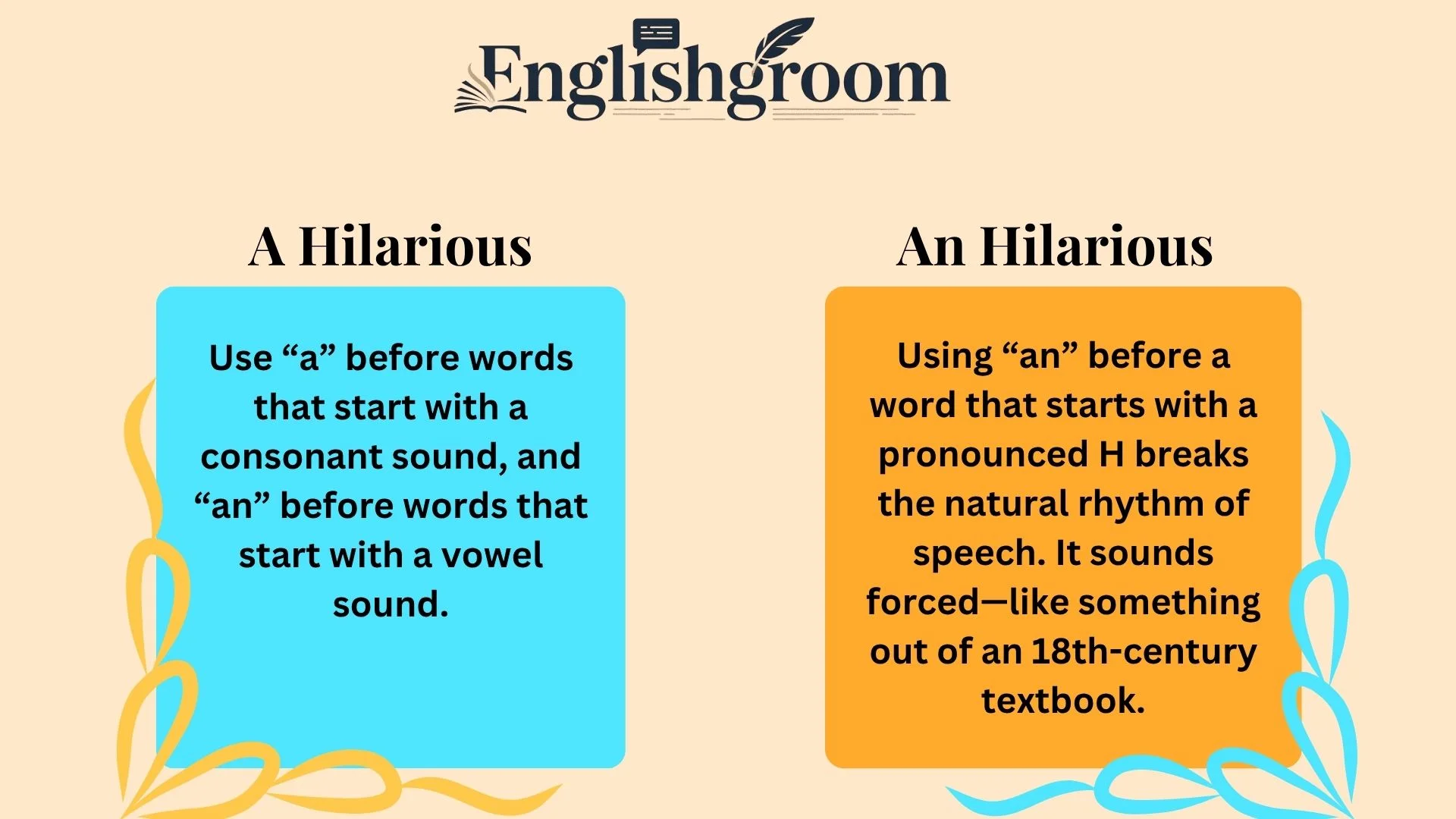
Use “a” before words that start with a consonant sound, and “an” before words that start with a vowel sound.
Notice that the rule says sound, not letter.
Examples
| Word | Sound Type | Correct Form |
|---|---|---|
| a university | Consonant sound (/juː/) | ✅ a university |
| an hour | Silent H → Vowel sound (/aʊ/) | ✅ an hour |
| a European trip | Consonant sound (/juː/) | ✅ a European trip |
| an honest mistake | Silent H → Vowel sound (/ɒ/) | ✅ an honest mistake |
So, it’s not about how the word looks—it’s about how it sounds when spoken.
The “H” Dilemma: Why Words Starting with H Cause Trouble
Now we come to the culprit—words beginning with H.
They’re special because the letter H can be pronounced or silent, depending on the word and sometimes even the speaker’s accent.
For instance:
- In “hour”, the H is silent → an hour.
- In “hero”, the H is pronounced → a hero.
Historically, British speakers often dropped the “H” sound, leading to phrases like “an historical” or “an hotel.” Over time, though, modern English (especially American English) began to pronounce the H clearly.
That’s where the confusion around “an hilarious” started—and why it still lingers.
“A Hilarious” vs. “An Hilarious”: Clearing Up the Confusion
Let’s compare the two in real-world usage:
| Phrase | Modern Usage | Sounds Natural? | Explanation |
|---|---|---|---|
| a hilarious story | Common, modern | ✅ Yes | “H” is pronounced → consonant sound |
| an hilarious story | Outdated, old British English | ❌ No | “H” pronounced → makes “an” incorrect |
Real-Life Usage Example
✅ That was a hilarious movie!
❌ That was an hilarious movie!
Even if you see “an hilarious” in older literature, don’t be fooled—it’s just an artifact of how English used to sound centuries ago.
Why “An Hilarious” Sounds Wrong Today
The key lies in pronunciation.
The word hilarious starts with a strong H sound: /hɪˈlɛəriəs/.
That initial sound is a consonant, so the article “a” is the correct choice.
You say “ha,” not “uh.”
Therefore, it’s a hilarious situation, not an hilarious one.
Using “an” before a word that starts with a pronounced H breaks the natural rhythm of speech. It sounds forced—like something out of an 18th-century textbook.
Why People Still Say “An Hilarious”
Some speakers adopt older British patterns or try to sound “posh,” thinking “an hilarious” is more formal. But modern grammar authorities like Merriam-Webster, Cambridge, and Oxford English Dictionary all confirm:
✅ “A hilarious” is correct in both American and British English today.
When to Use “A” Before H-Words
Here’s a quick guide to using “a” with H-words:
| Word | Pronunciation | Correct Article | Example |
|---|---|---|---|
| house | /haʊs/ | a | a house |
| horse | /hɔːrs/ | a | a horse |
| hilarious | /hɪˈlɛəriəs/ | a | a hilarious story |
| human | /ˈhjuːmən/ | a | a human being |
| historic | /hɪˈstɒrɪk/ | a | a historic victory |
Pro Tip:
If your mouth breathes out a clear “H” sound before the vowel, always use “a.”
The Silent H Exception
But not every H is vocalized. English loves to break its own rules.
Here’s where “an” sneaks back in.
Examples of Silent H Words
| Word | Pronunciation | Correct Article | Example |
|---|---|---|---|
| hour | /aʊər/ | an | an hour passed quickly |
| honest | /ˈɒnɪst/ | an | an honest mistake |
| heir | /ɛər/ | an | an heir to the throne |
| honor | /ˈɒnər/ | an | an honor to meet you |
The trick is simple:
If the H is silent, the word begins with a vowel sound, so you use “an.”
The Role of Pronunciation and Accent in Article Choice
Accent plays a big role in how we choose between a and an.
- American English almost always pronounces the H sound: a historic moment, a hilarious joke.
- Older British English sometimes drops the H in words like historic or hotel, leading to an historic or an hotel.
Modern British dictionaries, however, now also prefer “a historic” and “a hotel.”
Quick Tip to Remember
When in doubt, say the phrase out loud.
If it flows naturally with “a,” that’s your answer.
Here’s how pronunciation affects choice:
| Phrase | Accent | Preferred Form |
|---|---|---|
| “a hilarious film” | US / UK modern | ✅ a hilarious film |
| “an hilarious film” | Archaic British | ❌ an hilarious film |
| “an hour” | All dialects | ✅ an hour |
| “a house” | All dialects | ✅ a house |
Common Mistakes and How to Avoid Them
Many English learners (and even native speakers) fall into these traps:
❌ Common Errors
- an hilarious joke ❌
- an historic event ❌
- an hotel reservation ❌
- a honest mistake ❌
✅ Correct Forms
- a hilarious joke
- a historic event
- a hotel reservation
- an honest mistake
Remember:
Listen to the sound, not the letter.
Quick Recap: Sound-Driven Article Rules
Here’s a short summary to keep handy.
| Starts With | Sound Type | Use | Example |
|---|---|---|---|
| Consonant sound | /h/, /y/, /w/, etc. | a | a hilarious story |
| Vowel sound | /a/, /e/, /i/, /o/, /u/ | an | an orange |
| Silent H | vowel sound | an | an hour |
| Pronounced H | consonant sound | a | a hero |
Mnemonic Tip:
“If it sounds like a vowel, use an.
If it sounds like a consonant, use a.”
Practical Tips for Mastering Article Usage
Let’s make this stick with a few smart techniques:
1. Listen More Than You Read
Watch movies, podcasts, or YouTube clips. Notice how native speakers pronounce words.
Your ear learns faster than your memory.
2. Use a Pronouncing Dictionary
Websites like Cambridge Dictionary show phonetic transcriptions and even let you listen to pronunciations.
Look for that little symbol /h/ — if you see it, use “a.”
3. Practice Sentences
Try saying these out loud:
- That was a hilarious moment.
- It’s an honor to meet you.
- She told a historic story.
- He waited for an hour.
4. Don’t Overthink Formality
“A historic” isn’t less formal than “an historic.” The difference is just modern vs. outdated usage.
5. Quiz Yourself
Ask: “What sound do I make right after the article?”
If it’s a consonant, use a.
If it’s a vowel, use an.
Case Study: How Language Evolution Changed Article Usage
In the 19th century, you’d often find phrases like “an historical event” or “an heroic act” in British literature.
At the time, the H was often dropped in speech, so “an historical” sounded natural.
But as pronunciation evolved, English speakers started enunciating the H, especially in American English.
Grammarians then standardized the rule: base the article on sound, not spelling.
Example from Literature
“It was an historic day for the Empire.”
— The Times, 1860s
Modern translation?
“It was a historic day for the nation.” ✅
Language always evolves toward clarity and ease—and a hilarious fits that natural rhythm.
FAQs About “A Hilarious or An Hilarious?”
Is “an hilarious” ever correct?
Technically, it’s not correct in modern English because hilarious begins with a pronounced “H.” Older British English sometimes used “an hilarious,” but that’s now outdated.
Why did people use “an hilarious” in the past?
In older dialects, speakers often dropped the H sound, making “hilarious” sound like it began with a vowel. So “an hilarious” once flowed naturally, though it doesn’t today.
Are both “a historic” and “an historic” acceptable?
Modern grammar and pronunciation favor “a historic”, but you may still see “an historic” in traditional British writing. Both are understood, but “a historic” sounds more natural.
How do I know whether to use “a” or “an”?
Listen to the first sound of the next word. If it’s a vowel sound, use an. If it’s a consonant sound, use a.
Can pronunciation differences change the rule?
Yes! Accents matter. If your dialect drops the H (rare today), “an” might sound right. But in most modern English, the H in hilarious is pronounced, so “a hilarious” is correct.
Conclusion
In the great debate of “A Hilarious or An Hilarious,” the winner is clear:
✅ “A hilarious” is correct in modern English.
❌ “An hilarious” is outdated and sounds unnatural.
Always remember:
It’s not about the letter—it’s about the sound.
When you trust your ear, grammar stops feeling like a rulebook and starts sounding like common sense.
So the next time you tell a joke, make sure it’s a hilarious one—and maybe correct your friend if they slip up. 😉

Hi! I’m Sami, a 28-year-old content writer with a love for words and storytelling. Writing has always been my way of expressing ideas, sharing knowledge, and connecting with people. I enjoy creating engaging and well-researched content—whether it’s blogs, articles, or social media posts—that not only informs but also inspires readers. My goal is to turn complex ideas into clear, creative, and meaningful pieces of writing that leave a lasting impact.