Last updated on February 12th, 2026 at 07:21 am
When it comes to professional communication, a tiny punctuation mark can make a world of difference.
Apostrophes may seem trivial, but misplacing them in time-based phrases like 24 Hours Notice, 24 Hour’s Notice, or 24 Hours’ Notice can confuse readers, appear unprofessional, and sometimes even cause legal complications.
This guide breaks down everything you need to know about this tricky phrase and ensures you always get it right.
Why Precision in This Phrase Matters
Small mistakes in written English can create misunderstandings. Imagine sending an email asking for “24 Hours Notice” without the apostrophe to your manager. It may seem minor, but in legal or HR contexts, it could lead to disputes about deadlines.
Here’s why it matters:
- Professional credibility: Correct punctuation signals attention to detail.
- Clarity: Apostrophes prevent ambiguity in time-based expressions.
- Legal and contractual accuracy: In agreements, a missing apostrophe could change the meaning of a notice period.
Even though this seems like a tiny detail, it’s often the difference between a polished document and a sloppy one.
Apostrophes and Time Expressions: A Quick Primer
Apostrophes serve two main purposes in English:
- Indicating possession: Sarah’s laptop means the laptop belongs to Sarah.
- Forming contractions: Don’t is a contraction for do not.
Time expressions like “24 Hours’ Notice” use the possessive form. Here’s the rule:
- Singular possessive: One hour → “1 hour’s notice”
- Plural possessive: More than one hour → “24 hours’ notice”
- No apostrophe: Incorrect, creates ambiguity
This subtle distinction ensures your sentence communicates exactly what you intend.
Breaking Down the Three Variants
“24 Hours Notice” – Missing Apostrophe
This version omits the apostrophe entirely.
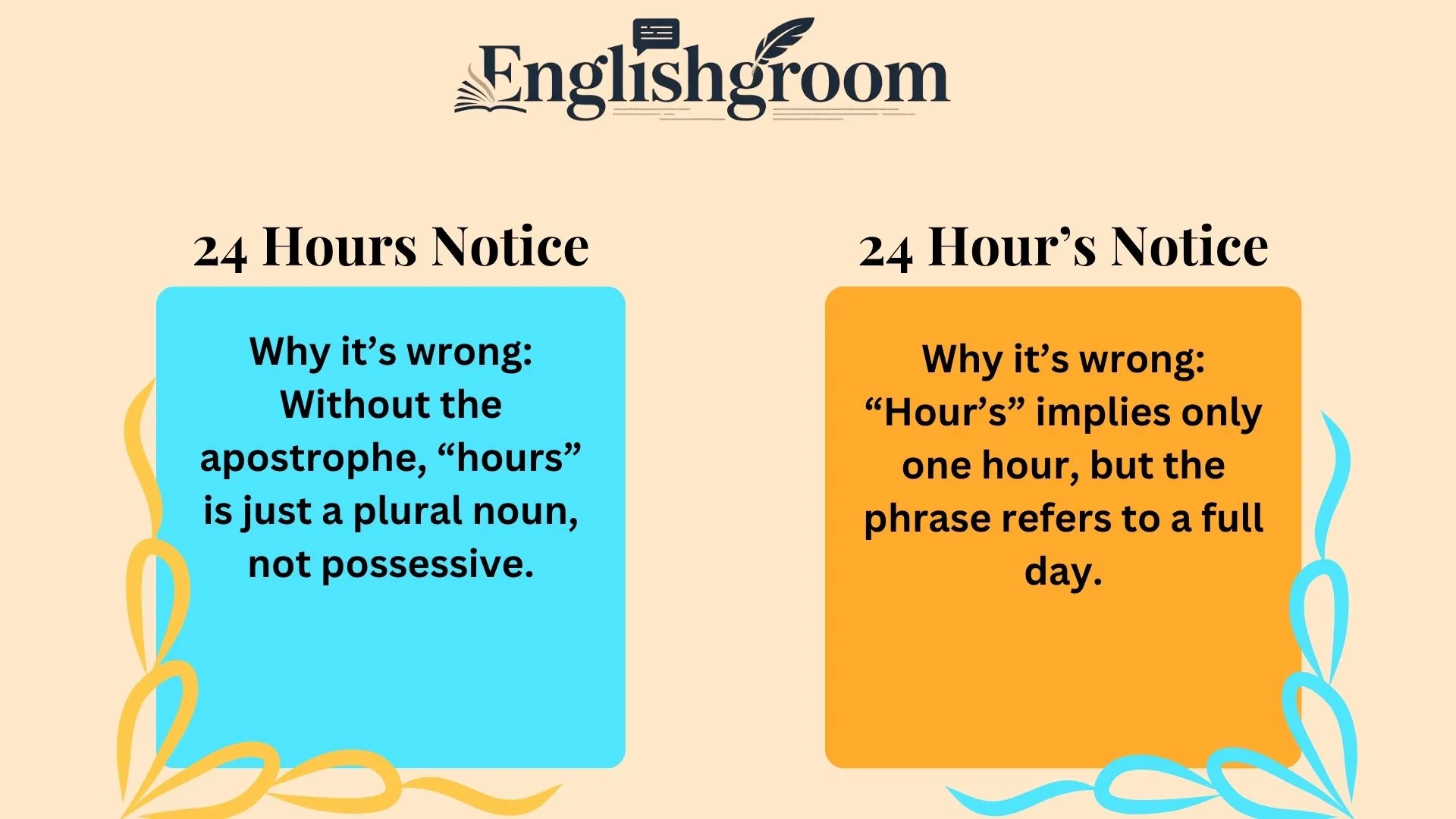
- Why it’s wrong: Without the apostrophe, “hours” is just a plural noun, not possessive.
- Example: Please provide 24 Hours Notice before cancelling.
Technically, this sentence is incomplete. It leaves readers wondering whose notice it is. - Where it appears: Casual emails, social media posts, or rushed typing.
“24 Hour’s Notice” – Singular Possessive Error
Some writers mistakenly use the singular possessive.
- Why it’s wrong: “Hour’s” implies only one hour, but the phrase refers to a full day.
- Example: You must give 24 Hour’s Notice for approval.
This is grammatically incorrect and logically inconsistent. - Common reason for mistake: Confusion between singular and plural possessives.
“24 Hours’ Notice” – Correct Form
This is the proper way to write the phrase.
- Why it’s correct:
- The noun “hours” is plural.
- The apostrophe after the “s” makes it possessive.
- It clearly communicates that the notice period belongs to the 24 hours.
- Example: Employees must provide 24 Hours’ Notice before taking leave.
This form is widely accepted in professional, legal, and casual English.
The Grammar Behind Time-Based Possession
Time-based possession is a unique grammatical case. Here’s the general rule:
| Expression | Correct Form | Explanation |
|---|---|---|
| 1 hour | 1 hour’s notice | Singular possessive |
| 24 hours | 24 hours’ notice | Plural possessive |
| 2 weeks | 2 weeks’ vacation | Plural possessive |
Key points:
- Always make the noun plural if the time period is more than one unit.
- Apostrophe placement signals ownership.
- Misplacement changes the meaning subtly but significantly.
Historical Usage and Evolution
The apostrophe has been in English since the 16th century. Originally, it indicated omitted letters in contractions. By the 17th century, it also signaled possession.
Time expressions with possessive forms like “24 Hours’ Notice” evolved to standardize clarity in legal, academic, and professional documents. Modern style guides now insist on the plural possessive when the time period exceeds one unit.
Why Mistakes Happen
Several factors contribute to errors in this phrase:
- Singular vs. plural confusion: Many people default to “hour’s” thinking it sounds right.
- Spoken language influence: Apostrophes aren’t spoken aloud, so writers skip them.
- Digital shortcuts: Typing fast in emails or chat often leads to omission.
- Autocorrect and grammar tools: Sometimes they suggest incorrect forms based on context.
Being aware of these pitfalls helps prevent repeated mistakes.
Professional and Style Guide Perspectives
Various style guides provide clear guidance:
- AP Stylebook: Use plural possessive for time expressions exceeding one unit.
- Chicago Manual of Style: Confirms “24 Hours’ Notice” is correct.
- Industry applications:
- HR documents: Always use correct plural possessive to avoid disputes.
- Legal contracts: Apostrophe errors can alter enforceability.
- Publishing: Editors flag missing apostrophes as grammatical errors.
Quote:
“A single apostrophe can change the meaning of a contract. Always double-check your time expressions.” – Grammar Expert
Best Practices for Writers and Professionals
Follow these practical tips:
- Always use plural possessive for time periods over one unit.
- Double-check emails and memos for small punctuation mistakes.
- Use reference tables to clarify other similar phrases.

| Phrase | Correct Usage | Example |
|---|---|---|
| 24 Hours Notice | ❌ | “Please give 24 Hours Notice” |
| 24 Hour’s Notice | ❌ | “Please give 24 Hour’s Notice” |
| 24 Hours’ Notice | ✅ | “Please provide 24 Hours’ Notice” |
- Proofread digital communications; autocorrect may insert errors.
- Educate your team on proper grammar in official documents.
Real-Life Case Studies
Case Study 1: HR Memo Error
An HR team sent a leave policy memo using “24 Hours Notice.” Several employees assumed the notice was optional. HR had to resend the memo correcting it to “24 Hours’ Notice,” avoiding disputes.
Case Study 2: Lease Agreement Revision
A landlord typed “24 Hour’s Notice” in a lease. A tenant challenged the timing legally, claiming ambiguity. Correcting it to “24 Hours’ Notice” clarified the timeframe.
Case Study 3: Tech Team Email Confusion
A software team requested “24 Hours Notice” for server downtime. Misunderstanding delayed responses, impacting project deadlines. After clarification with the correct form, workflow resumed smoothly.
Lesson: Small punctuation errors have real-world consequences in business, legal, and tech settings.
FAQs
What is the correct form of the phrase?
The correct form is 24 Hours’ Notice.
Can I use 24 Hour’s Notice?
No, it incorrectly implies only one hour.
Why do people often write it wrong?
Confusion between singular and plural possessives, plus typing shortcuts and spoken language influence.
Does style guide matter?
Yes, AP, Chicago, and legal style guides all confirm 24 Hours’ Notice as correct.
Is it okay to omit the apostrophe in casual writing?
In casual texts, it’s sometimes overlooked, but in professional or legal contexts, always include it.
Learn More English With These Best Articles:
Die vs Dice The Definitive Guide to Correct Usage
Appal vs Appall Meaning Usage and the Real Difference Explained
Loot vs Lute Why These Sound-Alike Words Confuse Even Fluent English Speakers
Tortuous vs Torturous The Confusing Pair Explained Simply
Through the Roof Meaning Usage & Real-Life Contexts Explained in Depth
Conclusion
Apostrophes may seem minor, but in time-based phrases like 24 Hours’ Notice, they matter. Using the correct plural possessive signals professionalism, ensures clarity, and avoids legal or workplace confusion. Remember:
- Wrong: 24 Hours Notice / 24 Hour’s Notice
- Right: 24 Hours’ Notice
Next time you write emails, contracts, or memos, double-check your apostrophes. Your clarity and credibility depend on it.

Hi! I’m Sami, a 28-year-old content writer with a love for words and storytelling. Writing has always been my way of expressing ideas, sharing knowledge, and connecting with people. I enjoy creating engaging and well-researched content—whether it’s blogs, articles, or social media posts—that not only informs but also inspires readers. My goal is to turn complex ideas into clear, creative, and meaningful pieces of writing that leave a lasting impact.